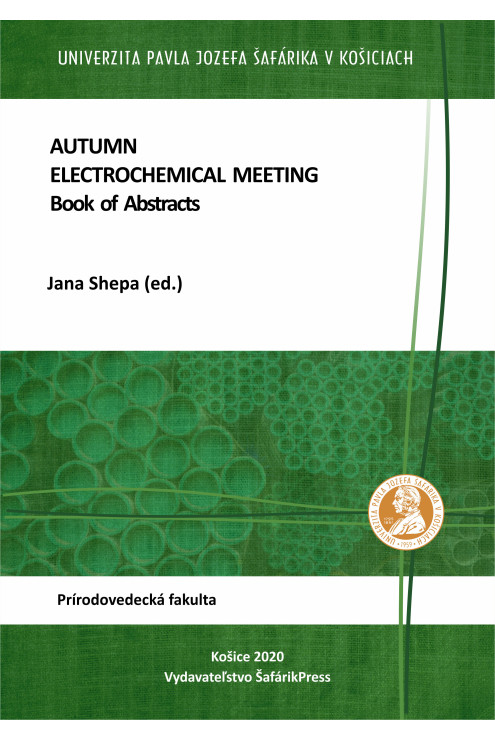
Autumn Electrochemical Meeting

E-book

Jana Shepa (ed.)

The book of abstracts from the first year of the international conference Autumn electrochemical meeting is composed of contributions from the participants of this student conference.

The conference consisted of one invited lecture and six student lectures. The message of this meeting is to create a dialogue between students of electrochemistry and the mutual exchange of knowledge. All contributions are professionally processed and inspiring.

Download the e-book for free  (pdf)

Quantity

978-80-8152-934-4

Data sheet

Method of publication:
E-book (pdf)
Editor:
Jana Shepa
Document type:
Book of abstracts
Number of pages:
28
Available from:
19.11.2020
Year of publication:
2020
Edition:
1st edition
Publication language:
slovenčina, angličtina
Faculty:
Prírodovedecká fakulta
License:
Creative Commons BY NC ND (Uveďte autora - Nepoužívajte komerčne - Nespracovávajte)
- Free for download

16 other products in the same category:

The 4th International Conference on...

E-book

E-book

Jana ShepaIvana Šišoláková (eds.)

Abstracts of the 4th International Conference Nanomaterials: Fundamentals and Applications (NFA) 2020 is the contributions summary of the conference participants. The conference will feature three invited lectures and eight registered lectures. This conference is a tool for creating a dialogue between experts in the field of nanomaterials, their use and overall application in various fields. Papers in the proceedings are thematically divided into 6 areas. All contributions are highly professional and interesting and can contribute to further creative scientific work.

Download the e-book for free  (pdf)

Praktické cvičenia z röntgenovej difraktometrie

E-book

E-book

Karel Saksl

The aim of these study texts is to provide students in the second and third levels of higher education with specific guidance on processing 2D diffraction data, performing phase analysis from X-ray diffraction data, and refining microstructural parameters of identified phases using the Rietveld refinement method.

This guide is designed in the form of real-world tasks from materials research and leads the reader step by step through the processes of processing, evaluating, and interpreting the measured data. For this purpose, freely accessible programs such as Fit2D, QualX, POV-Ray, and GSAS II will be used, as well as a freely downloadable commercial program (Diamond) that allows for task execution in demonstration mode. Phase analysis will be conducted exclusively using the freely distributable crystallographic database Crystallography Open Database (COD).

Download the e-book for free  (pdf)

Určitý integrál

E-book

E-book

Ondrej Hutník

The concept of the integral is one of the most significant concepts in mathematics as a whole. In its most primitive form, it was already used by the ancient Greeks in the creation of Euclidean geometry. However, it was only after Descartes' work on analytical geometry in 1637 that mathematicians could begin to consider the integral as a subject of analysis. Descartes' work laid the groundwork for the discovery of infinitesimal calculus by Leibniz and Newton around 1665. At that time, a great dispute arose over the priority of this discovery, dividing scholars of Germany and England into two opposing camps, each favoring their own champion. Today, we know that Newton's work on fluxions and fluents was somewhat earlier, but Leibniz's notation and approach have gained more acceptance in the mathematical world, and the symbols ∫ ∫ and d d are still used today. A brief overview of the history of the integral will be presented in Chapter 1.

Today, there is a plethora of scripts, textbooks, and books dedicated to explaining the concept of the integral. Therefore, every potential author faces the initial question of whether to write another text on this topic. Our affirmative answer to this question was driven by the students' request to find the subject matter of a part of the winter semester of the second year presented in a coherent form. The second motivation is a slightly different approach to the topic. If we consider the methods typically used in solving problems and gaining routine with a certain integral, it mainly involves the Newton-Leibniz formula, and often there is little time left to compute the definite (Riemann) integral using its definition. Therefore, we included a discussion of the Newton integral in Chapter 2, which reflects this fact and is directly related to the indefinite integral, whose various calculation methods receive relatively much attention in the previous semester. Only after that, in Chapter 3, do we build the theory of the Riemann integral, present criteria for its existence, classes of integrable functions, basic properties, and finally its relationship with the Newton integral. Questions primarily concerning geometric applications are addressed in Chapter 4, and in the final chapter, we focus on extending the Riemann integral to unbounded functions and unbounded intervals.

Download the e-book for free (pdf)

ANATOMICKÉ TERMÍNY PRE JEDNOODBOROVÉ A...

E-book

E-book

Juraj ŠevcFilip Mochnacký

Students studying biology as the single-subject or as a part of two-subject programs on various faculties of sciences are often encountered with the problem, how to limit the topics in the subject Human anatomy. This List of anatomical terms is aiming to help the non-medical students to get acquainted with the extensive anatomical nomenclature and to optimize the number of anatomical terms, which should be memorized, to preserve the sufficient capacity of the students for another knowledge of the field of systemic, comparative, developmental and functional anatomy. The emphasis on the arrangement of individual anatomical terms into the logical units supports the hierarchical view on the architecture of the human body.

Despite the common opinion, anatomical nomenclature represents a framework, which is during the further study gradually enveloped with the knowledge of more or less related disciplines concerning with the human body and its biological processes. Moreover, besides this ambition, which exceeds the area of the human anatomy, this List of anatomical terms continues the long tradition with respect to the valid Latin and Slovak anatomical terminology.

Download the e-book for free  (pdf)

Úvod do porovnávacej morfológie živočíchov

E-book

E-book

Andrej Mock

The structure of the animal body is extremely varied. Each species has its distinctive morphological features, which bears as a testimony to long-term development and belonging to the developmental lineage. At the same time, the body has been tested for a long time by natural conditions, resulting in unique adaptations to the environment and life strategy. Despite this admirable variety - which includes both recent and fossil animals and which we have far from mapped – a comparison of body parts brings knowledge we can generalize: the main building principles, and boundaries within which phenotypic diversity is realized.

Comparative animal morphology today uses the latest methodological material and knowledge from other disciplines, from genetics, molecular biology and experimental embryology, through progressive imaging methods (e.g. electron microscopy, computer micro-tomography) and the possibilities of subsequent software processing of image material (measurement, staining, etc.) to the view of physics, chemistry, statics and geometry on the structures (to nanostructures) of the living body. Detailed knowledge of historical and contemporary conditions on Earth is an important interpretative context in the study of animal morphology. Surprisingly, the knowledge accumulated after centuries of research is now rapidly supplemented by new knowledge, and often the traditional knowledge is subsequently reinterpreted. Finally, and no less important, in studying animal (and human) morphology, we learn surprising knowledge about ourselves.

The author of the presented textbook had the ambition in a simplified form to introduce the reader, especially the student of biological studies, into a dynamic and fascinating scientific discipline, as the current comparative animal morphology is.

Stiahnite si e-knihu zadarmo (pdf)

Základy chiropterológie

€25.00
Availability: 13 In Stock

Marcel Uhrin - Petr Benda -  Peter Kaňuch

Bats represent a unique group of mammals, characterised by different life strategies. They are the only mammals capable of active flight, which, combined with their almost exclusively nocturnal activity, has led to the evolution of specific adaptations. One of the most striking is echolocation, which enables them to orientate themselves perfectly in their surroundings in the dark. Bats are mainly native to the tropics, but have also colonised areas outside the tropics, which, has led to a complex phenological cycle with active phases and interruptions during hibernation, especially in temperate zones. In this diverse and species-rich group (almost 1,500 known species), there is a wide range of social organisation as well as feeding and roosting strategies. The textbook "Fundamentals of Chiropterology" brings the current state of knowledge about these extraordinary animals in eleven chapters and two appendices for the first time in the Slovak language.

Polovodičové prvky

E-book

E-book

Peter Kollár

The textbook Semiconductor Elements was developed gradually over the past years as an aid for second-year master's students in condensed matter physics. It is intended to support students’ understanding of lectures, considering that important texts, mathematical relationships, and illustrations are provided in advance in the form they will be presented during the lecture.

This allows students to supplement individual pages with their own notes during the lecture, either electronically or in printed form. In this way, a study aid is created for the student, which I believe will help with the final review of knowledge gained throughout the semester in preparation for the exam. This textbook is not meant to serve as standalone literature but is designed to assist orientation in the literature, which is abundant in English but mostly written for scientists, researchers, and students for whom this topic is central and not just one of many parts of their education. Therefore, it is not allocated a larger scope in the study program.

Download e-book for free (pdf)

Matematika pre nematematické odbory
  • On sale!
  • -€7.96

Matematika pre nematematické odbory

€8.96 €1.00 -€7.96
Availability: 135 In Stock

Danica StudenovskáTomáš Madaras 

Táto publikácia je určená pre študentov nematematických odborov na Prírodovedeckej fakulte UPJŠ v Košiciach. Jej obsahom je látka preberaná v prvom semestri v rámci predmetu Matematika I..

Publikácia nadväzuje na učivo stredných škôl a nevyžaduje žiadne predbežné špeciálne znalosti. Môže slúžiť ako základ na ďalšie samostatné štúdium a môže byť užitočná aj pre iných záujemcov o matematiku a jej aplikácie.

Vyriešené príklady v jednotlivých kapitolách majú pomôcť čitateľovi pri zvládnutí štúdia. Tomu napomáhajú aj ilustratívne obrázky.

Autori

NOVEL TRENDS IN CHEMISTRY, RESEARCH AND...

E-book

Jana Šandrejová - Andrea Gajdošová (eds.)

The scientific book of abstracts from the conference „Novel Trends in Chemistry, Research and Education 2024“ is a summary of the contributions of conference participants, which contain the original results of their scientific and research activities. The contributions published in this volume are divided according to content into the fields of analytical, inorganic, organic, physical chemistry, biochemistry and didactics of chemistry.

Download the e-book for free (pdf)

18th Czech and Slovak Conference on Magnetism –...

E-book

E-book

Jozef Bednarčík - Hana Vargová (eds.)

The Czech and Slovak Conference on Magnetism (CSMAG) is a scientific meeting that honors a longstanding tradition initiated in Košice in 1960. Evolving from a regional gathering of the Czechoslovak magnetic community into a prominent international forum, CSMAG brings together researchers from diverse fields of magnetism. The conference covers a wide range of topics including theoretical and experimental magnetism, magnetic materials for energy and spintronics applications, low-dimensional and molecular magnets, rare-earth and actinide systems, and multifunctional materials. With contributions from over 20 countries, CSMAG’25 fosters cross-disciplinary collaboration and showcases the latest advances in both fundamental studies and practical applications of magnetic phenomena.

Download the e-book for free (pdf)

Bibliography of the amphibian and reptile...

E-book

E-book

Marcel UhrinDavid JandzikAndrej ČerňanskýMichal RindošBlanka LehotskáStanislav DankoJán KautmanPeter MikulíčekPeter UrbanDaniel Jablonski

Bibliographies provide basic scientific information, illustrate quality and intensity of research in a particular topic, area, or time, and thus help build a cultural-historical perspective of society’s appreciation of knowledge and education. Here we provide a bibliography of herpetological research in the region of Slovakia between the years 1791 and 2017. We collected 2,183 references authored by 1,453 different authors and covering all species of amphibians (18) and reptiles (13) occurring in Slovakia and, in addition, amphibian and reptile taxa occurring in 94 other countries.

Most of the contributions were published in popular magazines and non-indexed journals, while only about 12% of all references represent scientific articles from journals indexed in relevant scientific databases. The extensiveness of study on amphibians and reptiles has varied among different periods within the selected time frame. However, an obvious intensification in the field of herpetology can be observed, especially during the second half of the 20th century. While there have only been few professionals specialized in herpetology, an important role in promoting the research and conservation of amphibians and reptiles in Slovakia has been played by non-governmental organizations and hobbyists. The most frequent type of herpetological data in the referenced literature comes from faunistic research, followed by conservation and general information on herpetofauna, with the majority of published articles in indexed journals coming from the fields of palaeontology, phylogeography, and population genetics.

The presented bibliography is the first step towards building a solid base for future systematic herpetological research in the country and Central Europe.

Download the e-book for free (pdf)

Zborník príspevkov z 11. Dní doktorandov...

E-book

E-book

Martin Bačkor - Silvia Mihaličová (eds.)

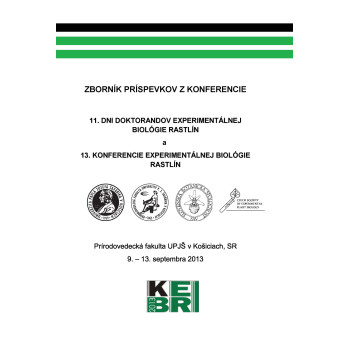
Proceedings of the 11th Conference of Doctoral Students in Experimental Plant Biology and the 13th Conference on Experimental Plant Biology, Košice, September 9–13, 2013

13th Conference of Experimental Plant Biology (Sections)

  1. Cell Biology and Cytology: Michal Martinka
  2. Developmental Biology and Morphogenesis: Alexander Lux
  3. “Omics” – Genomics, Transcriptomics, and Proteomics: Boris Vyskot
  4. Hormonal Regulation of Plant Growth and Development: Jana Albrechtová
  5. Photosynthesis, Assimilate Production, and Transport: Jiří Šantrůček
  6. GMOs and Plant Biotechnology: Eva Čellárová
  7. Biophysical Signals and Optical Properties of Plants: Jan Nauš Stress
  8. Physiology: Ľudmila Slováková
  9. Plant Interactions with Organisms: Martin Bačkor
  10. Water and Mineral Nutrition of Plants: Miroslav Repčák
  11. Productive Biology of Plants and Agriculture: Václav Hejnák
  12. Ecological Plant Biology and Global Climate Change: Michal Marek

11th Days of Doctoral Students in Experimental Plant Biology (Sections)

  1. Molecular & Cell Genetics: Viktor Žárský
  2. Developmental Biology: Alexander Lux
  3. Biochemistry & Physiology: Jiří Šantrůček
  4. Systematics & Evolution: Jana Albrechtová
  5. Ecophysiology: Jana Albrechtová

Download the e-book for free (pdf)

School of XFEL and Synchrotron Radiation Users...

E-book

E-book

Jozef Bednarčík (ed.)

Pavol Jozef Šafárik University in Košice under the auspices of Ministry of Education, Research, Development and Youth of the Slovak Republic, Ministry of Economy of the Slovak Republic and European X-Ray Free-Electron Laser Facility GmbH in Hamburg organizes School of XFEL and Synchrotron Radiation Users 2024 (SFEL 2024). The school is continuation of the Winter Schools of Synchrotron radiation held in 2011, 2013, 2014 and SFEL 2017, 2018, 2019 and 2022. The aim of the SFEL2024 school is to facilitate the growth of new Slovak research community of high expertise in high-efficiency RTG laser and synchrotron and neutron sources. The SFEL school is designed for efficient transfer of the rapidly developing know-how in these areas to young generation – researchers and university students. The next aim of the SFEL2024 is strengthening of personal connections between the local Slovak research community and forming scientific teams of XFEL users. Slovak research community thus can take advantage of the fact that Slovakia is a shareholder of European XFEL GmbH Company in Hamburg, but also makes more efficient use of other closely related scientific facilities, including ILL and ESRF in Grenoble and DESY in Hamburg.

Download the e-book for free (pdf)

Jarná škola doktorandov 2020

E-book

E-book

Peter Fedoročko (ed.)

Proceedings of the 7th Annual Doctoral Spring School 2020

From November 10 to November 11, 2020, the 7th annual Spring School for Doctoral Students at Pavol Jozef Šafárik University in Košice will take place in Košice in a modified mode in the on-line space. The scientific program of the spring school will comprise 2 plenary lectures by leading scientific experts of Pavol Jozef Šafárik University in Košice. Doctoral students will present their research papers in two sections: 24 doctoral students of Faculty of Public Administration, Faculty of Law and Faculty of Arts, and 22 doctoral students of Faculty of Medicine and Faculty of Science.

The scientific programme of the spring school will also include a panel discussion with the management of Pavol Jozef Šafárik University in Košice.

Download the e-book for free  (pdf)

This website uses cookies to ensure you get the best experience on our website