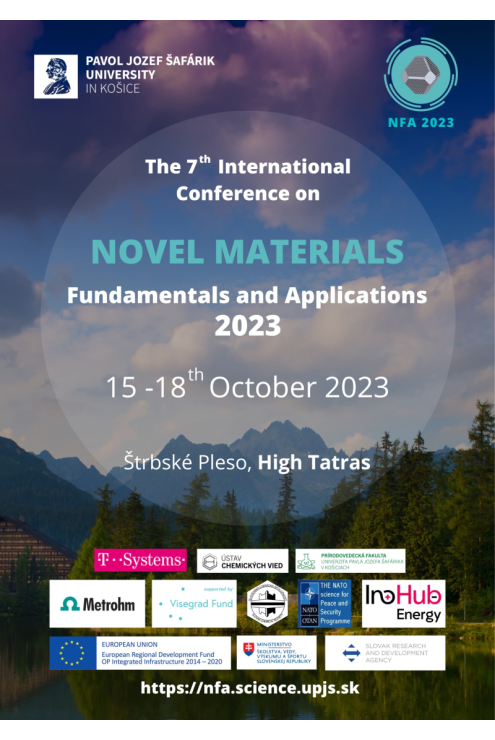
The 7th International Conference on Novel Materials Fundamentals and Applications

E-book

Jana Shepa (ed.)

The book of abstracts from 7th International Conference on Novel Materials: Fundamentals and Applications, NFA 2023 is composed of contributions from the participants of this international conference. The conference consisted of 3 invited lecture and 40 abstracts of participants. The conference is focused on novel materials and its application in various research areas. All contributions are professionally processed and inspiring.

Download the e-book for free (pdf)

Quantity

978-80-574-0244-2

Data sheet

Method of publication:
E-book (pdf)
Editor:
Jana Shepa
Document type:
Book of abstracts
Number of pages:
122
Available from:
24.10.2023
Year of publication:
2023
Edition:
1st edition
Publication language:
English
Faculty:
Prírodovedecká fakulta
- Free for download

16 other products in the same category:

Špeciálne praktikum II - Štúdium magnetických...

E-book

E-book

Erik Čižmár

The textbook "Special Practicum II" is dedicated to describing experimental methods used for studying the magnetic properties of solid materials, especially low-dimensional and molecular magnets. It subsequently contains instructions for the practical exercise "Special Practicum II," during which master's and doctoral students use state-of-the-art commercial equipment-an electron paramagnetic resonance (EPR) spectrometer and a SQUID magnetometer.

The introductory chapter briefly describes the origin of magnetism in solids, the role of the crystal field, and magnetic interactions in explaining their magnetic properties. This is followed by an explanation of the principles of EPR, the operation of the EPR spectrometer, and the optimization of its parameters for the specific practical exercise.

The next part of the textbook is devoted to an overview of the behavior of magnetic quantities with changes in magnetic field or temperature in various types of magnets. The textbook concludes with a description of the operating principle of the SQUID magnetometer and an example of its use in a practical exercise measuring the magnetic moment.

Download the e-book for free (pdf)

Geografické poznatky bez hraníc - výber z...

E-book

E-book

Dušan Barabas a kol.

The presented text is the final product of work within the project "Tanuljunk egymástól!/Let’s Learn from Each Other!" The project emerged from long-standing contacts between the staff of the Centre for Regional Studies of the Hungarian Academy of Sciences and the Institute of Geography at the Faculty of Science, Pavol Jozef Šafárik University in Košice, as a natural effort to expand mutual cooperation. The first step was collaboration within Interreg II projects, involving a broad range of institutions from both academic and non-academic environments. This initial attempt was unsuccessful due to administrative errors. Consequently, a project titled HUSK/0801/1.6.1/0003 "Tanuljunk egymástól!/Let’s Learn from Each Other!" was prepared and developed in agreement with the Hungarian side. It was approved and co-financed by the European Regional Development Fund under the Hungary-Slovakia Cross-Border Cooperation Program 2007–2013.

Download the e-book for free (pdf)

Praktikum z nukleárnej magnetickej rezonancie....

E-book

E-publication
Mária Vilková-Zuzana Kudličková-Ján Elečko
This study material is intended for students of chemistry and related disciplines interested in applied nuclear magnetic resonance (NMR) and physical chemistry. It offers practice-oriented tasks designed to develop skills in NMR spectroscopy, quantitative analysis, and data interpretation. Students learn modern approaches to determining physicochemical parameters (e.g., partition coefficients, pKa values, keto–enol equilibria, or enantiomeric excess) and gain experience with software tools for spectrum processing.
Download the e-book for free (pdf)

Dátová veda a jej aplikácie

E-book

E-book

Ľubomír Antoni a kol.

In university textbooks, we present the history of data science, basic concepts in artificial intelligence, machine learning, or deep learning. We describe the relationships between data science and other disciplines and summarize the tasks of the data scientist. We present an overview of university subjects in the field of data science, which were created and innovated at Slovak universities within the national project IT Academy - Education for the 21st Century. We present extended subject annotations, application examples and case studies using various methods in the field of data science. University textbooks are intended for students of bachelor's, master's, engineering and doctoral study programs in computer science, but also in non-informatics fields.

Download e-book for free (pdf)

Matematická analýza 1

E-book

E-book

Božena Mihalíková - Ján Ohriska

This text is intended for first-year students in 76-12-8 ‘General Education Teaching’ in combinations with mathematics. It is based on the authors' lectures and their more than ten years of experience in teaching this subject at the Faculty of Education of the University of Applied Sciences. When writing it, the authors tried to take into account the specificity of mathematics teaching studies.

The present teaching text was not written due to the lack of textbooks on mathematical analysis. The reason for writing it was the authors' findings that the students do not have sufficient experience in working with specialized literature from secondary school, the difficulties for many of them (especially in the first semesters) are caused by even a slightly different interpretation, not rarely also by a change in labeling, which makes them miss the essence of the studied problem. The authors of the text did not set out to be original. Their aim was to make such a selection of topics as is necessary for a future teacher of mathematics and to choose such a method of interpretation which, in their opinion, is suitable for first-year students.

A good mastery of the curriculum (expansion of the mathematical apparatus and the related possibilities of applying other methods of proof as well as the acquisition of the necessary numerical skills) presupposes the use of other literary sources (textbooks, collections of problems) according to the teacher's recommendation.

Download the e-book for free (pdf)

Vybrané kapitoly z elektrochémie

E-book

E-book

Kveta Markušová - Daniela Kladeková

Electrochemistry is the science that studies ionic systems and the processes or phenomena that occur at the interface between ionic systems and metals or semiconductors. At the current stage of development, electrochemistry can be divided into two main areas based on its focus. The first one - ionics - deals with the properties of ionic systems (solutions, melts, solid electrolytes). The second area - electrodeics - focuses on phenomena at the electrode/ionic system interface.

Both ionics and electrodeics investigate equilibrium and non-equilibrium phenomena and processes. Research into the properties of ionic systems under equilibrium conditions provides information and insights into the structure and composition of electrolyte solutions, melts, and solid electrolytes, while measurements under non-equilibrium conditions provide data on the electrical conductivity of ionic systems. In the field of electrodeics, the study of equilibria at the electrode/solution (or melt) interface is the domain of electrochemical thermodynamics. Measuring the rates of processes occurring at this phase interface and explaining the principles governing these processes fall under the scope of electrode process kinetics or electrochemical kinetics.

Download the e-book for free (pdf)

Praktikum z molekulového modelingu

E-book

E-book

Ladislav Janovec

An enormous progress in computer technology, closely linked with advances in computational chemistry, has enabled the user to exploit the principles of quantum chemistry to elucidate the chemical phenomena.

Computational chemistry is the branch of science that requires, except an academic knowledge, software skills to fully exploit a potential of theoretical methods. The aim of this textbook is to help the user take the legendary first step in the field of computational chemistry to opening a new horizon of knowledge.

Download the e-book for free (pdf)

Špeciálne praktikum školských pokusov z...

E-book

E-book

Jana Špaková Raschmanová - Zuzana Kudličková - Kvetoslava Stanková

Organic chemistry plays a key role in our lives, from the pharmaceutical industry to the production of plastics and food additives. Additionally, it is essential in biochemistry, as it deals with the basic building blocks of living organisms, such as carbohydrates, lipids, proteins, and nucleic acids. One of the best ways to teach organic chemistry and increase students' interest in the subject is through conducting school experiments. This study material presents a collection of visually striking practical experiments in organic chemistry that will help students better understand the chemical processes and techniques used in the field. This electronic study material is supplemented with visual material, allowing students to verify the results of experiments and better understand the individual procedures. At the end of each section, there are questions to help assess the acquired knowledge and encourage deeper understanding of the experiments conducted.

Download the e-book for free (pdf)

Praktické cvičenia z biochémie

E-book

E-book

Erik Sedlák - Rastislav Varhač -  Patrik Danko - Helena Paulíková - Dušan Podhradský

The presented scripts were created in an effort to update and especially clarify the tasks that are solved in the basic practical exercises in biochemistry students of the 2nd and 3rd year of the bachelor's degree in chemistry, biology and their combinations with other disciplines. Most of the tasks come from the original scripts "Podhradský, Mihalovová: Praktické cvičenia z biochémie, Košice 1989".

Some of them have been modified to a greater or lesser extent and adapted to current conditions in the laboratory. New tasks were also added, such as those dedicated to nucleic acids. The scripts are thematically divided into six separate units, each of which consists of several tasks. The names of the units correspond to the nature of the biomacromolecules, which form their central theme. Theoretical introductions at the beginning of the unit are newly constructed and their main goal is to provide a brief overview of the basic biochemical methods used in the study of biomacromolecules.

These scripts are intentionally only available in electronic form. The reason is the effort to continuously update and modernize individual tasks according to the changing possibilities of our laboratory. We hope that the scripts will fulfill their role and that students will have sufficient theoretical knowledge and practical skills in the field of basic biochemical methods after completing these laboratory exercises.

Download e-book for free (pdf)

NOVEL TRENDS IN CHEMISTRY, RESEARCH AND...

E-book

E-book

Monika TvrdoňováMiroslava Martinková

The scientific book of abstracts from conference „Novel Trends in Chemistry, Research and Education 2022“ is a summary of the contributions of conference participants, which contain the original results of their scientific and research activities. The contributions published in this volume can be divided according to content into the field of analytical, inorganic, organic, physical chemistry, biochemistry, didactics of chemistry and NMR spectroscopy.

Download e-book for free (pdf)
Určitý integrál

E-book

E-book

Ondrej Hutník

The concept of the integral is one of the most significant concepts in mathematics as a whole. In its most primitive form, it was already used by the ancient Greeks in the creation of Euclidean geometry. However, it was only after Descartes' work on analytical geometry in 1637 that mathematicians could begin to consider the integral as a subject of analysis. Descartes' work laid the groundwork for the discovery of infinitesimal calculus by Leibniz and Newton around 1665. At that time, a great dispute arose over the priority of this discovery, dividing scholars of Germany and England into two opposing camps, each favoring their own champion. Today, we know that Newton's work on fluxions and fluents was somewhat earlier, but Leibniz's notation and approach have gained more acceptance in the mathematical world, and the symbols ∫ ∫ and d d are still used today. A brief overview of the history of the integral will be presented in Chapter 1.

Today, there is a plethora of scripts, textbooks, and books dedicated to explaining the concept of the integral. Therefore, every potential author faces the initial question of whether to write another text on this topic. Our affirmative answer to this question was driven by the students' request to find the subject matter of a part of the winter semester of the second year presented in a coherent form. The second motivation is a slightly different approach to the topic. If we consider the methods typically used in solving problems and gaining routine with a certain integral, it mainly involves the Newton-Leibniz formula, and often there is little time left to compute the definite (Riemann) integral using its definition. Therefore, we included a discussion of the Newton integral in Chapter 2, which reflects this fact and is directly related to the indefinite integral, whose various calculation methods receive relatively much attention in the previous semester. Only after that, in Chapter 3, do we build the theory of the Riemann integral, present criteria for its existence, classes of integrable functions, basic properties, and finally its relationship with the Newton integral. Questions primarily concerning geometric applications are addressed in Chapter 4, and in the final chapter, we focus on extending the Riemann integral to unbounded functions and unbounded intervals.

Download the e-book for free (pdf)

Kmity, vlny a optika

E-book

E-book

Ján Füzer

Auxiliary teaching material for the course General Physics III – Oscillations, Waves, and Optics is intended for students of single-subject and interdisciplinary studies of physics.

The content provides a basic outline of the material covered, without detailed explanations, with an emphasis on the physical method of thinking using the simplest elements of higher mathematics. The presented text does not aim to replace the recommended textbooks, but rather to help students navigate the subject matter. Recommended literature can be found at the end of the text.

The teaching material contains the basic framework of the lectures and is supplemented and revised each year, with lectures enriched by supporting demonstration experiments.

Download e-book for free (pdf)

Geopriestorové technológie v bádateľsky...

E-book

E-book

Stela Csachová - Ján Kaňuk - Alena GessertLadislav NovotnýŠtefan GáborJozef Šupinský

This book addressed the inquiry-based learning and teaching with the support of geospatial technologies. Today, geospatial technologies are influencing geography teaching learning, particularly in secondary education. Theoretical framework gives the reader the insight to inquiry-based learning, with special focus on inquiry in geography. The one-by-one step of inquiry is analysed in detail. The major part of the book presents the eleven models of geography lessons, representing the subject content of physical, human and regional geographies, various levels of inquiry and use of different geospatial technologies. The readers are acquainted with the use of geographic information system (particularly Google Earth and ArcGIS online), web portals, webGIS, open data, mobile applications and new forms of 3D cartographic visualisation (virtual reality, 3D print, dynamic 3D map) in teaching geography. The lesson models were tested with the students to be geography teachers in school year 2021/2022. This books serves as resource mainly for undergraduate teacher students and in-service geography teachers.

Download e-book for free (pdf)

Internet vecí a jeho aplikácie

E-book

E-book

Ľubomír Antoni a kol.

In university textbooks, we present the basics of the Internet of Things, its origin and technological development, concept. We classify Internet of Things applications into the areas of healthcare, intelligent environment, personal and social areas, transport and logistics, smart cities.

We present an overview of university subjects in the field of the Internet of Things, which were created and innovated at Slovak universities within the national project IT Academy - Education for the 21st Century. We present extended subject annotations, application examples and case studies using various methods in the field of the Internet of Things.

University textbooks are intended for students of bachelor's, master's, engineering and doctoral study programs in computer science, but also in non-informatics fields.

Download e-book for free(pdf)

This website uses cookies to ensure you get the best experience on our website