E-journal
Juraj Schenk et al.
The scientific journal Sociálne a politické analýzy (Social and Political Analyses) serves as an interactive electronic platform for communication and the presentation (publication) of experts and their work in the fields of basic and applied research and analyses within sociological, psychological, political, and methodological contexts. It is a medium focused on intensively supporting research activities and analyses within an interdisciplinary framework, facilitating the exchange of experiences, fostering collaboration, and revitalizing the production of scientific work in this area.
The publication section of the journal offers space for works such as:
- Original sociological, psychological, and political studies and analyses in any areas of social life
- Methodological studies
- Research reports
- Studies from qualification theses Research and analysis projects
- Reviews
Data sheet
E-book
Selected Chapters in Epistemology" is a work resulting from the author's multi-year research and also represents a fulfillment of the requirements from pedagogical practice in this subject. The chapters, presented in this synthesized form, have not been published before, and I am convinced that precisely in this form they can gain higher value and greater real impact on our philosophy students.
The individual chapters focus on the problem of knowledge today, primarily on the problem of criticizing metaphysics and questions related to creating post-metaphysical thinking. It is no coincidence that Friedrich Nietzsche is a common denominator for the presented texts; he is a philosopher who has fundamentally influenced and continues to influence current philosophical discussions and intellectual movements. The chapters are written to lead our students or other readers toward reflection, i.e., critical thinking, personal growth, and professional independence.
To what extent I have succeeded in fulfilling my intentions and goals remains for the reader to decide.
Autor
E-book
Lukáš Šutor (ed.)
The fifth volume of Doctoral Miscellanea was created as a conference proceedings, returning to the original idea of the entire project: to establish a publication space for contributions from emerging scientists.
The first two issues of Doctoral Miscellanea consisted of outputs from departmental seminars, which involved internal discussions. Compared to direct publication, it proved more beneficial for doctoral students to verify their initial research results in multiple stages and present them in diverse ways (reaching more listeners and readers). The length of the texts in the first two issues was adapted to the duration of the presentations, but this practice was slightly disrupted by the omission of seminars in previous issues. In the current issue, the scope of the studies is somewhat more uniform.
An added value of the fifth volume was the meeting of all contributors at a joint conference, the Autumn School for Doctoral Students of the Faculty of Arts at UPJŠ in Košice, which took place on October 17, 2018, and October 18, 2018, in Danišovce.
We believe that this unique experience—often the first for many—of actively presenting at a scientific event could contribute to a better final version of the submitted contributions. At the same time, it allowed doctoral students to broaden their horizons within the humanities and social sciences, at least within the scope of the currently addressed dissertation research.
Lukáš Šutor
E-book
Iveta Bónová - Marián Gladiš (eds.)
The Foundation of the Faculty is a major “thing” created and developed by many personalities. The collected information, opinions, and critical judgements have led me to the conclusion that there exist among us plenty of narratives on the formation of this Faculty.
What is appealing about this fact is that from each party concerned, specifically teachers of Philosophy, Psychology and Education at the UPJŠ Faculty of Science, teachers of Psychology at the UPJŠ Faculty of Public Administration in Košice, teachers of the Department of Foreign Languages at UPJŠ, teachers at Prešov University who were approached with a bid to create the conditions of and opportunities for the development of their study branches at the new UPJŠ Faculty of Arts in Košice, there is a significant clue reflected in the inception of the new Faculty of this University.
It is necessary to say that it is a justifiable reflection, because without this, it would not be possible to develop exploration and offer the students courses in the field of Humanities, in social and behavioural sciences, educational sciences, and in the field of History and Ethnology.
E-book
The university textbook Lingua Latina – cursus communis is designed for students of all study programs at the Faculty of Arts, where Latin is included as a subject related to the main field of study or specialization (history, philosophy, philological specializations, etc.).
The textbook contains Latin grammar, exercise sentences intended for practicing the grammatical phenomena covered in seminars under the guidance of an instructor, and a Latin-Slovak dictionary. To practice Latin grammar at home, parallel workbooks are available, which are tailored to meet the needs of students from specific study fields and specializations (e.g., Lingua Latina – workbook for historians, Lingua Latina – workbook for philosophers, Lingua Latina – workbook for philologists).
The textbook Lingua Latina – cursus communis is accessible electronically in PDF format. As part of the educational program, online tests available on the KKF FF UPJŠ website serve to reinforce the learned material. This textbook is a product of the grant project KEGA 010UPJŠ-4/2017.
E-journal
Juraj Schenk a kol.
The scientific journal Sociálne a politické analýzy (Social and Political Analyses) serves as an interactive electronic platform for communication and the presentation (publication) of experts and their work in the fields of basic and applied research and analyses within sociological, psychological, political, and methodological contexts. It is a medium focused on intensively supporting research activities and analyses within an interdisciplinary framework, facilitating the exchange of experiences, fostering collaboration, and revitalizing the production of scientific work in this area.
The publication section of the journal offers space for works such as:
- Original sociological, psychological, and political studies and analyses in any areas of social life
- Methodological studies
- Research reports
- Studies from qualification theses Research and analysis projects
- Reviews
E-book
The primary aim of the presented monograph is to introduce Slovak readers to the current state of knowledge in the field of parental control psychology and its consequences for various aspects of adolescent development. Additionally, it seeks to present research findings obtained from a representative sample of Slovak adolescents in early adolescence. The topic of parental control has been marginally addressed in the Slovak context, primarily as part of studies on parenting styles, but a detailed analysis of its forms and consequences within the Slovak environment is lacking.
The monograph is divided into nine chapters, with the first seven being theoretical in nature: Chapter 1 focuses on specific aspects of the parent-adolescent relationship and describes changes that occur during adolescence. Chapter 2 introduces the construct of parental control, situating it within several social-personality theories and general parenting styles. Chapter 3 examines two fundamental forms of control: behavioral and psychological, as well as their interplay. Chapter 4 defines the concept of structure as one form of parental control. Chapter 5 summarizes current knowledge about gender differences in the application of parental control. Chapter 6 presents factors related to the application of control, including child-related, parent-related, and contextual factors. Chapter 7, concluding the theoretical section, discusses discrepancies in perceptions of control between adolescents and their parents.
E-book
The present monograph titled Evolutionary Ethics: Selected Issues and Challenges discusses a range of problems, theoretical concepts, and beliefs from the perspective of evolutionary ethics. The term evolution has become one of the central terms in contemporary science and philosophy.
In social sciences in general, and in socio-biology and evolutionary psychology in particular, evolution has had great impact on our understanding of the genesis of culture. Evolutionary theories play a similar role within the theory of consciousness and of the mind (evolutionary epistemology). The interrelation between our evolutionary past and our sense of good and evil is also a subject of heightened interest in ethics; it has in fact become one of its challenges. The concept of evolution challenges the way we create thought patterns through which we understand, or hope to understand, ourselves and the world around us.
This monograph represents a general summary of selected issues in evolutionary ethics, touching upon various aspects of current research into evolutionary ethics and the related domains of evolution, science, ethics, and morals. Evolutionary ethics has become a project which presupposes that in order to understand the essence and basis of morals one must turn to the process of evolution of thought, and to the theories put forth by evolutionists, specifically evolutionary biologists.
The structure of this monograph, as well as its potential usefulness for research and education clearly show that the analysis of the problems discussed here has significant implications for domains far removed from the purely theoretical parts of moral philosophy or biology. The advantage of such discourse is that it enables the implementation of evolutionary ethics in social and ethical issues of public interest (for example Sex Literacy, Sex Education), and this should be recognised and welcome.
E-book
The presented monograph aims to critically map the understanding of the concept of possible worlds.
The first chapter describes the formation of the semantics of possible worlds, along with indicating some problems it brings, which were incisively revealed primarily by W. V. O. Quine. In the next two chapters, the work focuses on more modern views on the nature of possible worlds, with the main attention given to the dichotomy between the possibilist and actualist approach to the question of modalities, alongside which it is necessary to assess other distinctions (essentialism - anti-essentialism, realism - reductionism (or ersatzism or fictionalism), naturalism - non-naturalism, etc.). Increased attention in the work is specifically devoted to the possibilism of D. Lewis and the actualist concepts of S. Kripke, A. Plantinga, R. M. Adams, N. Rescher, D. Armstrong, and J. Hintikka.
An unconventional approach to the issue of possible worlds is captured in the fourth chapter. It is primarily dedicated to the significant concept of Jaakko Hintikka, which works with the notion of epistemic possible worlds and documents the inclination towards the modification and relativization of modal discourse. The conclusion provides an evaluation of the discussion that touches on the main problems associated with considerations of possible worlds.
In the presented monograph, some representative concepts of possible worlds, or possible individuals, are clarified, and the overall process is indicated from assessing possible worlds as ideal logical constructs through their relativization by separate domains of individuals for individual worlds and further through the relationship of attainability to financial, impossible, and non-standard possible worlds.
E-book
Mária Bačíková - Anna Janovská - Oľga Orosová
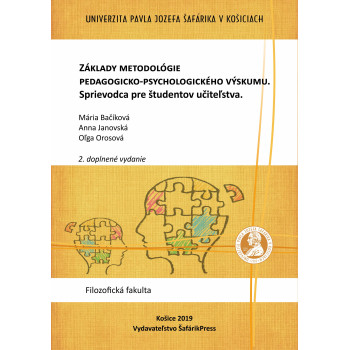
The textbook is primarily intended for students of teaching academic subjects, but it will enrich anyone who needs to familiarize themselves with research methodology focusing on psychological and educational sciences. In the textbook, students become acquainted with the basic principles of conducting research, the process of research implementation, and the basic methods of quantitative or qualitative approaches.
The examples used in the textbook are mostly focused on research conducted in a school environment. By acquiring the basic knowledge presented in the textbook, the reader will be able to conduct simple research in school conditions. At the same time, understanding the principles of research methodology helps with the critical evaluation of information from various sources.
The second, expanded edition has been extended by three chapters, focusing on conducting research directly during the teaching process in the form of teacher action research, on the possibilities of evaluating preventive programs, and the final chapter deals with the possibilities of publishing research.
E-book
Margita Mesárošová - Miroslava Köverová - Radka Miháliková
The publication is a follow-up to the university textbook Progress in Educational Psychology. It is intended for both bachelor and master degree students.
It contains questions, tasks, practical exercises, case studies and topics for discussion in the field of educational psychology.
The aim of the publication is to support the active involvement of students in teaching, consolidation and deepening of their theoretical knowledge in educational psychology, as well as practicing and improving practical skills.
Download e-book for free (pdf)
E-book
Františka Petriková - Vladimír Lichner - Eva Žiaková
The proposed methodological guide focuses on a self-care questionnaire for the target group of adolescents. The creation of this methodology was prompted by its absence in the conditions of the Slovak Republic. The methodological guide consists of both theoretical and empirical parts.
In the theoretical part, the authors present theoretical foundations for the proposed methodology—self-care among adolescents—and also provide theoretical definitions of components of self-care in this target group. The second, empirical part of the methodological guide is dedicated to validation methods used to verify the questionnaire. It also presents results examining differences or correlations in the presented issues.
Download e-book for free (pdf)
E-journal
Juraj Schenk et al.
The scientific journal Sociálne a politické analýzy (Social and Political Analyses) serves as an interactive electronic platform for communication and the presentation (publication) of experts and their work in the fields of basic and applied research and analyses within sociological, psychological, political, and methodological contexts. It is a medium focused on intensively supporting research activities and analyses within an interdisciplinary framework, facilitating the exchange of experiences, fostering collaboration, and revitalizing the production of scientific work in this area.
The publication section of the journal offers space for works such as:
- Original sociological, psychological, and political studies and analyses in any areas of social life
- Methodological studies
- Research reports
- Studies from qualification theses Research and analysis projects
- Reviews
E-book
Beáta Jurečková - Lívia Barnišinová
The e-Slovak textbook for dentists in practice - case studies is intended for foreign students of dentistry. It is primarily intended for students of the Slovak language as a foreign language, but the knowledge of the grammatical and lexical basics of the Slovak language at the A1, A2 level is needed.
The textbook consists of eight lessons, which are focused on listening comprehension (audio recordings), vocabulary expansion, systematisation of grammar and development of speech skills (case studies). The two lessons consist of repetitive, concluding exercises. The primary goal of the textbook is to connect language training with professional dental practice.
E-bool
When studying the Renaissance, researchers utilize various critical and core terms and concepts which it is necessary to characterize.
However, many such points, notably the following, are problematic: The relationship between the Renaissance and the antiquity; The connection with the Middle Ages; The transformation to Mannerism and Baroque; Realism and Secularism in Renaissance art; The individualism of the Renaissance artist; The reasons for the creation of Renaissance art in Italy, its determinants and stimulators; Distinguishing between the analysis of the genesis of the Renaissance and the analysis of the creation of the period’s art generally; Regional differences in Italy and their impact on the art; Chronological limits of the Renaissance and its milestones; The terms “Medieval Ages” and “Early Modern Period”; The impact, and its extent, of the artistic influences of the Byzantine, Gothic and Romanesque arts on the Renaissance. The term “Renaissance” itself, its content and existence, are also the subject of the discussion with students, alongside learning how such terms and definitions came about and continue to evolve, how they attain their content, how this content morphs in the historical discourse, what academical pluralism and freedom of thinking look like in the discourse led by historians, what the differences are between scientists and schools of thought on the same subject and how it is possible that they are so numerous.
The students will come to recognize the leading scholars in the field, and follow their arguments and methodological approaches. They shall be invited to closely trace and scrutinize the logic which those historians use in building their argumentation. It shall be seen that the freedom to create terms, concepts and new definitions cannot stand on an ignorance of the (historical) facts, as becomes clear with expanding knowledge of those historical facts, the variability of their interpretation growing in tandem. This approach, actually used across the whole range of seminars and lectures, shall drive discussion on the topics covered, students being invited to formulate their own theses and antitheses.
E-book
The presented university textbook is a reaction to two fundamental shortcomings. The first one is the absence of a similar, if not equivalent, textbook in the Slovak university environment. The second shortcoming is the mistake that Leibniz's philosophy is a system called monadology.
The presented textbook corrects this mistake and at the same time fills the gap of the absence of this kind of textbook with a Leibniz subject. For the above reasons, the presented textbook brings a new perspective on the philosophy of G. W. Leibniz, especially in the period of early philosophical beginnings with an overlap into the so-called Paris period and the De summa rerum period up to the first philosophical doctrinal formulation expressed in the Discours de métaphysique (Winter 1685-1686). The textbook is conceived as a selection of sections of source texts translated by the author of the textbook from French and partly from Latin and equipped with comments accessible to the target audience.
It is therefore the author's wish that this textbook not only serve as a form of correction for the misinterpretation of Leibniz's philosophy, but as an inspiring text that will introduce the reader to the world of Leibniz's philosophy in its undistorted light.
Download e-book for free (pdf)
E-book
Lukáš Šutor (ed.)
Okrúhle číslo Doktorandských miscelaneí nás vyzýva na krátke bilancovanie. V desiatich zväzkoch zborníka sme uverejnili spolu 116 príspevkov zo siedmich doktorandských študijných odborov. V každom čísle boli zastúpené štúdie z literárnej vedy (v prvých šiestich zväzkoch bol pre interdisciplinárne filologické štúdie používaný názov literárna veda/slovakistika). Z ostatných odborov boli najčastejšie uverejňované texty z filozofie a sociálnej práce, pričom štúdie z filozofie chýbali iba v posledných dvoch zväzkoch a štúdie zo sociálnej práce v prvých dvoch a v siedmom zväzku.
V zborníku sa snažíme udržiavať prvotnú myšlienku, ktorou bolo kultivovať domáci výskumný priestor najmladšej generácie bádateľov v interdisciplinárnom dialógu, čo si vyžaduje dosahovanie medzinárodných štandardov kvality, no na druhej strane aj zachovanie identity zborníka ako jedinečnej domácej publikačnej platformy.
Download the e-book for free (pdf.)
This website uses cookies to ensure you get the best experience on our website