Slovenčina


E-book
The university textbook offers a view of the family in social contexts. It deals with the basic characteristics of the family, the life cycle of the family from the choice of partner, through the arrival of children in the family to the end of the family. During its duration, the family performs various functions. A functional family is ideal for a harmonious relationship between partners and a suitable environment for raising children.
However, a number of factors enter the life of the family, which directly or indirectly affect the performance of these functions and can cause various disorders. It is here that the task of social work is to offer help to families to cope with their big and small problems. A specific feature of social work is the focus on the whole and a comprehensive assessment of the family, where it is necessary to take into account both the client's point of view and the aspect of the environment in which he lives and which constantly affects him. Therefore, the university textbook offers procedures for social work with the family, from the assessment of the life situation, through the plan of work with the family to social intervention.
The university textbook is intended for students of social work, who have the opportunity to practice complex issues within the assessment of the case through the enclosed case studies.
Download e-book for free (pdf)

Data sheet
E-journal
Juraj Schenk et al.
The scientific journal Sociálne a politické analýzy (Social and Political Analyses) serves as an interactive electronic platform for communication and the presentation (publication) of experts and their work in the fields of basic and applied research and analyses within sociological, psychological, political, and methodological contexts. It is a medium focused on intensively supporting research activities and analyses within an interdisciplinary framework, facilitating the exchange of experiences, fostering collaboration, and revitalizing the production of scientific work in this area.
The publication section of the journal offers space for works such as:
- Original sociological, psychological, and political studies and analyses in any areas of social life
- Methodological studies
- Research reports
- Studies from qualification theses Research and analysis projects
- Reviews
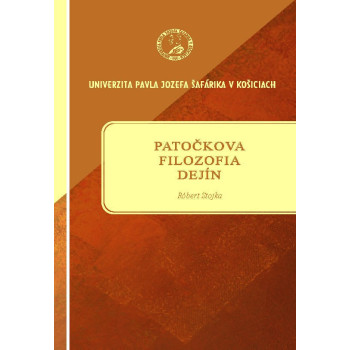
Cieľom predkladanej monografie je predovšetkým čo najkomplexnejšie predstaviť Patočkov koncept filozofie dejín, aj keď si uvedomujem, že to vôbec nie je ľahká úlo-ha, nielen preto, ako už bolo spomenuté, že v súčasnosti neexistuje rozsiahlejšia a vyčerpávajúca práca k tejto téme. Existuje síce pomerne veľké množstvo štúdií , venovaných Patočkovmu konceptu filozofie dejín, žiadna z nich však neskúma tento koncept komplexným pohľadom, ako určitý celok – zväčša sú zamerané na niektoré parciálne problémy (a nie je ich málo), vyplývajúce z tohto konceptu. Aj tento fakt, mimochodom, je pre mňa samého dôkazom toho, že ide jednoznačne o veľmi náročnú tému.
E-book
Tomáš Dvorský - Lucia Laczkó - Katarína Lörincová (eds.)
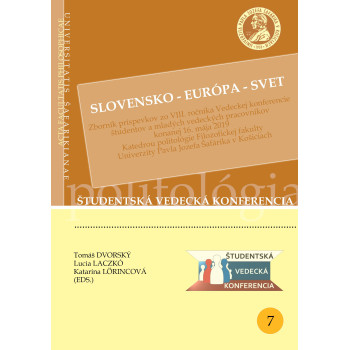
The collection of articles from the VIII. International Scientific Conference for Students and Young Scientists, organized by the Department of Political Science of the Faculty of Arts of the Pavol Jozef Šafárik University in Košice, in cooperation with the Res Publica Civic Association the Faculty of Social Sciences of the University of Saints Cyril and Methodius in Trnava, held on 16 May 2019 in Košice.
The aim of this publication, entitled Slovakia-Europe-World, is to point out a complex of diverse topics that are actual in the world, in Europe and in the Slovak republic.
The publication consists of 15 articles, which are primarily written in Slovak. The individual contributions deal with selected topics and aspects of national and foreign policy.
The topics of the articles are human rights, freedom of expression, the rise of religiously motivated nationalism, the issue of unemployment, parliamentary elections and election research. The publication also contains contributions focused on topics in the field of environmental policy, cultural policy or migration policy.
E-book
Zuzana Kolaříková - Helena Petruňová - Renáta Timková
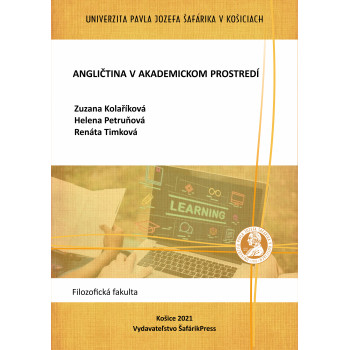
English in the Academic Environment is intended primarily for those interested in improving their academic English and is primarily designed to fulfill the needs of university students and teachers who use English in their studies, in their work activities, and in their communication with foreign colleagues and professionals.
The publication offers selected phrases and sentence structures from the field of academic English, gives practical examples of the use of nominal, verbal and prepositional phrases, free and established collocations, idiomatic expressions, including translations of some selected phrases. It also highlights some common mistakes in the use of English in an academic environment, which are a manifestation of incorrect or insufficiently acquired linguistic resources and, last but not least, a consequence of the linguistic influence of Slovak.