Slovenčina



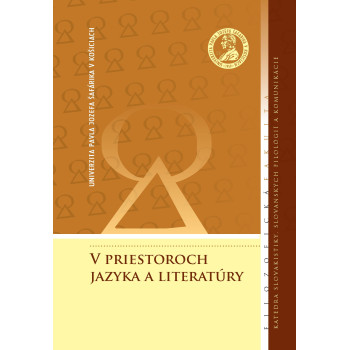
Ivica Hajdučeková (ed.)
Recenzovaný zborník z interného seminára KSSFaK FF UPJŠ konaného pri príležitosti životného jubilea prof. PhDr. Jána Sabola, DrSc., 26. marca 2009 je prvým spoločným počinom jazykovednej, literárnovednej a mediálnej orientácie novovzniknutej katedry. Po slávnostnom príhovore dekana FF UPJŠ prof. PhDr. J. Gbúra, CSc., je uvedená prednáška jubilujúceho prof. PhDr. Jána Sabola, DrSc. Vzťah segmentov a suprasegmentov v zvukovej rovine. Ďalej sú do dvoch častí Jazyk a Literatúra rozdelené príspevky jednotlivých členov katedry, ale aj prvých doktorandov. Tematický záber roztvára najprv problematiku jednotlivých rovín jazyka (zvukovú stránku jazyka, experimentálnu fonetiku, dialektológiu, morfológiu aj lexikológiu), potom literárnovedných disciplín (verzológie, genológie, metodológie, textovej semiotiky) aj mediológie.

Data sheet
Specific References
E-book
With great interest, I read the proposal for the reissue of the monograph by Prof. PhDr. Ján Hvozdík, DrSc., Základy školskej psychológie (Foundations of School Psychology). It was an honor for me to be part of the editorial board for the new edition of the textbook.
The reissue comes at a time when school psychology seems to be experiencing a renaissance in its application. This is no coincidence, as the professor’s conception of school psychology as a theoretical-applied and integrated psychological discipline strives not only directly but also indirectly, through the pedagogical practice of teachers, to influence specific situations in educational practice within the school environment. From my perspective, I also appreciate the attention given in the textbook to the ever-relevant topic of self-directed learning, that is, the autodidactics of pupils and students. School psychology has become a core subject, within which its specializations are also realized.
It is worth mentioning the fact that, under the conditions of totalitarianism, the professor was not a member of the Communist Party of Czechoslovakia, and yet he made significant contributions to the development of school counseling, both in theory and in practice, which commands respect and admiration. The reissue of the textbook is not an apology but rather a celebration of his positive contributions.
prof. PhDr. Ján Grác, DrSc.
E-book
The university textbook „Cursus Latinus – exercise book“ is a parallel study material to the textbook „Cursus Latinus – textbook“. It is designed for practicing grammar at home. The content of the exercises corresponds in its focus to the lessons of the mentioned textbook, both in terms of the grammatical phenomena, as well as the vocabulary. For this reason, only vocabulary that was not included in the lessons of the textbook is included in the exercises. The Latin-Slovak dictionary at the end of the exercise book contains the entire vocabulary from the exercise book and the textbook. Part of the exercise book is a key that allows students to immediately check the correctness of their work. „Cursus Latinus - exercise book“ is available electronically in PDF format.
E-book
Lucia Tóthová - Katarína Šiňanská - Eva Žiaková
Here is the translation of the provided text into English: A guide to oncological treatment was created at a time when the importance of health became even more emphasized, becoming a kind of mega-value for the new modern "pandemic" human. The use of the term "pandemic" person arose, of course, in connection with the emergence of the coronavirus pandemic worldwide, but primarily because other dangerous long-term diseases that threaten contemporary humans are somehow being pushed into the background.
The severity of such diseases (including cancer) does not diminish just because attention has shifted to something more acute. It is very important to realize this and not fall under the illusion that if we overcome an acute danger, then automatically improve conditions for chronic diseases as well. We believe it's quite the opposite; prolonged stress and social negative factors constantly affecting us—among which undoubtedly includes pandemic situations—worsen not only psychological but also somatic states.
The guide to oncological treatment aims precisely at highlighting those psychological and social factors that negatively "support" cancer development in any form and can positively influence treatment and coping with illness. The guide offers opportunities for social engagement with groups of people undergoing similar oncological treatments, allowing them to share psychologically as well as professionally similar situations with those facing similar problems in treatment. The authors hope that this guidebook will reach those who will become more self-sufficient in overcoming such a formidable enemy as cancer.
Authors
E-book
Gabriel Eštok - Mária Hrehová - Renáta Bzdilová (eds.)
Collection of contributions from II. year of the Student Scientific Conference held on May 17, 2013 by the Department of Political Science of the Faculty of Arts of the University of Pavel Jozef Šafárik in Košice
The collection was created on the basis of an event with a thematically defined and political science, perhaps the most frequently discussed issue of democracy. I would add that the event was also attended by doctoral students of other fields of study, who analyzed the topic of democracy from positions other than political science. I very much welcomed the fact that a contribution from the legal issues of the European Union appeared in the proceedings. Enriching the collection is also a contribution from international political issues, which sheds light on democratic rules applied in territory other than European. Other contributions focus on various aspects of the creation of a democratic political environment in Slovakia and the European Union, while several sympathetic attempts at non-traditional perspectives on the development of civil society, public and party politics appear in them.