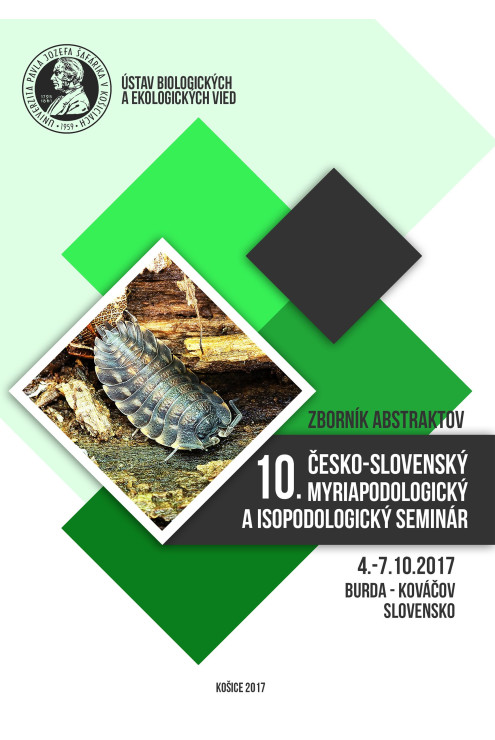
10th Czech and Slovak Myriapodological and Isopodological Workshop

E-book

Andrej Mock

Burda - Kováčov, Slovensko, 4.-7.10.2017

Abstracts of lectures by Czech and Slovak zoologists, ecologists, and physiologists, who study soil arthropods in the taxa Myriapoda and Oniscidea as model groups, presented at the 10th seminar in Kováčová near Chľaba, Slovakia.

Download the e-book for free (pdf)

Quantity

978-80-8152-531-5

Data sheet

Method of publication:
E-book (pdf)
Editor:
Andrej Mock
Document type:
Book of abstracts
Number of pages:
24
Available from:
20. 9. 2017
Year of publication:
2017
Edition:
1st edition
Publication language:
slovenčina, angličtina, čeština
Faculty:
Prírodovedecká fakulta
- Free for download

16 other products in the same category:

Študentská vedecká konferencia PF UPJŠ 2016

E-book

E-book

Vladimír Zeleňák (ed.)

Proceedings of Abstracts of the Student Scientific Conference of the Faculty of Science, Pavol Jozef Šafárik University in Košice

A characteristic feature of education at high-quality universities — among which the Faculty of Science at Pavol Jozef Šafárik University (UPJŠ) in Košice proudly belongs — is the close connection between education and scientific research. Students gain knowledge in their field of study not only through theoretical coursework in individual disciplines, but also through active involvement in solving specific scientific tasks as part of research teams. This can occur during the development of final theses or through participation in the Student Research Assistant Program (ŠPVS), which was revitalized at the faculty in 2015.

The Student Scientific Conference (ŠVK) is one of the faculty’s traditional events, organized during the Faculty’s Science Days as part of Sciencefest. By its very nature, it fits seamlessly into the aforementioned framework of combining education with research, and it has long enjoyed great popularity and student interest. In 2016, the conference featured presentations by 125 students of the Faculty of Science at UPJŠ in Košice, across 16 thematic sections. This collection of abstracts provides an overview of the focus and goals of the student projects. We believe it will serve as inspiration for other potential participants of future conferences and will also be of interest to the broader public, offering additional insight into the faculty's activities.

Download the e-book for free (pdf)

Internet vecí a jeho aplikácie

E-book

E-book

Ľubomír Antoni a kol.

In university textbooks, we present the basics of the Internet of Things, its origin and technological development, concept. We classify Internet of Things applications into the areas of healthcare, intelligent environment, personal and social areas, transport and logistics, smart cities.

We present an overview of university subjects in the field of the Internet of Things, which were created and innovated at Slovak universities within the national project IT Academy - Education for the 21st Century. We present extended subject annotations, application examples and case studies using various methods in the field of the Internet of Things.

University textbooks are intended for students of bachelor's, master's, engineering and doctoral study programs in computer science, but also in non-informatics fields.

Download e-book for free(pdf)

Metodika tvorby učebných úloh a didaktických...

E-book

E-book

Mária Ganajová

The current teaching of chemistry has its specific problems. On one hand, due to the shift of the focus of chemistry curriculum towards theoretical content, the difficulty of chemistry material has increased, and in connection with this, students' interest in chemistry has decreased.

The lack of student interest in chemistry is mostly supported by the opinion that it is precisely chemistry that significantly contributes to the deterioration of environmental quality. On the other hand, we live in an era where we encounter chemical products practically everywhere. It is necessary to learn the basics of chemistry as well as possible, which makes the question of increasing interest in chemistry education and improving its effectiveness very relevant. State educational programs have been introduced into Slovak schools as a foundation for the creation of school educational programs. These emphasize not only acquiring a certain amount of knowledge but also the development and enhancement of key and specific competencies of students, preparing them for lifelong learning and their application in life.

Therefore, increasing attention is being paid to one of the fundamental didactic tools for raising student activity in teaching, and thus improving the effectiveness of chemistry education – learning tasks. From both theory and practice of chemistry teaching, we know that learning tasks, questions, examples, exercises, etc., are among the important components of every teaching lesson. Learning tasks are applied in all phases of teaching – in the motivational phase, the phase of acquiring knowledge, the phase of consolidating knowledge, and the phase of checking the acquired knowledge. It is therefore clear that every teacher will sooner or later find themselves in a situation where they will have to select learning tasks from textbooks, workbooks, collections of problems and examples, or create them themselves.

This scientific monograph is intended for educational specialists and chemistry teachers, aiming to familiarize them with examples of various types and forms of learning tasks and the basics of their creation in chemistry. It can also be helpful for them in preparing certification works focused on test creation and their statistical evaluation.

Download the e-book for free (pdf)

Zbierka úloh z fyziky elementárnych častíc

E-book

E-book

Marek Bombara

The collection of exercises summarises and supplements the exercises realised at the Pavol Jozef Šafárik in Košice within the lecture course Elementary Particle Physics. The collection is intended for the master students of the Nuclear and Subnuclear Physics subject, but it could be beneficial also for other physics subjects or even for interdisciplinary study. 

The division of chapters roughly copies the order of lectures. At the beginning, students will briefly familiarize themselves with the basics of special relativity and its practical use in particle physics.

Download the e-book for free (pdf)

50 rokov katedry organickej chémie

E-book

E-book

Zuzana Kudličková(ed.)

Proceedings of Abstracts from the Scientific Conference with International Participation Organized on the Occasion of the 50th Anniversary of the Establishment of the Department of Organic Chemistry, Faculty of Science, Pavol Jozef Šafárik University in Košice, held on June 8–10, 2016 in Košice.

The Department of Organic Chemistry was established on February 1, 1966. From its inception, the department’s development prospects have been linked to high-quality scientific research focused on the synthesis of isothiocyanates and the products of their nucleophilic additions. In addition, studies were conducted on the use of cycloaddition, cyclocondensation, and photocyclization reactions of heterocumulenes in the synthesis of heterocycles.

Currently, research at the Department of Organic Chemistry is concentrated on stereoselective syntheses of iminosugars and γ-lactam-β-lactone antibiotics, total synthesis of natural compounds and their analogues possessing a sphingoid structure, research into the synthesis of indole alkaloids from the phytoalexin group, and the synthesis of acetylcholinesterase inhibitors based on acridine and coumarin derivatives.

Download the e-book for free (pdf)

HOST-GUEST A SUPRAMOLEKULOVÁ CHÉMIA

E-book

E-book

Miroslava Matiková Maľarová

The university textbook entitled: Host-guest and supramolecular chemistry provides basic information about this scientific field as well as the types of compounds that belong to it. It provides basic characteristics of non-bonded interactions as well as methods of characterization and classification for these compounds. It summarizes knowledge about various types of host-guest systems from the oldest such as Hofmann clathrates to inclusive compounds such as cyclodextrins and calixarenes. In addition to structural and synthetic information, which is supplemented with images, the textbook also addresses the possibilities of application or practical use of compounds. The conclusion of each chapter is supplemented with tasks for elaboration on a given topic.

Download the e-book for free (pdf)

Biológia kryptogamov

E-book

E-publication
Michal Goga-Marko S. Sabovljević-Martin Bačkor-Dajana Kecsey-Deepti Routray
A comprehensive guide that introduces you to the fascinating diversity and systematics of lower plants. These practical lessons are designed to provide hands-on training, allowing students to engage directly with the interesting study of Cryptogams by observation, analysis, and identification and experimentation. Beginning with the overall idea of cryptogam in a field trip near by the vicinity of Botanical garden then followed by the basics of microscopy in, will help to gain essential skills in understanding the components and proper usage of a microscope, a fundamental tool in botanical studies.
Download the e-book for free (pdf)

ATÓMOVÁ ŠTRUKTÚRA LÁTOK I - Základy RTG...

E-book

E-book

Jozef Bednarčík

Crystallography deals with discerning the arrangement and bonding of atoms in crystalline solids. Almost immediately after their discovery, X-rays began to be used to study the internal structure of substances.

The first chapter of this textbook deals with the basic concepts of crystallography. At the beginning, crystalline solids are characterized. In the next section, the basic types of bonds and their characteristics are briefly presented. The main subject of this chapter is the interpretation of basic concepts such as symmetry operations, translational periodicity, grid, elementary cell. Spatial lattices and crystal systems are presented. At the end of this chapter, attention is paid to the description of individual types of defects in crystal structures. In the second chapter, the Bohr model of the hydrogen atom is presented. Individual quantum numbers and their meaning are given.

Next, energy levels and allowed transitions within an atom with multiple electrons are described. The second chapter concludes with the characterization of the basic absorption and emission processes. The third chapter is devoted to the production of X-ray radiation and its properties. Sources of X-ray radiation and a description of their operation are presented.

Interaction of X-ray radiation with matter, absorption and detection of X-ray radiation are the subject of the last part of this chapter.

Download the e-book for free (pdf)

Exactly Solvable Models in Statistical Physics

E-book

E-book

Jozef Strečka

Over the past fifteen years, the course on ’Exactly Solvable Models in Statistical Physics’ has become an indispensable ground of the study programme ’Theoretical Physics’ at Faculty of Science of Pavol Jozef Šafarik University in Košice. At first, the course based on the first edition of this textbook was intended for undergraduate students only, however, I have later prepared follow-up course taught at a postgraduate level on demand of several ambitious students who wished to continue in studying this exciting research field.

It is already more than decade when our students enrolled in the study programme ’Theoretical Physics’ graduate from ’Introduction to Exactly Solvable Models in Statistical Physics’ at a master level and ’Exactly Solvable Models in Statistical Physics’ at a postgraduate level. Of course, it was necessary somehow to rearrange topics for the courses of undergraduate and postgraduate students.

More specifically, a few more challenging topics concerned with exact solutions of 2D Ising model (chapter 3) were moved to a more advanced course intended for the postgraduate students, while an introductory course intended for the undergraduate students was contrarily supplemented with a few new topics requiring the second edition of this textbook.

The second edition of this textbook thus contains a completely new chapter 4 devoted to the exact solution of the Ising model on the Bethe lattice using the method of exact recursion relations, while the chapter 5 was supplemented by exact results for ground state of a few frustrated Heisenberg spin models using the variational method. It is my hope that the next edition of this textbook will come soon and it will involve all topics specifically taught within the postgraduate course as well. 

Download the e-book for free  (pdf)

Návody na praktické cvičenia z biotechnológie

E-book

E-book

Danica Sabolová

This university textbook is intended for students of the Faculty of Science of the University of Applied Sciences in Košice who have enrolled in practical exercises in Biotechnology, but also for all other students who are interested in learning about the practical applications of biotechnology.

The aim of the practical course is to familiarize students with basic biotechnological methods and their applications. The students will verify in practice the theoretical knowledge acquired in the Biotechnology lectures such as the course of fermentation processes, wine production, preparation of fermented milk products and cheese, preparation of culture media, inoculation and cultivation of microorganisms, etc. The practical exercises also include the use of analytical and spectral methods, which are an integral part of biochemistry.

The scripts are published only in electronic form and are available on the University's website: http://kosice.upjs.sk/~kbch/sk, for the reason that it will always be possible to update and modernize the content of the laboratory exercises.

Download the e-book for free (pdf)

Predictive Modeling of Soil Types and Their...

E-book

E-book

Vasyl Cherlinka - Michal Gallay - Yuryi Dmytruk

The textbook is a practical guide to predictive mapping of soil types and properties in R. It bridges digital soil mapping theory with hands-on practice, covering the full workflow from data acquisition and preprocessing to validation and uncertainty quantification. Early chapters introduce the tidyverse ecosystem and the sf and terra packages for spatial data handling. Subsequent parts address modelling of categorical variables (soil types/WRB) and continuous variables (soil organic carbon) using Random Forest, Cubist, and Quantile Regression Forests. Step-by-step code examples show training/testing, feature selection, accuracy metrics, and model interpretation. Reproducibility and cartographic best practice are emphasised. A Slovakia case study demonstrates real-world application while outlining limits and generalisability. The book targets bachelor’s, master’s, and PhD students in geography, geoinformatics, environmental and agricultural sciences, as well as practitioners. Written in English, it fits international courses and mobility programmes.

Download the e-book for free (pdf)

Kmity, vlny a optika

E-book

E-book

Ján Füzer

Auxiliary teaching material for the course General Physics III – Oscillations, Waves, and Optics is intended for students of single-subject and interdisciplinary studies of physics.

The content provides a basic outline of the material covered, without detailed explanations, with an emphasis on the physical method of thinking using the simplest elements of higher mathematics. The presented text does not aim to replace the recommended textbooks, but rather to help students navigate the subject matter. Recommended literature can be found at the end of the text.

The teaching material contains the basic framework of the lectures and is supplemented and revised each year, with lectures enriched by supporting demonstration experiments.

Download e-book for free (pdf)

Praktikum z molekulového modelingu

E-book

E-book

Ladislav Janovec

An enormous progress in computer technology, closely linked with advances in computational chemistry, has enabled the user to exploit the principles of quantum chemistry to elucidate the chemical phenomena.

Computational chemistry is the branch of science that requires, except an academic knowledge, software skills to fully exploit a potential of theoretical methods. The aim of this textbook is to help the user take the legendary first step in the field of computational chemistry to opening a new horizon of knowledge.

Download the e-book for free (pdf)

Študentská vedecká konferencia PF UPJŠ 2023

E-book

E-book

Marián Kireš  (ed.)

Proceedings of Abstracts from the Student Scientific Conference of the Faculty of Science, Pavol Jozef Šafárik University in Košice

The Student Scientific Conference (SSC) represents the culmination of long-term and intensive work on a selected topic, collaboration with a supervisor, or a broader team at the workplace. In practice, however, it often marks the beginning of scientific research, focusing on a chosen subject, field, or close cooperation with a future supervisor of a bachelor's, master's, or doctoral thesis.

This year, the Student Scientific Conference took place on April 19, 2023, featuring 14 sections, a programming competition, and the IHRA contest. Bachelor’s and master’s students presented 101 contributions. Additionally, 8 high school students participated non-competitively, presenting their SOČ projects; 14 students took part in the programming competition, and 3 students competed in the IHRA contest.

We believe that the proceedings of abstracts and related documents serve not only as an archive but also as a dignified presentation of scientific activities at our faculty for the wider public.

Download the e-book for free  (pdf)

Praktické cvičenia z röntgenovej difraktometrie II

E-book

E-book

Karel Saksl

Solving crystal structures is the royal discipline of X-ray crystallography. Its primary task, with the exception of defects, is to describe the atomic structure of the motif that, by its repetition, fills the volume of the entire crystal or crystalline phase. This task is nowadays more or less routine for single-crystal X-ray diffraction, which can locate hundreds to thousands of non-hydrogen atoms in large unit cells. However, in real practice, we often have material available only in powder form instead of single crystals. Solving the atomic structure from its X-ray diffraction data is non-trivial, mainly because the three-dimensional diffraction space of a single crystal is reduced to one dimension by measuring a large number of randomly oriented microcrystals (crystallites). Therefore, the solution itself requires, in addition to proper measurement methodology, the selection of suitable tools, procedures, and strategies that, through optimization, will lead to the solution and refinement of the given crystalline phase. The current limit of this method is approximately 100 non-hydrogen atoms in the asymmetric part of the unit cell, which, however, is sufficient for most inorganic materials.

The goal of these educational texts is to provide students in the second and third levels of university studies with specific guidance on solving crystal structures from powder X-ray diffraction data. These scripts build upon my first monograph and require practical knowledge of its content. Similar to my previous monograph, I offer solved examples without a deep theoretical introduction, demonstrating procedures and strategies leading to the correct solution of crystalline phases using the freely available GSAS-II program. The examples are arranged from simpler to more complex, and the reader will find many useful pieces of information in the literature references as well as in the comments below the line. Part of these scripts are data intended for your individual practice of the described procedures. 

Karel Sakls

Download the e-book for free  (pdf)

This website uses cookies to ensure you get the best experience on our website