Slovenčina


E-book
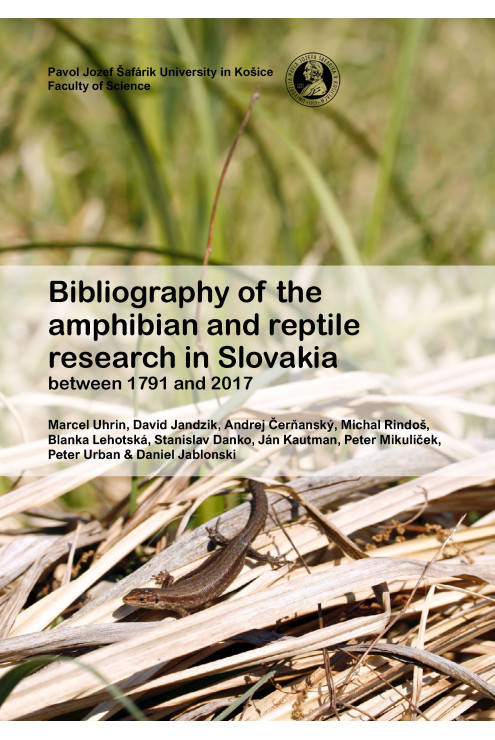
Marcel Uhrin - David Jandzik - Andrej Čerňanský - Michal Rindoš - Blanka Lehotská - Stanislav Danko - Ján Kautman - Peter Mikulíček - Peter Urban - Daniel Jablonski
Bibliographies provide basic scientific information, illustrate quality and intensity of research in a particular topic, area, or time, and thus help build a cultural-historical perspective of society’s appreciation of knowledge and education. Here we provide a bibliography of herpetological research in the region of Slovakia between the years 1791 and 2017. We collected 2,183 references authored by 1,453 different authors and covering all species of amphibians (18) and reptiles (13) occurring in Slovakia and, in addition, amphibian and reptile taxa occurring in 94 other countries.
Most of the contributions were published in popular magazines and non-indexed journals, while only about 12% of all references represent scientific articles from journals indexed in relevant scientific databases. The extensiveness of study on amphibians and reptiles has varied among different periods within the selected time frame. However, an obvious intensification in the field of herpetology can be observed, especially during the second half of the 20th century. While there have only been few professionals specialized in herpetology, an important role in promoting the research and conservation of amphibians and reptiles in Slovakia has been played by non-governmental organizations and hobbyists. The most frequent type of herpetological data in the referenced literature comes from faunistic research, followed by conservation and general information on herpetofauna, with the majority of published articles in indexed journals coming from the fields of palaeontology, phylogeography, and population genetics.
The presented bibliography is the first step towards building a solid base for future systematic herpetological research in the country and Central Europe.

Data sheet
E-book
The aim of this textbook is to acquaint students in physics, chemistry and material science on both undergraduate and graduate level, with the techniques used to prepare micro-electromechanical devices, nanoobjects and nanostructures using the so called top down methodologies. The is no requirement for this course to pass any prior courses. The introduction part of the text defines the forces that affect nanoobjects and the interactions between them. Reader can understand in detail why properties of nanomaterials and nanostructures are so different when comprared to their macroscopic counterparts. Text gives also an overview of thin film preparation technologies as precursors for the preparation of nanostructures. The main emphasis in Volume I is on conventional lithographic technologies for the preparation and shaping of nanostructures, methods for characterization of thin films, nanoparticles and nanomaterials. Unconventional lithographic methods will also be discussed in the prepared upcoming Volume II. Student will also get acquainted with the applications of nanostructures in research focused on nanophysics, nanocatalysis and nanoelectronics. The textbook is used as a study material for the course ÚFV / MPN / 14 - Methods of preparation and characterization of nanostructures. Part of the course is also a laboratory exercise in which the student gets acquainted with the techiques used for the preparation and characterization of thin films and top-down technologies used for the preparation of nanostructures.
Peter Kollár a kol.
Skriptá Základné fyzikálne praktikum II. sú určené pre študentov Prírodovedeckej fakulty UPJŠ v Košiciach študujúcich na študijných programoch fyzika a medziodborových programoch v kombinácii s fyzikou. Obsahom skrípt sú úlohy z elektriny, magnetizmu a optiky. Podľa študijných programov sú zaradené do 3.semestra bakalárskeho štúdia, v ktorom by už študenti mali mať absolvovaný predmet všeobecná fyzika II. (elektrina a magnetizmus). Súčasťou každej úlohy sú základné poznatky venované javom, ktoré sú obsahom samotnej úlohy.
Autori
E-book
Pavol Sokol - Ladislav Bačo - Tomáš Bajtoš
In the university textbook, we present the theoretical foundations and technical details of the activities of a forensic investigator. We describe the identification and provision of digital tracks, file system analysis. analysis of various artifacts of the Windows operating system, analysis of the operating memory. The textbook is also supplemented by a chapter devoted to the analysis of malicious code (malware). University textbooks are intended for students of bachelor's, master's, engineering and doctoral study programs in computer science, but also in non-informatics fields.
E-publication
Beáta Valkayed.
Ivana Slepáková-Lenka Maliničová a kol.
The EFFUSE Teacher's Guide is a practical educational material for primary and secondary school teachers who want to develop environmental awareness with their pupils through field-based learning. It is based on the concept of the EFFUSE project (‘Environment for the future by science education’), which aims to link science, research and education with environmental protection. The manual provides teachers with methodological support for planning and implementing outdoor activities aimed at observing and documenting organisms around the Laborec River and the Uh River. It contains instructions for working with real samples, basic biomonitoring procedures and offers the opportunity to participate in the creation of a virtual laboratory that mirrors the state of the local aquatic ecosystem. Through these activities, pupils will learn to understand the links between human activity and the state of the environment, while learning the basics of how scientists work in the fields of biology and ecology. The guide also motivates teachers to become agents of positive change, inspire the younger generation to be active and engage the community in conservation. It is a challenge and an opportunity to create a space for meaningful learning in line with current trends in environmental and digital education.