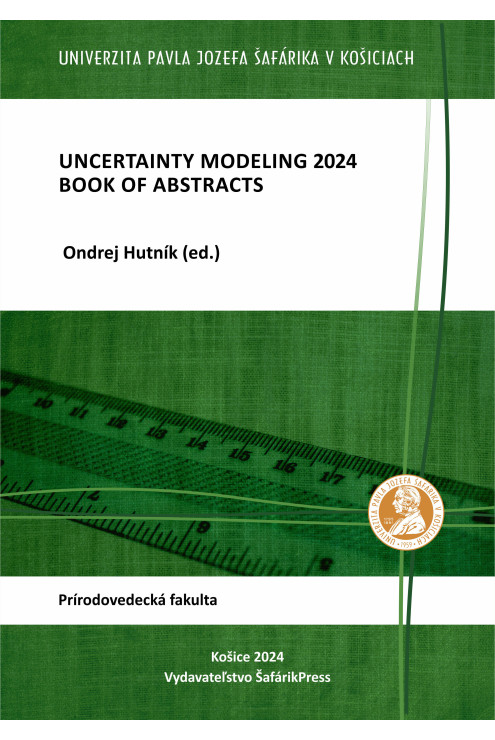
Uncertainty Modeling 2024

E-book

Ondrej Hutník (ed.)

Book of abstract

Uncertainty Modeling 2024 (UM 2024) is organized by Pavol Jozef ˇSaf´arik University in Koˇsice. It is a continuation of the series of colloquia held in Rzesz´ow under the name International Symposium on Fuzzy Sets (ISFS) and in Bratislava under the name Uncertainty Modeling.

Download the e-book for free (pdf)

Quantity

978-80-574-0318-0

Data sheet

Method of publication:
E-book (pdf)
Editor:
Ondrej Hutník
Document type:
Book of abstracts
Number of pages:
31
Available from:
04.06.2024
Year of publication:
2024
Edition:
1st edition
Publication language:
English
Faculty:
Prírodovedecká fakulta
- Free for download

16 other products in the same category:

Praktické cvičenia z fyzikálnej chémie

E-book

E-book

Andrea Morovská TuroňováRenáta OriňakováFrantišek Kaľavský 

The university textbooks "Practical Exercises in Physical Chemistry" are intended as teaching literature for students of the 2nd year of the Chemistry study program and the 3rd year of the interdisciplinary study program at the Faculty of Science of the Pavel Jozef Šafárik University in Košice.

The three chapters summarize the basic knowledge of thermodynamics, electrochemistry and kinetics, the next chapter deals with the measurement of some other physico-chemical quantities. The tasks developed on the basis of cooperation with the Criminalistics and Expertise Institute of the Police in Košice, which also participates in the innovation of practical teaching, are also very attractive and interesting for students. Thematic units are updated and supplemented by new knowledge, principles as well as detailed working procedures using new instrumentation.

The aim of laboratory exercises in physical chemistry is to illustrate and confirm the physicochemical laws and correlations that apply to the quantitative description of chemical phenomena. Students will learn to use instruments and equipment that occur in physico-chemical laboratories, they will learn the principles of accurate and correct quantitative measurement of physical quantities, important from a chemical point of view. They can also develop professional and scientific communication skills, and we want to support their creative approach to making measurement protocols.

Download the e-book for free  (pdf)

Globálne navigačné satelitné systémy

E-book

E-book

Vladimír Sedlák

In the presented university textbooks, so-called satellite-based augmentation systems (SBAS, from the English Satellite Based Augmentation Systems, in Slovak Systémy rozširujúce základné satelitné systémy) are also discussed. These systems enhance, expand, or refine the basic satellite navigation systems. They are supportive satellite systems for GNSS (Global Navigation Satellite Systems). Currently, the long-operational American GPS and Russian GLONASS systems, as well as the partially operational European Galileo system (since December 2016), have and will continue to have broad applications in various fields of human activity, both professional and personal.

The university textbook Globálne navigačné satelitné systémy (Global Navigation Satellite Systems) reflects the current progressive development in the technological and instrumental principles and components of such satellite navigation systems. It presents the state of these satellite technologies from their historical origins and development to the present. The rapid advancements, particularly in the instrumental base of satellite navigation systems, will require updates on their current state in future editions of these university textbooks.

Download the e-book for free (pdf)

Systematika cievnatých rastlín, 5. vydanie

E-book

E-book

Pavol Mártonfi

The university textbook deals with the latest knowledge from the systematics of vascular plants in a clear manner. Vascular plants arose in the Silurian period in the Paleozoic, when the first primitive plants moved from water to dry land, which required evolutionary progress in the morphological and anatomical structure of these plants. During about 420 million years of the existence of vascular plants, several of their main groups have evolved: the spore vascular plants, including the lycopods (branch Lycopodiophyta) and group of ferns and related plants (branch Monilophyta), and the seed plants, including gymnosperms (branch Gymnospermae) and angiosperms ( Angiospermae), which currently dominate among plants. The textbook provides a brief but comprehensive overview of the main groups, orders and families of plants with their description, distribution, main representatives, while also addressing the useful properties of selected species. The work is complemented by an overview of the system of plants by Cronquist, Tachtadžjan, APG and an overview of the families of the Slovak flora, as well as a taxonomic index.

Download e-book for free (pdf)

Doménové steny a ich dynamika

E-book

E-book

Rastislav Varga

The movement of domain walls in ferromagnetic materials is utilized in various magnetic devices for storing, processing, or transmitting signals and information. This mainly includes transformer cores, various sensors, memory devices (e.g., HDDs in PCs), as well as modern spintronic devices such as Racetrack memories, domain wall motion-based electronics, and so on.

This book is intended to serve as a textbook for advanced courses in the field of magnetic materials. It is primarily aimed at students interested in studying magnetic materials, as well as professionals from various fields who wish to understand the basics of domain structure and its changes. It is divided into nine chapters. The first chapter deals with a brief history of the study of domain structure in magnetic materials. The second chapter provides an introduction to the causes and manifestations of magnetic anisotropies. The third and fourth chapters are devoted to the causes of domain structure formation and domain walls. The fifth chapter discusses the structure of domain walls, their potential, and the critical field required for domain wall movement. The sixth chapter is dedicated to magnetization processes, one of which - domain wall movement - is discussed in detail in chapter 7. The eighth chapter contains a theoretical solution for domain wall movement. The final ninth chapter presents a modern method of domain wall movement induced by electric current.

The presented work assumes that the reader has at least basic knowledge in the field of magnetism. Otherwise, the author refers the reader to basic literature (e.g., [2.1 - 2.6]).

Download the e-book for free (pdf)

Výpočtová a kognitívna neuroveda II (Návody na...

E-book

E-book

Norbert Kopčo

Neuroscience is an interdisciplinary field of science at the interface of biological, psychological and computer sciences, which aims to describe the functioning of the brain and mind. Computational and cognitive neuroscience are subfields of neuroscience focused on the study of information processing in the human and animal nervous systems, and on the theoretical description of the brain and mind. This university textbook contains several assignments that provide an overview of the methods used in computational and cognitive neuroscience, with an emphasis on mathematical modeling and on the behavioral study of cognitive processes. The textbook builds on the author's previous works.

Download e-book for free (pdf)

Cytológia pracovný zošit na praktické cvičenia

€10.00
Availability: 35 In Stock

Ján Kleban a kolektív

Predkladaný pracovný zošit na praktické cvičenia z cytológie je určený poslucháčom 1. ročníka bakalárskeho štúdia biológie a 1. ročníka bakalárskeho medziodborového štúdia v kombinácii s biológiou na Prírodovedeckej fakulte Univerzity Pavla Jozefa Šafárika v Košiciach. Slúži ako návod, ktorý má študentom uľahčiť prácu a umožniť rýchlejšiu orientáciu v zadanej úlohe. Úprava pracovného zošita do formy protokolov umožňuje študentom zakresliť vlastné pozorovanie a tým stimuluje študentov k presnejšiemu a trvalejšiemu zapamätaniu si precvičovanej úlohy a zároveň umožňuje spätnú kontrolu pedagógom. Počas cvičení sa študenti postupne oboznámia so základnými pojmami optiky, s aplikáciami využívajúcimi mikroskopickú techniku, ale aj so základnými rozdielmi medzi štruktúrou rastlinnej a živočíšnej bunky a ich organelami.

Geopriestorové technológie v bádateľsky...

E-book

E-book

Stela Csachová - Ján Kaňuk - Alena GessertLadislav NovotnýŠtefan GáborJozef Šupinský

This book addressed the inquiry-based learning and teaching with the support of geospatial technologies. Today, geospatial technologies are influencing geography teaching learning, particularly in secondary education. Theoretical framework gives the reader the insight to inquiry-based learning, with special focus on inquiry in geography. The one-by-one step of inquiry is analysed in detail. The major part of the book presents the eleven models of geography lessons, representing the subject content of physical, human and regional geographies, various levels of inquiry and use of different geospatial technologies. The readers are acquainted with the use of geographic information system (particularly Google Earth and ArcGIS online), web portals, webGIS, open data, mobile applications and new forms of 3D cartographic visualisation (virtual reality, 3D print, dynamic 3D map) in teaching geography. The lesson models were tested with the students to be geography teachers in school year 2021/2022. This books serves as resource mainly for undergraduate teacher students and in-service geography teachers.

Download e-book for free (pdf)

Počítačová fyzika II

E-book

E-book

Milan Žukovič

This textbook is intended for master's degree students and is a follow-up to the Computational Physics I course studied at the bachelor's level. The content of the textbook Computational Physics II focuses on stochastic methods of solving physical problems, mainly on Monte Carlo (MC) simulation of many-particle systems.

The focus on this computationally intensive approach is motivated by the gradual increase in the computing capacities of ordinary computers as well as the introduction of high-performance computing clusters. This has led to significant progress in the development of new simulation techniques, thanks to which MC simulations have found application in various areas of research and application practice. Considering the main research focus of the department, this text is particularly devoted to the presentation of basic and more advanced MC simulation techniques applied to a simple Ising spin model in order to investigate its magnetic, thermodynamic and critical properties.

The next part is devoted to MC simulations of random processes. It focuses on the simplest but also the most basic random walk process and demonstrates its applications in financial analysis and the solution of a quantum system described by the time-dependent Schrödinger equation. The last part is dedicated to the basics of molecular dynamics, applied to simulating the classical movement of atoms in a given force field. By mastering the problems addressed in this course, students will obtain a potential tool for working out of their diploma theses, or a methodology useful for their further scientific and research practice in the field of investigating of complex systems.

The lectured topic is subsequently exercised in the form of preparing projects implemented in the freely distributable software Octave, which is easy on the user's programming skills and which students have the opportunity to familiarize themselves with in the previous study.

Download e-book for free (pdf)

Cell Biophysics II

E-book

E-book

Katarína Štrofeková

Cell Biophysics II is the one semester comprehensive course textbook for PhD students. It encompasses basic principles and mechanisms underlying cell physiology and biophysics with aims:

• General knowledge of the principles of cellular function, including membrane, cytoplasmic and nuclear roles in normal and abnormal conditions.
• In-depth understanding of the mechanisms underlying the cell functions at the molecular and subcellular level.
• Awareness of cell pathologies that lead to specific disease symptoms and phenotypes.
• The ability to apply learned principles to solve new problems (analysis & synthesis).

Download the e-book for free (pdf)

UNINFOS 2014 • Univerzitné informačné systémy...

E-book

E-book

Gabriel Semanišin - Emil Hutňan - Jana Oleničová

The proceedings contain abstracts of contributions from participants of the UNIFOS 2014 conference, University Information Systems in Košice, which took place from October 27 to 29, 2014.

ICT centers are important element that provide functioning and development hardware and software infrastructure at Slovak Universities. There are more differences between them in real position, management, personal sources and financing. ICT centers provide a wide range of services to large number of university users and they implement the policy of information security recently.

Download the e-book for free (pdf)

Metodika tvorby učebných úloh a didaktických...

E-book

E-book

Mária Ganajová

The current teaching of chemistry has its specific problems. On one hand, due to the shift of the focus of chemistry curriculum towards theoretical content, the difficulty of chemistry material has increased, and in connection with this, students' interest in chemistry has decreased.

The lack of student interest in chemistry is mostly supported by the opinion that it is precisely chemistry that significantly contributes to the deterioration of environmental quality. On the other hand, we live in an era where we encounter chemical products practically everywhere. It is necessary to learn the basics of chemistry as well as possible, which makes the question of increasing interest in chemistry education and improving its effectiveness very relevant. State educational programs have been introduced into Slovak schools as a foundation for the creation of school educational programs. These emphasize not only acquiring a certain amount of knowledge but also the development and enhancement of key and specific competencies of students, preparing them for lifelong learning and their application in life.

Therefore, increasing attention is being paid to one of the fundamental didactic tools for raising student activity in teaching, and thus improving the effectiveness of chemistry education – learning tasks. From both theory and practice of chemistry teaching, we know that learning tasks, questions, examples, exercises, etc., are among the important components of every teaching lesson. Learning tasks are applied in all phases of teaching – in the motivational phase, the phase of acquiring knowledge, the phase of consolidating knowledge, and the phase of checking the acquired knowledge. It is therefore clear that every teacher will sooner or later find themselves in a situation where they will have to select learning tasks from textbooks, workbooks, collections of problems and examples, or create them themselves.

This scientific monograph is intended for educational specialists and chemistry teachers, aiming to familiarize them with examples of various types and forms of learning tasks and the basics of their creation in chemistry. It can also be helpful for them in preparing certification works focused on test creation and their statistical evaluation.

Download the e-book for free (pdf)

Teória vypočítateľnosti

E-book

E-book

Ľubomír Antoni-Stanislav Krajči

An important part of theoretical computer science is the problem of Turing machines. This computational model has two basic properties: like any other computational program, the software of a Turing machine is composed of instructions, but in its case they are all of a single type. Every other (so far known) computer program can be transformed into a Turing machine program without loss of information. While the second feature reduces the question of what a calculator cannot do to the question of what a Turing machine cannot do, the first feature allows a much simpler investigation of such a question. Using this computational model, we can thus find concrete problems that no automaton can ever deal with (perhaps the most famous is the problem of the Turing machine stopping). Their existence demonstrates the fundamental limitations of (not only ideal) computational means, and thus encourages both criticality and humility in our thinking.

Download e-book for free (pdf)

Novel Trends in Chemistry, Research and...

E-book

E-publication
Soňa Király

The Book of Abstracts of the institutional conference Novel Trends in Chemistry, Research and Education 2025 consists of 88 contributions that reflect the current scientific direction and disciplinary diversity of chemical research at our faculty. The publication is divided into several chapters, including abstracts of 6 invited lectures, 4 plenary lectures, and thematically oriented sessions covering a broad spectrum of chemical disciplines. A total of 78 abstracts are included within the sections.

Download the e-book for free

Laboratórny potkan a jeho využitie v...

E-book

E-book

Terézia KiskováStanislav MatéffyFrantiška Horváthová

The laboratory rat (Rattus norvegicus) is one of the most commonly used experimental animals. It serves as a model organism for analyzing numerous biological processes and pathological mechanisms, such as cardiovascular diseases, metabolic disorders (e.g., lipid metabolism, diabetes mellitus), neurological and neuropsychiatric conditions (e.g., stroke, epilepsy, or Alzheimer's disease), neurobehavioral research, autoimmune diseases (e.g., arthritis), cancer, and renal diseases. It offers many unique advantages for modeling human diseases, testing drugs and natural substances, and studying responses to environmental factors. The size of the laboratory rat, compared to the mouse, creates ideal conditions for physiological manipulations. Additionally, rats are used in clinical toxicology to test chemical substances (Hedrich, 2000).

Download the e-book for free (pdf)

DidSci+ Conference 2022 - PROCEEDINGS −...

E-book

E-book

Mária Ganajová - Jozef Hanč - Ivana Sotáková - Petra Letošníková (eds.)

The International Conference on Research in Didactics of the Science – DidSci+ 2022, continues in the educational legacy of the successful series of the previous DidSci conferences held from 2004 in Krakow, Prague, Brno, or Trnava. The DidSci+ conferences present a platform for enduring international cooperation, focusing on the frontiers and current challenges in science education research. This special edition of DidSci conferences, celebrating its 10th anniversary, was held in Košice, at the Faculty of Science of Pavol Jozef Šafárik University, from June 26 to 29, 2022. The careful double-blind review process has led to two major publications offering a comprehensive look at the latest advances in STEM and science subjects education. The first volume of selected papers is published as the IOP Conference Series proceedings, Vol. 3037 with open access at https://iopscience.iop.org/issue/1742-6596/3037/1, and is primarily devoted to STEM education, assessment, evaluation, feedback strategies, and teacher development. The second volume of selected papers, published by ŠafárikPress, focuses more on curriculum development, educational innovation, and digital technologies, primarily in chemistry and biology. Both publications are intended for a wide audience, including in-service and pre-service teachers of science subjects, university students in scientific disciplines, researchers in science education, professionals in pedagogical and methodological centers, curriculum developers, and textbook authors.

Download the e-book for free (pdf)

Kmity, vlny a optika

E-book

E-book

Ján Füzer

Auxiliary teaching material for the course General Physics III – Oscillations, Waves, and Optics is intended for students of single-subject and interdisciplinary studies of physics.

The content provides a basic outline of the material covered, without detailed explanations, with an emphasis on the physical method of thinking using the simplest elements of higher mathematics. The presented text does not aim to replace the recommended textbooks, but rather to help students navigate the subject matter. Recommended literature can be found at the end of the text.

The teaching material contains the basic framework of the lectures and is supplemented and revised each year, with lectures enriched by supporting demonstration experiments.

Download e-book for free (pdf)

This website uses cookies to ensure you get the best experience on our website