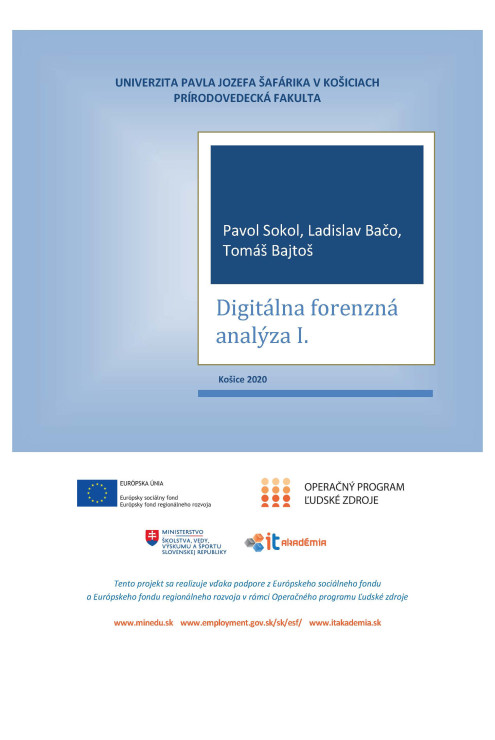
Digitálna forenzná analýza I.

E-book

Pavol Sokol - Ladislav Bačo - Tomáš Bajtoš

In the university textbook, we present the theoretical foundations and technical details of the activities of a forensic investigator. We describe the identification and provision of digital tracks, file system analysis. analysis of various artifacts of the Windows operating system, analysis of the operating memory. The textbook is also supplemented by a chapter devoted to the analysis of malicious code (malware). University textbooks are intended for students of bachelor's, master's, engineering and doctoral study programs in computer science, but also in non-informatics fields.

Download the e-book for free  (pdf)

Quantity

978-80-8152-916-0

Data sheet

Method of publication:
E-book (pdf)
Authors:
Pavol Sokol - Ladislav Bačo - Tomáš Bajtoš
Document type:
Course Notes
Number of pages:
97
Available from:
31.12.2020
Year of publication:
2020
Edition:
1st edition
Publication language:
Slovak
Faculty:
Prírodovedecká fakulta
Note:
Tento projekt sa realizuje vďaka podpore z Európskeho sociálneho fondu v rámci Operačného programu Ľudské zdroje. Spracované s finančnou podporou národného projektu IT Akadémia – vzdelávanie pre 21. storočie
License:
Creative Commons BY (Uveďte autora)
- Free for download

16 other products in the same category:

HOST-GUEST A SUPRAMOLEKULOVÁ CHÉMIA

E-book

E-book

Miroslava Matiková Maľarová

The university textbook entitled: Host-guest and supramolecular chemistry provides basic information about this scientific field as well as the types of compounds that belong to it. It provides basic characteristics of non-bonded interactions as well as methods of characterization and classification for these compounds. It summarizes knowledge about various types of host-guest systems from the oldest such as Hofmann clathrates to inclusive compounds such as cyclodextrins and calixarenes. In addition to structural and synthetic information, which is supplemented with images, the textbook also addresses the possibilities of application or practical use of compounds. The conclusion of each chapter is supplemented with tasks for elaboration on a given topic.

Download the e-book for free (pdf)

EFFUSE – edukačné materiály pre verejnosť

E-book

E-publication

Beáta Valkay ed.
Ivana Slepáková-Lenka Maliničová a kol.

The publication EFFUSE – Educational Materials for the Public was developed within the EFFUSE project and focuses on current environmental issues of river landscapes. It emphasizes the importance of water as an irreplaceable resource and the need to protect it. Special attention is given to bioindicators – organisms whose presence or absence reflects the state of the environment. Monitoring bioindicators makes it possible to detect ecosystem changes before serious damage occurs. The publication highlights that biodiversity is essential for ecosystem stability and health. As such, it serves as a valuable educational resource for the public, raising environmental awareness and encouraging active involvement in nature conservation.

Download the e-book for free (pdf)

Študentská vedecká konferencia PF UPJŠ 2013

E-book

E-book

Vladimír Zeleňák (ed.)

The publication contains abstracts of contributions presented at the Student Scientific Conference of the Faculty of Natural Sciences at UPJŠ in Košice, held on April 25, 2013. The event was marked by the celebration of the 50th anniversary of the Faculty of Natural Sciences at UPJŠ and was part of a series of events called ScienceFest.

Download the e-book for free (pdf)

Globálne navigačné satelitné systémy: GPS,...

E-book

E-book

Vladimír Sedlák

The university textbooks entitled Global Navigation Satellite Systems: GPS, GLONAS, Galileo, Compass present four navigation systems of the GNSS (Global Navigation Satellite Systems): American NAVSTAR GPS, Russian GLONASS, European Galileo and Chinese Compass. The Satellite-Based Augmentation Systems (SBAS) are also briefly explained. They provide regional service in augmenting the reach and support of signals from satellites of the GNSS (GPS, GLONASS, Galileo, Compass). Each satellite navigation system in the frame of GNSS is elucidated in terms of its principles of operation, structure, specificities, applications, and future perspectives.

The university textbook aims to improve the reader’s understanding of the principles and activities of the presented GNSS. The book emphasizes the possibilities of GNSS applications in geodesy and geography. The university textbook constitutes the basic study literature for the class Global Navigation Satellite Systems within the study program Geography and Geoinformatics at the Faculty of Science of the Pavol Jozef Šafárik University in Košice. For a deeper study of the GNSS issue, it is necessary to extend the study materials to include other educational scientific literature dealing with navigation satellite systems and their applications.

Download the e-book for free  (pdf)

Kvantová teória poľa 1

E-book

E-book

Michal Hnatič - Tomáš Lučivjanský

This textbook is primarily intended for first-year master's degree students at Pavol Jozef Šafárik University in Košice, especially those in the nuclear physics, subnuclear physics, and theoretical physics programs. For many years, these lectures were taught by one of the authors at this university, and naturally, over time, there arose an effort to provide these lectures to students in printed form.

In this textbook, we will focus mainly on classical field theory, its quantization based on the operator approach, and the introduction of interactions. Descriptions based on functional integration, Feynman diagram techniques, and more advanced parts will be covered in a subsequent volume of the textbook. In this context, we want to emphasize that in many modern quantum field theory textbooks, the operator approach is used to a lesser extent and is replaced by the approach using (functional) path integrals.

This is probably due to time considerations, as the functional approach leads much faster to practical calculations. On the other hand, we believe that the operator approach is better from a pedagogical point of view. It is much closer to the traditional quantum mechanics course, which is often based on the Schrödinger or Heisenberg formalism. Therefore, students can much more easily follow the flow of ideas that led to the construction of quantum field theory and its fundamental concepts.

Download e-book for free (pdf)

Počítačová fyzika II

E-book

E-book

Milan Žukovič

This textbook is intended for master's degree students and is a follow-up to the Computational Physics I course studied at the bachelor's level. The content of the textbook Computational Physics II focuses on stochastic methods of solving physical problems, mainly on Monte Carlo (MC) simulation of many-particle systems.

The focus on this computationally intensive approach is motivated by the gradual increase in the computing capacities of ordinary computers as well as the introduction of high-performance computing clusters. This has led to significant progress in the development of new simulation techniques, thanks to which MC simulations have found application in various areas of research and application practice. Considering the main research focus of the department, this text is particularly devoted to the presentation of basic and more advanced MC simulation techniques applied to a simple Ising spin model in order to investigate its magnetic, thermodynamic and critical properties.

The next part is devoted to MC simulations of random processes. It focuses on the simplest but also the most basic random walk process and demonstrates its applications in financial analysis and the solution of a quantum system described by the time-dependent Schrödinger equation. The last part is dedicated to the basics of molecular dynamics, applied to simulating the classical movement of atoms in a given force field. By mastering the problems addressed in this course, students will obtain a potential tool for working out of their diploma theses, or a methodology useful for their further scientific and research practice in the field of investigating of complex systems.

The lectured topic is subsequently exercised in the form of preparing projects implemented in the freely distributable software Octave, which is easy on the user's programming skills and which students have the opportunity to familiarize themselves with in the previous study.

Download e-book for free (pdf)

ANATOMICKÉ TERMÍNY PRE JEDNOODBOROVÉ A...

E-book

E-book

Juraj ŠevcFilip Mochnacký

Students studying biology as the single-subject or as a part of two-subject programs on various faculties of sciences are often encountered with the problem, how to limit the topics in the subject Human anatomy. This List of anatomical terms is aiming to help the non-medical students to get acquainted with the extensive anatomical nomenclature and to optimize the number of anatomical terms, which should be memorized, to preserve the sufficient capacity of the students for another knowledge of the field of systemic, comparative, developmental and functional anatomy. The emphasis on the arrangement of individual anatomical terms into the logical units supports the hierarchical view on the architecture of the human body.

Despite the common opinion, anatomical nomenclature represents a framework, which is during the further study gradually enveloped with the knowledge of more or less related disciplines concerning with the human body and its biological processes. Moreover, besides this ambition, which exceeds the area of the human anatomy, this List of anatomical terms continues the long tradition with respect to the valid Latin and Slovak anatomical terminology.

Download the e-book for free  (pdf)

NOVEL TRENDS IN CHEMISTRY, RESEARCH AND...

E-book

Jana Šandrejová - Andrea Gajdošová (eds.)

The scientific book of abstracts from the conference „Novel Trends in Chemistry, Research and Education 2024“ is a summary of the contributions of conference participants, which contain the original results of their scientific and research activities. The contributions published in this volume are divided according to content into the fields of analytical, inorganic, organic, physical chemistry, biochemistry and didactics of chemistry.

Download the e-book for free (pdf)

Štruktúra a reaktivita – riešené príklady a...

E-book

E-book

Slávka Hamuľaková

The textbook "Structure and reactivity - solved examples and tasks, part 1" is the basis for teaching the subject "Structure and reactivity" for students of the 1st year of master's studies at the Faculty of Science, UPJŠ, department of Organic Chemistry. The textbook is divided into individual chapters, each chapter offering students examples of chemical reactions, where their course is explained on the basis of appropriate reaction mechanisms. A substantial part of the textbook consists of unresolved tasks, the main goal of which is the development of students' knowledge and skills. Due to the fact that the textbook is focused on only one semester of study, it cannot cover all reactions, rather it is only representative examples of different types of reactions, such as: addition reactions, elimination reactions, aromatic substitution, addition-elimination reactions, radical reactions and pericyclic reactions.

Download the e-book for free (pdf)

UNINFOS 2014 • Univerzitné informačné systémy...

E-book

E-book

Gabriel Semanišin - Emil HutňanJana Oleničová

The proceedings contain contributions from participants of the UNIFOS 2014 conference, University Information Systems in Košice, which took place from October 27 to 29, 2014.

ICT centers are important element that provide functioning and development hardware and software infrastructure at Slovak Universities. There are more differences between them in real position, management, personal sources and financing. ICT centers provide a wide range of services to large number of university users and they implement the policy of information security recently.

Download the e-book for free (pdf)

Zbierka úloh z matematickej analýzy III.
  • On sale!
  • -€12.62

Zbierka úloh z matematickej analýzy III.

€13.62 €1.00 -€12.62
Availability: 9 In Stock

Ondrej Hutník a kol. 

Zbierka úloh z matematickej analýzy III. je pokračovaním predchádzajúcich dvoch vydaných zbierok autorov Kulcsár a Kulcsárová. Táto časť obsahuje príklady na zopakovanie a precvičenie učiva stredných škôl, ako aj časti prvého semestra kurzu matematická analýza určeného pre študentov matematiky, fyziky, informatiky a učiteľského štúdia v kombinácii s matematikou. Zbierka môže tiež pomôcť všetkým učiteľom, ktorí chcú použiť rôzne úlohy vo svojom vyučovaní. Zbierka zahŕňa oblasť postupností reálnych čísel: aritmetické a geometrické postupnosti, všeobecne a rekurentne zadané postupnosti, nachádzajú sa tu úlohy na vyšetrovanie vlastností postupností (monotónnosť, ohraničenosť, konvergencia) a výpočet rôznych typov limít. Všetky zadané úlohy sú vyriešené na konci každej kapitoly s podrobným komentárom.

Autori

Doménové steny a ich dynamika

E-book

E-book

Rastislav Varga

The movement of domain walls in ferromagnetic materials is utilized in various magnetic devices for storing, processing, or transmitting signals and information. This mainly includes transformer cores, various sensors, memory devices (e.g., HDDs in PCs), as well as modern spintronic devices such as Racetrack memories, domain wall motion-based electronics, and so on.

This book is intended to serve as a textbook for advanced courses in the field of magnetic materials. It is primarily aimed at students interested in studying magnetic materials, as well as professionals from various fields who wish to understand the basics of domain structure and its changes. It is divided into nine chapters. The first chapter deals with a brief history of the study of domain structure in magnetic materials. The second chapter provides an introduction to the causes and manifestations of magnetic anisotropies. The third and fourth chapters are devoted to the causes of domain structure formation and domain walls. The fifth chapter discusses the structure of domain walls, their potential, and the critical field required for domain wall movement. The sixth chapter is dedicated to magnetization processes, one of which - domain wall movement - is discussed in detail in chapter 7. The eighth chapter contains a theoretical solution for domain wall movement. The final ninth chapter presents a modern method of domain wall movement induced by electric current.

The presented work assumes that the reader has at least basic knowledge in the field of magnetism. Otherwise, the author refers the reader to basic literature (e.g., [2.1 - 2.6]).

Download the e-book for free (pdf)

Sekundárny metabolizmus (Úvod do štúdia...

E-book

E-book

Miroslava Martinková

This electronic material focuses on the subject of secondary metabolism and its products - secondary metabolites. The material gives an overview of the basic building blocks and construction mechanisms through which molecules can be synthesized in living organisms (plants). The processes of formation of the mentioned metabolites are explained using the basic mechanisms of organic reactions. Several of the secondary metabolites presented have a remarkable biological profile and are used as therapeutics or serve as lead compounds for the development of novel pharmacological agents. This electronic document is primarily intended for students of the Master's degree programme in Organic Chemistry as supporting material for the profile subject Chemistry of Natural Products.

Download e-book for free (pdf)

Pokročilé elektrochemické metódy

E-book

E-book

Ivana Šišoláková - Radka Gorejová - Jana Shepa - Renáta Oriňaková

The university textbook "Advanced Electrochemical Methods" is a teaching aid intended for master's or doctoral students studying electrochemical subjects at the Department of Physical Chemistry, Faculty of Science, Pavol Jozef Šafárik University in Košice.

These textbooks follow and further develop textbooks focused on the basic electrochemical methods currently used in modern research. The presented teaching texts are processed in sixteen clear chapters, where they provide a theoretical principle and derivation of electrochemical processes and mechanisms in individual methods. Teaching texts also consist of practical laboratory exercises, in which students can try out the real application of the studied electrochemical methods.

The practical tasks are focused primarily on the demonstration of research that is carried out at our workplace. Students will be able to try, for example, electrochemical modification of the electrode surface, preparation of electrochemical sensors for the determination of analytes, preparation and characterization of a dye-sensitized solar cell or electrochemical evolution of hydrogen.

Download the e-book for free (pdf)

Názvoslovie organických zlúčenín

E-book

E-book

Miroslava Martinková

This electronic material provides the basic principles of creating a systematic nomenclature of organic compounds, from the simplest hydrocarbons to the more complicated nomenclature of carbohydrates. For some groups of derivatives, alternative ways of generating system names are also mentioned, as well as the most common trivial names that are still in use in the literature and in practice, in some cases being the characteristic (dominant) ones. In the introductory section, the basic rules to be respected when writing names of organic compounds are discussed. This document is intended primarily for interdisciplinary undergraduate and graduate students as support material for the courses Organic Chemistry and Selected Chapters in Organic Chemistry and Biochemistry. In the final section of this document, solved examples are given so that the student can check how the rules for forming the names of organic compounds have been understood.

Download e-book for free (pdf)

This website uses cookies to ensure you get the best experience on our website