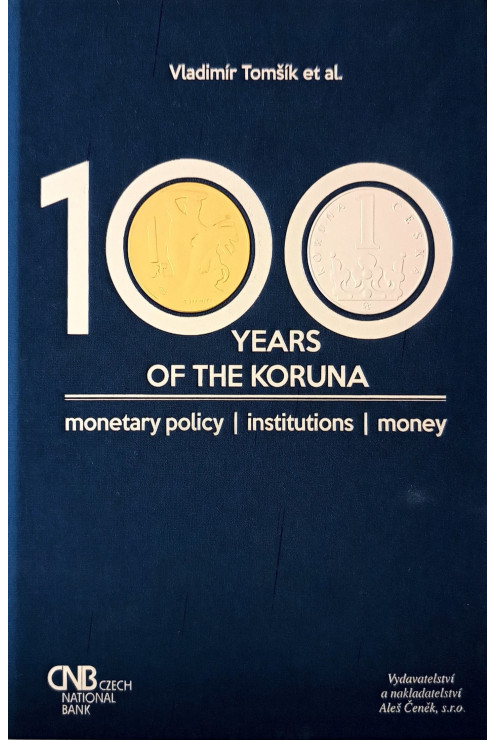
100 years of the koruna

€29.23

Vladimír Tomšík et al.

The book was prepared to mark an important anniversary – one hundred years of our national currency. It was written by a team of Czech National Bank experts headed by CNB Vice-Governor, Professor Vladimír Tomšík. This publication charts the monetary policy history of our central bank (or, to use older terminology, the bank of issue) and describes its institutional development and the banknotes it has issued over time. It covers the period from the establishment of the independent Czechoslovak state in October 1918 and its currency in February 1919 to the present. We have therefore named the publication 100 years of the koruna. Given the twists and turns of history, however, part of the narrative relates to the joint Czechoslovak state, part to the occupied Protectorate and part to the independent Czech Republic. As a result, the original joint Czechoslovak currency was divided temporarily in 1939–1945 and then again – this time for good – in 1993. From that point on, the currencies of the two successor states went their own ways, the Czech koruna continuing to the present day and the Slovak koruna until it was replaced by the single European currency in 2009.

Quantity
Last items in stock

978-80-7380-729-0

Data sheet

Method of publication:
Printed publication
Authors:
Jan Filáček - Jan Frait - Tomáš Holub - Jitka Koderová - Jakub Kunert - Martin Mandel - Jiří Mataj - Jaroslav Moravec - Jiří Rusnok - Tomáš Rýdl
Document type:
Monograph
Number of pages:
354
Year of publication:
2018
Edition:
1st edition
Publication language:
English
License:
Copyright

16 other products in the same category:

Aktuálne výzvy daňového práva

E-book

E-book

Adrián Popovič  - Jozef Sábo

Reviewed proceedings from the student symposium organized on the occasion of IV. Slovak-Czech days of tax law.

The International Scientific Conference IV. Slovak-Czech days of tax law was held 16th - 18th June 2021 in Košice (Faculty of Law of Pavol Jozef Šafárik University in Košice). On this occasion, a student symposium on the topic: "Current Challenges of Tax Law" was organized for students of the Pavol Jozef Šafárik University Faculty of Law in Košice on 15th June 2021. The focus of the symposium was chosen due to the content of the grant project APVV-19-0124 entitled "Tax law and new phenomena in the economy (digital services, shared economy, virtual currencies)", which is currently being addressed at the Department of Financial Law, Tax Law and Economy, Faculty of Law, Pavol Jozef Šafárik University in Košice. The output of this symposium is a reviewed proceeding of papers, in which students focus on examining the current challenges of tax law. In this context, students examine not only the current challenges in the field of real estate tax and the introduction of taxation based on their market value of real estate, the decision-making of the Court of Justice of the European Union in the field of direct taxation and indirect taxation, but also new and extremely current taxation issues of cryptoactive (virtual currency) taxation, not only in the Slovak Republic but also in the world. The authors also assess in detail the current situation in the research area, and they also present de lege ferenda proposals that could contribute to the development and improvement of several aspects of taxation, which is a benefit not only for legal science but also for application practice.

Download e-book for free (pdf)

Extrateritoriálne účinky cudzích správnych...

E-book

E-book

Radomír Jakab - Diana Repiščáková (eds.)

The collection of scientific papers was created as part of a scientific seminar entitled “Extraterritorial Effects of Foreign Administrative Decisions in the Conditions of the European Union – Starting Points and Current State,” held from November 23 to 25, 2022, at the training and educational facility in Danišovce, in connection with the implementation of a scientific project entitled “Extraterritorial Effects of Foreign Administrative Decisions in the Conditions of the European Union,” supported by a grant from the Scientific Grant Agency under No. 01/187/2022.

The aim of the mentioned project is the scientific examination of extraterritoriality, i.e., the extraterritorial effects of administrative decisions of the Member States of the European Union on the territory of other Member States, in order to assess the need for, possibilities of, and desirable scope of harmonization of the legal regulation of the Member States of the European Union, with the goal of increasing the level of free movement of administrative decisions within the European Union. As part of the research project, an initial scientific seminar was held under the title “Extraterritorial Effects of Foreign Administrative Decisions in the Conditions of the European Union – Starting Points and Current State.”

Members of the research team, who are also members of the Department of Constitutional Law and Administrative Law at the Faculty of Law of Pavol Jozef Šafárik University in Košice, participated in this scientific seminar. At the seminar, contributions were presented that primarily summarized the current state of knowledge in the area of extraterritorial effects of foreign administrative decisions in the context of the European Union. This summary will serve as a basis for the further scientific examination of this issue by the members of the research team. These contributions subsequently formed the scientific papers included in this collection.

Download the e-book for free (pdf)

Ochrana proti obmedzovaniu hospodárskej súťaže

E-book

E-book

Žofia Mrázová(ed.)

Proceedings from the VI. Student Symposium on Commercial Law Held on November 28, 2018, at the Faculty of Law, Pavol Jozef Šafárik University in Košice

The Department of Commercial and Economic Law at the Faculty of Law, Pavol Jozef Šafárik University in Košice, organized the sixth annual Student Symposium on Commercial Law on November 28, 2018. The event was part of the research project VEGA 1/0917/16 titled "Atypical and De Facto Relationships in Commercial Law." The symposium aims to provide a platform for discussion among students with the guidance of mentors from the department, including professors, researchers, and doctoral candidates.

This year’s symposium focused on protection against anti-competitive practices. Unchecked anti-competitive behavior could grant economic advantages to violators at the expense of other competitors and threaten the free-market system. Students explored various challenges related to competition law, analyzing Slovak and European legal frameworks as well as court rulings and decisions by other authorities. Through their research, students honed their analytical thinking, argumentation skills, and critical reasoning. The discussions generated new perspectives and encouraged active engagement among participants.

This proceedings volume presents the outcomes of students' work from this event.

Download the e-book for free(pdf)

Hranice zmluvnej slobody v pracovnom práve

E-book

E-book

Marcel Dolobáč

The author's ambition is to build on the current and at the same time to stimulate further discussion of the anchoring of labour law in the system of private law sectors and to contribute to the variation of views in relation to freedom of contract and its limits in labour law. The broad contractual freedom of civil law does not apply to the field of labour law, and thus the penetration of standard civil law institutes into labour law relations is not always self-evident.

The above constitutes the main theses of the present monograph. The issue of freedom of contract in labour law can be grasped in several ways. The author has chosen a content structure that is built on three basic pillars. In the first part, the author assesses the position of labour law in the system of law, which is determined primarily by the actual subject of legal regulation - dependent labour and the specific method of legal regulation through cogent and relatively cogent norms. In this context, the author would like to note at the outset that the much-discussed dispositive nature of labour law norms appears to be merely presumptive. Labour law is built on minima and maxima, with relative mandatory norms being the building blocks of fixed boundaries, a fact that distinguishes labour law from other branches of private law. These considerations are followed by the author's view of autonomy of will in labour law. The limits of contractual freedom (not only) in the theoretical sense form the second pillar of the author's ideas.

Finally, the third part of the thesis is to be the one that translates the theoretical-legal considerations of the interconnection of civil law and labour law into the interpretation of selected civil law institutes and the possibility of their application and implementation in labour law relations.

Download he e-book for free (pdf)

100 rokov Trianonskej zmluvy - diplomacia, štát...

E-book

E-book

Erik ŠtenpienIvan Svatuška (eds.)

The Collection of scientific Contributions of the International scientific conference: 100 Years of Treaty of Trianon – Diplomacy, State and Law on the Turn of the Century.

The presented publication is the first of a series of proceedings published within the solution of the grant APVV-19-0419. The conference took place from 14 to 15 October 2021 with the participation of experts from Slovakia, Hungary and Poland. The ambition of the research team, composed of legal historians and positive lawyers from three countries, is to provide a comprehensive, unbiased view of the peace negotiations that resulted in the Treaty of Trianon with Hungary. The conference, the result of which is the presented collection, was devoted to the causes of possible disputes in Europe - focusing on diplomacy and constitutional development of Central European countries at the turn of the 19th and 20th centuries, ie in the period immediately preceding the outbreak of World War I.

Download the e-book for free  (pdf)

Správne právo procesné

€18.10
Availability: 67 In Stock

Radomír Jakab - Peter Molitoris

Predkladaná učebnica má slúžiť ako učebná pomôcka v pedagogickom procese v rámci študijných predmetov zameraných na správne právo procesné. Z hľadiska štruktúry a obsahových náležitostí reflektuje požiadavky, ktoré sú požadované pre účely postupových skúšok a štátnej skúšky na Právnickej fakulte a Fakulte verejnej správy Univerzity Pavla Jozefa Šafárika v Košiciach. Rovnako, je využiteľným zdrojom informácií aj pre potreby štúdia na iných právnických fakultách v rámci Slovenskej republiky. V neposlednom rade, môže byť vhodnou pomôckou i pre aplikačnú prax, a to tak na orgánoch verejnej správy, na súdoch, ako aj pre advokátov prichádzajúcich do styku so správnym konaním.

Zamestnanec v digitálnom prostredí

E-book

E-book

Monika MinčičováMarcel DolobáčJana Žuľová

The presented proceedings of papers is the result of the international scientific conference "Employee in the digital environment", which was organized as part of the research project VEGA 1/0790/20 Employee protection in the context of the Industrial Revolution 5.0 - starting points, opportunities and risks. The online scientific conference took place on the 5th of November 2021 under the auspices of the Department of Labour Law and Social Security Law, Faculty of Law, P. J. Šafárik University in Košice. The proceedings includes a variety of scientific papers focused on the study of current issues caused by the digital transformation of society.Authors respond to partial legal problems of labour law and social security law at the theoretical-legal and application level and reflect on the consequences of ongoing phenomena for the labour market and labour law legislation.

Download e-book for free(pdf)

Teória práva

€13.78
Availability: 2 In Stock

Alexander Bröstl a kol.

Učebný text z teórie práva sa pokúša priblížiť a objasniť právo vo všetkých dôležitých javových formách predovšetkým študentom prvého ročníka právnického štúdia a má propedeutický charakter. Vychádza z historického vývoja názorov na pojem právo a zo skúmania jeho rôznych významov. Hľadá spoločné znaky a odlišnosti medzi právnymi normami a inými normami správania (morálka, spravodlivosť). Dôraz kladie na skúmanie práva ako súboru právnych pravidiel vydaných a uznaných legitímnou autoritou, záväzných pre všetky subjekty právnych vzťahov. Klasifikuje systém práva a jeho štruktúru. Od tvorby práva prechádza k prameňom práva, so zreteľom na systém práva Slovenskej republiky, ale aj Európskej únie. V nadväznosti na pramene práva predkladá analýzu právnych noriem: ich pojem, znaky, štruktúru, druhy a pôsobnosť. Právne vzťahy vo svetle ich predpokladov a prvkov chápe ako vzťahy upravované právnymi normami. S realizáciou a aplikáciou práva súvisí výklad práva, spojený s otázkami analógie v práve. Právna zodpovednosť je prezentovaná ako ústredná právna kategória vychádzajúca zo schopnosti (nevyhnutnosti) niesť následky svojho konania: predmetom pozornosti sú predovšetkým objektívna zodpovednosť a subjektívna zodpovednosť. Záverečná časť sa týka právneho štátu ako ideálneho „miesta deja“ vo vzťahu k opísaným formám práva a ich uskutočňovaniu, zaoberá sa historickým vývojom i súčasným stavom modelov Rechtsstaat – Rule of Law, ako aj princípmi ich fungovania. Učebný text má poskytnúť orientáciu v základných pojmoch a odkázať na bohaté zdroje odbornej literatúry, ktoré možno študovať paralelne.

Zákon o národnostiach a Rada vlády Slovenskej...

E-book

E-book

Jana Šutajová

From January 1, 1969, the Constitutional Act on the Status of Nationalities in the Czechoslovak Socialist Republic (ČSSR) and the Constitutional Act on the Federation came into effect. The Constitutional Act on the Status of Nationalities represented at least a formal significant step forward in the legal regulation of minority rights. However, this law was intended to serve as a foundation for further legal adjustments. It was declared that additional steps and negotiations for the adoption of implementing regulations would follow and that further laws would be enacted at both the federal and national levels. Nevertheless, no additional law or government regulation related to the constitutional act on the status of nationalities in the ČSSR was ever issued.

During the normalization period, issues concerning further legislation related to national minorities were not addressed. However, in the brief period following the adoption of the constitutional act in 1968 until the end of 1969, some institutions attempted to prepare and promote such legal norms. One of these institutions was the Government Council of the Slovak Socialist Republic (SSR) for Nationalities (hereafter referred to as the Council or the Government Council for Nationalities). The monograph provides an insight into the development of additional legal norms arising from the constitutional act on the status of nationalities in the Slovak Socialist Republic, prepared by the Government Council of SSR for Nationalities. This council was one of the institutions established in Slovakia after the formation of the Czechoslovak federation and dealt with nationality issues.

In addressing further legal norms stemming from the constitutional act on nationalities in ČSSR, it was necessary to consider prior developments. Therefore, the first part of the monograph examines the status of minorities in Czechoslovakia before adopting the constitutional act, activities of nationalities preceding its adoption, and its enactment itself. Subsequent sections focus on institutional changes in SSR following federalization, the establishment of the Government Council of SSR for Nationalities, and specific actions taken by this Council and its expert bodies in drafting proposals for laws concerning nationalities in the Slovak Socialist Republic.

The motivation for writing this monograph stemmed from the fact that this topic has so far received attention only in a few studies in Slovakia, which primarily focused on the Hungarian minority during either the Prague Spring or normalization periods.

Download the e-book for free (pdf)

LAW – COMMERCE – ECONOMY XII.

E-book

E-book

Jozef Suchoža - Ján Husár - Regina Hučková

The Proceedings of the International Scientific Symposium "LA W-BUSINESS-ECONOMICS XII" is a collection of scientific works by authors participating in the symposium of the same name. The publication focuses primarily on the area of representation in private law, related pai1ies in corporate and bankruptcy law, and current issues of legal regulation of artificial intelligence.

The authors of indivídua! contributions are erudite experts from various branches of law. The collection of scientific papers is a complete work in the form of a collection, with an overlap into private and public law sectors.

Readers are presented with scientific outputs from authors from the Slovak legal environment, as well as from foreign authors. Several authors' paper provide a European legal perspective or an international comparative perspective.

Download e-book for free (pdf)

Ochrana práv veriteľov v obchodných záväzkových...

E-book

E-book

Žofia Mrázová (ed.)

Proceedings of Contributions from the V. Student Symposium on Commercial Law

The proceedings are the result of student works presented at the fifth annual student symposium organized by the Department of Commercial Law and Economic Law, Faculty of Law, UPJŠ in Košice, which took place on November 30 – December 1, 2017, at the UPJŠ educational and training facility in Danišovce.

This year’s symposium focused on problematic issues related to creditor rights protection in commercial contractual relationships.

The purpose of these annually organized symposia is to provide students with a platform to present their own opinions and improve their analytical and argumentation skills.

Download the e-book for free (pdf)

Novelizovaný správny súdny poriadok

€6.29
Availability: 1 In Stock

Novelizovaný správny súdny poriadok s aktualizovanými dôvodovými správami.

ÚSTAVA SLOVENSKEJ REPUBLIKY Č. 460/1992 ZB. V ZNENÍ ÚSTAVNÉHO ZÁKONA Č. 244/1998 Z. Z., ÚSTAVNÉHO ZÁKONA Č. 9/1999 Z. Z., ÚSTAVNÉHO ZÁKONA Č. 90/2001 Z. Z., ÚSTAVNÉHO ZÁKONA Č. 140/2004 Z. Z., ÚSTAVNÉHO ZÁKONA Č. 323/2004 Z. Z., ÚSTAVNÉHO ZÁKONA Č. 463/2005 Z. Z., ÚSTAVNÉHO ZÁKONA Č. 92/2006 Z. Z., ÚSTAVNÉHO ZÁKONA Č. 210/2006 Z. Z., ÚSTAVNÉHO ZÁKONA Č. 100/2010 Z. Z., ÚSTAVNÉHO ZÁKONA Č. 356/2011 Z. Z., ÚSTAVNÉHO ZÁKONA Č. 232/2012 Z. Z., ÚSTAVNÉHO ZÁKONA Č. 161/2014 Z. Z., ÚSTAVNÉHO ZÁKONA Č. 306/2014 Z. Z., ÚSTAVNÉHO ZÁKONA Č. 427/2015 Z. Z., ÚSTAVNÉHO ZÁKONA Č. 44/2017 Z. Z., ÚSTAVNÉHO ZÁKONA Č. 71/2017 Z. Z., ÚSTAVNÉHO ZÁKONA Č. 137/2017 Z. Z., NÁLEZU ÚSTAVNÉHO SÚDU SLOVENSKEJ REPUBLIKY Č. 40/2019 Z. Z., ÚSTAVNÉHO ZÁKONA Č. 99/2019 Z. Z., ÚSTAVNÉHO ZÁKONA Č. 422/2020 Z. Z., ÚSTAVNÉHO ZÁKONA Č. 378/2022 Z. Z., ÚSTAVNÉHO ZÁKONA Č. 24/2023 Z. Z. A ÚSTAVNÉHO ZÁKONA Č. 241/2023 Z. Z. 

III. SLOVAK-CZECH DAYS OF TAX LAW. Positive and...

E-book

E-book

Vladimír BabčákAdrián PopovičJozef Sábo (eds.)

Within the project APVV-16-0160 "Tax evasion and tax avoidance (motivation factors , formation and elimination)" was organized conference called III. SLOVAK-CZECH DAYS OF TAX LAW " Positive and Negative Stimulation of the State in the Area of Taxation ". From this conference was prepared the eponymous output in the form of reviewed proceedings of scientific works.

In this publication is published the contributions from several prominent personalities of tax law science in Slovakia and the Czech Republic. lndividual contributions map tax legislation and also changes due to the development of tax legislation , especially under the influence of European Union law. Th ese changes are approached in the context of their specific economic impacts and their impact on status and legal relations in the business and social field . The main topics elaborated in the individual contributions are in particular: EU activities in relation to tax fraud and tax evasion, the impact of tax construction on the act of the addressees of tax law and tax policy of the state and its economic impacts.

The publication presents one of the most actual topics in the current legal and economic environment.

Prof. h.c. prof. JUDr. Vladimír Babčák, CSc.

Download the e-book for free  (pdf)

Zákony II.A / 2025

€12.86
Availability: 2 In Stock

Verejné obstarávanie, Autorské právo, Živnostenské podnikanie, Správne právo

  • Obchodné právo
  • Živnostenský zákon
  • Správne právo
  • Autorské právo
  • Občianske právo

Publikácia obsahujúca právne predpisy z obchodného a občianskeho práva je určená podnikateľom fyzickým osobám - živnostníkom, právnickým osobám, študentom vysokých škôl a ďalším osobám, ktoré sa o danú tému zaujímajú. Všetky zmeny v právnych predpisoch sú zapracované k 1. 1. 2025.
Súbor právnych predpisov v obchodnom práve upravuje postavenie podnikateľov, obchodné zaväzkové vzťahy, ako aj niektoré vzťahy súvisiace s podnikaním. Občianske právo vo vzťahu k občanovi upravuje predovšetkým rodinné právo, vlastnícke právo, dedičské právo a záväzkové právo.

Titul obsahuje úplné znenie zákonov a súvisiacich predpisov:
Obchodné právo (1. kapitola)
Zákon č. 513/1991 Zb. Obchodný zákonník
Zákon č. 200/2011 Z. z. o Obchodnom vestníku
Zákon č. 309/2023 Z. z. o premenách obchodných spoločností a družstiev
Zákon č. 272/2015 Z. z. o registri právnických osôb, podnikateľov a orgánov verejnej moci
Zákon č. 530/2003 Z. z. o obchodnom registri a o zmene
Zákon č. 343/2015 Z. z. o verejnom obstarávaní
Zákon Národnej rady Slovenskej republiky č. 18/1996 Z. z. o cenách
Zákon č. 187/2021 Z. z. o ochrane hospodárskej súťaže
Zákon č. 350/2016 Z. z. o niektorých pravidlách uplatňovania nárokov na náhradu škody spôsobenej porušením práva hospodárskej súťaže
Živnostenský zákon (2. kapitola)
Zákon č. 455/1991 Zb. o živnostenskom podnikaní (živnostenský zákon)
Zákon č. 178/1998 Z. z. o podmienkach predaja výrobkov a poskytovania služieb na trhových miestach
Správne právo (3. kapitola)
Zákon č. 147/2001 Z. z. o reklame
Zákon č. 211/2000 Z. z. o slobodnom prístupe k informáciám a o zmene a doplnení niektorých zákonov (zákon o slobode informácií)
Zákon č. 382/2004 Z. z. o znalcoch, tlmočníkoch a prekladateľoch
Zákon č. 385/2000 Z. z. o sudcoch a prísediacich
Autorské právo (4. kapitola)
Zákon č. 185/2015 Z. z. Autorský zákon
Občianske právo (5. kapitola)
Zákon č. 40/1964 Zb. Občiansky zákonník
Zákon č. 36/2005 Z. Z. o rodine
Zákon č. 108/2024 Z. Z. o ochrane spotrebiteľa
Zákon č. 294/1999 Z. Z. o zodpovednosti za škodu spôsobenú vadným výrobkom
Zákon č. 514/2003 Z. Z. o zodpovednosti za škodu spôsobenú pri výkone verejnej moci
Zákon č. 116/1990 Zb. o nájme a podnájme nebytových priestorov
Zákon č. 504/2003 Z. Z. o nájme poľnohospodárskych pozemkov, poľnohospodárskeho podniku a lesných pozemkov

Občianske právo ako odvetvie súkromného práva v predmete rieši vzťahy medzi troma subjektmi, a to fyzická osoba, právnická osoba a štát. Uvedené právo upravuje majetkové vzťahy, zakladá sa na princípe rovnosti subjektov a na princípe dobrovoľnosti. Vzťahy v premete občianskeho práva majú rôzny charakter. Osobný a majetkový charakter týka sa napr. pozemkov, nemajetkový charakter sa týka napr. autorského práva a ochrana osobnosti sa týka práva na ochranu mena alebo názoru.
Najvyšším prameňom obchodného práva na Slovensku je Obchodný zákonník, ktorý upravuje postavenie podnikateľov, obchodno-záväzkové vzťahy a iné vzťahy s podnikaním súvisiace.

Law without borders

E-book

E-book

Eva Berníková - Dominika PisarčíkováDiana Repiščáková (eds.)

Proceedings of the International Scientific Conference of Doctoral Students and Young Researchers

At the Department of Constitutional and Administrative Law of the Faculty of Law at Pavol Jozef Šafárik University in Košice, a research team led by the principal investigator Associate Professor JUDr. Radomír Jakab, PhD., is conducting a research project entitled "Extraterritorial Effects of Foreign Administrative Decisions in the Conditions of the European Union," supported by a grant from the Scientific Grant Agency under number 1/0187/22.

The aim of this project is the scientific examination of the extraterritorial impact of administrative decisions of the EU member states on the territory of other member states, in order to assess the need, possibilities, and desirable scope of harmonizing legal regulation among EU member states to enhance the free movement of administrative decisions within the European Union. On April 27, 2023, in connection with the project, an international scientific conference of doctoral students and young researchers titled "Law Without Borders" was held, attended by doctoral students and young researchers from Slovak as well as foreign universities.

At this conference, contributions based on various legal systems were presented to highlight the interweaving and mutual influence of different legal orders. The conference featured presentations not only from positive law disciplines but also from theoretical and historical legal perspectives. Scientific papers based on these contributions were compiled in the proceedings.

Download the e-book for free (pdf)

Základné zásady v rozhodovacej činnosti súdnej...

E-book

E-book

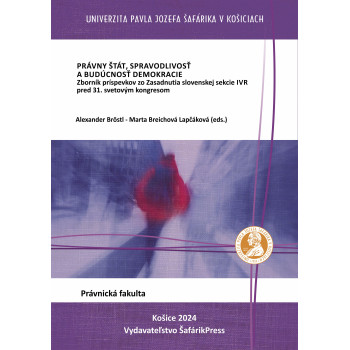
Alexander Bröstl - Marta Breichová Lapčáková - Martin Štrkolec (eds.)

Collection of scientific papers by doctoral students.

Thematically, the contributions are diverse: they feature fundamental principles in public law (basic principles of criminal proceedings, the principle of contradiction, basic principles of constitutional court proceedings, basic principles in private law and procedural law (superficies solo cedit), the principle of civil court proceedings in deciding labor disputes, equality of participants and the duty to instruct, objection of bias in light of the right to an impartial court, the principle of speed and the principle of economy in the decision-making activities of general courts, basic principles in legal theory and international law (general legal principles recognized by civilized nations), coexistence of the principle of equality and the principle of non-discrimination in the legal order of the European Union, argumentation through the principle of rule of law in the decision-making activities of courts, the impact of fundamental principles on the interpretation of legal norms.

It is important that the authors, i.e., doctoral students from law faculties in the Czech Republic and the Slovak Republic, almost unanimously examine these principles in the process of application (interpretation) of law, from the perspective of how legal (primarily judicial) practice deals with them. This should be fundamentally welcomed and appreciated.

Download the e-book for free (pdf)

This website uses cookies to ensure you get the best experience on our website