Novelizovaný civilný sporový poriadok

€5.90
Tax included

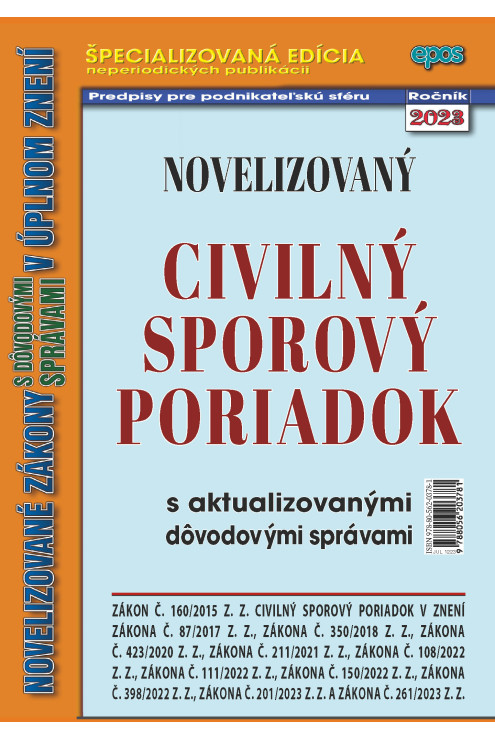
Novelizovaný Civilný sporový poriadok s aktualizovanými dôvodovými správami v úplnom znení

ZÁKON Č. 160/2015 Z. Z. CIVILNÝ SPOROVÝ PORIADOK V ZNENÍ ZÁKONA Č. 87/2017 Z. Z., ZÁKONA Č. 350/2018 Z. Z., ZÁKONA Č. 423/2020 Z. Z., ZÁKONA Č. 211/2021 Z. Z., ZÁKONA Č. 108/2022 Z. Z., ZÁKONA Č. 111/2022 Z. Z., ZÁKONA Č. 150/2022 Z. Z., ZÁKONA Č. 398/2022 Z. Z., ZÁKONA Č. 201/2023 Z. Z. A ZÁKONA Č. 261/2023 Z. Z.

Quantity
Last items in stock

978-80-562-0378-1

Data sheet

Method of publication:
Printed publication
Author:
Kolektív autorov
Document type:
Legislation
Number of pages:
96
Year of publication:
2023
Publication language:
Slovak
License:
Copyright

Specific References

MPN
303345

4 other products in the same category:

INNOVATIVE LAW & INNOVATIONS IN LAW

INNOVATIVE LAW & INNOVATIONS IN LAW

E-book

E-book

Dominika Cukerová - Andrej Oriňak - Kateřina Hrabánková (eds.)

The proceedings offers contributions from the international scientific conference of doctoral students and young researchers held on 25 April 2024 at the Faculty of Law, UPJŠ in Košice, which was thematically oriented on Innovative Law and Innovations in Law. The authors of the papers confirmed that innovation in law can take many forms. The first part of the papers, which pays attention to how law can respond to innovations, is a manifestation of this. These are the papers by Jana Cihanová, Andrej Oriňák, Denisa Rudžiková and Matej Biroš, who presented the use of deepfake technology, artificial intelligence and software tools in legal practice in the context of their legal regulation. Looking at familiar things differently can also be a source of innovation. In this vein, Dominik Mizerski, Juraj Valentovič, Lucián Török and Kateřina Hrabánková presented interpretive and application innovations in the field of private law. The third part of the papers by Michaela Szittyaiová, Natália Priateľová, Filip Baláži, Elena Lazoríková and Laura Gazdagová offers a preview of the innovations that the public law section is facing today. Finally, the fourth and last group of papers specifically explains innovations against the background of criminal law regulation. These are contributions by Michal Novák, Miroslav Srholec, Vladimír Petrila and Martina Makaturová. The variety of topics covered in this proceedings shows that each area of legal regulation can be characterised by specific innovations and, in this context, by the dynamics with which they permeate legal regulation.

Download the e-book for free (pdf)

The loan or usury? Compulsory enforcement of judgment - roman and law foundations and problems of application practice

The loan or usury? Compulsory enforcement of...

E-book

E-book

Terézia HišemováDarina Kmecová (eds.)

Reviewed proceedings of scientific papers of Conference of Slovak and Czech law romanists, which take place at May, 10.-11.5.2018, at Faculty of Law, UPJŠ in Košice.

The submitted reviewed proceeding of scientific papers on „The loan or usury? Compulsory enforcement of roman - law basics and problems of application practice.”  is prepared within the solution of the grant project VEGA on: „The loan or usury? Compulsory enforcement of historical - law basics and problems of application practice.”, no. p. 1/0198/17.

The authors of papers are important personalities of Roman law working in the Slovak and Czech Republic, as well as PhD students and young scientists from Slovak and foreign universities who are active in the academic environment as well as in legal practice. The main goal of the editors is to help improve the current legal situation, which is assessed as unsatisfactory, and through a historical excursion of the development of the loan institute and then the forced execution of the decision, to create de lege ferenda proposals considering all areas of research.

The Proceedings trace the interrelationships between the substantive law institute in terms of the Roman law of contractus unilaterales - mutuum in its various types, often realized by the attachment of high interest rates, which bordered on the insurrection and the procedural law of individual lawsuits enforced in the legislative, formular and cognitive process. If there was no possibility to impose certain behaviour on the obligated person (the debtor, the sentenced person), then the declared general obligation to enforce the legal norms was only a legal term. It has always been the case that every internally well-organized state, whether antique or present, has to use power tools - often with the use of gross violence - but within the limits of the law, to promote what it has declared valid law. It must protect creditors on the one hand, but it must also prevent self-help and the use of illegal, unjustified and disproportionate violence.

The loan contract as a real contract has often become an integral part and relatively the most frequent reason leading to the compulsory enforcement, especially when contracting parties often agree on the connection of interest - sometimes within the legal limit, sometimes exceeding the legal framework - and in this way the potential future creditor (the plaintiff) significantly increased the insolvency risk of the debtor (the defendant, the sentenced) and of the subsequent execution. The pronounced and deepening social stratification of the Roman population and the secondary depreciation effort, the cancellation of the debts of the poor part of the population logically culminated in social unrest and revolt against the enforcement of the enforcement law.

The proceedings capture not only the rich scientific discussion of Slovak and Czech legal Romanists, but also the opinions, experience and knowledge of experts on contemporary law dealing with this type of issues. As a result, it provides a unique interdisciplinary view of the subject and raises many stimulus points for future research. This work proves that the problems encountered by the various representatives of the Roman jurisprudence and their legal and theoretical bases and solutions are undoubtedly useful and serve as a guideline also for solving legal issues in the field of modern enforcement proceedings.

Download the e-book for free (pdf)

Zákony V. / 2026

Zákony V. / 2026

€17.24
Availability: 1 In Stock

Kolektív autorov

Titul obsahuje úplné znenie zákonov z oblastí rozpočtových pravidiel, štátnej a verejnej služby, zákonov z oblasti školstva, samosprávy, miest a obcí po novelách k 1. 1. 2026. . Zmeny v zákonoch sú v texte prehľadne vyznačené. Publikácia sa venuje rozpočtovým pravidlám, poskytovaniu dotácií, výkonu práce vo verejnom záujme, elektronickej komunikácii, výchove a vzdelávaniu, financovaniu škôl, majetku obcí, verejným prácam, regionálnemu rozvoju, investičnej pomoci...

Titul Štátna a verejná správa, školy a obce obsahuje:
1. Rozpočtové pravidlá
ZÁKON č. 523/2004 Z. z. o rozpočtových pravidlách verejnej správy
ZÁKON č. 70/2025 Z. z. o poskytovaní dotácií pre Plán obnovy...
ZÁKON č. 583/2004 Z. z. o rozpočtových pravidlách územnej samosprávy
2. Štátna a verejná služba
ZÁKON č. 552/2003 Z. z. o výkone práce vo verejnom záujme
ZÁKON č. 553/2003 Z. z. o odmeňovaní niektorých zamest. pri výkone práce vo verejnom záujme
ZÁKON č. 55/2017 Z. z. o štátnej službe
ZÁKON č. 452/2021 Z. z. o elektronických komunikáciách
3. Školy
ZÁKON č. 245/2008 Z. z. o výchove a vzdelávaní (školský zákon)
ZÁKON č. 131/2002 o vysokých školách
ZÁKON č. 321/2005 Z. z. o školskej správe a o zmene a doplnení niektorých zákonov
VYHLÁŠKA č. 541/2021 Z. z. o materskej škole
VYHLÁŠKA č. 223/2022 Z. z. o základnej škole
VYHLÁŠKA č. 224/2022 Z. z. o stredných školách
ZÁKON č. 322/2025 Z. z. o financovaní škôl a školských zariadení
4. Obce a mestá
ZÁKON č. 369/1990 Zb. o obecnom zriadení
ZÁKON č. 138/1991 Zb. o majetku obcí
ZÁKON č. 500/1991 Zb. o pôsobnosti obcí vo veciach nájmu a podnájmu nebyt. priestorov
ZÁKON č. 254/1998 Z. z. o verejných prácach
VYHLÁŠKA č. 83/2008 Z. z., ktorou sa vykonáva zákon č. 254/1998 Z. z. o verejných prácach
NARIADENIE VLÁDY Č. 341/2004 Z. z., ktorým sa ustanovujú katalógy pracovných činností pri výkone práce vo verejnom záujme
NARIADENIE č. 296/2022 Z. z., VLÁDY, ktorým sa ustanovujú zvýšené stupnice platových taríf zamestnancov pri výkone práce vo verejnom záujme
ZÁKON č. 564/1991 Zb. o obecnej polícii
ZÁKON č. 302/2001 Z. z. o samospráve vyšších územných celkov (zákon o samospr.krajoch)
ZÁKON č. 416/2001 Z. z. o prechode niektorých pôsobností z orgánov štátnej správy na obce a na vyššie územné celky
ZÁKON č. 514/2003 Z. z. o zodpovednosti za škodu spôsobenú pri výkone verejnej moci
ZÁKON č. 180/2013 Z. z. o organizácii miestnej štátnej správy
ZÁKON č. 525/2003 Z. z. o štátnej správe starostlivosti o životné prostredie
ZÁKON č. 539/2008 Z. z. o podpore regionálneho rozvoja
ZÁKON č. 57/2018 Z. z. o regionálnej investičnej pomoci
ZÁKON č. 305/2013 Z. z. o elektronickej podobe výkonu pôsobnosti orgánov verejnej moci


Úvod do trestného práva procesného

Úvod do trestného práva procesného

E-book

E-book

Martin Štrkolec

Anotation Within the university textbook, the author focuses on the introduction to the criminal law of procedural and criminal proceedings, especially in terms of its purpose, individual parts and stages, subjects, procedural acts, decisions, as well as the costs of criminal proceedings. This publication is intended for easier orientation in the basics of criminal procedural law, on which it is possible to build qualified knowledge within the following legal branches or legal institutes. The methodology presented in the publication represents a concentrated form of individual provisions of the relevant generally binding legal regulations, while arguments of criminal law doctrine.

Download the e-book for free  (pdf)

This website uses cookies to ensure you get the best experience on our website