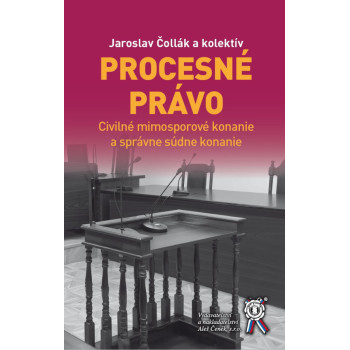
Procesné právo. Civilné mimosporové konanie a správne súdne konanie

€30.00
Tax included

Jaroslav Čollák a kolektív

Učebnica širokého a vedecky kvalitného kolektívu autorov (sudcovia všeobecných súdov a ústavného súdu, advokáti, vysokoškolskí pedagógovia, notári, či ďalší odborníci z praxe) komplexne spracúva problematiku civilného mimosporového konania a správneho súdneho konania. Zámerom kolektívu bolo vytvoriť komplexný, moderný a svieži učebný text s cieľom pomôcť pochopiť podstatu mimosporového a správneho súdneho konania ako celku, nie len jeho jednotlivých procesnoprávnych súčastí. Osobitný výklad o charakteristikách mimosporového konania a jeho odlišnostiach od konania sporového je vhodným úvodom k podrobnému výkladu jednotlivých mimosporových konaní, ktoré sú spracované optikou ich procesného priebehu na akejsi pomyselnej „časovej osi“ súdneho konania. Spracovanie správneho súdneho konania ponúka komplexný výklad o procesnoprávnych inštitútoch správneho súdneho konania, princípoch tohto typu súdneho konania a o jeho odlišnostiach od typologicky odlišných procesných štruktúr (sporové konanie, mimosporové konanie). Publikácia prezentuje výklad o všeobecných procesných – správnych inštitútoch, všeobecnej správnej žalobe, osobitných typoch správnych žalôb a o všetkých osobitných typoch správnych súdnych konaní, ktoré účinná právna úprava upravuje. Predkladaná publikácia s charakterom komplexného a uceleného moderného učebného textu je prioritne určená študentom právnických fakúlt, absolventom pripravujúcim sa na odborné profesijne skúšky (advokátske, justičné, notárske či iné) ako aj študentom akýchkoľvek iných vedných odborov, v ktorých sa ich rozsah dotýka problematiky súdneho konania Absolútne jedinečnou súčasťou obsahu publikácie je „kompas študenta“, ktorý takmer po každej kapitole prezentovanej matérie predkladá čitateľovi základný rámec orientácie v súvisiacej judikatúre súdov a významných odborných publikáciách, ktorý môže pomôcť pri orientácii v problematike či tvorbe záverečných prác.

Quantity
Last items in stock

978-80-7380-955-3

Data sheet

Method of publication:
Printed publication
Author:
Jaroslav Čollák - Jana Baricová - Alexander Bröstl - Marian Ďurana - Anita Filová - Martina Gajdošová - Daniela Gandžalová - Juraj Göbl - Peter Koromház - Martin Kubinec - Michal Matulník - Peter Potásch - Matej Smalik - Milan Sudzina
Number of pages:
566
Year of publication:
2024
Publication language:
Slovak
License:
Copyright

Specific References

MPN
303448

16 other products in the same category:

Vatican diplomacy around Trianon from a Hungarian Perspective

Vatican diplomacy around Trianon from a...

E-book

E-book

Nándor Birher-Péter Tamás Bertalan

The document, titled "Vatican Diplomacy Around Trianon from a Hungarian Perspective," is a scholarly work that examines the geopolitical and ecclesiastical changes in East-Central Europe after the Treaty of Trianon in 1920, with a focus on the role of the Vatican. The book explores the interactions between the Vatican and the reshaped geopolitical landscape, emphasizing the influence of religious and ecclesiastical issues on international relations. The monograph posits that Central Europe is not merely a geographic or economic concept but a "spiritual kingdom" with a shared destiny shaped by interdependence and cultural achievements, despite its history of conflicts. Central Europe's rich intellectual and cultural heritage, deeply influenced by religious convictions and Vatican diplomacy, continues to impact the region's identity and unity. The book suggests that the lessons from the early 20th century, including the Trianon Peace Treaty and subsequent geopolitical shifts, are still relevant in understanding the contemporary political and cultural dynamics of Central Europe. The authors encourage readers to reflect on the past and consider how historical events and decisions have shaped present-day Central Europe. The book aims to provide insights into the region's complex history and its ongoing struggle to find its place in the broader European and global context.

Download e-book for free (pdf)

Ústavné právo Slovenskej republiky

Ústavné právo Slovenskej republiky

€27.59
Availability: 2 In Stock

Alexander Bröstl  - Pavel  - Holländer - Patrik Príbelský a kolektív

Publikácia nie je obmedzená výlučne na ústavné právo Slovenskej republiky má oveľa širší záber. Výklad zvolený v tejto príručke vychádza z pojmu a klasifikácie ústav a pokračuje stručným a orientačným prehľadom základných línií ústavného vývoja na území Slovenskej republiky za ostatných stopäťdesiat rokov. Rozsiahla časť je venovaná základným právam a slobodám v následnosti, ktorá sa riadi systematikou Ústavy Slovenskej republiky z roku 1992. Otázky týkajúce sa jednotlivých druhov moci v kontexte modelu deľby moci sú predmetom pozornosti záverečných kapitol: po tradičných mociach je do tejto časti zaradená aj kontrolná moc spolu s prokuratúrou a verejným ochrancom práv. Sprievodným znakom publikácie sú tiež odkazy na rozhodovaciu činnosť Ústavného súdu Slovenskej republiky, najmä v spojitosti s problematikou základných práv a slobôd. Kniha je určená predovšetkým študentom magisterského štúdia v odbore právo v rámci študijných programov tam, kde sa tieto programy týkajú ústavného práva Slovenskej republiky.

ODKAZ 105. VÝROČIA PARÍŽSKEJ MIEROVEJ KONFERENCIE

ODKAZ 105. VÝROČIA PARÍŽSKEJ MIEROVEJ KONFERENCIE

E-book

E-book

Laura Gazdagová (ed.)

The topic that the students focused on in The proceedings of the XVIIIth edition of the Student Symposium on International and European Law held on November 15, 2024 was centered around the legacy of the 105th anniversary of the Paris Peace Conference. The proceedings, which contain the students' contributions, reflect the pivotal role of this conference in shaping post-war geopolitical stability and redefining relations between states. The expert analyses included in the proceedings focus on the conditions that were intended to ensure lasting peace, yet also created controversial aspects that led to disputes and laid the foundation for future tensions. The students also addressed the impact of the conference's decisions on political and social structures that significantly influenced global development in the 20th century. In addition to the declared outcomes, the students also expressed, in written form within the proceedings, the need to strengthen international cooperation and establish institutions for the prevention of military conflicts, a need that remains relevant today, as these decisions continue to shape the dynamics of contemporary international relations.

Download the e-book for free (pdf)

Medzinárodné daňové úniky a metódy ich predchádzania

Medzinárodné daňové úniky a metódy ich...

E-book

E-book

Peter Huba - Jozef Sábo - Martin Štrkolec

The presented monograph aims to provide an in-depth overview of the issue of international tax evasion, both in terms of its conceptual foundations and with regard to specific methods and schemes used to carry out tax evasion.

The members of the authorial team have also addressed questions of tax evasion in their previous works: "International Tax Evasion and Tax Havens" (JUDr. Jozef Sábo) and "Legal Aspects of the Elimination of Double Taxation and Prevention of Tax Evasion" (JUDr. Peter Huba).

This monograph represents a synthesis of the relevant research activities of the authorial team, enriched by the interdisciplinary dimension of the tax evasion problem. At the same time, it highlights those shortcomings that appear to be the most serious from the perspective of the risk of international tax evasion and base erosion in Slovakia. In this respect, a comparative perspective on the issue is presented, drawing extensively from American sources, mainly due to the high quality and long-standing research on international tax evasion in the United States.

The authorial team believes that this monograph will help to bring the issue of corporate income tax evasion closer to the professional public, and that it will receive attention equal to that given to VAT fraud and other pressing issues of current tax legislation.

Download the e-book for free (pdf)

Implementácia iniciatív EÚ v oblasti spotrebných daní a ich rozpočtovo-právne dopady

Implementácia iniciatív EÚ v oblasti...

E-book

E-book

Karin Cakoci et al.

The authors in the monograph focused on describing the genesis and current state of the legal regulation of consumption taxes in the Slovak Republic in interaction with the harmonization process, as well as identifying the mutual dependence of the legal regulation and revenues from consumption taxation on the effect on the state budget of the Slovak Republic.

Given the importance and justification of the researched issue, particularly in relation to the future functioning of the European Union, as well as the impact on the performance of the economies of individual member states, with an emphasis on the development and quality functioning of the single internal market, the authors, through the publication of the monograph, attempt to provoke a broader professional discussion about their own summarized presented results, which were obtained during the entire period of solving the scientific project, concerning current trends as well as perspectives in the field of EU tax policy and its influence on domestic tax legislation in the Slovak Republic in the area of consumption taxes in interaction with budgetary impacts.

The overall goal of the monograph is to present existing and own acquired knowledge related to the issue of consumption taxes in Slovakia, with an emphasis on the development of EU initiatives in this area, as well as a critical evaluation of their impact on the state budget of the Slovak Republic, and presenting possible future developments.

Download the e-book for free  (pdf)

Aktuálne otázky trestného práva z pohľadu európskeho a medzinárodného práva

Aktuálne otázky trestného práva z pohľadu...

E-book

E-book

Dominika Marčoková Becková (ed.)

Proceedings of Papers of XVIth year of the student symposium of the Institute of International Law and European Law

Proceedings of Papers of XVIth year of the student symposium of the Institute of International Law and European Law is devoted to selected aspects of the place and role of criminal law from the point of view of contemporary EU law and international law. In their contributions, students deal with current topics of criminal law in the law of the European Union and international law. In the EU law, the most actual issue is the European Public Prosecutor's Office, a body of the EU responsible for investigateing and prosecuting criminal offenses affecting the Union's financial interests.

The first part of papers dealt with the reasons for the establishment of the European Public Prosecutor's Office, its structure and tasks, the issue of conducting the investigation of the European Public Prosecutor's Office in the conditions of the Slovak Republic, as well as with the relations of the European Public Prosecutor's Office with its closest partner, the European Anti-Fraud Office.

The second part of the contributions reflects current issues and challenges of criminal law in international law. Authors in their papers focused on the issue of the International Criminal Tribunal for Ukraine, the legal problems and challenges associated with its creation, on the issue of the crime of aggression before the International Criminal Court, as well as on issues of immunity of state representatives before national courts.

Download the e-book for free  (pdf)

STAV A PERSPEKTÍVY VEREJNÝCH FINANCIÍ V EÚ

STAV A PERSPEKTÍVY VEREJNÝCH FINANCIÍ V EÚ

E-book

E-book

Elena LazoríkováAdrián PopovičAnna Románová

Reviewed proceedings of scientific papers

The Proceedings presents papers from international scientific conference “The Condition of Public Finances in the EU and their Future Perspectives” held on June 2 – 3, 2022 in Košice, Slovakia and is published as a partial outcome of the implementation of the VEGA project No. 1/0485/21: "Simultaneity and possibilities of reforming the system of own resources of the EU budget (legal and economic aspects also in the context of the consequences of the COVID-19 pandemic)" and VEGA project No. 1/0214/21: "Real Property Tax - Legal Status and Potential".

The proceedings consist of contributions from conference participants divided into two thematic sections: “The EU Budget” and “Real Estate in Taxation.” While the first section addresses both the revenue side of the EU budget (particularly in the context of the own resources system), as well as its expenditure side and its relationship to other budgets, the second section focuses on real estate as the subject of specific regulations under various taxes, including those that directly tax real estate through a tax of the same name.

Download e-book for free (pdf)

V.SLOVENSKO-ČESKÉ DNI DAŇOVÉHO PRÁVA

V.SLOVENSKO-ČESKÉ DNI DAŇOVÉHO PRÁVA

E-book

E-book

Miroslav Štrkolec - Filip Baláži - Natália Priateľová - Anna Vartašová

Tax Law and New Phenomena in the Economy. This collection of scientific papers presents contributions from the international scientific conference “V. SLOVAK-CZECH DAYS OF TAX LAW: Tax Law and New Phenomena in the Economy,” which took place on June 5 and 6, 2023, at the Faculty of Law of Pavol Jozef Šafárik University in Košice and was supported by the Scientific and Grant Agency within the project APVV-19-0124 “Tax Law and New Phenomena in the Economy (digital services, shared economy, virtual currencies).”

The individual contributions focus on addressing current issues of tax law in the context of new phenomena in the economy. The authors in their contributions mainly deal with digitalization and the resulting challenges for tax law, especially specific problems related to crypto-assets, digital tax, and technologies, as well as the shared economy and its tax impacts.

Attention is also given to selected extraordinary measures adopted in the financial sector in response to the COVID-19 pandemic and application problems that have arisen or may arise in their implementation in practice.

Download e-book for free (pdf)
Zákony III. A / 2026

Zákony III. A / 2026

€17.24
Availability: 1 In Stock

Kolektív autorov

Publikácia obsahujúca najdôležitejšie právne predpisy z pracovnoprávnej oblastí, miezd, zamestnanosti, BOZP a správneho práva. Všetky právne predpisy obsahujú zmeny k 1. 1. 2026 a sú uvádzané v úplnom znení. Zmeny v zákonoch sú v texte prehľadne vyznačené. Hlavné témy: Zákonník práce, Minimálna mzda, Služby zamestnanosti, Inšpekcia práce, BOZP, Ochrana osobných údajov.

Titul obsahuje úplné znenie zákonov a súvisiacich predpisov pre rok 2026:
Zákonník práce (1. kapitola)
Zákon č. 311/2001 Z. z. Zákonník práce
Mzdové predpisy (2. kapitola)
Zákon NR č. 663/2007 Z. z. o minimálnej mzde
Zákon č. 462/2003 Z. z. o náhrade príjmu pri dočasnej pracovnej neschopnosti zamestnanca
Zákon NR SR č. 241/1993 Z. z. o štátnych sviatkoch, dňoch pracovného pokoja a pamätných dňoch
Zákon č. 215/2021 Z. z. o podpore v čase skrátenej práce
Oznámenie MPSVaR SR č. 245/2025 Z. z. o sume minimálnej mzdy na rok 2026
Oznámenie MPSVaR SR č. 244/2025 Z. z. o sumách minimálnych mzdových nárokov na rok 2026
Zamestnanosť (3. kapitola)
Zákon č. 5/2004 Z. z. o službách zamestnanosti
Zákon č. 404/2011 Z. z. o pobyte cudzincov
Zákon č. 351/2015 Z. z. o cezhraničnej spolupráci pri vysielaní zamestnancov na výkon prác pri poskytovaní služieb
Pedagogickí zamestnanci (4. kapitola)
Zákon č. 138/2019 Z. z. o pedagogických zamestnancoch a odborných zamestnancoch
Bezpečnosť a ochrana zdravia pri práci (5. kapitola)
Zákon NR SR č. 124/2006 Z. z. o bezpečnosti a ochrane zdravia práci
Zákon č. 82/2005 Z. z. o nelegálnej práci a nelegálnom zamestnávaní
Zákon č. 125/2006 Z. z. o inšpekcii práce
Správne právo (6. kapitola)
Zákon č. 18/2018 Z. z. o ochrane osobných údajov
Zákon č. 54/2019 Z. z. o ochrane oznamovateľov protispoločenskej činnosti

Podľa Zákonníka práce má každý právo na prácu a na slobodnú voľbu zamestnania, na spravodlivé a uspokojivé pracovné podmienky a na ochranu proti svojvoľnému prepusteniu zo zamestnania. Tieto práva má každý zamestnanec bez akýchkoľvek obmedzení a diskriminácie.  Zamestnávateľ  má podľa Zákonníka práce právo na slobodný výber zamestnancov. Zamestnávateľ určuje podmienky a spôsob uplatnenia tohto práva, ak Zákonník práce, osobitný predpis alebo medzinárodná zmluva, ktorou je Slovenská republika viazaná, neustanovuje inak. Zamestnávateľ je právnická osoba alebo fyzická osoba, ktorá zamestnáva aspoň jednu fyzickú osobu v pracovnoprávnom vzťahu, a ak to ustanovuje osobitný predpis aj v obdobnom pracovnom vzťahu. Zamestnávateľom je aj organizačná jednotka zamestnávateľa, ak to ustanovujú osobitné predpisy alebo stanovy podľa osobitného predpisu.

Míľniky právneho vývoja v Európe po prvej svetovej vojne

Míľniky právneho vývoja v Európe po prvej...

E-book

E-book

Ivan SvatuškaLucia Pištejová (eds.)

Collection of Scientific Contributions from the International Scientific Conference of PhD Students and Young Researchers held on April 22, 2022, organized by the Department of State and Law History of the Faculty of Law, Pavol Jozef Šafárik University in Košice.

We recommend this collection to the attention not only of PhD students and young researchers but also to all experts working in the fields of general history and legal science. At the same time, we bring it to the attention of all lay enthusiasts interested in the issues of legal development after the First World War. After all, as one of the world-renowned foreign legal historians likes to say: "Law is the most beautiful science in the world, because everyone can find an area that interests them in it."

Download the e-book for free (pdf)

Public Administration as a Provider of Public Services of a Social State

Public Administration as a Provider of Public...

E-book

E-book

Stanislav Konečný

The topic of our research task of the same name VEGA 1/0757/17 was based on the question – and was likewise defined in its approved project – how public administration as one of the providers of public services can act as efficiently as possible in favour of making these services available from the aspect (place of permanent residence) of the citizen.

This can be done with a certain optimality in the structure of public administration, primarily at the local, but also at the supra-local, e.g. regional, level. If, for example, the settlement structure is too disintegrated, or conversely the regional structure is too aggregated (or even too fragmented), various alternative solutions must be sought that are rational and optimal for satisfying citizens and that will not waste public resources.

In this, it is also questionable how the system of state administration authorities and local government authorities is reflected in this structure (in the case of known differences in their operation in both these regimes, or in a regime of delegated performance of state administration), including the conditions of funding these services as public services.

Download the e-book for free (pdf)

Pracovnoprávne elementy výkonu (závislej) práce. Kritika a deformácia práva.

Pracovnoprávne elementy výkonu (závislej)...

E-book

E-book

Jana Žuľová (ed.)

Collection of Scientific Works

Article 35 of the Constitution of the Slovak Republic guarantees everyone the right to freely choose their profession and receive training for it, as well as the right to engage in entrepreneurial or other gainful activity. Everyone has the right to freely decide whether to secure their livelihood through self-employment—with all the associated consequences and risks—or through employment within labor-law relationships by performing dependent work.

The framework and rules for exercising these rights are primarily regulated by labor, commercial, and tax legislation, each with its own set of rights and obligations applicable specifically to entrepreneurs and employees. Constant competitive pressure, along with the effects of economic crises, pushes employers to seek ways to extract the most from workers while optimizing for the lowest possible insurance, administrative, and tax costs. As a result, employment contracts are being terminated, and under the pressure of losing their income, individuals are "voluntarily" shifting to commercial-law relationships.

This situation, along with other distortions in the labor market, confronts those entitled to work with unfair practices by employers, thereby undermining their ability to freely exercise this fundamental right.

Download the e-book for free (pdf)

JARNÁ ŠKOLA DOKTORANDOV 2024

JARNÁ ŠKOLA DOKTORANDOV 2024

E-book

E-book

Monika Halánová (ed.)

On June 4-6, 2024, Stará Lesná will host the 10th year of the university-wide event ‘Spring School of Doctoral Students of Pavol Jozef Šafárik University in Košice’. As part of the professional program, there will be five plenary lectures by prominent experts from Pavol Jozef Šafárik University in Košice and Comenius University, and one workshop will be held. A total of 47 full-time doctoral students will present the results of their scientific research work, of which 23 doctoral students in the section of medical and natural sciences (Faculty of Medicine/Faculty of Science) and 24 doctoral students in the section of social sciences and humanities (Faculty of Law/Faculty of Public Administration/Faculty of Arts). Part of the professional program of the event will be a panel discussion with the Management of Pavol Jozef Šafárik University in Košice.

Download the e-book for free (pdf)

The place, role and significance of domestic law

The place, role and significance of domestic law

E-book

E-book

Dominika BeckováAdam Giertl (eds.)

Collection of Papers of PhD. students and young researchers

Institute of International Law and European Law offered a place to PhD. students and young researchers to publish scientific outputs of their research. Submited collection of scientific contributions is the result of that initiative. Papers deal with the implementation of international law and law of the EU into the domestic legal system.

Thematically is the collection of contributions divided into several parts, that are dedicated to contributions dealing with the issues of legal theory and international and european law.

Contributions are addressing issues of human rights protection, they aim to the roles of international and supranational judiciary, environment, criminal and public law. Collection of contributions includes also chosen problems of private law and it also dedicates space for contributions focused on foreign investments.

Download the e-book for free  (pdf)

The loan or usury? Compulsory enforcement of judgment - roman and law foundations and problems of application practice

The loan or usury? Compulsory enforcement of...

E-book

E-book

Terézia HišemováDarina Kmecová (eds.)

Reviewed proceedings of scientific papers of Conference of Slovak and Czech law romanists, which take place at May, 10.-11.5.2018, at Faculty of Law, UPJŠ in Košice.

The submitted reviewed proceeding of scientific papers on „The loan or usury? Compulsory enforcement of roman - law basics and problems of application practice.”  is prepared within the solution of the grant project VEGA on: „The loan or usury? Compulsory enforcement of historical - law basics and problems of application practice.”, no. p. 1/0198/17.

The authors of papers are important personalities of Roman law working in the Slovak and Czech Republic, as well as PhD students and young scientists from Slovak and foreign universities who are active in the academic environment as well as in legal practice. The main goal of the editors is to help improve the current legal situation, which is assessed as unsatisfactory, and through a historical excursion of the development of the loan institute and then the forced execution of the decision, to create de lege ferenda proposals considering all areas of research.

The Proceedings trace the interrelationships between the substantive law institute in terms of the Roman law of contractus unilaterales - mutuum in its various types, often realized by the attachment of high interest rates, which bordered on the insurrection and the procedural law of individual lawsuits enforced in the legislative, formular and cognitive process. If there was no possibility to impose certain behaviour on the obligated person (the debtor, the sentenced person), then the declared general obligation to enforce the legal norms was only a legal term. It has always been the case that every internally well-organized state, whether antique or present, has to use power tools - often with the use of gross violence - but within the limits of the law, to promote what it has declared valid law. It must protect creditors on the one hand, but it must also prevent self-help and the use of illegal, unjustified and disproportionate violence.

The loan contract as a real contract has often become an integral part and relatively the most frequent reason leading to the compulsory enforcement, especially when contracting parties often agree on the connection of interest - sometimes within the legal limit, sometimes exceeding the legal framework - and in this way the potential future creditor (the plaintiff) significantly increased the insolvency risk of the debtor (the defendant, the sentenced) and of the subsequent execution. The pronounced and deepening social stratification of the Roman population and the secondary depreciation effort, the cancellation of the debts of the poor part of the population logically culminated in social unrest and revolt against the enforcement of the enforcement law.

The proceedings capture not only the rich scientific discussion of Slovak and Czech legal Romanists, but also the opinions, experience and knowledge of experts on contemporary law dealing with this type of issues. As a result, it provides a unique interdisciplinary view of the subject and raises many stimulus points for future research. This work proves that the problems encountered by the various representatives of the Roman jurisprudence and their legal and theoretical bases and solutions are undoubtedly useful and serve as a guideline also for solving legal issues in the field of modern enforcement proceedings.

Download the e-book for free (pdf)

Demokracia, dôstojnosť, diverzita: Zborník z prezentácií slovenskej sekcie pred 29. svetovým kongresom IVR 2019

Demokracia, dôstojnosť, diverzita: Zborník z...

E-book

E-book

Alexander BröstlMarta Breichová Lapčáková (eds.)

Under the auspices of the Institute of Legal Theory of Gustav Radbruch and the Slovak Section of the International Association for Philosophy of Law and Social Philosophy (IVR), a 3D flash conference was held on May 16, 2019, at the Faculty of Law of UPJŠ in Košice. This event was primarily dedicated to the upcoming 29th World Congress of IVR in Lucerne, Switzerland. In line with the main theme of the congress, the conference focused on "Dignity, Democracy, Diversity." At the time of the conference, it was clear that the number of participants at the world congress would significantly exceed 1,000, with discussions taking place in 151 special workshops and 28 working groups.

During the congress, a round table was also announced featuring Professor Brian Tamanaha, recipient of the IVR award for best book for "Realistic Theory of Law" (Cambridge 2017), a meeting regarding the IVR Encyclopedia, a panel on academic freedom issues, and a gathering of chairs from national sections of IVR.

Download the e-book for free (pdf)

This website uses cookies to ensure you get the best experience on our website