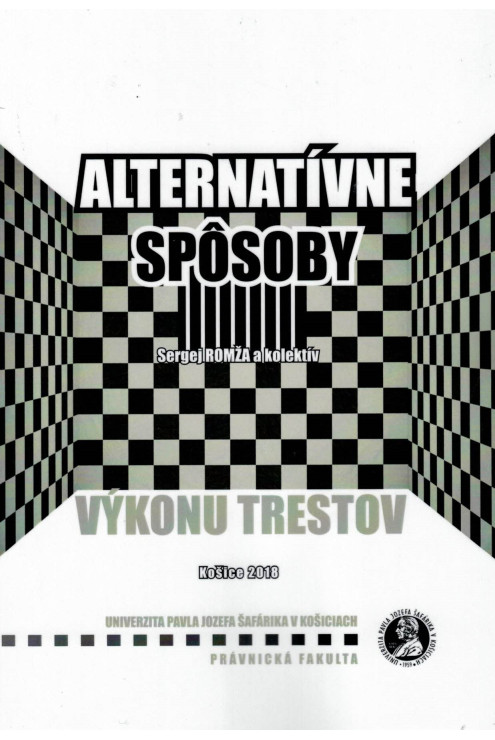
Alternatívne spôsoby výkonu trestov

€15.50
Tax included

Sergej Romža a kolektív

OBSAH:

1 HISTORICKO-PRÁVNE ASPEKTY
2 KOMPARATÍVNE ASPEKTY
3 JURISTICKÉ ASPEKTY
4 KRIMINOLOGICKÉ ASPEKTY
5 PENOLOGICKÉ ASPEKTY
6 VIKTIMOLOGICKÉ ASPEKTY
7 ORGANIZAČNO TECHNICKÉ ASPEKTY

Quantity

978-80-8152-653-4

Data sheet

Method of publication:
Printed publication
Authors:
Sergej Romža a kolektív
Number of pages:
170
Year of publication:
2018
Edition:
1st edition
Publication language:
Slovak
Faculty:
Faculty of Law
License:
Copyright

Specific References

MPN
302109

16 other products in the same category:

Zdravie pri práci v spektre teórie a praxe

Zdravie pri práci v spektre teórie a praxe

E-book

E-book

Jana Žuľová  - Monika Minčičová - Marcel Dolobáč (eds.)

The legal regulation of occupational health and the process of assessing the health capacity is one of the manifestations of fulfilling the protective function of labour law.

Due to the importance of pursuing the interest in protecting the life and health of the individual during his working life, as well as the consequences of damage to the employee's health for further work and continuance of employment relationship, research in this area finds its irreplaceable place in legal science. Its topicality is also highlighted by the emerging risks of work and the working environment. Technological progress associated with a change in the way of performing work, as well as the pandemic situation, have opened a number of new challenges for labour law that require attention.

The presented proceedings of abstracts responds to the outlined facts. It is a group of initial motives and conclusions of lectures presented at the scientific online conference "Health at Work in the Spectrum of Theory and Practice" organized by the Department of Labour Law and Social Security Law of the Faculty of Law, P. J. Šafárik University in Košice on16th April 2021. Authors point to a variety of problematic areas that are not only a reflection of academic considerations, but also of those legal issues that need to be addressed in ordinary legal practice.

Download the e-book for free (pdf)

Implementácia iniciatív EÚ v oblasti spotrebných daní a ich rozpočtovo-právne dopady

Implementácia iniciatív EÚ v oblasti...

E-book

E-book

Karin Cakoci et al.

The authors in the monograph focused on describing the genesis and current state of the legal regulation of consumption taxes in the Slovak Republic in interaction with the harmonization process, as well as identifying the mutual dependence of the legal regulation and revenues from consumption taxation on the effect on the state budget of the Slovak Republic.

Given the importance and justification of the researched issue, particularly in relation to the future functioning of the European Union, as well as the impact on the performance of the economies of individual member states, with an emphasis on the development and quality functioning of the single internal market, the authors, through the publication of the monograph, attempt to provoke a broader professional discussion about their own summarized presented results, which were obtained during the entire period of solving the scientific project, concerning current trends as well as perspectives in the field of EU tax policy and its influence on domestic tax legislation in the Slovak Republic in the area of consumption taxes in interaction with budgetary impacts.

The overall goal of the monograph is to present existing and own acquired knowledge related to the issue of consumption taxes in Slovakia, with an emphasis on the development of EU initiatives in this area, as well as a critical evaluation of their impact on the state budget of the Slovak Republic, and presenting possible future developments.

Download the e-book for free  (pdf)

PRÁVO – OBCHOD – EKONOMIKA X.

PRÁVO – OBCHOD – EKONOMIKA X.

E-book

E-book

Jozef SuchožaJán Husár - Regina Hučková

Proceedings of the International Scientific Symposium

Collection Law-Commerce-Economy X. is a publication containing professional contributions by the authors, especially with regard to commercial law, civil law, labor law, intellectual property law, but also digital technology law. The thematic focus of the international scientific symposium was concentrated in three areas representing open problems of commercial law with regard to the solution of the economic and social crisis caused by the so-called pandemic (corona crisis), current issues of corporate law in the EU and artificial intelligence and law: the influence of artificial intelligence on the normative activity of the state and court decisions. With regard to the content orientation of the outputs, the publication is suitable not only for readers from the academic environment, but also from applied practice.

Download e-book for free (pdf)

Informačná spoločnosť a medzinárodné právo

Informačná spoločnosť a medzinárodné právo

E-book

E-book

Adam Giertl - Ľubica Gregová Širicová (eds.)

Proceedings from the 5th Student Symposium held on April 21-22, 2013

The French delegate to the Commission on Human Rights, while discussing the inclusion of the term "media" in the article on freedom of expression in the draft of the International Covenant on Civil and Political Rights, wisely urged other members of the commission to be forward-looking regarding the information media of the future.

The discussion took place in 1950, when delegates could not yet foresee the impact of the internet on social relations. Given that it is now clear that information technologies significantly influence law, including international law, the organizers of the student symposium decided to dedicate its sixth edition to the theme "Information Society and International Law."

Students of the Faculty of Law, after registering for the symposium, first focused on preparing their contributions, with each participant having access to a consultant if needed. This year, the list of consultants, in addition to members of the Institute of European Law and the Department of International Law, was expanded to include an expert in intellectual property law, Mgr. Martin Husovec, a graduate of our Faculty of Law and currently an IMPRS-CI doctoral student at the Max Planck Institute for Intellectual Property and Competition Law. We also take this opportunity to thank him for dedicating his time to the students and providing them with valuable advice in preparing their contributions. After the preparatory phase, the symposium itself took place, with the aim of presenting the prepared contributions and discussing them.

The presented contributions reflected a wide range of intersections between international law and the information society.

Download the e-book for free (pdf)

Impact of the European Union on Criminal Law of EU Member States

Impact of the European Union on Criminal Law of...

E-book

E-book

Dominika Marčoková Becková (ed.)

Reviewed collection of papers of the international scientific conference is the output of the international scientific conference held on 7th October 2022 within the framework of the project APVV-18-0421 „European Public Prosecutor's Office in Connections of the Constitutional Order of the Slovak Republic as Strengthening of the European Integration through Law“.

Unlike other areas of activities of the European Union, the European Union did not begin to enter the area of criminal law and criminal policy until much later. The reason is that the sphere of criminal law has traditionally been associated with the sovereignty of the state, which is why the Member States of the European Union are very slow to allow the European Union into it. The issue of the European Union's influence on the criminal law of its Member States is therefore becoming actual and raises many questions and application problems. In their papers, the authors address the various problems posed by the European Union's influence in the area of criminal law. Among the scientific problems and issues that the authors paid attention to in their works are the following: reasons for competence of the European Union within the field of criminal law; Impact of the EU legislation on criminal law of EU Member States; proposals to improve existing legislation, whether at European Union or national level, cooperation of the Court of Justice of the European Union and national judges via preliminary proceedings within the field of criminal law; as well as the issue of the European Public Prosecutor's Office.

Download the e-book for free  (pdf)

Orgány obchodných spoločností

Orgány obchodných spoločností

E-book

E-book

Kristián Csach - Dušan Rostáš (eds.)

Proceedings of the 2nd Student Symposium on Company Law In November 2014

The second annual Student Symposium on Commercial Law—more specifically, on Company Law—was held at the university’s facility in Danišovce. As in the previous year, the aim of the symposium was to provide students with a greater opportunity to articulate their own perspectives on current legal issues and to present the results of their individual work.

The theme of the second symposium focused on the governing bodies of commercial companies, aligning it thematically with the APVV research project being carried out by members of the Department of Commercial and Economic Law at our Faculty of Law. This overarching topic made it possible to assign a range of current legal issues, allowing students to explore problems they are likely to encounter in their future professional practice. The selected topics are not among those unanimously settled by legal doctrine or established case law.

On the contrary, they were deliberately chosen for their complexity and the lack of sufficient domestic literature. As a result, students had to go beyond standard textbook or commentary-based knowledge to thoroughly address their assigned topics.

Download the e-book for free (pdf)

Rozhodovacia prax súdnych autorít v súkromnom práve II

Rozhodovacia prax súdnych autorít v súkromnom...

E-book

E-book

Žofia Mrázová Natália Kalinák

On November 28, 2025, the Department of Commercial Law and Economic Law, in cooperation with the Department of Labor Law and Social Security Law of the Faculty of Law at UPJŠ in Košice, organized the 10th anniversary student symposium focused on commercial law, labor law, and IT law. The symposium, entitled "Decision-making practice of judicial authorities in private law II," built on the success of the previous year and once again provided students with an opportunity to showcase their analytical skills and legal creativity. The symposium was prepared as part of the APVV-23-0331 scientific project "Integration of the Capital Markets Union: Changes in Corporate Financing and the Rescue of Commercial Companies in Financial Difficulties."

Download the e-book for free (pdf)

Správne právo procesné

Správne právo procesné

€19.00
Availability: 35 In Stock

Radomír Jakab - Peter Molitoris

Predkladaná učebnica má slúžiť ako učebná pomôcka v pedagogickom procese v rámci študijných predmetov zameraných na správne právo procesné. Z hľadiska štruktúry a obsahových náležitostí reflektuje požiadavky, ktoré sú požadované pre účely postupových skúšok a štátnej skúšky na Právnickej fakulte a Fakulte verejnej správy Univerzity Pavla Jozefa Šafárika v Košiciach. Rovnako, je využiteľným zdrojom informácií aj pre potreby štúdia na iných právnických fakultách v rámci Slovenskej republiky. V neposlednom rade, môže byť vhodnou pomôckou i pre aplikačnú prax, a to tak na orgánoch verejnej správy, na súdoch, ako aj pre advokátov prichádzajúcich do styku so správnym konaním.

Technologický vývoj a jeho vplyv na medzinárodné právo

Technologický vývoj a jeho vplyv na...

E-book

E-publication
Laura Gazdagová-Bartolomej Mižák-Vladyslava Kryvoshei
Technological development is increasingly reshaping the environment in which international law operates. Rapid digitalization, global interconnectedness, and the emergence of new technologies raise questions that traditional legal norms are not always prepared to address. New forms of cross-border interactions, security challenges, and ethical dilemmas influence the functioning of states, international organizations, and other actors. Against this backdrop, discussions are evolving on how international law can maintain its relevance in an era of rapid innovation and how it may adapt to a dynamic technological landscape.
Download the e-book for free

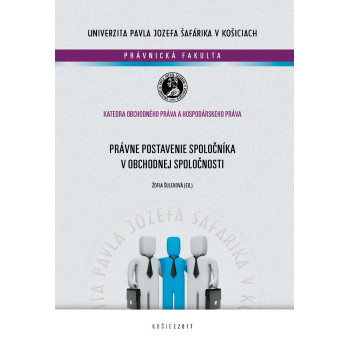
Právne postavenie spoločníka v obchodnej spoločnosti

Právne postavenie spoločníka v obchodnej...

E-book

E-book

Žofia Šuleková (ed.)

Proceedings of the Contributions from the IV. Student Symposium on Corporate Law held on November 24-25, 2016, at the Training Facility of Pavol Jozef Šafárik University in Danišovce.

The Department of Commercial Law and Economic Law at the Faculty of Law of Pavol Jozef Šafárik University in Košice organized the fourth edition of the student symposium, this time focusing on corporate law.

The event took place on November 24-25, 2016, at the training facility of Pavol Jozef Šafárik University in Danišovce. The aim of the annually organized symposiums is to create a discussion platform for students with the participation of mentors from the department, including teachers, researchers, and doctoral students. This year’s symposium focused on problematic issues related to the legal status of a partner in a commercial company. The topics were assigned to allow students to demonstrate and develop their analytical and argumentative skills while improving their ability to present and formulate their own views and perspectives.

The presented proceedings are the outcome of the students' work from this event.
Download the e-book for free (pdf)

Ochrana proti obmedzovaniu hospodárskej súťaže

Ochrana proti obmedzovaniu hospodárskej súťaže

E-book

E-book

Žofia Mrázová(ed.)

Proceedings from the VI. Student Symposium on Commercial Law Held on November 28, 2018, at the Faculty of Law, Pavol Jozef Šafárik University in Košice

The Department of Commercial and Economic Law at the Faculty of Law, Pavol Jozef Šafárik University in Košice, organized the sixth annual Student Symposium on Commercial Law on November 28, 2018. The event was part of the research project VEGA 1/0917/16 titled "Atypical and De Facto Relationships in Commercial Law." The symposium aims to provide a platform for discussion among students with the guidance of mentors from the department, including professors, researchers, and doctoral candidates.

This year’s symposium focused on protection against anti-competitive practices. Unchecked anti-competitive behavior could grant economic advantages to violators at the expense of other competitors and threaten the free-market system. Students explored various challenges related to competition law, analyzing Slovak and European legal frameworks as well as court rulings and decisions by other authorities. Through their research, students honed their analytical thinking, argumentation skills, and critical reasoning. The discussions generated new perspectives and encouraged active engagement among participants.

This proceedings volume presents the outcomes of students' work from this event.

Download the e-book for free(pdf)

LAW – COMMERCE – ECONOMY XII.

LAW – COMMERCE – ECONOMY XII.

E-book

E-book

Jozef Suchoža - Ján Husár - Regina Hučková

The Proceedings of the International Scientific Symposium "LA W-BUSINESS-ECONOMICS XII" is a collection of scientific works by authors participating in the symposium of the same name. The publication focuses primarily on the area of representation in private law, related pai1ies in corporate and bankruptcy law, and current issues of legal regulation of artificial intelligence.

The authors of indivídua! contributions are erudite experts from various branches of law. The collection of scientific papers is a complete work in the form of a collection, with an overlap into private and public law sectors.

Readers are presented with scientific outputs from authors from the Slovak legal environment, as well as from foreign authors. Several authors' paper provide a European legal perspective or an international comparative perspective.

Download e-book for free (pdf)

Mierové rokovania po roku 1918 a ich vplyv na moderné právo

Mierové rokovania po roku 1918 a ich vplyv na...

E-book

E-book

Erik Štenpien - Lucia Pištejová  - Ivan Svatuška (eds.)

Proceedings of the international scientific conference held on April 13-14, 2023, organized by the Department of History of State and Law, Faculty of Law, University of Pavel Jozef Šafárik in Košice.

The presented collection provides a summary of scientific works from the last international conference dealing with the issue of the Trianon Peace Treaty and the negotiations during the peace conference after 1918. The collection contains scientific contributions from members of the research team of the APVV 19-0419 project, as well as other experts from the field of legal history. Through their contributions, they offer an insight into the complex processes of the formation of Europe after the First World War. They approximate the essential and relatively complicated processes of negotiations on important issues of the post-war arrangement and the further direction of individual countries. Contributions of foreign legal historians, which bring an alternative view of the examined issue, are a stimulating contribution to the collection.

The anthology includes scientific studies related to the investigated issue, often with an overlap with the present. The collection also includes scientific contributions with positive legal topics. The collection in the presented form is thus primarily intended for readers from the professional public.

Last but not least, it can interest the lay public interested in the issue of the post-war arrangement and Slovak-Hungarian relations.

Download the e-book for free (pdf)

PRÁVO – OBCHOD – EKONOMIKA XIV. ZBORNÍK VEDECKÝCH PRÁC (2025)

PRÁVO – OBCHOD – EKONOMIKA XIV. ZBORNÍK...

E-book

E-publication

Diana Treščáková - Regina Hučková (eds.)

Publication Law Business Economy XIV. is collection of international scientific works which contains scientific contributions of wide variety of branches of law, as well as related fields of scientific expertise. Among areas of issues which were discussed in this publication are questions of civil, commercial, competition, intellectual property, arbitration and corporate law, as well as other partial areas, including scientific works dealing with business and IT law. Entire publication is significant with richness of scientific contributions from various jurisdictions, because of renowed authors from various countries. Apart from theoretical contribution and expansion of current state of the art in submitted interdisciplinary area, solutions to legal problems were formulated at de lege ferenda level.

Download the e-book for free

Zákon o národnostiach a Rada vlády Slovenskej socialistickej republiky pre národnosti (predstavy a realita)

Zákon o národnostiach a Rada vlády Slovenskej...

E-book

E-book

Jana Šutajová

From January 1, 1969, the Constitutional Act on the Status of Nationalities in the Czechoslovak Socialist Republic (ČSSR) and the Constitutional Act on the Federation came into effect. The Constitutional Act on the Status of Nationalities represented at least a formal significant step forward in the legal regulation of minority rights. However, this law was intended to serve as a foundation for further legal adjustments. It was declared that additional steps and negotiations for the adoption of implementing regulations would follow and that further laws would be enacted at both the federal and national levels. Nevertheless, no additional law or government regulation related to the constitutional act on the status of nationalities in the ČSSR was ever issued.

During the normalization period, issues concerning further legislation related to national minorities were not addressed. However, in the brief period following the adoption of the constitutional act in 1968 until the end of 1969, some institutions attempted to prepare and promote such legal norms. One of these institutions was the Government Council of the Slovak Socialist Republic (SSR) for Nationalities (hereafter referred to as the Council or the Government Council for Nationalities). The monograph provides an insight into the development of additional legal norms arising from the constitutional act on the status of nationalities in the Slovak Socialist Republic, prepared by the Government Council of SSR for Nationalities. This council was one of the institutions established in Slovakia after the formation of the Czechoslovak federation and dealt with nationality issues.

In addressing further legal norms stemming from the constitutional act on nationalities in ČSSR, it was necessary to consider prior developments. Therefore, the first part of the monograph examines the status of minorities in Czechoslovakia before adopting the constitutional act, activities of nationalities preceding its adoption, and its enactment itself. Subsequent sections focus on institutional changes in SSR following federalization, the establishment of the Government Council of SSR for Nationalities, and specific actions taken by this Council and its expert bodies in drafting proposals for laws concerning nationalities in the Slovak Socialist Republic.

The motivation for writing this monograph stemmed from the fact that this topic has so far received attention only in a few studies in Slovakia, which primarily focused on the Hungarian minority during either the Prague Spring or normalization periods.

Download the e-book for free (pdf)

Učíme právo zážitkovo

Učíme právo zážitkovo

E-book

E-book

Daniela Lamačková-Renáta Orosová- Beáta Sakalová- Diana Repiščáková

Methodological guide for teachers for classroom lessons and civics Teaching law experientially? Is it even possible? The answers to these questions are provided by a methodological guide that uniquely links experiential learning methods with legal content. This methodological guide is a set of techniques based on the use of interactive and participatory learning methods, focusing on selected human rights and value-oriented topics, which also have the potential to develop other key competences of students, such as their communication skills, their ability to learn and educate independently, their ability to think critically, their ability to work with and analyse texts, their ability to discuss and express their opinions, and their ability to listen to each other. The methodological guide consists of a set of training activities - techniques, while each technique contains a precise description of the procedure for conducting a specific activity, the expected duration of the activity, aids, discussion topics and also a short pedagogical and legal commentary, precisely "tailored" to the specific legal topic. The legal topics are chosen to be generally applicable to both classroom and civics lessons, to raise questions about the functioning of rules and the need to respect them, mutual respect and tolerance, and to encourage reflection on the limits of individual rights and on responsibility in exercising one's rights. The techniques use training methods such as group work, brainstorming, role-playing, dealing with model situations, as well as a simulated court process. The methodological guide is intended for classroom teachers in the implementation of classroom lessons, and also for the purposes of the subject of civics, as well as for students of pedagogy at the Pavol Jozef Šafárik University in Košice.

Download e-book for free (pdf)

This website uses cookies to ensure you get the best experience on our website