- -50%

Zavolajte nám:
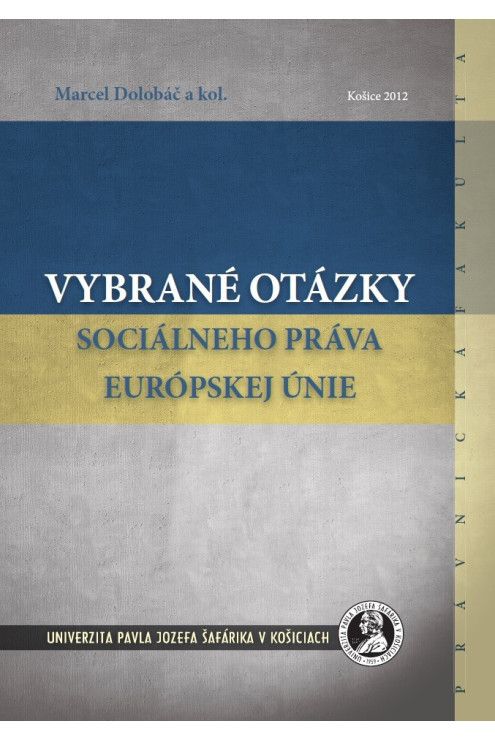
+421 55 234 1635Učebnica s názvom Vybrané otázky sociálneho práva Európskej únie prierezovo spracúva najzásadnejšie otázky pracovného práva a práva sociálneho zabezpečenia v Európskej únii. V úvodných statiach učebnice sa autori zamerali na objasnenie základnej terminológie a stručne poukazujú na vývoj sociálneho práva v Únii. Ďalšie kapitoly práce postupne vysvetľujú vybranú problematiku ktorá celkovo dotvára sociálne právo Európskej únie, konkrétne – voľný pohyb zamestnancov, zákaz diskriminácie, flexibilitu pracovných vzťahov prostredníctvom atypických pracovných pomerov, dočasné pridelenie zamestnancov, ochranu osobitných kategórií zamestnancov, ochranu osobných údajov, oblasť bezpečnosti a ochrany zdravia pri práci, ochranu práv zamestnancov pri prevode, prechode zamestnávateľa a jeho platobnej neschopnosti, kolektívnu ochranu práv zamestnancov a napokon uplatňovanie systémov sociálneho zabezpečenia. Učebnica analyzuje predovšetkým úniovú úpravu s akcentom na rozhodnú judikatúru Súdneho dvora Európskej únie, vnútroštátny právny poriadok objasňuje iba vo vybraných problematických oblastiach.
Autori
Data sheet
E-book
Marcel Dolobáč - Monika Seilerová
The Industrial Revolution cannot be avoided or hidden from, but it is equally wrong to see it only in gray tones. Let us be optimistic. The Information Age can also mean a reduction in working hours, perhaps more time for family and interpersonal relationships, or an overall increase in individual economic luxury. The Information Age will take away many job opportunities but will put many others on the table, though mostly for the educated. Science and research will become even more important for overall economic development than they are today. Let us be prepared.
The ambition of this monograph is not, and cannot be, to provide an exhaustive answer to the above-outlined debates. Its goal is to stimulate broader scientific discussion, particularly on the issue of mental health protection in correlation with the advent of the Information Age. The subject of study is the protection of the individual—the employee—who must adapt to a new technological environment and its associated demands.
The monograph represents a comprehensive output by authors who, over the past two years, have published on similar topics within the APVV-16-0002 grant "Mental Health in the Workplace and Assessment of Employee Health Capability." The authors believe that thanks to this APVV grant, they will continue to build on this topic in the coming years. Most importantly, they hope that its content will engage you, the readers.
Marcel Dolobáč
E-book
Ľudmila Pošiváková - Adam Giertl
The presented selection of public international law documents aims to map international law from both historical and sectoral perspectives. The reader will find several historical documents in this collection, but the focus is primarily on currently valid legal sources.
The selection is guided by the publication Public International Law – General and Special Part by Prof. Ján Klučko, which is reflected in the division into general and special parts. The general part addresses the historical development of international law but primarily focuses on the protection of individuals and responsibility relationships in international law. The special part then examines the international regulation of various institutions of international law.
We acknowledge that this selection offers room for expansion, but we believe it meets basic requirements and fills a certain gap in the study of international law.
We trust that this collection of public international law materials will be beneficial for students, and not only for them, in the study of public international law and will contribute to raising awareness in this field.
E-book
Valéria Ružičková (ed.)
Proceedings of the XIVth Student Symposium on International Law and European Law.
For the XIV Year of Student Symposium on International Law and European Law under the topic „Artificial Intelligence from the Perspective of Law“, students of the Faculty of Law and the Faculty of Science prepared several papers regarding current questions related to the ongoing development of the artificial intelligence. From the legal point of view, the papers regard the importance of the artificial intelligence in human activities in space, its impact on fundamental rights, development of new human rights in relation to its application in healthcare and nursing care as well as personal data protection while making use of the artificial intelligence.
Apart from the papers concerning the artificial intelligence from the legal perspective, two of the papers regard the artificial intelligence from the scientific perspective, explaining the importance of the artificial intelligence in localization in indoor environment as well as its importance in prediction of healthcare costs.
Učebnica Všeobecnej štátovedy predstavuje tradičný obsah predmetu, ako sa rozvinul v európskej kontinentálnej podobe (altematívou štátovedy je dnes na viacerých univerzitách, aj mimo právnických fakúlt, politická veda). Medzi dvanástimi kapitolami sa okrem viac-menej stabilne prítomných (1. Jednotlivca spoločnosť; 2. Teórie o príčinách vzniku štátu a o účele štátu; 3. Znaky (prvky)štátu; 8. Politické strany a štát) nachádzajú aj kapitoly, ktoré spravidla nie sú, alebo doteraz neboli predmetom štandardného záujmu (5. Politický spor, zmena ústavy, revolúcia, právo na odpor; 6. Rozpadnuté a stroskotané štáty; 7. Štát a cirkev).Niektoré kapitoly predstavujú návrat k pôvodným štátovedným klasifikáciám (9. Funkcie štátu). V rámci prezentácie historických a aktuálnych otázok týkajúcich sa Formy štátu (najrozsiahlejšia 1O. kapitola)ide o pokus objasnit' nové aspekty problematiky(napríklad, podkapitoly ako Parlamentná opozícia, Ústavné súdnictvo). Záverečná časť učebnice sa venuje Modernému ústavnému štátu: právnemu štátu(12.kapitola)a možno ju považovat' za príspevok k analýze princípov právneho štátu a jeho viacerých teórií. Úmyslom autora bolo tiež prispieť k autentickému výkladu názorov niektorých myslitel'ov predošlých období, návratom k pôvodným textom ich diel. Všeobecná štátoveda, adresovaná predovšetkým študentom, má za ciel' tvoriť úvod do právnického štúdia ako jeho osvedčená základňa, zdroj i východisko.
E-book
Juraj Panigaj (ed.)
Collection of Contributions from the XVth Student Symposium on International Law and European Law, held on April 22, 2022, in a hybrid format, with the participation of students from the Faculty of Law of Pavol Jozef Šafárik University in Košice and the Faculty of Law of Trnava University in Trnava.
The jubilee XV. year of student symposium from international and European law took place at the University of Pavol Jozef Šafárik, faculty of law, on April 22, 2022, symbolically on Day Earth. This year's event was dedicated to the increasingly pressing issue of environmental protection. The topic "Green ambitions in the light of European and international law" appealed to many students, resulting in several interesting contributions, falling under both European Union law and international law. European law currently brings great challenges, but also expectations through the European Green Deal. This is also why several student contributions dealt with topics falling under the European Green Deal, either from the point of view of its individual initiatives in general, or more specifically, in the intentions of Agenda 2030, or the implementation of the so-called green diplomacy.
The other part of contributions dealt with environmental protection within international law. Students addressed issues of an environmental nature in the areas of climate change, international maritime law, atmospheric protection, or the issue of so-called climate refugees. The publication itself is an output of the APVV project APVV-20-0576 "Green ambitions for sustainable development (European Green Deal in the context of international and national law)".
Download e-book for free (pdf)
E-book
Daniela Lamačková-Renáta Orosová- Beáta Sakalová- Diana Repiščáková
Methodological guide for teachers for classroom lessons and civics Teaching law experientially? Is it even possible? The answers to these questions are provided by a methodological guide that uniquely links experiential learning methods with legal content. This methodological guide is a set of techniques based on the use of interactive and participatory learning methods, focusing on selected human rights and value-oriented topics, which also have the potential to develop other key competences of students, such as their communication skills, their ability to learn and educate independently, their ability to think critically, their ability to work with and analyse texts, their ability to discuss and express their opinions, and their ability to listen to each other. The methodological guide consists of a set of training activities - techniques, while each technique contains a precise description of the procedure for conducting a specific activity, the expected duration of the activity, aids, discussion topics and also a short pedagogical and legal commentary, precisely "tailored" to the specific legal topic. The legal topics are chosen to be generally applicable to both classroom and civics lessons, to raise questions about the functioning of rules and the need to respect them, mutual respect and tolerance, and to encourage reflection on the limits of individual rights and on responsibility in exercising one's rights. The techniques use training methods such as group work, brainstorming, role-playing, dealing with model situations, as well as a simulated court process. The methodological guide is intended for classroom teachers in the implementation of classroom lessons, and also for the purposes of the subject of civics, as well as for students of pedagogy at the Pavol Jozef Šafárik University in Košice.
Download e-book for free (pdf)
E-journal
Michal Jesenko (editor) - Eva Mihalíková - Darina Koreňová
Public Administration and Society is a scientific journal publishing scientific academic articles, contributions to discussion and reviews having the content orientation on the theory and practice of Public Administration. The mission of the Journal is to publish significant results of the scientific scholarly researches regarding the area of public administration and related disciplines which are connected with the study profile and scientific bias of our Faculty. The Scientific Journal is issued in electronic version.
E-book
Adrián Popovič - Jozef Sábo - Anna Vartašová (eds.)
Reviewed proceedings from the IV. annual student symposium
E-book
Ján Klučka a kol.
The presented monograph, “Regionalism and Its Contribution to General International Law,” was prepared at the Institute of European Law and the Department of International Law of the Faculty of Law at Pavol Jozef Šafárik University in Košice as part of a project of the same name (APVV-0823-11) carried out in the years 2011–2015, and represents one of its final publication outputs.
The main reason for choosing this topic was the effort to evaluate regionalism in its various forms in relation to international law, and, conversely, to assess the place, significance, and role of international law in the creation and functioning of different forms of regional groupings. In fact, although regionalism is receiving increasing attention in doctrine, a more comprehensive assessment of its impact on international law and vice versa has so far been lacking.
This monograph attempts to partially fill this gap. Against the background of a brief historical development of regionalism, as well as its substantive and terminological components, the monograph examines in greater detail the individual types of regionalism—such as old and new regionalism, as well as contractual and institutional regionalism—their specific features, and their contribution to general international law.
Attention is also devoted to a specific phenomenon of contemporary regionalism, namely the influence of the European Union on its stabilization and development, both through practical measures and through a set of measures regulated by international treaties.
E-book
Adrián Popovič - Jozef Sábo - Anna Vartašová
Reviewed Proceedings of the 3rd Annual Student Symposium
The Intemational Scientific Conference - V. Slovak-Czech days of tax law on the topic Tax Law and New Phenomena in the Economy was held 5th - 6th June 2023 in Košice. Onthis occasion, a student symposium on the topic: "Financial Law and Tax Law in the 21st Century" was organized for students of the Pavol Jozef Šafárik University Faculty of Law in Košice on 7th June 2023. The focus of the symposium was chosen due to the content of thegrant project VEGA no. 1/0485/21: "Simultaneity and possibilities of reforming the system ofown resources of the EU budget (legal and economic aspects also in the context of the consequences of the COVID-19 pandemic) ",of the grant project VEGA no.1/0214/21: "Taxa/ionof real property - legal status and polential" and of the grant project APVV-19-0124 entitled" Tax law and new phenomena in the economy (digital services, sharedeconomy,virtualcurrencies) ", which are currently being addressed at the Department of Financial Law, Tax Law and Economy, Faculty of Law, Pavol Jozef Šafárik University in Košice.
The output of this symposium is a reviewed proceeding of papers, in which students focus on examining the issues of new phenomena in the digital economy (virtual currencies and the shared economy), but also the iss ues of the budget process, thedecision - making activity of the Court of Justice of the EU and theoretical - legal issues of tax justice with regard to the development of tax law.
The authors also assess in detail the current situation in the research area, and they also present de lege ferenda proposals that could contribute to the development and improvementof several aspects of taxation, which is a benefit not only for legal science but also for application practice.
Download e-book for free (pdf)
E-book
Alexander Bröstl - Marta Breichová Lapčáková (eds.)
Under the auspices of the Institute of Legal Theory of Gustav Radbruch and the Slovak Section of the International Association for Philosophy of Law and Social Philosophy (IVR), a 3D flash conference was held on May 16, 2019, at the Faculty of Law of UPJŠ in Košice. This event was primarily dedicated to the upcoming 29th World Congress of IVR in Lucerne, Switzerland. In line with the main theme of the congress, the conference focused on "Dignity, Democracy, Diversity." At the time of the conference, it was clear that the number of participants at the world congress would significantly exceed 1,000, with discussions taking place in 151 special workshops and 28 working groups.
During the congress, a round table was also announced featuring Professor Brian Tamanaha, recipient of the IVR award for best book for "Realistic Theory of Law" (Cambridge 2017), a meeting regarding the IVR Encyclopedia, a panel on academic freedom issues, and a gathering of chairs from national sections of IVR.
E-book
Dominika Cukerová - Andrej Oriňak - Kateřina Hrabánková (eds.)
The proceedings offers contributions from the international scientific conference of doctoral students and young researchers held on 25 April 2024 at the Faculty of Law, UPJŠ in Košice, which was thematically oriented on Innovative Law and Innovations in Law. The authors of the papers confirmed that innovation in law can take many forms. The first part of the papers, which pays attention to how law can respond to innovations, is a manifestation of this. These are the papers by Jana Cihanová, Andrej Oriňák, Denisa Rudžiková and Matej Biroš, who presented the use of deepfake technology, artificial intelligence and software tools in legal practice in the context of their legal regulation. Looking at familiar things differently can also be a source of innovation. In this vein, Dominik Mizerski, Juraj Valentovič, Lucián Török and Kateřina Hrabánková presented interpretive and application innovations in the field of private law. The third part of the papers by Michaela Szittyaiová, Natália Priateľová, Filip Baláži, Elena Lazoríková and Laura Gazdagová offers a preview of the innovations that the public law section is facing today. Finally, the fourth and last group of papers specifically explains innovations against the background of criminal law regulation. These are contributions by Michal Novák, Miroslav Srholec, Vladimír Petrila and Martina Makaturová. The variety of topics covered in this proceedings shows that each area of legal regulation can be characterised by specific innovations and, in this context, by the dynamics with which they permeate legal regulation.
E-book
Lucia Bakošová - Ľudmila Elbert - Ľubica Gregová Širicová
Disasters, whether natural or industrial, have a serious impact on the functioning of society and are a negative phenomenon which, with the increasing impact of climate change, is increasingly affecting the sustainable development and prosperity of States. Their increasing regularity and intensity affect the current evolution not only of social life, but also of legal debates on the necessity of responding to international and national disaster response, eliminating their negative consequences and protecting affected persons. No State is immune to the occurrence of disasters, and this also applies to the Slovak Republic, which is mostly affected by sudden natural disasters, namely floods, landslides, droughts, fires, windstorms and snow calamities.
The subject of this publication is the proposal of the methodological guidelines regulating the activities of NGOs in case of disaster, as well as cooperation with the state affected by the disaster, and the glossary of legal terms which need to be clear and unified in case of disaster. Slovak and English version of the proposal is basic precondition of its usability not only for the state organs of the Slovak republic and Slovak NGOs, but also for foreign NGOs.The Proposal of the methodological guidelines is the result of the research project VVGS-PCOV 2018-459: Návrh metodického postupu mimovládnych organizácií v prípade katastrofy v podmienkach Slovenskej republiky (The Proposal of the methodological guidelines for the non-governmental organisations in case of disaster in conditions of the Slovak republic).
E-book
Milena Barinková (ed.)
The complex of legal norms protecting work, ensuring safety and health protection at work, is very broad in scope, extending beyond the Labour Code to include other specific legal regulations, collective agreements, executive legal regulations, and internal corporate normative acts.
Health protection of employees from hazardous workplace influences is a central requirement stemming from fundamental human rights guaranteed by the Constitution of the Slovak Republic. To ensure its universal enforcement across all employers in both private and public sectors, strict regulation through cogent norms is fully justified. The European Commission’s Communication to the European Parliament, Council, European Economic and Social Committee, and Committee of the Regions on the EU Strategic Framework on Health and Safety at Work 2014–2020 (COM(2014) 332 final) addresses the need to account for labor market changes arising from demographic shifts, aging populations, and technological advancements.
Work pace demands are intensifying, and all age categories of employees must adapt to new technologies, organizational changes, and evolving job structures. This increases requirements for maintaining health fitness throughout entire professional careers. Mental health fitness, which receives insufficient specific attention, is an inherent part of health fitness requirements. Prevention plays a critical role in mental health protection.
E-book
Ján Klučka - Ľuboslav Sisák - Laura Gazdagová (eds.)
This publication captures the conference proceedings of the international scientific conference "20 years in the European Union in terms of law and the era of sustainability". The conference took place on 3rd September 2024 at the Faculty of Law, Pavol Jozef Šafárik University in Košice, in hybrid form.
The first part of the conference proceedings includes contributions concerning EU law in proceedings before the Constitutional Court of the Slovak Republic with focus to current issues and challenges after 20 years of membership of the Slovak Republic in the EU, European law from the perspective of international constitutionalism in a green coat, the impact of the entry of the Baltic states into the European Union on the question of the nationality of natural persons, the single digital market in the context of the Slovak Republic, the impact of European Union law in the field of personal data protection on the territory of the Slovak Republic, the principle of environmental protection in economic competition and international jurisdiction for private law claims for compensation for damage caused to the environment.
The second part of the conference proceedings includes contributions concerning the process of enshrining human right to environment in international law and European law, the development of biodiversity protection in the EU, NATO´s role in climate change response to meet the sustainability and suing tort damages from the Dieselgate emissions scandal.
E-book
Ladislav Orosz - Diana Horňáková - Patrik Mário Čerňanský
This scientific proceedings volume serves as the final joint publication output of essentially the entire research team of the aforementioned scientific project. It consists of contributions presented at the scientific seminar The Constitution of the Slovak Republic and Its Perspectives. Improving the Constitutional Text and Increasing the Authority of the Slovak Constitution – A Real Possibility or a Naive Illusion? held from November 23 to 25, 2022, at the training and educational facility of UPJŠ in Košice, Danišovce. The final form of the contributions emerged from the constructive scientific discourse that accompanied the entire course of this seminar.
The content of this scientific proceedings volume, which we offer not only to the broad (especially legal-political) professional public but also primarily to Slovak constitution makers, includes, alongside contributions from members of the research team and invited guests, the literary debut works of doctoral students from the organizing Department of Constitutional and Administrative Law of the Faculty of Law of UPJŠ and the Department of Public Law Disciplines of the Faculty of Public Administration of UPJŠ in Košice. These works thematically correspond to the tasks addressed within the aforementioned scientific project “Constitutional Activity of the National Council of the Slovak Republic (Legal-Political Analysis – Evaluation – Perspectives).”
Download e-book for free (pdf)
This website uses cookies to ensure you get the best experience on our website