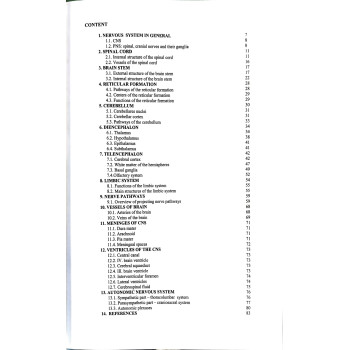
Neuroanatomy: Handouts from the lectures

€9.32
Tax included
Quantity
Last items in stock

978-80-8152-039-6

Data sheet

Method of publication:
Printed publication
Author:
Darina Kluchová
Document type:
Course Notes
Number of pages:
86
Year of publication:
2013
Edition:
2nd edition
Publication language:
English
Faculty:
Faculty of Medicine
License:
Copyright

Specific References

MPN
302111

4 other products in the same category:

Lekárska chémia -  Návody a protokoly na praktické cvičenia

Lekárska chémia - Návody a protokoly na...

E-book

E-book

Marek Stupák et al.

A well-known proverb says: "It is better to see once than to hear a hundred times." With this in mind, the electronic version of the teaching materials has been designed, as we are convinced that practical laboratory experience is irreplaceable and still holds its significance in university studies.

In the provided teaching texts, you will find a set of experiments that complement and help better understand the theoretical knowledge gained through self-study as well as lectures in an appropriate manner. Additionally, this e-version allows students, after printing and subsequently completing individual tables, observations, and conclusions, to submit them as a laboratory report that confirms they have successfully mastered the assigned tasks.

Download the e-book for free (pdf)

Elementary organic molecules in biochemistry

Elementary organic molecules in biochemistry

€22.00
Availability: 45 In Stock

Vladimíra Tomečková

Nature, as well as the human body, contains an abundant quantity of organic molecules. This textbook describes selected oxygen, sulfur, nitrogen derivatives of hydrocarbons, heterocyclic compounds of their reactions, which are important in the human body or are found in pharmaceutical active substances, poisons, foodstuffs and heat-treated food. The last part of the textbook describes the isomerism of organic compounds, which enables dynamic changes in the structure of molecules that have different properties. Nature is filled with different plants and animals and is the first laboratory to produce bioactive organic natural compounds. These compounds are compatible with human cells and are applicable as therapeutic medicine. There is an effort to reproduce natural molecules in chemical laboratories, but they cannot be as perfect as the natural ones. Synthetic molecules can serve as a model for multiple studies, but there still does not exist a magic panacea pill or a perfect copy of nature, for the treatment of various diseases. Knowledge about the regenerative and toxic effect of medicinal substances in dependence on their structure (type and number of substituents) is very important for the understanding of their role in modulation of health and disease in dependence on their concentration. Compounds can be used daily only in recommended doses (higher doses can be toxic), but still will not replace a healthy diet. People need a varied diet to be healthy, in which are all necessary nutrients, what Hippocrates demonstrated long ago “Let food be the medicine, and let medicine be the food.” This book is written for students who select bioorganic chemistry subject during the study of general medicine or dentistry as well as for motivated students who would like to practice their knowledge and wish to improve in this subject and for students who would like to learn simplified basic organic reactions with their future application in biochemistry. Learn the simple models mainly through creative simple instruction by using different colours, by repetition, practice by drawing of formulas by hand (at least three times) and memorization of common names of compounds and their reactions which have application in biochemistry. Thus, establishing simple educational methods how to distinguish organic molecules according to the colours of a functional group can promote universal learning for all students who thought that chemistry is a difficult subject, but hopefully they change their opinion after study of this book.

Keywords: organic molecules, oxygen, sulfur, nitrogen derivatives of hydrocarbons, heterocyclic compounds, chemical reactions, isomerism of organic compounds

Komunikácia v zdravotníckej praxi

Komunikácia v zdravotníckej praxi

E-book

E-book

Renáta SuchanováLucia Dimunová

The following textbook deals with issues related to communication in medical practice which significantly affects the survival and behaviour of a patient. Communication skills and the attitude of healthcare professionals exercised towards a patient have significant impact on patient’s ability to handle treatment and his or hers co-operation during the process.

This publication is intended to serve as a guide applicable towards deeper knowledge, better comprehension and overall understanding of the mental state of an ill person, his or her needs, stances, behaviour patterns, but also his or her management of the illness. Attention is also paid to the active building of a relationship between the healthcare professional and the patient, with emphasis on respect, truthfulness, and mutual understanding in communication. Particularly accentuated are issues related to specific effective communication skills, methods, and techniques serviceable during interactions with a patient; application of empathy and proactive approach are highlighted.

Download e-book for free (pdf)

Roma Health Organizations Database

Roma Health Organizations Database

E-book

E-book

Kvetoslava Rimárová

This document is a part of the EU-funded project MEHO - Migrant and Ethnic Health Observatory and Slovak grant VEGA 1/4501/09.
This monograph includes a database of organizations dealing with Roma health and community issues and is part of the Interim Report 2007. The published monographs try to enclose all kinds of information about Roma health including organizations on national, international, governmental and non-governmental levels in Europe as well as international organizations such as WHO and UNDP. The views expressed in this monograph are those of the author and do not necessarily represent the views of the EU MEHO Project or Slovak grant VEGA 1/4501/09.
Kvetoslava Rimárová

This website uses cookies to ensure you get the best experience on our website