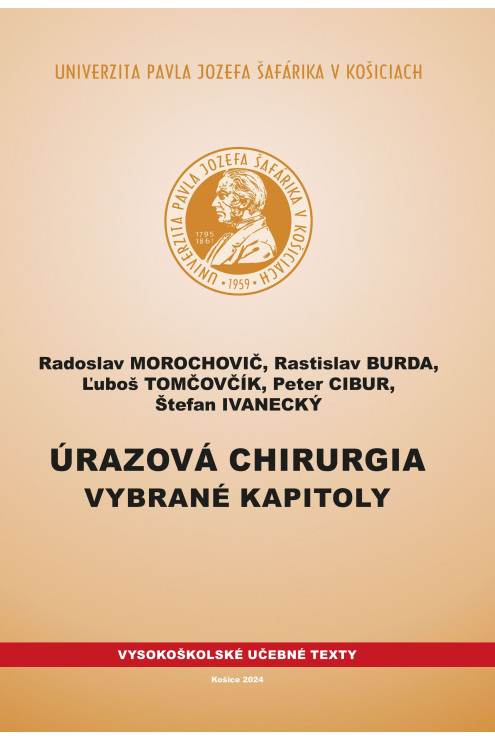
Úrazová chirurgia - vybrané kapitoly

€24.00
Tax included

Radoslav Morochovič - Rastislav Burda -

Ľuboš TomčovčíkPeter CiburŠtefan Ivanecký

Vysokoškolský učebný text určený pre študentov všeobecného lekárstva, zubného lekárstva a fyzioterapie, ktorý obsahuje podstatné časti z predmetu úrazová chirurgia potrebných na zvládnutie vysokoškolského štúdia.

Quantity

978-80-574-0289-3

Data sheet

Method of publication:
Printed publication
Authors:
Radoslav Mrochovič - Rastislav Burda - Ľuboš Tomčovčík - Peter Cibur - Štefan Ivanecký
Document type:
Course Notes
Number of pages:
186
Year of publication:
2024
Edition:
1st edition
Publication language:
Slovak
Faculty:
Faculty of Medicine
License:
Copyright

Specific References

MPN
303366

16 other products in the same category:

Practical lessons in medical biology

E-book

E-publication

Eva Slabá-Helena Mičková-Jozef Židzik-Lucia Klimčáková-Janka Vašková

Teaching texts „Practical Lessons in Medical biology“ provide the theoretical foundations of microscopy, various microscopic techniques and preparation of microscopic slides in an understandable form. The chapters of the teaching texts contain model questions and tasks from cytology, molecular biology and genetics enabling students to acquire new knowledge from individual thematic areas and provide instructions for the implementation of tasks during laboratory lessons in medical biology. Teaching texts are primarily intended for the practical lessons in the subjects Biology 1 and Biology 2 for foreign students of the first year of General Medicine and the subjects Medical Biology and Genetics and Regenerative Medicine for foreign students of the first and second year of Dental Medicine at P. J. Šafárik University in Košice – Faculty of Medicine.

Download the e-book for free (pdf)

General dermatovenerology

€12.00
Availability: 200 In Stock

Janette Baloghová

Všeobecná dermatovenerológia je nosnou časťou dermatovenerológie. Morfológia, popis a charakteristika jednotlivých eflorescencií sú kľúčové v diagnostike a diferenciácii kožných ochorení spolu s dobre odobratou anamnézou. Snahou bolo vytvoriť vysokoškolský učebný text, ktorý tvorí praktický návod ako vyšetrovať pacienta s kožným ochorením. Cieľom jednotlivých kapitol je dokonale si osvojiť dermatologickú terminológiu, fyzikálnym vyšetrením vnímať špeciálne kožné znaky a zmeny, vedieť sa orientovať v algoritme pomocných vyšetrovacích metód a testov a pochopiť rozdielne vlastnosti a charakteristiku kože vzhľadom na vek pacienta, vznik, priebeh a trvanie kožných prejavov. Posledná kapitola predstavuje praktickú topografiu kožných ochorení v tabuľkách. Dermatovenerológia patrí k interdisciplinárnym odborom, preto všeobecná dermatológia bude určite dobrým sprievodcom pri diagnostike kožných ochorení nielen študentov medicíny, ale aj lekárov prvého kontaktu a styčných odborov.

Chirurgická liečba cerebrovaskulárnej...

E-book

E-book

Peter Berek

With the development of endovascular surgery, there is a gradual advancement in ACI stenting. The minimally invasive approach has made this methodology suitable for patients with serious concomitant cardiac or pulmonary diseases. Another advantage compared to surgical treatment was better access to the ICA in patients after radiotherapy, after previous neck surgeries, as well as in patients with stenoses close to the skull base.

The comparison of CEA vs CAS is an interesting and debatable topic in many studies. However, despite the massive global development of endovascular treatment, carotid endarterectomy remains the gold standard for treating ICA stenosis in both symptomatic and asymptomatic patients. In this monograph, we would like to accentuate and systematize the issue of surgical stroke prevention from the perspective of a vascular surgeon.

Download the e-book for free  (pdf)

Elementary organic molecules in biochemistry

€22.00
Availability: 45 In Stock

Vladimíra Tomečková

Nature, as well as the human body, contains an abundant quantity of organic molecules. This textbook describes selected oxygen, sulfur, nitrogen derivatives of hydrocarbons, heterocyclic compounds of their reactions, which are important in the human body or are found in pharmaceutical active substances, poisons, foodstuffs and heat-treated food. The last part of the textbook describes the isomerism of organic compounds, which enables dynamic changes in the structure of molecules that have different properties. Nature is filled with different plants and animals and is the first laboratory to produce bioactive organic natural compounds. These compounds are compatible with human cells and are applicable as therapeutic medicine. There is an effort to reproduce natural molecules in chemical laboratories, but they cannot be as perfect as the natural ones. Synthetic molecules can serve as a model for multiple studies, but there still does not exist a magic panacea pill or a perfect copy of nature, for the treatment of various diseases. Knowledge about the regenerative and toxic effect of medicinal substances in dependence on their structure (type and number of substituents) is very important for the understanding of their role in modulation of health and disease in dependence on their concentration. Compounds can be used daily only in recommended doses (higher doses can be toxic), but still will not replace a healthy diet. People need a varied diet to be healthy, in which are all necessary nutrients, what Hippocrates demonstrated long ago “Let food be the medicine, and let medicine be the food.” This book is written for students who select bioorganic chemistry subject during the study of general medicine or dentistry as well as for motivated students who would like to practice their knowledge and wish to improve in this subject and for students who would like to learn simplified basic organic reactions with their future application in biochemistry. Learn the simple models mainly through creative simple instruction by using different colours, by repetition, practice by drawing of formulas by hand (at least three times) and memorization of common names of compounds and their reactions which have application in biochemistry. Thus, establishing simple educational methods how to distinguish organic molecules according to the colours of a functional group can promote universal learning for all students who thought that chemistry is a difficult subject, but hopefully they change their opinion after study of this book.

Keywords: organic molecules, oxygen, sulfur, nitrogen derivatives of hydrocarbons, heterocyclic compounds, chemical reactions, isomerism of organic compounds

Applications of the Autonomic Nervous System in...

E-book

E-book

Ladislav Kočan - Dušan Rybár - Róbert Rapčan

The autonomic nervous system is a vital component of the peripheral nervous system, responsible for maintaining homeostasis and regulating internal processes within the body. Unlike the voluntary control exerted by the central nervous system, the autonomic nervous system operates involuntarily, innervating smooth organs, vessels, skin glands, and even exerting some influence over skeletal muscles in connection with vegetative functions such as breathing, digestion, and the urinary and gonadal systems. Its impact extends crucially to the cardiac muscles of the heart and plays a significant role in endocrine and metabolic functions, thermoregulation, as well as emotional and behavioral responses, including adaptive reactions to stressors.

The aim of this publication is to provide a comprehensive and objective exploration of the anatomical and physiological intricacies of the autonomic nervous system, offering insights into its clinical applications. Within these pages, we meticulously delineate various interventional therapeutic procedures tailored to specific diagnoses related to the autonomic nervous system, aligning each intervention with the anatomical framework of the autonomic system. The efficacy of these procedures is evaluated based on the level of evidence, as per the current recommendations of Evidence-Based Medicine.

This publication is primarily crafted for fifth and sixth-year medical students and medical professionals specializing in anesthesiology, intensive care, and pain medicine. It serves as a valuable resource for gaining a deeper understanding of autonomic nervous system function and its clinical implications, facilitating informed decision-making in clinical practice.

Download the e-book for free (pdf)

Autonómny nervový systém v klinickej praxi

E-book

E-book

Ladislav Kočan-Dušan Rybár-Róbert Rapčan

The autonomic nervous system is a vital component of the peripheral nervous system, responsible for maintaining homeostasis and regulating internal processes within the body. Unlike the voluntary control exerted by the central nervous system, the autonomic nervous system operates involuntarily, innervating smooth organs, vessels, skin glands, and even exerting some influence over skeletal muscles in connection with vegetative functions such as breathing, digestion, and the urinary and gonadal systems. Its impact extends crucially to the cardiac muscles of the heart and plays a significant role in endocrine and metabolic functions, thermoregulation, as well as emotional and behavioral responses, including adaptive reactions to stressors. The aim of this publication is to provide a comprehensive and objective exploration of the anatomical and physiological intricacies of the autonomic nervous system, offering insights into its clinical applications. Within these pages, we meticulously delineate various interventional therapeutic procedures tailored to specific diagnoses related to the autonomic nervous system, aligning each intervention with the anatomical framework of the autonomic system. The efficacy of these procedures is evaluated based on the level of evidence, as per the current recommendations of Evidence-Based Medicine. This publication is primarily crafted for fifth and sixth-year medical students and medical professionals specializing in anesthesiology, intensive care, and pain medicine. It serves as a valuable resource for gaining a deeper understanding of autonomic nervous system function and its clinical implications, facilitating informed decision-making in clinical practice.

Download e-book for free (pdf)

Pathology Part 1 Practical lessons for...

€15.00
Availability: 99 In Stock

Alžbeta Blichárová a kolektív

“Pathology Part 1 (winter semester) - Practical lessons for students of dental medicine” represents the first half of the university textbook designed for the pregradual study of pathology. The textbook complements the lectures of pathology and serves as a source of information for students of dental medicine, that are preparing for the practical as well as the final oral examination.

In this part of the “Pathology” series, fifty-four selected histopathological slides are presented. Each selected slide is provided with general information in relation to etiology and pathogenesis of the disease, as well as with corresponding morphological features, including the gross appearance and the most important histopathological characteristics. The textbook summarizes the basic concepts of general pathology that are necessary to master the broad field of systemic pathology in the second semester.


Textbook of practical physiology: part I -...

€11.50
Availability: 10 In Stock

Mária Pallayová - Štefan Kujaník

The “Textbook of Practical Physiology, Part I - Cardiovascular Physiology” by Mária Pallayová and Štefan Kujaník is a practical textbook of Human Physiology intended for English speaking medical students from general medicine and dentistry curricula.

The textbook covers basic principles in cardiovascular physiology and methods of the cardiovascular examination. Adequate knowledge of the cardiovascular physiology is important for the understanding of cardiovascular system function, as well as for the diagnosis and proper treatment of cardiovascular and other diseases. The practical tasks are constructed to facilitate knowledge acquisition and encourage students to develop practical skills, for instance the ability to follow experimental protocols, to work as part of a team, and to interpret data.

The textbook is written in English and comprises 91 pages in B5 format, grouped into twelve chapters. Each chapter is divided into six sections (Introduction, Principle, Importance, Materials, Procedure, and Protocol) to facilitate students’ understanding of the topics and assist them with preparation of the laboratory reports. The text is accompanied by explanatory figures, graphs, and tables that contribute to the learning experience.

Authors

Praktické cvičenia z lekárskej biológie

E-book

E-publication

Eva Slabá-Helena Mičková- Terézia Hudáková-Janka Vašková

Teaching texts „Praktické cvičenia z lekárskej biológie“ provide the theoretical foundations of microscopy, various microscopic techniques and preparation of microscopic slides in an understandable form. The chapters of the teaching texts contain model questions and tasks from cytology, molecular biology and genetics enabling students to acquire new knowledge from individual thematic areas and provide instructions for the implementation of tasks during laboratory lessons in medical biology. Teaching texts are primarily intended for the practical lessons in the subjects Biológia 1 and Biológia 2 for Slovak students of the first year of General Medicine and the subjects Lekárska biológia and Genetika a regeneratívna medicína for Slovak students of the first and second year of Dental Medicine at P. J. Šafárik University in Košice – Faculty of Medicine.

Download the e-book for free (pdf)

Metódy v genetike človeka a molekulovej biológii

E-book

E-book

Jozef Židzik - Terézia Hudáková - Martina Šemeláková - Ján Šalagovič

Methods in human genetics and molecular biology encompass various experimental, diagnostic and analytical techniques used to investigate the structure, function, expression, and regulation of genes, as well as general molecular processes in human cells. The university textbook Methods in Human Genetics and Molecular Biology provides a comprehensive overview of classical and modern experimental and analytical procedures. In fifteen chapters, it addresses methods such as PCR, RFLP, FISH, Western blot, DNA sequencing, DNA microarrays, molecular cloning, cytogenetic analysis, and forensic genetic analysis. The book is primarily intended as study material for the course of the same name taught in the 2nd year of study at the UPJŠ Faculty of Medicine, but it can also be used by all university students in the fields of biology, biotechnology, and related disciplines.

Download the e-book for free (pdf)

Pán doktor, hovoríte po slovensky?

€14.00
Availability: 19 In Stock

Ingrid Madárová - Lívia Barnišinová - Veronika Pálová

Táto učebnica je určená pre zahraničných študentov medicíny – začiatočníkov – ako slovenčina na špecifický účel výučby. Jej cieľom je pomôcť zahraničným študentom, ktorí (1) študujú medicínu (2) v cudzom jazyku (anglický jazyk) a (3) v zahraničí (Slovensko) zvládnuť výzvu pri príprave na praktickú časť ich štúdia – konverzácia s pacientom v Slovenskom jazyku.Zámerom je poskytnúť študentom krok za krokom najfrekventovanejšie slovné spojenia a výrazy potrebné pri komunikácii s pacientom. Lekcie sa zameriavajú hlavne na slovnú zásobu týkajúcu sa častí ľudského tela a na základné symptómy a príznaky chorôb.Dôraz je kladený na krátke dialógy medzi lekárom a pacientom. Pri precvičovaní dialógov sú študenti vedení k nácviku komunikácie so zreteľom na porozumenie, bez prípadných obáv o gramatickú správnosť. Gramatické javy sú predstavované postupne, cez jednoduché  pomôcky – „tipy“.V prípade potreby si môžu študenti nájsť a doplniť si „chýbajúce časti gramatiky“ prostredníctvom odkazov na odporúčanú literatúru. Cieľom tejto knihy je uľahčiť a zefektívniť celý proces štúdia/osvojenia si (lekárskej) slovenčiny.

Dve úrovne vedomia: bazálne a rozvinuté vedomie

€19.10
Availability: 2 In Stock

Jozef Kafka

Význam vedomia pre každého človeka ale aj pre pozná­vanie je taký rozhodujúci, že by bolo nesprávne hovoriť o ňom iba pri psychických procesoch, lebo je jadrom ľudskej individuality a práve vedomím sa človek odlišuje od ostat­ných živých tvorov.

Je potešujúce, že nová oblasť poznávania označovaná ako veda o mysli začína sa vedomím zaoberať podrobnejšie a vylučuje tvrdenia, že vedomie nejestvuje hoci zatiaľ hovorí podľa mojej mienky iba o bazálnom vedomí a jej inter­pretácie prekračujú zistené fakty.

V svojej odbornej činnosti a aj v učebniciach som rozlišoval dve cesty poznávania vedomia a  iba postupne som si uvedomil, že mám pred sebou dva úrovne vedomia. V tejto práci  rozlišujem tieto dve úrovne:

  • bazálne vedomie,
  • rozvinuté vedomie.

Ak bazálne vedomie vyjadruje bdenie a spánok, tiež po­zornosť a gnostické rozpoznávanie, teda  idiognózia a somatognózia, rozvinuté vedomie predpokladá reč a vytvára také prejavy, ktoré označujeme ako duševné, teda identita, sebareali­záciu, čo vyjadruje schopnosť uvedomovania si seba, okolia, spoločnosti ale aj všetkého čo sme schopní poznať.

Také chápanie je blízke výkladu fyziológa Pavlova o dvoch signálnych sústavách a chápaniu Poppera o treťom sve­te ale aj ďalšie náhľady, nikto však neurobil určitejšie závery a nedošiel k náhľadu, že naše vedomie má dvojvrstevnú podobu, dve úrovne.

Napriek rozsiahlej a takmer neprehľadnej literatúre vieme o vedomí málo, okrem toho, že je to schopnosť uvedomo­vania, teda schopnosť uvedomiť si, že jestvujem, že som, že jest­vujú aj iní ľudia, že jestvuje niečo čo označujeme ako svet ako nepredstaviteľný vesmír. Uvedomujem si, že som individua­litou jedinečnou, ale limitovanou narodením a smrťou a že mám aj zmysel svojho bytia. Toto uvedomovanie, akokoľvek spo­chybňované je pre človeka prítomné v jeho poznávaní, hoci nemáme zmysly, ktorými by sme vedeli lokalizovať jeho prí­tomnosť v mozgu, ale svojou charakteristikou s dynamikou a integráciou má však duševný charakter, odlišný od    ostatných preja­vov mozgovej činnosti.

Práca sa pokúša v deviatich kapitolách osvetliť, čo sa chápe pojmom bazálne a rozvinuté vedomie    a možno ju rozdeliť do troch okruhov:

V prvých šiestich kapitolách diela hovorí o vedomí ako o doméne bytia človeka, podáva sa preto výklad vedomia a jeho rozlíšenie, potom sa hovorí o kolobehu života a rozvoji ve­domia, kladie sa otázka vedomia u stavovcov, potom náhľady filozofické a metodológia skúmania vedomia. Nasledujú ďalšie kapitoly, ktoré analyzujú podrobnejšie dve formy, úrovne vedomia, sú to kapitoly 7-9, začínajú ana­lýzou individuality človeka, lebo to je báza vedomia aj je­ho foriem, ďalej kapitoly o bazálnom vedomí a rozvinu­tom vedomí, čo považujem za jadro predkladanej práce. Napokon sa opisujú niektoré poruchy vedomia, ktoré dokladajú realitu vedomia v podobe  jej porúch ale aj možnosti rozlí­šenia dvoch úrovní, ktoré sa dajú zistiť pri starostlivom štúdiu a pri práci s chorými.

Ošetrovateľstvo vo vnútornom lekárstve III

E-book

E-book

Mária Sováriová Soósová a kol.

The proposed university textbook provides knowledge in the field of nursing in internal medicine. It is intended primarily for students of the nursing program, but also for nurses working in this specialization. The textbook builds on the previous two parts: Nursing Process in Internal Medicine I (Sováriová Soósová, 2006) and Nursing Process in Internal Medicine II (Suchanová, 2007). It is divided into four chapters, focusing on disorders of water and electrolyte balance and acid-base equilibrium, kidney and urinary tract diseases, endocrine system diseases, and musculoskeletal disorders.

Each chapter is similarly structured, beginning with diagnostic methods commonly used in the respective area. Subsequent subchapters address nursing care for selected diseases of specific bodily systems. Each subchapter consists of a clinical introduction (characteristics of the disease, its etiology, clinical presentation, diagnosis, and treatment) and nursing care for the given disease. This includes assessment, formulation of nursing diagnoses, and planning nursing care (setting goals, outcome criteria, and planning possible interventions).

The textbook serves as a model framework and algorithm for managing nursing care using the nursing process method.

Download the e-book for free (pdf)

Aktuálne problémy epidemiológie a mikrobiológie...

E-book

E-book

Monika Halánová-Leonard Siegfried

Although chronic non-communicable diseases currently dominate overall morbidity and mortality in developed countries, epidemics of infectious diseases, especially those caused by new or emerging pathogens, occur more frequently and spread faster and further in new territories. The starting factors of this threat are mainly ecological and climatic changes and changes in human demography and behaviour. The growing resistance to ATB is also very serious, as a result of which there is a significant increase in the incidence of infectious diseases and their spread to new geographical locations. Current problems of epidemiology and microbiology in research and clinical practice are mainly focused on rapid detection and subsequent response to diagnosed diseases. The correct diagnosis of an infectious disease is the result of a clinical picture, knowledge of the current epidemiological situation and laboratory confirmation of the etiological agent. The identification of microorganisms allows us to establish the correct definitive diagnosis and subsequent targeted therapy, but also to start immediately with appropriate anti-epidemic measures to control the spread of the infectious agent.

Download e-book for free (pdf)

This website uses cookies to ensure you get the best experience on our website