Slovenčina



Slavomír Perečinský - Ľubomír Legáth - Lenka Murínová - Marek Varga
Vysokoškolské učebné texty sú zamerané na najčastejších profesionálnych respiračných ochorení, ktoré sú na Slovensku i v ostatných krajinách Európskej únie treťou najčastejšou skupinou ochorení súvisiacich s pracovnou expozíciou. Poškodenie dýchacieho traktu môže mať prechodný, ale aj trvalý a často klinicky a prognosticky závažný charakter. Publikácia sa venuje základným skupinám ochorení – intersticiálne ochorenia pľúc, alergické ochorenia a nádorové ochorenia. Jednotlivé kapitoly podrobne približujú etiopatogenézu ochorení, klinický obraz, diagnostické metódy a diferenciálnu diagnostiku. Záverečná kapitola upriamuje pozornosť na vyšetrovacie metódy v pracovnom lekárstve. V jej prvej časti sú rozpracované funkčné vyšetrovacie metódy dýchacieho systému. Druhá časť sa venuje zobrazovacím vyšetrovacím metódam s názornou obrazovou dokumentáciou najčastejšie hlásených pneumokonióz.
Data sheet
Specific References
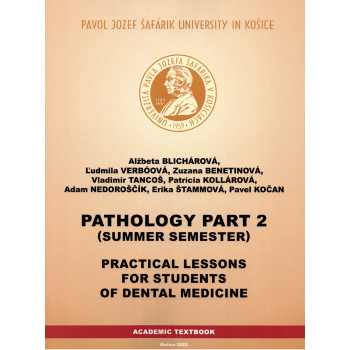
Alžbeta Blichárová - Ľudmila Verbóová - Zuzana Benetinová - Vladimír Tancoš - Patrícia Kollárová - Adam Nedoroščík - Erika Štammová - Pavel Kočan
“Pathology Part 2 (summer semester) - Practical lessons for students of dental medicine” represents the second half of the university textbook designed for the pregradual study of pathology. The textbook complements the lectures of pathology and serves as a source of information for students of dental medicine, that are preparing for the practical credit, as well as the final oral examination.
In this part of the “Pathology” series, forty-four selected histopathological slides are presented. Each selected slide is provided with general information in relation to etiology and pathogenesis of the disease, as well as with corresponding morphological features, including the gross appearance and the most important histopathological characteristics. The textbook summarizes the basic concepts of systemic pathology (pathology of the heart, vessels, lungs, gastrointestinal, urogenital system, breast, musculoskeletal, nervous system, skin and infancy) and pathology of the orofacial region, that is logical continuation and completion of general pathology in the first semester.
E-book
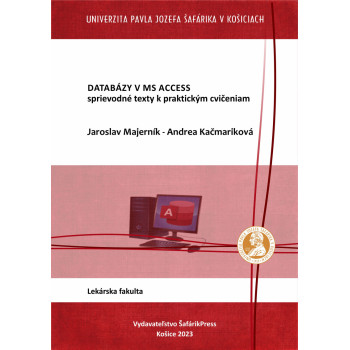
Jaroslav Majerník - Andrea Kačmariková
The university textbook "Databases in MS Access - accompanying texts for practical exercises" is intended for students of medical faculties, students of non-technical universities and all beginners in working with databases. It introduces the reader to the issue of database data processing and explains the basic principles that need to be known when creating relational databases. It is therefore suitable for those who have not yet worked with databases, or who have started thinking about managing their data using their own database.
However, even more "experienced" computer users can find useful information here. The university textbook is written in the way that its content can be mastered with basic knowledge of working with computers and programs running in the environment of MS Windows operating system.
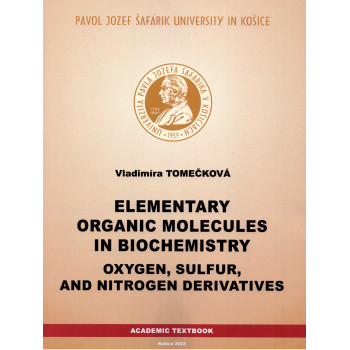
Nature, as well as the human body, contains an abundant quantity of organic molecules. This textbook describes selected oxygen, sulfur, nitrogen derivatives of hydrocarbons, heterocyclic compounds of their reactions, which are important in the human body or are found in pharmaceutical active substances, poisons, foodstuffs and heat-treated food. The last part of the textbook describes the isomerism of organic compounds, which enables dynamic changes in the structure of molecules that have different properties. Nature is filled with different plants and animals and is the first laboratory to produce bioactive organic natural compounds. These compounds are compatible with human cells and are applicable as therapeutic medicine. There is an effort to reproduce natural molecules in chemical laboratories, but they cannot be as perfect as the natural ones. Synthetic molecules can serve as a model for multiple studies, but there still does not exist a magic panacea pill or a perfect copy of nature, for the treatment of various diseases. Knowledge about the regenerative and toxic effect of medicinal substances in dependence on their structure (type and number of substituents) is very important for the understanding of their role in modulation of health and disease in dependence on their concentration. Compounds can be used daily only in recommended doses (higher doses can be toxic), but still will not replace a healthy diet. People need a varied diet to be healthy, in which are all necessary nutrients, what Hippocrates demonstrated long ago “Let food be the medicine, and let medicine be the food.” This book is written for students who select bioorganic chemistry subject during the study of general medicine or dentistry as well as for motivated students who would like to practice their knowledge and wish to improve in this subject and for students who would like to learn simplified basic organic reactions with their future application in biochemistry. Learn the simple models mainly through creative simple instruction by using different colours, by repetition, practice by drawing of formulas by hand (at least three times) and memorization of common names of compounds and their reactions which have application in biochemistry. Thus, establishing simple educational methods how to distinguish organic molecules according to the colours of a functional group can promote universal learning for all students who thought that chemistry is a difficult subject, but hopefully they change their opinion after study of this book.
Keywords: organic molecules, oxygen, sulfur, nitrogen derivatives of hydrocarbons, heterocyclic compounds, chemical reactions, isomerism of organic compounds