Slovenčina


E-book
Renáta Orosová (executive editor)
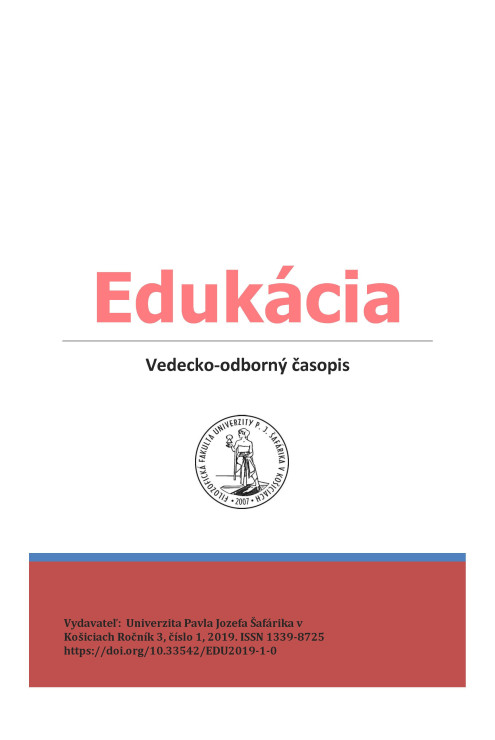
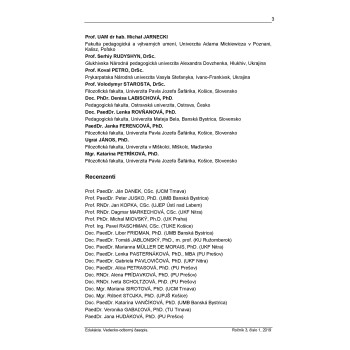
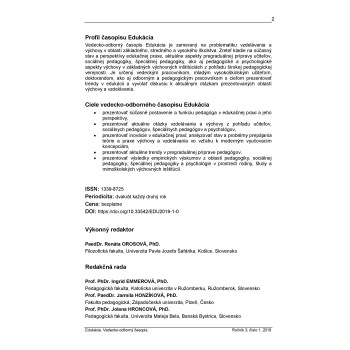
The scientific-professional journal Edukácia focuses on issues of education and upbringing in primary, secondary, and higher education. It emphasizes the current state and perspectives of educational practice, current aspects of pre-graduate teacher training, social pedagogy, special education, as well as pedagogical and psychological aspects of education in basic educational institutions from the perspective of the broader pedagogical community. It is intended for researchers, young university teachers, doctoral students, as well as professional and pedagogical staff, with the aim of presenting trends in education and stimulating discussion on current issues in the presented areas of upbringing and education.

Data sheet
E-book
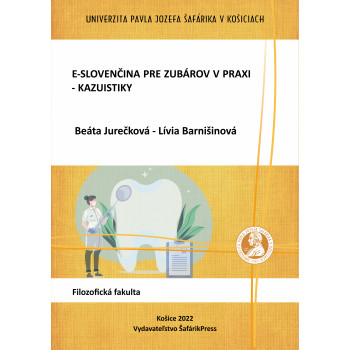
Beáta Jurečková - Lívia Barnišinová
The e-Slovak textbook for dentists in practice - case studies is intended for foreign students of dentistry. It is primarily intended for students of the Slovak language as a foreign language, but the knowledge of the grammatical and lexical basics of the Slovak language at the A1, A2 level is needed.
The textbook consists of eight lessons, which are focused on listening comprehension (audio recordings), vocabulary expansion, systematisation of grammar and development of speech skills (case studies). The two lessons consist of repetitive, concluding exercises. The primary goal of the textbook is to connect language training with professional dental practice.
E-book
Philosophy is interwoven throughout its history with several principles that bring light and order to this kind of thinking, whether it is a systematic or a non-systematic form of philosophizing.
Each of the principles represents in its own way the origin (ἀρχή) of all deductive reasoning, but not all philosophical statements and conceptions are obliged to proceed in the same way, for not all philosophical statements and conceptions are calculus. Actually, such a form of rationalist philosophizing is really a minority in the history of philosophy. But in spite of its minority presence, it will always attract attention to some extent, whether by becoming a pillar of thought itself and finding a permanent place in its foundations, or by becoming an indispensable mainstay of philosophical reasoning. In fact, there are not many principles in the history of philosophical thought.
The state of affairs is primarily due to the heterogeneous and in many cases irrationalist nature of philosophical thinking.
Soňa Lovašová - Katarína Šiňanská - Magdaléna Halachová - Vladimír Lichner (eds.)
The central theme of the conference is violence in social work. Violence in social work appears in various forms, whether it involves working with clients who are victims of different types of violence or dealing with aggressive clients where the social worker themselves becomes the victim. Violence in society is rapidly increasing, and social work is a science that must necessarily adapt to society; this is its essence. Therefore, managing aggressive situations in any form is an important part of a social worker's personal skill set.
Unfortunately, protecting social workers from violence will gradually become a necessity, and in the future, we may not avoid training in self-defense and reducing aggression as part of professional preparation or lifelong education.
The aim of this collection is to present the issue of violence in social work from various perspectives to both the professional and lay public. We hope that this serious problem will receive increasing attention and that the individual contributions will help readers understand the extent of the problem of violence in social work.
E-book
Katarína Gajdošová - Lucia Jasinská
Book of Abstracts from the XXXI Colloquium of Young Linguists (Danišovce, November 30 – December 1, 2022)
In the present book of abstracts from the 31st Colloquium of Young Linguists, VARIA XXXI, we offer readers an overview of the current research efforts of its participants. The volume contains 23 thematically and methodologically diverse contributions by 24 authors from Slovak as well as Czech linguistic institutions. From the perspective of language components, the book includes abstracts from the fields of corpus linguistics, onomastics, morphology, dialectology, syntax, stylistics, lexicology, phraseology, didactics, and also with overlaps into literary texts.
Download e-book for free (pdf)