Slovenčina


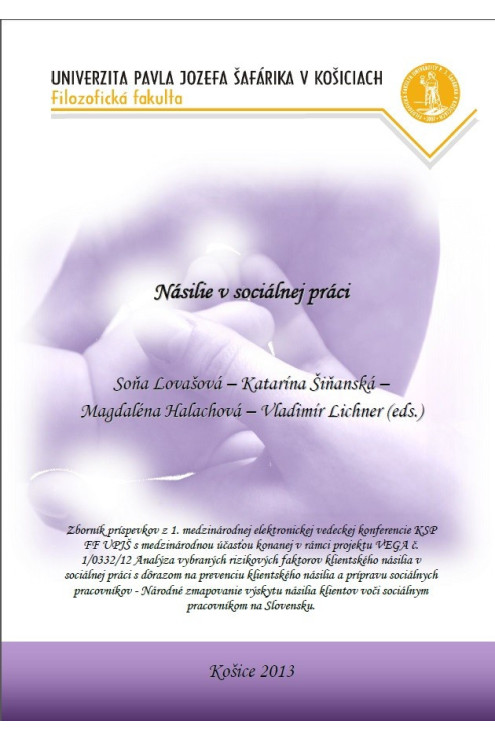
Soňa Lovašová - Katarína Šiňanská - Magdaléna Halachová - Vladimír Lichner (eds.)
The central theme of the conference is violence in social work. Violence in social work appears in various forms, whether it involves working with clients who are victims of different types of violence or dealing with aggressive clients where the social worker themselves becomes the victim. Violence in society is rapidly increasing, and social work is a science that must necessarily adapt to society; this is its essence. Therefore, managing aggressive situations in any form is an important part of a social worker's personal skill set.
Unfortunately, protecting social workers from violence will gradually become a necessity, and in the future, we may not avoid training in self-defense and reducing aggression as part of professional preparation or lifelong education.
The aim of this collection is to present the issue of violence in social work from various perspectives to both the professional and lay public. We hope that this serious problem will receive increasing attention and that the individual contributions will help readers understand the extent of the problem of violence in social work.

Data sheet
E-journal
Juraj Schenk et al.
The scientific journal Sociálne a politické analýzy (Social and Political Analyses) serves as an interactive electronic platform for communication and the presentation (publication) of experts and their work in the fields of basic and applied research and analyses within sociological, psychological, political, and methodological contexts. It is a medium focused on intensively supporting research activities and analyses within an interdisciplinary framework, facilitating the exchange of experiences, fostering collaboration, and revitalizing the production of scientific work in this area.
The publication section of the journal offers space for works such as:
- Original sociological, psychological, and political studies and analyses in any areas of social life
- Methodological studies
- Research reports
- Studies from qualification theses Research and analysis projects
- Reviews
E-book
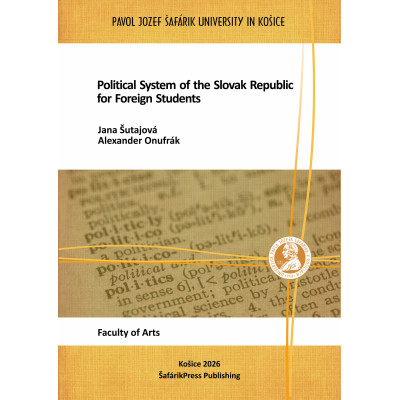
Jana Šutajová Alexander Onufrák
This university textbook, „Political System of the Slovak Republic for Foreign Students“, is designed to introduce Erasmus students and other international students to basic information regarding the historical and political development of Slovakia and the political system of the Slovak Republic. It focuses on political developments since 1918.
It introduces foreign students to pivotal historical events that influenced political developments in Slovakia (the establishment of the First Czechoslovak Republic, the Munich Agreement and the Vienna Arbitration, the Slovak State, postwar developments and the Košice Government Program, the 1946 elections, February 1948, the Prague Spring of 1968, normalization, the Velvet Revolution of 1989, the dissolution of the Czechoslovak Federal Republic, the establishment of the Slovak Republic, and its integration into the European Union and the North Atlantic Treaty Organization) and with the political system of the Slovak Republic (constitutional institutions, the party system, the electoral system).
E-journal
Juraj Schenk et al.
The scientific journal Sociálne a politické analýzy (Social and Political Analyses) serves as an interactive electronic platform for communication and the presentation (publication) of experts and their work in the fields of basic and applied research and analyses within sociological, psychological, political, and methodological contexts. It is a medium focused on intensively supporting research activities and analyses within an interdisciplinary framework, facilitating the exchange of experiences, fostering collaboration, and revitalizing the production of scientific work in this area.
The publication section of the journal offers space for works such as:
- Original sociological, psychological, and political studies and analyses in any areas of social life
- Methodological studies
- Research reports
- Studies from qualification theses Research and analysis projects
- Reviews
E-book
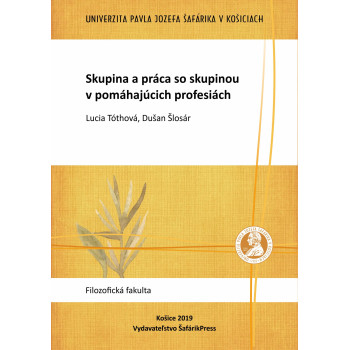
The presented monographic processing of the issues of groups, as a basic phenomenon of our social life, draws a lot of current knowledge from realized researches, their empirical results and practical work with the group, which offers a comprehensive view of the social group. Social group looks both as a natural part of human life and it is analyzed and studied, so that knowledge of the social group can be rewarded.
This has been transferred to artificially created groups to help individuals through group work. At the same time, the monograph also considers the method of social work with a group as one of the methods used in various helping professions.