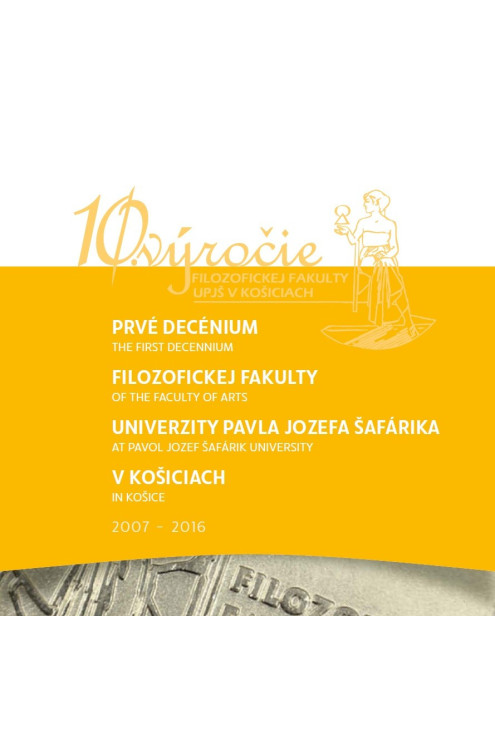
Prvé decénium Filozofickej fakulty Univerzity Pavla Jozefa Šafárika v Košiciach (2007 – 2016)

E-book

Iveta Bónová - Marián Gladiš (eds.)

The Foundation of the Faculty is a major “thing” created and developed by many personalities. The collected information, opinions, and critical judgements have led me to the conclusion that there exist among us plenty of narratives on the formation of this Faculty.

What is appealing about this fact is that from each party concerned, specifically teachers of Philosophy, Psychology and Education at the UPJŠ Faculty of Science, teachers of Psychology at the UPJŠ Faculty of Public Administration in Košice, teachers of the Department of Foreign Languages at UPJŠ, teachers at Prešov University who were approached with a bid to create the conditions of and opportunities for the development of their study branches at the new UPJŠ Faculty of Arts in Košice, there is a significant clue reflected in the inception of the new Faculty of this University.

It is necessary to say that it is a justifiable reflection, because without this, it would not be possible to develop exploration and offer the students courses in the field of Humanities, in social and behavioural sciences, educational sciences, and in the field of History and Ethnology.

Download the e-book for free (pdf)

Quantity

978-80-8152-497-4

Data sheet

Method of publication:
E-book (pdf)
Editors:
Iveta Bónová - Marián Gladiš
Document type:
Other publications
Number of pages:
44
Available from:
15.06.2017
Year of publication:
2017
Edition:
1st edition
Publication language:
slovenčina, angličtina
Faculty:
Faculty of Arts
- Free for download

16 other products in the same category:

Výsledky vedeckého výskumu ako inšpirácia pre...

E-book

E-book

Eva ŽiakováLucia Tóthová et al.

The scientific monograph was developed within the framework of the grant project Vega 1/0230/15 entitled "Social and Personality Characteristics of Oncological Ill Men and Women as one of the most important factors of sociotherapy with this group of men and women clients", with the aim of finding some common personal characteristics oncological men and women patients, to focus on choosing their coping strategies that can be significant in terms of oncological disease as well as suggesting ways and means of using the basic methods of sociotherapy as one of the most important methods of social work in working with this group of men and women clients, from the knowledge of their personal and social characteristics.

It is also a starting point for other necessary steps, namely to link the results of research to prax the themselves oncologists to hospitals, their outpatient clinics and patients as well as to support the merit of developing the sociooncology, a specific science discipline.

Download the e-book for free  (pdf)

Pavol Jozef Šafárik v kontinuite

E-book

E-book

Marianna SedlákováMarián Gladiš (eds.)

The content of the book publication Pavol Jozef Šafárik in Continuity consists of contributions from two events organized by the Department of Slovak Studies, Slavic Philologies, and Communication at the Faculty of Arts of Pavol Jozef Šafárik University in Košice during its short existence.

The first event was a scientific seminar held on the occasion of the 150th anniversary of the death of P. J. Šafárik, titled Pavol Jozef Šafárik – Scientist and Artist, which took place on January 27–28, 2012, in Košice and Kobeliarovo. The second event was an internal scientific seminar on the occasion of the 220th anniversary of Šafárik’s birth, held on December 15, 2015, under the title In the Quiet Home Circle. Symbolically—beginning with death and ending with birth (thus indicating the living continuity of Šafárik’s research legacy)—we aim to continue the study of Pavol Jozef Šafárik’s scientific work and increasingly involve the youngest generation of researchers (represented by doctoral students of the department in the field of literary studies). This is despite the fact that the literature on the life and work of this scholar and poet, who stood at the birth of Slavic studies, is very rich, and most of his works have already been scientifically analyzed. However, it appears that even seemingly outdated views of Šafárik still deserve scientific attention in the new context of humanities and natural sciences, as can be read in the contributions published in this volume.

Through the continuous publication of the Collected Works of Pavol Jozef Šafárik, both mentioned seminars, and the publication of this volume, the Faculty of Arts of Pavol Jozef Šafárik University in Košice has continued the activities of the Prešov Faculty of Arts from the time before its separation from the union of faculties of Pavol Jozef Šafárik University in Košice in 1997. The selection and arrangement of contributions in the volume symbolize the "passing of the baton" in research and publishing activities related to Pavol Jozef Šafárik—a scientific personality of global stature, who in 1959 gave his name to our university.

Compiled by the editors.

Download the e-book for free  (pdf)

Voľby 2023/2024: výsledky - hodnotenia -...

E-book

E-book

Alexander Onufrák, Peter Dubóczi, Lukáš Jakabovič

The submitted publication entitled Voľby 2023/2024: výsledky – hodnotenia – dôsledky reflects a wide range of topics related to the electoral processes that took place in 2023 and 2024 in Slovakia and abroad. The publication deals with both the evaluation of the currently valid electoral legislation, including proposals for its further improvement, and the broader socio-political consequences of the elections in connection with democratization and integration processes. The submitted publication is published as an output of the VEGA project No. 1/0474/24 Audit of Slovak electoral and referendum legislation, the project leader of which is prof. JUDr. Ladislav Orosz, CSc. from the Faculty of Law of the Pavol Jozef Šafárik University in Košice and in which the Department of Political Science of the Faculty of Arts of the Pavol Jozef Šafárik University in Košice also participates. The authors of the individual contributions analyze all types of elections, from municipal and regional, through parliamentary and presidential, to elections to the European Parliament. While some authors focused primarily on the local or regional level, others chose an approach focused on the national or supranational level, and the geographical scope of the cases examined was extremely diverse. 

Download the e-book for free (pdf.)

Prejavy radikalizmu a extrémizmu v sociálnych...

E-book

E-book

Lucia TóthováDušan Šlosár

The publication "Manifestations of Radicalism and Extremism in Social Relations" is an input analysis of the individual areas that the authors want to focus on in their research activities in the study of radicalism and extremism. The context of the study is in the possibility of social work in influencing radical and extremist tendencies in those areas that we can designate as working fields of social work.

The authors of the individual papers focus on the theoretical definition of extremism and radicalism, types and forms of extremism, factors affecting the formation of the radical and extremist thoughts, focusing on specific target groups (especially youth) and the role of social work in the issue of radicalism and extremism, and they also represent the results of research in the field.

Download the e-book for free (pdf)

Lingua Latina – cvičebnica pre filozofov

E-book

E-book

Jana BalegováFrantišek Šimon

The university textbook "Lingua Latina – Exercise Book for Philosophers" is a parallel study material to the textbook "Lingua Latina – Cursus Communis." It is designed for practicing grammatical lessons at home. The content of the exercises corresponds to the focus of each lesson in the mentioned textbook, both in terms of the covered grammatical phenomena and vocabulary. For this reason, only vocabulary not included in the lessons of the textbook is presented in the exercises.

The Latin-Slovak dictionary at the end of the exercise book contains the entire vocabulary from both the exercise book and the textbook, while the Slovak-Latin dictionary includes the vocabulary from exercises that require translation into Latin. The vocabulary in this exercise book is oriented towards the needs of philosophy students and, with regard to the selection of source materials, also includes non-classical lexicon or non-classical meanings of classical words (this lexicon is marked with an asterisk *).

The exercise book includes a key that allows students to directly verify the correctness of their work. The textbook "Lingua Latina – Exercise Book for Philosophers" is available electronically in PDF format. As part of the educational program, online tests available on the website of the Department of Classical Philology at the Faculty of Arts, UPJŠ (https://www.upjs.sk/filozoficka-fakulta/katedra-klasickejfilologie/katedra/) also serve to practice the covered material.

Download the e-book for free (pdf)

Teaching Across Cultures: Building...

E-book

E-book

Ingrid Madárová - Lívia Barnišinová - Barbara Mitríková - Zuzana Kolaříková Veronika Pálová - Lucia Tóthová

This handbook is primarily intended for university teachers who regularly come into contact with international students. It focuses on supporting effective intercultural communication in the academic environment. Through examples of specific situations from everyday academic life, it offers recommendations on how to prevent potential misunderstandings arising from intercultural differences. It also includes practical advice aimed at building open, culturally sensitive, and respectful communication that enhances mutual understanding and fosters an inclusive educational environment.

Download the e-book for free (pdf)

Mediácia v systéme sociálnej práce

E-book

E-book

Dušan ŠlosárVladimír Lichner

This university textbook aims to provide readers with knowledge of the philosophical foundations, meaning, and purpose of mediation, based on research and analysis of mediators' activities. In countries where mediation services operate, their staff often include graduates of social work departments.

An individual approach to both the perpetrator and victim of a criminal offense requires knowledge and skills from social work, psychology, sociology, communication, and related fields tied to social work. The principles of social work apply not only in social policy and social care but also in justice. A mediator’s mission is to facilitate alternative resolutions to unlawful acts while preserving the purpose of legal proceedings as defined by valid legal norms. They fulfill this mission through specific methods of individual social work applied in the justice sector. The mediator’s focus extends beyond the current conflict to uncover related issues, activate parties to resolve disputes, and prevent new conflicts.

Special attention is devoted to the philosophical foundations of mediation in Slovakia. We provide an overview of mediators’ core activities and mediation types used to uphold justice in Slovakia. We analyze mediation goals, the roles of parties involved, and procedural steps. In applying mediation, we explore its potential and implementation in both legal and social work contexts.

As indicated, mediation cannot be understood solely as a specialized activity in criminal justice, as it has broader applications in non-judicial dispute resolution, such as family or community work, which are often overlooked by the public. The mediator’s approach to diverse target groups is grounded in theoretical frameworks. From this foundation, we derive activities expected of mediators in the future. Expanded activities arise from concrete situations encountered during mediation.

Download the e-book for free (pdf)

Pomáhajúce profesie a starostlivosť o seba z...

E-book

E-book

Miroslava KöverováMargita Mesárošová (eds.)

The publication „Helping professions and self-care from the perspective of psychology and social work“ includes research studies focused on self-care, and the positive and negative effects of helping among specific groups of helping professionals – psychologists and social workers.

A number of Slovak as well as foreign authors contributed to the book of proceedings. The contributions are theoretical studies, research studies and case studies. The theoretical and research studies are focused on important issues of professional helping: self-care, compassion satisfaction, compassion fatigue, burnout, perceived stress, secondary traumatic stress, mindfulness, empathy, job satisfaction and turnover among psychologists and social workers.

Research interest in the phenomena is especially important in the context of the mental health of helping professionals and in reducing the negative consequences of helping. 

Download the e-book for free (pdf)

Betriebswirtschaft für Übersetzer. Lehr- und...

E-book

E-book

Blanka JenčíkováUlrika Strömplová

Text book Betriebswirtschaft für Übersetzer. Lehr- und Übungsbuch is primarily intended for students of translation and interpreting who speak German at least at level B1 of the European Framework of Reference for Languages. The aim is to convey basic knowledge about business and entrepreneurship, to build a basic terminology database, to consolidate selected grammatical phenomena, and to develop translation procedures and strategies. The thematic areas were selected with regard to common translation and interpretation practice.

Download e-book for free (pdf)

Sociálne a politické analýzy 2-2009

E-book

E-journal

Juraj Schenk et al.

The scientific journal Sociálne a politické analýzy (Social and Political Analyses) serves as an interactive electronic platform for communication and the presentation (publication) of experts and their work in the fields of basic and applied research and analyses within sociological, psychological, political, and methodological contexts. It is a medium focused on intensively supporting research activities and analyses within an interdisciplinary framework, facilitating the exchange of experiences, fostering collaboration, and revitalizing the production of scientific work in this area.

The publication section of the journal offers space for works such as:

- Original sociological, psychological, and political studies and analyses in any areas of social life

- Methodological studies

- Research reports

- Studies from qualification theses Research and analysis projects

- Reviews

Download the e-journal for free (pdf)

Uplatnenie systémovej teórie pri integrácii...

E-book

E-book

Jana BajusováDušan Šlosár

The integration of immigrants into society is currently of interest to many professionals and to the general public. Immigration is a consequence of a variety of factors, mainly due to political, social, economic or security conditions in the countries of origin. Immigration is subsequently linked to the process of integrating immigrants into the host country. The integration of immigrants into society or integration, as this process is called in the monograph, is a complex phenomenon that extends to many spheres of everyday life for the citizens of the receiving country, and at the same time is often difficult for immigrants. Many governmental and non-governmental organizations are involved in the process of social integration of immigrants, who develop different strategies and mechanisms to streamline the outcome of this process.

In relation to immigrants, the Slovak Republic is bound to provide social and legal protection and therefore it is necessary to deal with the issue of social services, which could potentially significantly contribute to their social integration into Slovak society. From the legislative point of view, however, these services are unified and do not take into account the differences of immigrants resulting from their culture, religion, social, ethical or other characteristics. That is why the monograph focuses on social integration of immigrants in Slovakia in the context of provided social services.

Download the e-book for free (pdf)

Školský systém na Slovensku v medzivojnovej...

E-book

E-book

Soňa Gabzdilová

The educational system (schooling) is one of the most effective tools for shaping the young generation in any advanced society. Schools not only create the knowledge base necessary for fulfilling the demands of the economy and the social sphere, but they also shape the national and ideological identity of each member of society. The school plays a decisive role in forming positive values, but it can also become a breeding ground for xenophobia and racist attitudes. The school has an irreplaceable role in creating national consciousness, identification with one's own nation, its history, the heroic deeds of ancestors, and the meaning of its existence.

After the dissolution of Austria-Hungary, there were fundamental geopolitical changes in Central Europe. One of these was the creation of Czechoslovakia, a state founded on radically different principles than pre-war Hungary. The founders of the Czechoslovak Republic (CSR), the personalities who decisively determined the character of the political system in the newly established republic, did not belong to the privileged classes of the previous regime. Unlike Hungary, where political power was controlled almost without exception by the nobility, the elite in Czechoslovakia consisted of men who were radical critics of Austria-Hungary.

A fitting example was the most influential figure of interwar Czechoslovakia, President Tomáš Garrigue Masaryk. Despite his origins, Masaryk was perceived by both Czechs and Slovaks as the founder of the state, a legendary figure whose political and social influence far exceeded the powers of the presidential office.

Download the e-book for free (pdf)

„Pán doktor, rozumiete po slovensky?“

E-book

SLOVAK IN DIALOGUES FOR BEGINNERS – INTERNATIONAL MEDICAL STUDENTS - Workbook

E-book

Ingrid MadárováVeronika PálováLucia Tóthová

Audio attachments - format RAR

The audio-exercise workbook “Pán doktor, rozumiete po slovensky?”is a follow-up to the textbook “Pán doktor, hovoríte po slovensky?” (Madárová et al.)and is intended for international students of Slovak as a foreign language in the medical environment.

This workbook provides the students with an opportunity to practise and enhance mostly their listening skills and pronunciation through various short dialogues between doctors and patients in the Slovak language. Dialogues contain the vocabulary used in the textbook Pán doktorhovoríte po slovensky?.  Students are encouraged to build their confidence in speaking Slovak by practising these dialogues in the new workbook.

The audio-exercise workbook is comprised of 16 units. Each unit offers short dialogues and recordings

A number of dialogues enable its wide use for self-studying while the most frequent phrases related primarily to body parts, signs and symptoms of illnesses, diseases or various medical conditions are practised in different contexts in a variety of exercises.

Original illustrations enable students to understand dialogues more easily and the correct answers of the exercises and the scripts of the recordings can be found in the Answer key at the end of the workbook.

Download the e-book for free (pdf)

Lingua Latina – cvičebnica pre historikov

E-book

E-book

Jana Balegová

University textbook Lingua Latina – Exercise Book for Historians is a parallel study material to the textbook Lingua Latina – Cursus Communis. It is designed for practicing grammar at home. The content of the exercises corresponds to the focus of the individual lessons in the mentioned textbook, both in terms of the covered grammatical phenomena and vocabulary. For this reason, only vocabulary not covered in the textbook's lessons is included in the exercises.

The Latin-Slovak dictionary at the end of the exercise book contains all the vocabulary from both the exercise book and the textbook. The Slovak-Latin dictionary includes the vocabulary from exercises that require translation into Latin. The vocabulary in this exercise book is oriented towards the needs of history students and, given the selection of source materials, also includes non-classical lexicon or non-classical meanings of classical words (this lexicon is marked with the symbol *).

The exercise book includes a key that allows students to directly verify the correctness of their work. The textbook Lingua Latina – Exercise Book for Historians is available electronically in PDF format. As part of the teaching program, online tests available on the KKF FF UPJŠ website (https://www.upjs.sk/filozoficka-fakulta/katedra-klasickejfilologie/katedra/) also serve to practice the covered material.

Download the e-book for free (pdf)

e-Slovenčina pre zubárov v praxi – kazuistiky

E-book

E-book

Beáta JurečkováLívia Barnišinová

The e-Slovak textbook for dentists in practice - case studies is intended for foreign students of dentistry. It is primarily intended for students of the Slovak language as a foreign language, but the knowledge of the grammatical and lexical basics of the Slovak language at the A1, A2 level is needed.

The textbook consists of eight lessons, which are focused on listening comprehension (audio recordings), vocabulary expansion, systematisation of grammar and development of speech skills (case studies). The two lessons consist of repetitive, concluding exercises. The primary goal of the textbook is to connect language training with professional dental practice.

Download the e-book for free  (pdf)

How to Use Slovak in a Medical Environment...

€17.00
Availability: 28 In Stock

Helena Petruňová

Učebnica je určená pre vyučovanie slovenského jazyka pre začiatočníkov (úroveň A1, A2 podľa SERR), zahraničných študentov lekárskej fakulty, odboru všeobecné lekárstvo a zubné lekárstvo. 

Učebnica AKO POUŽÍVAŤ SLOVENČINU V LEKÁRSKOM PROSTREDí  základy slovenčiny pre študentov medicíny obsahuje 13 lekcií, ktoré sú vhodné pre samoštúdium a pre prácu s učiteľom na jazykovom seminári. Tematicky zamerané lekcie ponúkajú základy slovenskej výslovnosti, slovnej zásoby, krátke dialógy a jednoduchý výklad užitočnej gramatiky. Všetky cvičenia a aktivity umožňujú študentom osvojovať si a precvičovať bohatú lekársku slovnú zásobu a vybranú gramatiku v kontexte. Obsahujú kľúčové slová, slovné spojenia, jednoduché frázy a základné otázky, ktoré sa používajú v komunikácii lekára s pacientom. Dôraz sa kladie na funkčnosť jazyka pre získavanie údajov o zdravotnom stave pacienta, o jeho živote, rodinnom prostredí, o chorobách predkov, súrodencov a pod. Na konci učebnice sú tematicky zoradené užitočné slová a slovné spojenia z prostredia nemocnice, zoznam základných slovies a kľúč k cvičeniam.   

This website uses cookies to ensure you get the best experience on our website