Slovenčina


E-book
Eva Žiaková (ed.)
The 5th edition of the Košice Days of Social Work
Proceedings of the scientific conference with international participation held on November 25, 2016, in Košice
The issue of re-education and resocialization is not new, but it is an increasingly urgent problem as various types of dependencies grow in both scope and content. It can be said that this issue represents one of the central themes of social work in its theoretical foundations as well as practical contexts.
This was the main reason for selecting this topic as the central theme of the 5th edition of the Košice Days of Social Work, which was the sixth continuation of the professional community’s gatherings to address social problems currently troubling our society. The presented proceedings include nearly three dozen contributions from more than twenty authors from Slovakia, as well as Poland and the Czech Republic. The content of the contributions deals not only with theoretical foundations and perspectives on the issue of resocialization and re-education but also with the consequences of these processes in various client social risk groups—whether it involves the addicted, aggressive, chronically ill, convicted, divorced, bullied, cyberbullied, etc.
I believe that such a wide range of contributions will enrich all those who work and study in the theoretical, research, and practical fields of social work.

Data sheet
E-book
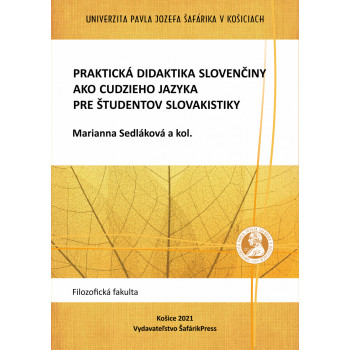
Marianna Sedláková a kol.
The textbook is intended for students of Slovak studies to study the subject of didactics of Slovak as a foreign language.
Its core consists of relevant knowledge gained from the didactics of Slovak as a foreign language, with references to other professional literature. The textbook also includes practical guides for teaching specific language phenomena in schools with Hungarian as the language of instruction or in schools where students predominantly have a mother tongue other than Slovak, such as Romani. Essentially, it involves transforming knowledge acquired and verified in teaching adult foreigners, mainly at universities, into a didactic context for the second level of elementary school and high school, with appropriate emphasis on teaching Slovak as a foreign language at the first level of elementary school as the starting point for the educational process.
The textbook builds on the findings of real research on the state of teaching Slovak as a foreign language in elementary and secondary schools in eastern Slovakia, conducted in projects (EXPERT and DiSaC) implemented at UPJŠ in Košice from 2012 to 2015.
E-book
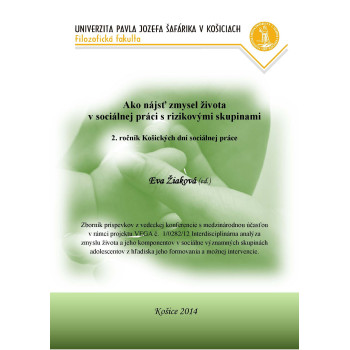
Eva Žiaková (ed.)
Proceedings of the Scientific Conference with International Participation within the VEGA Project No. 1/0282/12 Interdisciplinary Analysis of the Meaning of Life and Its Components in Socially Significant Groups of Adolescents in Terms of Its Formation and Possible Intervention.
The introductory word is a very good opportunity for us to jointly evaluate what we have managed to achieve in addressing our common scientific research task focused on the study of the meaning of life in socially at-risk groups of adolescents. First and foremost, we asked ourselves what we have discovered about the meaning of life so far, that is, what we know about it.
The second question we asked was: what surprised us about the results we have obtained so far. The third question was about what we want to do to resolve the discrepancy between what we have discovered and what we want to achieve.
The final question in evaluating the solution of the scientific research task was: what do we (not) know about the meaning of life of adolescents and want to know in the future, or what should we focus on to develop the most effective logotherapeutic and sociotherapeutic methods for social workers working with socially at-risk groups of adolescents.
E-journal
Juraj Schenk et al.
The scientific journal Sociálne a politické analýzy (Social and Political Analyses) serves as an interactive electronic platform for communication and the presentation (publication) of experts and their work in the fields of basic and applied research and analyses within sociological, psychological, political, and methodological contexts. It is a medium focused on intensively supporting research activities and analyses within an interdisciplinary framework, facilitating the exchange of experiences, fostering collaboration, and revitalizing the production of scientific work in this area.
The publication section of the journal offers space for works such as:
- Original sociological, psychological, and political studies and analyses in any areas of social life
- Methodological studies
- Research reports
- Studies from qualification theses Research and analysis projects
- Reviews
E-book
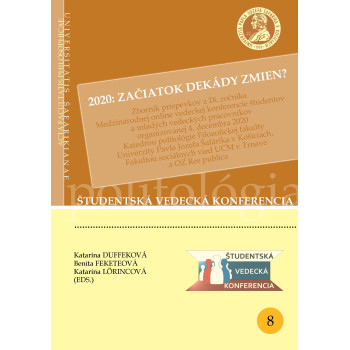
Katarína Duffeková - Benita Feketeová - Katarína Lörincová (eds.)
The presented work is a collection of contributions from the 9th International Online Scientific Conference of Students and Young Scientists, organized on December 4, 2020 by the Department of Political Science, Faculty of Arts, Pavol Jozef Šafárik University in Košice, the Faculty of Social Sciences UCM in Trnava and the OZ Res Publica.
The aim of the publication is to provide a platform to discuss important issues which could influence the course of events in next decade in Slovakia, Europe and world.
The publication consists of more than twenty articles, which are primarily in Slovak but also in English. The contributions deal with both domestic and foreign policy with focus on the third decade of the 21st century.
In addition to geopolitical issues, the contributions also cover migration, regional integration, populism and nationalism, the influence of the media and social networks in the political sphere and also the development of liberal democracy. The authors also address issues of municipal policy, the electoral system and the referendum.