Slovenčina


E-book
The educational system (schooling) is one of the most effective tools for shaping the young generation in any advanced society. Schools not only create the knowledge base necessary for fulfilling the demands of the economy and the social sphere, but they also shape the national and ideological identity of each member of society. The school plays a decisive role in forming positive values, but it can also become a breeding ground for xenophobia and racist attitudes. The school has an irreplaceable role in creating national consciousness, identification with one's own nation, its history, the heroic deeds of ancestors, and the meaning of its existence.
After the dissolution of Austria-Hungary, there were fundamental geopolitical changes in Central Europe. One of these was the creation of Czechoslovakia, a state founded on radically different principles than pre-war Hungary. The founders of the Czechoslovak Republic (CSR), the personalities who decisively determined the character of the political system in the newly established republic, did not belong to the privileged classes of the previous regime. Unlike Hungary, where political power was controlled almost without exception by the nobility, the elite in Czechoslovakia consisted of men who were radical critics of Austria-Hungary.
A fitting example was the most influential figure of interwar Czechoslovakia, President Tomáš Garrigue Masaryk. Despite his origins, Masaryk was perceived by both Czechs and Slovaks as the founder of the state, a legendary figure whose political and social influence far exceeded the powers of the presidential office.

Data sheet
E-journal
Juraj Schenk a kol.
The scientific journal Sociálne a politické analýzy (Social and Political Analyses) serves as an interactive electronic platform for communication and the presentation (publication) of experts and their work in the fields of basic and applied research and analyses within sociological, psychological, political, and methodological contexts. It is a medium focused on intensively supporting research activities and analyses within an interdisciplinary framework, facilitating the exchange of experiences, fostering collaboration, and revitalizing the production of scientific work in this area.
The publication section of the journal offers space for works such as:
- Original sociological, psychological, and political studies and analyses in any areas of social life
- Methodological studies
- Research reports
- Studies from qualification theses Research and analysis projects
- Reviews
E-book
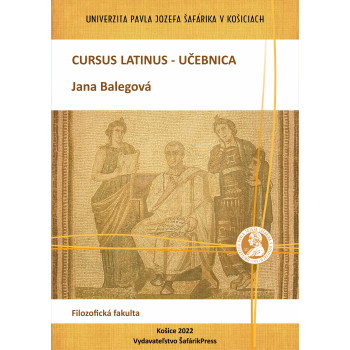
University textbook „Cursus Latinus - textbook“ is intended for students of the study program Latin language and literature. It is divided into „Introduction“ and 37 lessons. The content of lessons is morphology, sentence syntax and selected phenomena of case syntax of the Latin language. Each of the lessons contains a grammatical explanation, followed by sentences designed to demonstrate the forms of grammatical phenomena and the required vocabulary (Dictionary). Using these examples, students learn the basic principles of translation from Latin into Slovak and from Slovak into Latin. The textbook also includes a Latin-Slovak dictionary containing the entire vocabulary used in the textbook. The „Cursus Latinus - textbook“ is intended for the interpretation of grammar and the acquisition of grammatical phenomena of the Latin language under the guidance of the teacher. A parallel exercise book (Cursus Latinus – exercise book) is used to practice Latin grammar at home. The exercise book includes a key to the exercises and a Latin-Slovak dictionary containing vocabulary from the textbook and the exercise book. University textbook „Cursus Latinus - textbook“ is available electronically in PDF format.
E-book
Eastern Christianity, represented in Slovakia by the Greek Catholic and Orthodox Churches, has influenced the development of Slovak society over the centuries. Both the common history and the coexistence of the two churches in one geographical area have brought diverse experiences that both churches keep in mind.
The university textbook, which deals with their history, contains basic materials for study and focuses on important milestones in their history. It contains general information about the origin of Eastern Christianity and presents in chronological order knowledge of the history of the churches that represent it in Slovakia from the 9th to the 21st century.
E-book
Vladimír Leško - Zlatica Plašienková (eds.)
Philosophical Proceedings Kant in the Contexts of Husserl's and Heidegger's Philosophy is a presentation of the results of the Second International Philosophical Conference, which took place on November 5-7, 2008 at the UPJŠ in Košice.
The conference was prepared by the Department of Philosophy and History of Philosophy, Faculty of Philosophy, UPJŠ in very close cooperation with the Slovak Philosophical Association at the Slovak Academy of Sciences in Bratislava. The structure of the presented proceedings was divided into three basic parts. The first part contains the papers that were presented at the conference and constitute a crucial part of the content of our proceedings. The individual papers are arranged in the order in which they were presented at the conference. The second part of the proceedings contains the speeches from the inauguration ceremony of the award of the honorary title of Doctor honoris causa to Milan Sobotka and Teodor Münz. In the third part, a photo-documentation is published in which the ceremonial academic act of conferring the honorary degree of Doctor honoris causa is captured. Translated with DeepL.com (free version)