Slovenčina



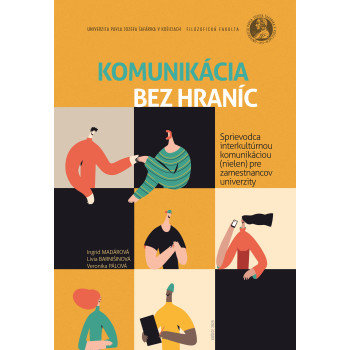
E-book
Ingrid Madárová -Lívia Barnišinová - Veronika Pálová
Táto príručka priamo prispieva k budovaniu inkluzívneho akademického prostredia, kde sa zahraniční študenti cítia vítaní a pochopení. Zároveň podporuje vzdelávacie a profesionálne zručnosti zamestnancov v oblasti interkultúrnej komunikácie, čo v konečnom dôsledku vedie k zvýšeniu kvality služieb poskytovaných univerzitou a k zlepšeniu medzinárodnej spolupráce.

Data sheet
E-book
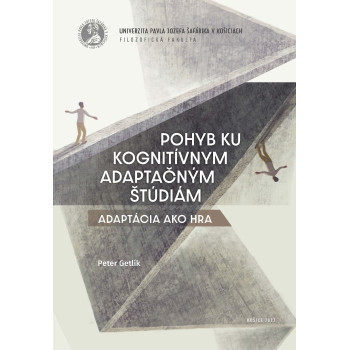
The main goal of the monograph "Moving Towards Cognitive Adaptation Studies: Adaptation as Play" was to orient current research in adaptation studies towards the empirically responsible cognitive branch of non-radical constructivism.
This intention results from the rapid progressive differentiation of adaptation studies research, which has mainly manifested itself in this area in the last two decades. With the model of adaptation as play in a cognitive-scientific perspective, author provides the possibility of predicting the nature (also in a broader sense) of the experience of adaptation. Since the form of this experience significantly shapes the products of the adaptation process into their final form, the model of adaptation as play can be applied even in the interpretation of individual adaptations. In the monograph, the author synthesized the model of adaptation as play based on the knowledge of various disciplines. In the field of cognitive sciences, he saw help from the starting points of philosophy, linguistics, informatics, psychology, anthropology, biology and neuroscience – especially affective neuroscience, which also deals with the emotional dimension of the play.
In the intersection with the essential interdisciplinary components of adaptation research, he also used the knowledge of classical and cognitive variations of literary science, film science (also theatrology) and media studies to a large extent. Consistent with other similar results of cognitive sciences, it turns out that even seemingly serious adaptations, like in many aspects of our culture, have a ludic base.
E-book
Jozef Bavoľár - Ladislav Lovaš - Simona Ďurbisová
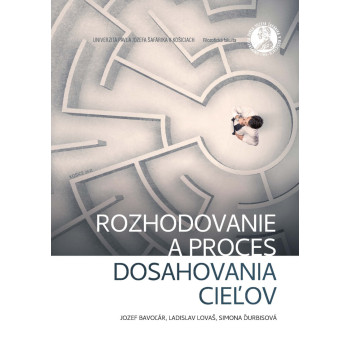
The process of achieving goals is one that has traditionally received significant attention in psychology. This attention is not only directed by researchers focused on motivation, with which the process of achieving goals is classically associated, but also from a wide range of other areas (e.g., emotions, personality). One aspect of goal-directed behavior that has received minimal, if not virtually no, attention is decision-making.
It is surprising to realize that various aspects of decision-making are present throughout the entire process of achieving goals - from evaluating different aspects of multiple alternative goals, through selecting among them, deciding on resource allocation (effort, time, finances, relationships...), continuously monitoring progress, to evaluating the outcome and its impact on future goal-directed behavior.
Even more surprising is that decision-making is directly addressed by one of the dominant theories explaining goal-directed behavior - the theory of mental action phases (mindset theory of action phases; Gollwitzer 1999, 2012). This theory distinguishes the pre-decisional and post-decisional phases as the first two phases of this behavior, separated precisely by the decision about which goal to pursue.
Download e-book for free (pdf)
E-book
The university textbook "Theories of Intercultural Communication" is primarily intended for master's degree students of translation and interpreting, as well as doctoral students of British and American Studies.
The goal of the textbook is to familiarize students with key theories in the field of intercultural communication. Eight chapters cover a selection of current theories focused on defining cultural dimensions, identity management and negotiation, accommodation and adaptation, anxiety and uncertainty management, and current research on the Sapir-Whorf hypothesis.
The final chapter provides a historical overview of intercultural communication theories and outlines key research questions for the future.
Ľubov Vladyková (ed.)
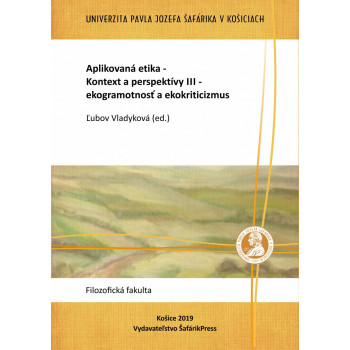
In the present text, opinions on environmental literacy are integrated. The most important discoveries of the 21th century exist not in the realm of science, medicine, or technology, but rather in the dawning awareness of the earth's limits and how those limits will affect human evolution. Humanity has reached a crossroad where various ecological catastrophes meet what some call sustainable development. While a great deal of attention has been given to what governments, corporations, utilities, international agencies, and private citizens can do to help in the transition to sustainability, little thought has been given to what schools, colleges, and universities can do. As the health of our planet continues to deteriorate, it is vital to educate and raise ecoliterate citizens.