Slovenčina



E-book
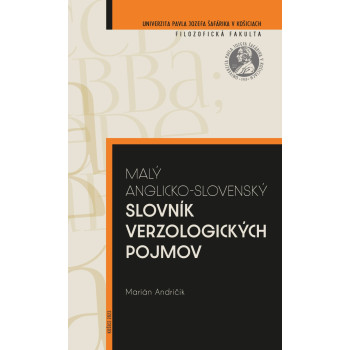
The basis for the creation of this publication was both our many years of translation activities in the field of Anglophone poetry and a consistent interest in theoretical questions in the area of versology. Years of collecting and compiling material ultimately culminated in this dictionary, which we present to the professional public with the awareness of its incompleteness and occasional terminological uncertainty in finding equivalents, since a more comprehensive comparative study in this field has not yet been published.
For this reason, alongside established terminological equivalents, we decided to offer our own proposals for those terms that so far have had no Slovak equivalents – these are graphically marked in italics. Given the narrowly defined target group of users, we have dispensed with the grammatical classification of individual headwords and, except for a few exceptions, also with their phonetic transcription, phenomena common in general dictionaries. In addition to individual headwords, the dictionary also contains established collocations used in versological literature. Since we expect the dictionary to serve as study material for students of English and Slovak philology, we have added a closer characterization or explanation of many equivalents in parentheses.
We believe that this dictionary, the first of its kind in our literary-scientific context, will become a solid foundation for further, more extensive, and more comprehensive handbooks.
Download e-book for free (pdf)
Data sheet
E-book
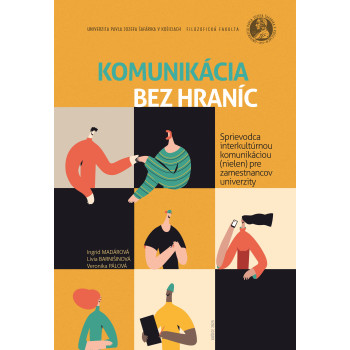
Ingrid Madárová -Lívia Barnišinová - Veronika Pálová
Táto príručka priamo prispieva k budovaniu inkluzívneho akademického prostredia, kde sa zahraniční študenti cítia vítaní a pochopení. Zároveň podporuje vzdelávacie a profesionálne zručnosti zamestnancov v oblasti interkultúrnej komunikácie, čo v konečnom dôsledku vedie k zvýšeniu kvality služieb poskytovaných univerzitou a k zlepšeniu medzinárodnej spolupráce.
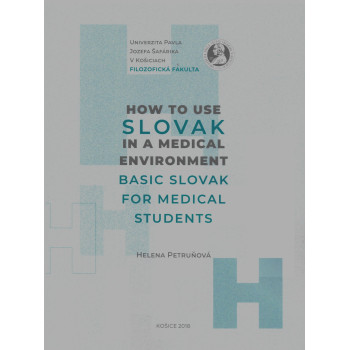
Učebnica je určená pre vyučovanie slovenského jazyka pre začiatočníkov (úroveň A1, A2 podľa SERR), zahraničných študentov lekárskej fakulty, odboru všeobecné lekárstvo a zubné lekárstvo.
Učebnica AKO POUŽÍVAŤ SLOVENČINU V LEKÁRSKOM PROSTREDí – základy slovenčiny pre študentov medicíny obsahuje 13 lekcií, ktoré sú vhodné pre samoštúdium a pre prácu s učiteľom na jazykovom seminári. Tematicky zamerané lekcie ponúkajú základy slovenskej výslovnosti, slovnej zásoby, krátke dialógy a jednoduchý výklad užitočnej gramatiky. Všetky cvičenia a aktivity umožňujú študentom osvojovať si a precvičovať bohatú lekársku slovnú zásobu a vybranú gramatiku v kontexte. Obsahujú kľúčové slová, slovné spojenia, jednoduché frázy a základné otázky, ktoré sa používajú v komunikácii lekára s pacientom. Dôraz sa kladie na funkčnosť jazyka pre získavanie údajov o zdravotnom stave pacienta, o jeho živote, rodinnom prostredí, o chorobách predkov, súrodencov a pod. Na konci učebnice sú tematicky zoradené užitočné slová a slovné spojenia z prostredia nemocnice, zoznam základných slovies a kľúč k cvičeniam.
E-book
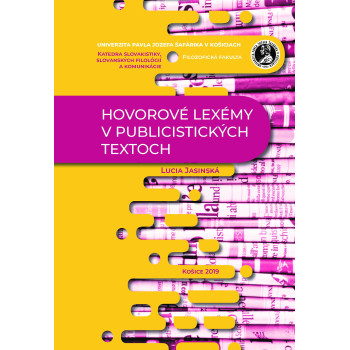
The submitted monograph, "Colloquial Lexemes in Journalistic Texts," presents an original perspective on the analysis and description of lexical and grammatical expressive means in the examined communication field.
The main research problem is the colloquialization of expressive means as a marked feature in publicly published journalistic texts. The starting point of the research itself was the search for lexical units with the stylistic qualifier of colloquiality in the "Short Dictionary of the Slovak Language." Their presence and frequency, as well as any potential shifts in meaning, were verified in publicly accessible media communications.
Since this is research into "living language," the source material consists of journalistic texts in the Slovak National Corpus database.
E-book
The aim of the monograph was to analyze the pedagogical possibilities of educational systems within children's and youth organizations, with an emphasis on those targeting the age group of children up to 15 years.
The starting point was an analysis of the current state of theory and practice in children's and youth organizations, with the intention of describing prevailing trends in their development and activities. This publication closely follows the previous monograph (Juščák, J. – Darák, M.: 2015), in which we processed, according to a unified methodology and using generally accepted pedagogical terminology, the collected available materials on the educational systems of selected (most representative) children's and youth organizations in Slovakia. Through a subsequent comparison of the obtained empirical data on educational systems, we aimed to identify their similar (identical) as well as specific (distinct) elements as a basis for establishing categorization criteria for their classification.
The culmination of our efforts was an attempt to characterize a children's organization as an educational institution, describing its characteristic features, functions, aims, content, principles, and educational methodology.