Filter By

Selections

Selections

Year of publication:

Year of publication:

Publication language:

Publication language:

Faculty:

Faculty:

Active filters

  • Year of publication:: 2012
  • Year of publication:: 2017
  • Year of publication:: 2023
  • Year of publication:: 2023
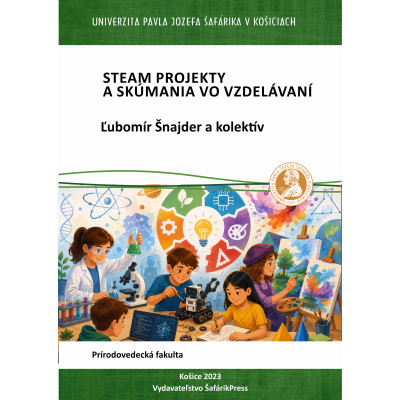
STEAM projekty a skúmania vo vzdelávaní
  • New

STEAM projekty a skúmania vo vzdelávaní

E-book

E-book

Ľubomír Šnajder a kol.

The publication is dedicated to teachers and future teachers of informatics, mathematics and science subjects. The publication presents activities that move students from the role of passive users of digital technologies to that of curious researchers, creative creators and critical thinkers. In the first chapter, we introduce educational strategies and practices to actively engage students in learning. In the second chapter, we briefly describe selected digital technologies that can be an aid to exploring the world around us and creating useful products. In the third chapter, we provide specific ideas for STEAM exploration and projects in which students search answers to real-world questions and solutions to real-world problems. Subject didacticians, experts from different fields and teachers worked closely together to develop ideas for the methodologies.

Download the e-book for free (pdf)

Attachment (zip)
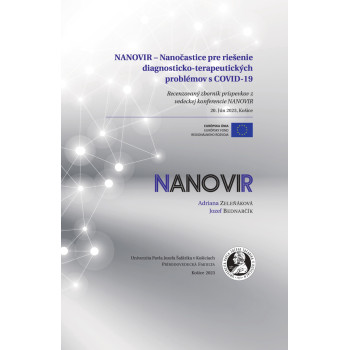
NANOVIR – Nanočastice pre riešenie diagnosticko-terapeutických problémov s COVID-19

NANOVIR – Nanočastice pre riešenie...

E-book

E-book

Adriana Zeleňáková - Jozef Bednarčík

Peer-reviewed Proceedings of the Scientific Conference NANOVIR

The main objective of the scientific conference NANOVIR was the presentation of scientific results obtained during the implementation of the NANOVIR project – Nanoparticles for solving diagnostic and therapeutic problems with COVID-19, co-financed by the European Regional Development Fund within the Operational Programme Integrated Infrastructure 2014 – 2020, ITMS: 313011AUW7.

The project was carried out from January 1, 2021, to June 30, 2023, and was supported with a sum of EUR 1,916,004.79. Three co-investigating organizations participated in the project: Pavol Jozef Šafárik University in Košice as the main investigator, the University of Veterinary Medicine and Pharmacy in Košice as partner no. 1, and the Institute of Experimental Physics of the Slovak Academy of Sciences as partner no. 2.

Download the e-book for free (pdf)

Skenovacia tunelová mikroskopia

Skenovacia tunelová mikroskopia

E-book

E-book

Tomáš Samuely

Today, scanning probe microscopes are standard tools in materials science, physics, chemistry, biology, and engineering. Thousands of these microscopes are in operation worldwide and are at least as common and popular as scanning electron microscopes.

Despite the vast number of newer scanning probe microscopy techniques, classical STM remains a significant and irreplaceable method, widely used, for example, in solid-state research. In this text, we will focus on both traditional and innovative STM techniques that are available and utilized in the laboratories of the Center for Low Temperature Physics in Košice.

Download e-book for free (pdf)

Kvantová teória poľa 1

Kvantová teória poľa 1

E-book

E-book

Michal Hnatič - Tomáš Lučivjanský

This textbook is primarily intended for first-year master's degree students at Pavol Jozef Šafárik University in Košice, especially those in the nuclear physics, subnuclear physics, and theoretical physics programs. For many years, these lectures were taught by one of the authors at this university, and naturally, over time, there arose an effort to provide these lectures to students in printed form.

In this textbook, we will focus mainly on classical field theory, its quantization based on the operator approach, and the introduction of interactions. Descriptions based on functional integration, Feynman diagram techniques, and more advanced parts will be covered in a subsequent volume of the textbook. In this context, we want to emphasize that in many modern quantum field theory textbooks, the operator approach is used to a lesser extent and is replaced by the approach using (functional) path integrals.

This is probably due to time considerations, as the functional approach leads much faster to practical calculations. On the other hand, we believe that the operator approach is better from a pedagogical point of view. It is much closer to the traditional quantum mechanics course, which is often based on the Schrödinger or Heisenberg formalism. Therefore, students can much more easily follow the flow of ideas that led to the construction of quantum field theory and its fundamental concepts.

Download e-book for free (pdf)

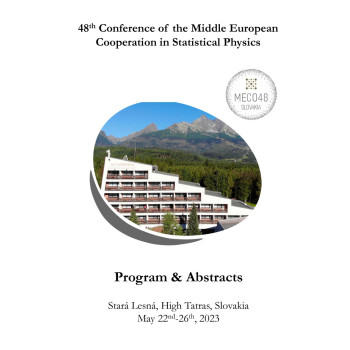
48th Conference of the Middle European Cooperation in Statistical Physics

48th Conference of the Middle European...

E-book

E-book

Jozef Strečka,Katarína Karľová

The 48th Conference of the Middle European Cooperation in Statistical Physics (MECO48) will be held on May 22nd-26th, 2023, in Stará Lesná, High Tatras, Slovakia. The MECO48 conference continues a long tradition of regular international meetings in the domain of statistical physics established in the early 1970s with the aim of bridging the gap between the communities of scientists from the Eastern and Western parts of Europe separated by the iron curtain.

In the modern era the MECO conferences attract attention of the community of scientists who are active in the field of statistical physics including various interdisciplinary applications to biology, medicine, geography, finance, quantum information theory, and machine learning.

The MECO48 conference is organized jointly by Faculty of Science of Pavol Jozef Šafárik University in Košice, Institute of Experimental Physics of Slovak Academy of Sciences in Košice, Institute of Physics, Slovak Academy of Sciences in Bratislava and Faculty of Humanities and Natural Sciences, University of Prešov under the financial support of Slovak Research and Development Agency (grant No. APVV-20-0150) and other sponsors.

Download e-book for free (pdf)

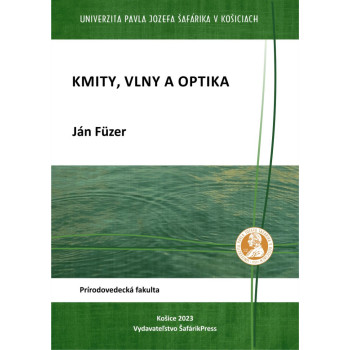
Kmity, vlny a optika

Kmity, vlny a optika

E-book

E-book

Ján Füzer

Auxiliary teaching material for the course General Physics III – Oscillations, Waves, and Optics is intended for students of single-subject and interdisciplinary studies of physics.

The content provides a basic outline of the material covered, without detailed explanations, with an emphasis on the physical method of thinking using the simplest elements of higher mathematics. The presented text does not aim to replace the recommended textbooks, but rather to help students navigate the subject matter. Recommended literature can be found at the end of the text.

The teaching material contains the basic framework of the lectures and is supplemented and revised each year, with lectures enriched by supporting demonstration experiments.

Download e-book for free (pdf)

JARNÁ ŠKOLA DOKTORANDOV 2023

JARNÁ ŠKOLA DOKTORANDOV 2023

E-book

E-book

Peter Fedoročko (ed.)

From June 13 to June 16, 2023, the 9th annual Spring School for Doctoral Students at Pavol Jozef Šafárik University in Košice will take place in Stará Lesná. The scientific program of the spring school will comprise 3 plenary lectures by leading scientific experts and 1 workshop.

Doctoral students will present their research papers in two sections: 24 doctoral students of Faculty of Public Administration, Faculty of Law and Faculty of Arts, and 24 doctoral students of Faculty of Medicine and Faculty of Science. The scientific programme of the spring school will also include a panel discussion with the management of Pavol Jozef Šafárik University in Košice.

Download the e-book for free  (pdf)

Študentská vedecká konferencia PF UPJŠ 2023

Študentská vedecká konferencia PF UPJŠ 2023

E-book

E-book

Marián Kireš  (ed.)

Proceedings of Abstracts from the Student Scientific Conference of the Faculty of Science, Pavol Jozef Šafárik University in Košice

The Student Scientific Conference (SSC) represents the culmination of long-term and intensive work on a selected topic, collaboration with a supervisor, or a broader team at the workplace. In practice, however, it often marks the beginning of scientific research, focusing on a chosen subject, field, or close cooperation with a future supervisor of a bachelor's, master's, or doctoral thesis.

This year, the Student Scientific Conference took place on April 19, 2023, featuring 14 sections, a programming competition, and the IHRA contest. Bachelor’s and master’s students presented 101 contributions. Additionally, 8 high school students participated non-competitively, presenting their SOČ projects; 14 students took part in the programming competition, and 3 students competed in the IHRA contest.

We believe that the proceedings of abstracts and related documents serve not only as an archive but also as a dignified presentation of scientific activities at our faculty for the wider public.

Download the e-book for free  (pdf)

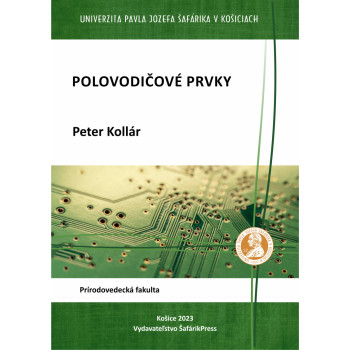
Polovodičové prvky

Polovodičové prvky

E-book

E-book

Peter Kollár

The textbook Semiconductor Elements was developed gradually over the past years as an aid for second-year master's students in condensed matter physics. It is intended to support students’ understanding of lectures, considering that important texts, mathematical relationships, and illustrations are provided in advance in the form they will be presented during the lecture.

This allows students to supplement individual pages with their own notes during the lecture, either electronically or in printed form. In this way, a study aid is created for the student, which I believe will help with the final review of knowledge gained throughout the semester in preparation for the exam. This textbook is not meant to serve as standalone literature but is designed to assist orientation in the literature, which is abundant in English but mostly written for scientists, researchers, and students for whom this topic is central and not just one of many parts of their education. Therefore, it is not allocated a larger scope in the study program.

Download e-book for free (pdf)

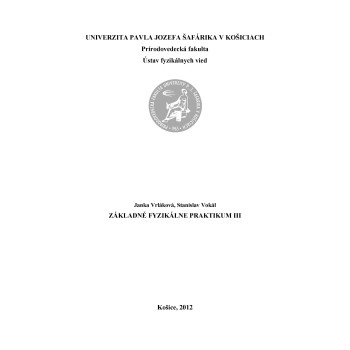
Základné fyzikálne praktikum III.

Základné fyzikálne praktikum III.

E-book

E-book

Janka Vrláková - Stanislav Vokál

Atomic and nuclear physics are relatively young scientific disciplines forming the final part of the general physics course at the Faculty of Physics of the Jagiellonian University. Their aim is to explain the nature of the basic physical properties of atoms, atomic nucleus and elementary particles.

This is also the content of the lectures and exercises ‘General Physics IV’ in the 2nd year of the Bachelor's degree in Physics at the Faculty of Natural Sciences (PF) of the P.J. Šafárik University (UPJŠ) in Košice. They are followed by optional lectures ‘Nuclear Radiation in the Environment’, ‘Introduction to the Physics of the Microworld’ in the 3rd year of the Bachelor's degree of single-discipline study of physics, or teacher study of physics in combination with another subject, and ‘Subnuclear Physics’ in the 1st year of the Master's degree of teacher study of physics in combination with another subject.

In the aforementioned lectures, the latest experimental findings on the structure and behaviour of the microworld are presented by means of physical theories and their subsequent experimental verification in experiments.

Download the e-book for free (pdf)

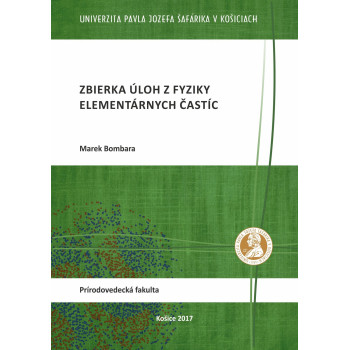
Zbierka úloh z fyziky elementárnych častíc

Zbierka úloh z fyziky elementárnych častíc

E-book

E-book

Marek Bombara

The collection of exercises summarises and supplements the exercises realised at the Pavol Jozef Šafárik in Košice within the lecture course Elementary Particle Physics. The collection is intended for the master students of the Nuclear and Subnuclear Physics subject, but it could be beneficial also for other physics subjects or even for interdisciplinary study. 

The division of chapters roughly copies the order of lectures. At the beginning, students will briefly familiarize themselves with the basics of special relativity and its practical use in particle physics.

Download the e-book for free (pdf)

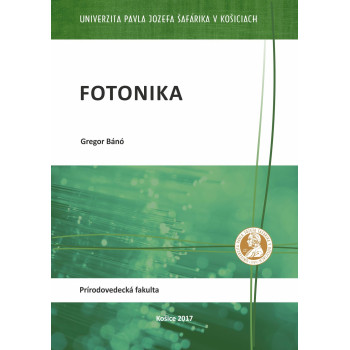
Fotonika

Fotonika

E-book

E-book

Gregor Bánó

Photonics is an application-oriented discipline at the interface of optics, opto-electronics and quantum optics. It includes classical optics extended by the description of physical phenomena and optical devices that rely on quantum (photon) nature of light.
The main objective of the Photonics course is to provide a comprehensive overview of essential optical and photonic phenomena routinely applied in experimental scientific research while working with various light sources (e.g. in the field of biophotonics). The first chapters are devoted to the description of light at different levels. The logical order of subsections in this part corresponds to the structure of the textbook: B. E. A. Saleh, M. C. Teich, Fundamentals of Photonics. The following chapters contain a description of laser operation and an overview of selected optical instruments and their applications.
The body text is complemented by practical notes on the use of theoretical knowledge during daily work in the laboratory. The course of Photonics requires a basic knowledge of mathematics, electromagnetism and optics, and thus it is recommended to students who previously passed through the courses of the Bachelor's program in Physics.

Download the e-book for free (pdf)

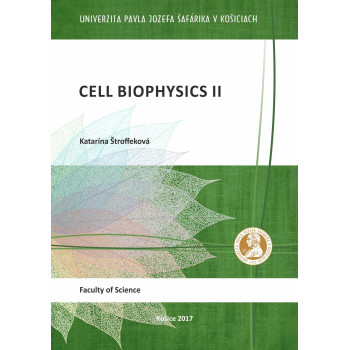
Cell Biophysics II

Cell Biophysics II

E-book

E-book

Katarína Štrofeková

Cell Biophysics II is the one semester comprehensive course textbook for PhD students. It encompasses basic principles and mechanisms underlying cell physiology and biophysics with aims:

• General knowledge of the principles of cellular function, including membrane, cytoplasmic and nuclear roles in normal and abnormal conditions.
• In-depth understanding of the mechanisms underlying the cell functions at the molecular and subcellular level.
• Awareness of cell pathologies that lead to specific disease symptoms and phenotypes.
• The ability to apply learned principles to solve new problems (analysis & synthesis).

Download the e-book for free (pdf)

This website uses cookies to ensure you get the best experience on our website