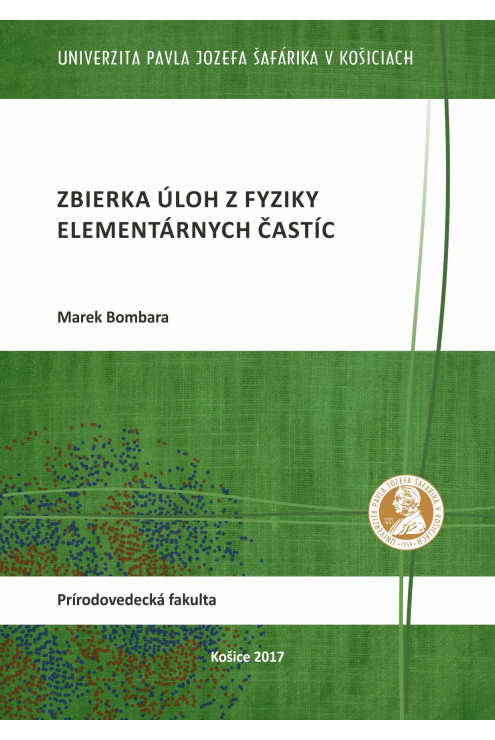
Zbierka úloh z fyziky elementárnych častíc

E-book

Marek Bombara

The collection of exercises summarises and supplements the exercises realised at the Pavol Jozef Šafárik in Košice within the lecture course Elementary Particle Physics. The collection is intended for the master students of the Nuclear and Subnuclear Physics subject, but it could be beneficial also for other physics subjects or even for interdisciplinary study. 

The division of chapters roughly copies the order of lectures. At the beginning, students will briefly familiarize themselves with the basics of special relativity and its practical use in particle physics.

Download the e-book for free (pdf)

Quantity

978-80-8152-496-7

Data sheet

Method of publication:
E-book (pdf)
Author:
Marek Bombara
Document type:
Course Notes
Number of pages:
76
Available from:
24.03.2017
Year of publication:
2017
Edition:
1st edition
Publication language:
Slovak
Faculty:
Prírodovedecká fakulta
- Free for download

16 other products in the same category:

Metodika tvorby učebných úloh a didaktických testov pre chémiu

Metodika tvorby učebných úloh a didaktických...

E-book

E-book

Mária Ganajová

The current teaching of chemistry has its specific problems. On one hand, due to the shift of the focus of chemistry curriculum towards theoretical content, the difficulty of chemistry material has increased, and in connection with this, students' interest in chemistry has decreased.

The lack of student interest in chemistry is mostly supported by the opinion that it is precisely chemistry that significantly contributes to the deterioration of environmental quality. On the other hand, we live in an era where we encounter chemical products practically everywhere. It is necessary to learn the basics of chemistry as well as possible, which makes the question of increasing interest in chemistry education and improving its effectiveness very relevant. State educational programs have been introduced into Slovak schools as a foundation for the creation of school educational programs. These emphasize not only acquiring a certain amount of knowledge but also the development and enhancement of key and specific competencies of students, preparing them for lifelong learning and their application in life.

Therefore, increasing attention is being paid to one of the fundamental didactic tools for raising student activity in teaching, and thus improving the effectiveness of chemistry education – learning tasks. From both theory and practice of chemistry teaching, we know that learning tasks, questions, examples, exercises, etc., are among the important components of every teaching lesson. Learning tasks are applied in all phases of teaching – in the motivational phase, the phase of acquiring knowledge, the phase of consolidating knowledge, and the phase of checking the acquired knowledge. It is therefore clear that every teacher will sooner or later find themselves in a situation where they will have to select learning tasks from textbooks, workbooks, collections of problems and examples, or create them themselves.

This scientific monograph is intended for educational specialists and chemistry teachers, aiming to familiarize them with examples of various types and forms of learning tasks and the basics of their creation in chemistry. It can also be helpful for them in preparing certification works focused on test creation and their statistical evaluation.

Download the e-book for free (pdf)

Jarná škola doktorandov 2020

Jarná škola doktorandov 2020

E-book

E-book

Peter Fedoročko (ed.)

Proceedings of the 7th Annual Doctoral Spring School 2020

From November 10 to November 11, 2020, the 7th annual Spring School for Doctoral Students at Pavol Jozef Šafárik University in Košice will take place in Košice in a modified mode in the on-line space. The scientific program of the spring school will comprise 2 plenary lectures by leading scientific experts of Pavol Jozef Šafárik University in Košice. Doctoral students will present their research papers in two sections: 24 doctoral students of Faculty of Public Administration, Faculty of Law and Faculty of Arts, and 22 doctoral students of Faculty of Medicine and Faculty of Science.

The scientific programme of the spring school will also include a panel discussion with the management of Pavol Jozef Šafárik University in Košice.

Download the e-book for free  (pdf)

Anatomické termíny pre štúdium anatómie človeka a neuroanatómie (2. vydanie)

Anatomické termíny pre štúdium anatómie človeka...

E-book

E-book

Juraj Ševc - Anna Alexovič Matiašová

Among students of single-discipline and interdisciplinary biology studies at faculties with a natural science focus, there often arises a problem in defining the scope of the curriculum when studying the subject of Human Anatomy. The presented study material aims to help students of non-medical scientific fields navigate the extensive anatomical terminology and to limit the amount of required anatomical terms to an optimum, so that alongside mastering Latin nomenclature, students still have sufficient capacity to memorize additional knowledge in the areas of systemic, comparative, developmental, and functional anatomy.

Emphasis on organizing individual anatomical terms into logical units simultaneously supports a hierarchical view of the architecture of the human body. Despite its seemingly self-serving nature, anatomical terminology thus becomes the framework upon which students build knowledge from more or less related scientific disciplines studying the human body and the processes occurring within it throughout their further studies. At the same time, alongside this ambition that goes beyond the scope of the anatomy discipline, the Anatomical Terms follow a long tradition of anatomical handbooks while respecting the valid Latin and Slovak anatomical nomenclature.

This script represents a practical supplement to university textbooks of Anatomy or Neuroanatomy and especially to anatomical atlases, but it certainly does not aim to replace them. Here you will find all the necessary terms gathered in one place, which you can always have at hand on your phone, e-reader, or laptop. The emphasis on organizing individual anatomical terms into logical units supports a hierarchical view of the architecture of the human body, and the inclusion of a brief introduction to each system is intended to encourage you to seek further, more detailed information about the structure and function of the given organ system.

Download the e-book for free (pdf)

NOVEL TRENDS IN CHEMISTRY, RESEARCH AND EDUCATION at the Faculty of Science of Pavol Jozef Šafárik University in Košice 2024

NOVEL TRENDS IN CHEMISTRY, RESEARCH AND...

E-book

Jana Šandrejová - Andrea Gajdošová (eds.)

The scientific book of abstracts from the conference „Novel Trends in Chemistry, Research and Education 2024“ is a summary of the contributions of conference participants, which contain the original results of their scientific and research activities. The contributions published in this volume are divided according to content into the fields of analytical, inorganic, organic, physical chemistry, biochemistry and didactics of chemistry.

Download the e-book for free (pdf)

Kmity, vlny a optika

Kmity, vlny a optika

E-book

E-book

Ján Füzer

Auxiliary teaching material for the course General Physics III – Oscillations, Waves, and Optics is intended for students of single-subject and interdisciplinary studies of physics.

The content provides a basic outline of the material covered, without detailed explanations, with an emphasis on the physical method of thinking using the simplest elements of higher mathematics. The presented text does not aim to replace the recommended textbooks, but rather to help students navigate the subject matter. Recommended literature can be found at the end of the text.

The teaching material contains the basic framework of the lectures and is supplemented and revised each year, with lectures enriched by supporting demonstration experiments.

Download e-book for free (pdf)
Nanotechnology

Nanotechnology

€17.68
Availability: 58 In Stock

 Andrej Oriňak - Renáta Oriňaková - Andrea Fedorková

Nanotechnology represent the fastest developing science in the present. They are based on the technologies that enable the matter manipulation at atomic level. Nanotechnology offer prepartion of the new materials with unknown and very specific properties and functions.Recent nanotechnology still stay in formative phase of their development. But more and more they are visible with nano-specific phenomenons in the fundamental control of the properties as well mater behaviour. This is quite possible that without nanotechnology will not work any science to the future, moreover that science will not exist anymore. Nanotechnolgy will give a chance and force to transform world to more environmental and comfortable. Expected is expansion of the nanotechnolgy to molecular nanosystems – heterogenous nets, in which molecules and supramolecules work as the nanodevices. The computers and robots will be reduced to the small and ultrasmall dimensions. In medicine will foremost the application of nanotechnology in genetic therapy and elimination of ageing. Nanosurgery will work at molecular level, cancer cells will be identified early and filtered , then substituted with healthy and unchanged. It is necessary to inform university or high school students  about principles of nanotechnolgy, preparation of the nanostructures, functionality of them and to offer full representation about molecular systems and nanodevices; the methods of nanostructures characterization and about application in miniaturized systems. 

Authors

The 5th International Conference on Nanomaterials: Fundamentals and Applications

The 5th International Conference on...

E-book

E-book

Veronika NiščákováIvana Šišoláková (eds.)

Abstracts of the 5th Intemational Conference Nanomaterials: Fundamentals and Applications (NF A) 2021 is the contributions summary of the conference participants. The conference will feature four invited lectures and ten registered lectures. This conference is a tool for creating a dialogue between experts in the field of nanomaterials, their use and overall application in various fields.

Papers in the proceedings are thematically divided into 6 areas. All contributions are highly professional and interesting and can contribute to further creative scientific work.

Download the e-book for free  (pdf)

Geopriestorové technológie v bádateľsky orientovanom vyučovaní geografie

Geopriestorové technológie v bádateľsky...

E-book

E-book

Stela Csachová - Ján Kaňuk - Alena GessertLadislav NovotnýŠtefan GáborJozef Šupinský

This book addressed the inquiry-based learning and teaching with the support of geospatial technologies. Today, geospatial technologies are influencing geography teaching learning, particularly in secondary education. Theoretical framework gives the reader the insight to inquiry-based learning, with special focus on inquiry in geography. The one-by-one step of inquiry is analysed in detail. The major part of the book presents the eleven models of geography lessons, representing the subject content of physical, human and regional geographies, various levels of inquiry and use of different geospatial technologies. The readers are acquainted with the use of geographic information system (particularly Google Earth and ArcGIS online), web portals, webGIS, open data, mobile applications and new forms of 3D cartographic visualisation (virtual reality, 3D print, dynamic 3D map) in teaching geography. The lesson models were tested with the students to be geography teachers in school year 2021/2022. This books serves as resource mainly for undergraduate teacher students and in-service geography teachers.

Download e-book for free (pdf)

Úvod do porovnávacej morfológie živočíchov

Úvod do porovnávacej morfológie živočíchov

E-book

E-book

Andrej Mock

The structure of the animal body is extremely varied. Each species has its distinctive morphological features, which bears as a testimony to long-term development and belonging to the developmental lineage. At the same time, the body has been tested for a long time by natural conditions, resulting in unique adaptations to the environment and life strategy. Despite this admirable variety - which includes both recent and fossil animals and which we have far from mapped – a comparison of body parts brings knowledge we can generalize: the main building principles, and boundaries within which phenotypic diversity is realized.

Comparative animal morphology today uses the latest methodological material and knowledge from other disciplines, from genetics, molecular biology and experimental embryology, through progressive imaging methods (e.g. electron microscopy, computer micro-tomography) and the possibilities of subsequent software processing of image material (measurement, staining, etc.) to the view of physics, chemistry, statics and geometry on the structures (to nanostructures) of the living body. Detailed knowledge of historical and contemporary conditions on Earth is an important interpretative context in the study of animal morphology. Surprisingly, the knowledge accumulated after centuries of research is now rapidly supplemented by new knowledge, and often the traditional knowledge is subsequently reinterpreted. Finally, and no less important, in studying animal (and human) morphology, we learn surprising knowledge about ourselves.

The author of the presented textbook had the ambition in a simplified form to introduce the reader, especially the student of biological studies, into a dynamic and fascinating scientific discipline, as the current comparative animal morphology is.

Stiahnite si e-knihu zadarmo (pdf)

The 6th International Conference on Nanomaterials: Fundamentals and Applications

The 6th International Conference on...

E-book

E-book

Jana Shepa (ed.)

The book of abstracts from 6th International Conference on Nanomaterials: Fundamentals and Applications, NFA 2022 is composed of contributions from the participants of this international conference. The conference consisted of 4 invited lecture and 52 abstracts of participants. The conference is focused on nanotechnology and its application in various research areas. All contributions are professionally processed and inspiring.

Download the e-book for free (pdf)

Praktikum z nukleárnej magnetickej rezonancie. Časť 1: Kvantitatívna NMR

Praktikum z nukleárnej magnetickej rezonancie....

E-book

E-book

Mária Vilková - Zuzana Kudličková - Aneta Salayová - Tomáš Ján Liška

The Nuclear Magnetic Resonance Practicum – Part 1: Quantitative NMR is designed for students taking the NMR Practicals course, which focuses on the practical aspects of quantitative nuclear magnetic resonance (qNMR). This publication builds on previous NMR courses and assumes basic theoretical knowledge of the method, emphasizing experimental procedures, data processing, and result interpretation. qNMR is a precise analytical technique with broad applications in analytical chemistry, pharmaceutical research, biomedicine, and quality control. The script provides a detailed guide to conducting experiments, as well as procedures for analyzing and evaluating acquired data. This publication offers students methodological guidance and support in mastering qNMR analysis and serves as a valuable resource not only during their studies but also for further research in NMR spectroscopy.

Download the e-book for free (pdf)

Predictive Modeling of Soil Types and Their Characteristics

Predictive Modeling of Soil Types and Their...

E-book

E-book

Vasyl Cherlinka - Michal Gallay - Yuryi Dmytruk

The textbook is a practical guide to predictive mapping of soil types and properties in R. It bridges digital soil mapping theory with hands-on practice, covering the full workflow from data acquisition and preprocessing to validation and uncertainty quantification. Early chapters introduce the tidyverse ecosystem and the sf and terra packages for spatial data handling. Subsequent parts address modelling of categorical variables (soil types/WRB) and continuous variables (soil organic carbon) using Random Forest, Cubist, and Quantile Regression Forests. Step-by-step code examples show training/testing, feature selection, accuracy metrics, and model interpretation. Reproducibility and cartographic best practice are emphasised. A Slovakia case study demonstrates real-world application while outlining limits and generalisability. The book targets bachelor’s, master’s, and PhD students in geography, geoinformatics, environmental and agricultural sciences, as well as practitioners. Written in English, it fits international courses and mobility programmes.

Download the e-book for free (pdf)

Vybrané kapitoly z biogeografie pre geografov

Vybrané kapitoly z biogeografie pre geografov

E-book

E-book

Dušan BarabasAlena Labunová

These study materials aim to provide basic information about biogeographical issues from a geographical perspective, i.e., a perspective focused primarily on the aspect of spatial differentiation of the biosphere. The basis for the division of the biosphere is its historical development, during which individual taxa and communities were formed.

The historical development of the biosphere did not occur under stable, constant conditions, but rather in ever-changing conditions caused by the position of our planet within the solar system, the position of the Earth's axis relative to the ecliptic, and also the position of the solar system within the galaxy. All changes in the Earth's position, together with the movement of continents (drift) and climate changes, created the prerequisites for the spatial expansion of the biosphere. The historical development of the biosphere, various perspectives, the hierarchical level of differentiation, and the causes of differentiation are incorporated in this study material, whose aim is to outline the basic principles of this division.

The goal is also to highlight certain differences in the understanding of terminology, as well as to point out some fundamental relationships operating within the landscape system in the broadest sense of the word. The section devoted to the ecological principles of the functioning and formation of the landscape system, according to MIČIAN and ZATKALÍK (1984), outlines the issues of understanding the terms ecosystem and geosystem. For this reason, the presented text includes chapters that attempt to explain the understanding and approach to some basic concepts.

These study materials are intended for students of single-subject, interdisciplinary, and supplementary studies as basic teaching material. By expanding the knowledge from this study material with further information, which is elaborated in more detail in the literature listed in the bibliography of this text, graduates will gain a comprehensive view of biogeographical issues.

Authors

Download the e-book for free (pdf)

This website uses cookies to ensure you get the best experience on our website