Slovenčina



E-book
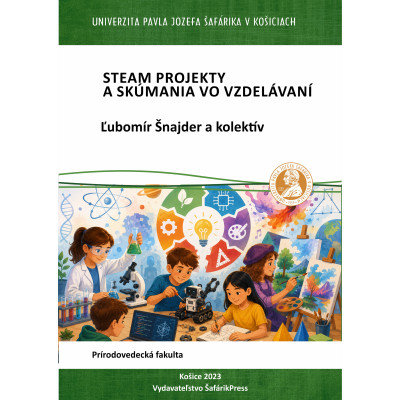
Ľubomír Šnajder a kol.
The publication is dedicated to teachers and future teachers of informatics, mathematics and science subjects. The publication presents activities that move students from the role of passive users of digital technologies to that of curious researchers, creative creators and critical thinkers. In the first chapter, we introduce educational strategies and practices to actively engage students in learning. In the second chapter, we briefly describe selected digital technologies that can be an aid to exploring the world around us and creating useful products. In the third chapter, we provide specific ideas for STEAM exploration and projects in which students search answers to real-world questions and solutions to real-world problems. Subject didacticians, experts from different fields and teachers worked closely together to develop ideas for the methodologies.
Download the e-book for free (pdf)
Attachment (zip)

Data sheet
E-book
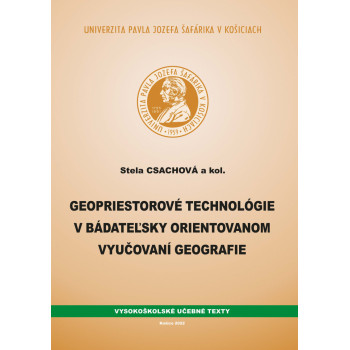
Stela Csachová - Ján Kaňuk - Alena Gessert - Ladislav Novotný - Štefan Gábor - Jozef Šupinský
This book addressed the inquiry-based learning and teaching with the support of geospatial technologies. Today, geospatial technologies are influencing geography teaching learning, particularly in secondary education. Theoretical framework gives the reader the insight to inquiry-based learning, with special focus on inquiry in geography. The one-by-one step of inquiry is analysed in detail. The major part of the book presents the eleven models of geography lessons, representing the subject content of physical, human and regional geographies, various levels of inquiry and use of different geospatial technologies. The readers are acquainted with the use of geographic information system (particularly Google Earth and ArcGIS online), web portals, webGIS, open data, mobile applications and new forms of 3D cartographic visualisation (virtual reality, 3D print, dynamic 3D map) in teaching geography. The lesson models were tested with the students to be geography teachers in school year 2021/2022. This books serves as resource mainly for undergraduate teacher students and in-service geography teachers.
Download e-book for free (pdf)
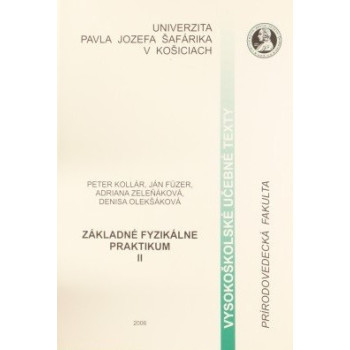
Peter Kollár a kol.
Skriptá Základné fyzikálne praktikum II. sú určené pre študentov Prírodovedeckej fakulty UPJŠ v Košiciach študujúcich na študijných programoch fyzika a medziodborových programoch v kombinácii s fyzikou. Obsahom skrípt sú úlohy z elektriny, magnetizmu a optiky. Podľa študijných programov sú zaradené do 3.semestra bakalárskeho štúdia, v ktorom by už študenti mali mať absolvovaný predmet všeobecná fyzika II. (elektrina a magnetizmus). Súčasťou každej úlohy sú základné poznatky venované javom, ktoré sú obsahom samotnej úlohy.
Autori
E-book
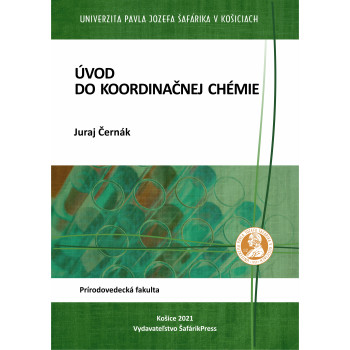
A significant part of inorganic chemistry is coordination chemistry, which deals with coordination compounds. Coordination compounds are numerous because they arise from the combination of central atoms, mostly metals, with ligands, and every organic compound is a potential ligand. This is confirmed by a recent report that American scientists M. Brookhart, C. Schauer, and their colleagues from universities in North Carolina and Washington described the preparation of a rhodium complex with methane as a ligand.
This textbook is based on the long-term experience of the author in teaching and testing this subject. The subject is well-covered in several textbooks of varying difficulty in English; their partial list can be found by readers in the list of used literature at the end of this textbook. On the other hand, in Slovak language, coordination chemistry issues are only marginally covered in several textbooks focused more on general inorganic chemistry but lack a comprehensive view on this topic. From this follows the goal of this proposed textbook - to cover the lack of study literature in this area for Slovak language.
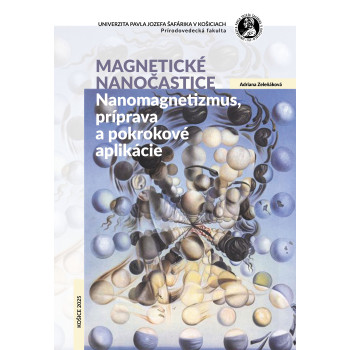
Magnetic nanoparticles are extremely interesting magnetic objects that still hide much that is undiscovered, both because of their physical properties and because of their diverse applications. Iron nanoparticles, or iron oxides, are used in medical diagnostics for magnetic resonance imaging, in the treatment of hyperthermia, and an important application is the use of magnetic particles for targeted drug delivery.
The textbook "Magnetic Nanoparticles: Nanomagnetism, Preparation and Advanced Applications" is intended primarily for students of the Master's programme in Physics and students of related disciplines at universities and faculties with a physical, chemical, metallurgical and biophysical focus. The motivation for writing this textbook was to develop study material that would contribute to improving the quality of teaching in the profile subject Nanomaterials and Nanotechnology at the Institute of Physical, Faculty of Sciences, UPJŠ, in the Master's programme Condensed Matter Physics, as well as in the profile subject in the PhD programme Advanced Materials.
The university textbook is divided into eight chapters. The first and second chapters are devoted to basic information about magnetism, the origin of nanomagnetism in nanoparticles and surface phenomena. The third and fourth chapters are devoted to nanomagnetism in nanoparticle systems. The fifth chapter describes in detail individual protocols for investigating the phenomenon of superparamagnetism and the phenomenon of superspin glass using the SQUID device. The sixth chapter describes individual procedures for the preparation of magnetic nanoparticles and the seventh chapter describes individual experimental techniques for the study of magnetic nanoparticles. The final eighth chapter describes the applications of nanoparticles in biomedicine.
During the writing of this textbook, the chapters were prepared using the foreign-language specialist literature listed in the recommended reading list.