Filter By

Selections

Selections

Year of publication:

Year of publication:

Publication language:

Publication language:

Faculty:

Faculty:

Active filters

  • Year of publication:: 2012
  • Year of publication:: 2013
  • Year of publication:: 2019
  • Year of publication:: 2023
  • Year of publication:: 2024
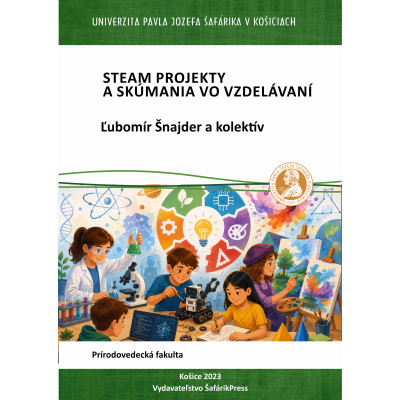
STEAM projekty a skúmania vo vzdelávaní
  • New

STEAM projekty a skúmania vo vzdelávaní

E-book

E-book

Ľubomír Šnajder a kol.

The publication is dedicated to teachers and future teachers of informatics, mathematics and science subjects. The publication presents activities that move students from the role of passive users of digital technologies to that of curious researchers, creative creators and critical thinkers. In the first chapter, we introduce educational strategies and practices to actively engage students in learning. In the second chapter, we briefly describe selected digital technologies that can be an aid to exploring the world around us and creating useful products. In the third chapter, we provide specific ideas for STEAM exploration and projects in which students search answers to real-world questions and solutions to real-world problems. Subject didacticians, experts from different fields and teachers worked closely together to develop ideas for the methodologies.

Download the e-book for free (pdf)

Attachment (zip)
Linear programming via problem solving

Linear programming via problem solving

E-book

E-book

Katarína Cechlárová

Linear programming belongs to parts of mathematics with the greatest number of real applications. This Slovak-English problem collection provides an overview of basic knowledge in the area, application problems as well as problems to acquire routine in calculations. It is complemented by questions motivating the student to look for further theoretical principles, construct conterexamples  and formulate arguments to explain the studied phenomena.

Download the e-book for free (pdf)

Teória vypočítateľnosti

Teória vypočítateľnosti

E-book

E-book

Ľubomír Antoni-Stanislav Krajči

An important part of theoretical computer science is the problem of Turing machines. This computational model has two basic properties: like any other computational program, the software of a Turing machine is composed of instructions, but in its case they are all of a single type. Every other (so far known) computer program can be transformed into a Turing machine program without loss of information. While the second feature reduces the question of what a calculator cannot do to the question of what a Turing machine cannot do, the first feature allows a much simpler investigation of such a question. Using this computational model, we can thus find concrete problems that no automaton can ever deal with (perhaps the most famous is the problem of the Turing machine stopping). Their existence demonstrates the fundamental limitations of (not only ideal) computational means, and thus encourages both criticality and humility in our thinking.

Download e-book for free (pdf)

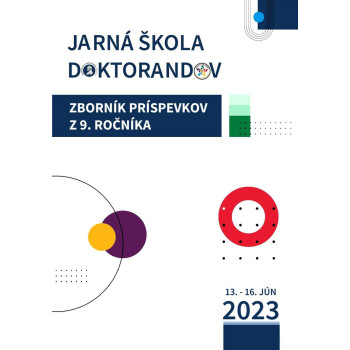
JARNÁ ŠKOLA DOKTORANDOV 2023

JARNÁ ŠKOLA DOKTORANDOV 2023

E-book

E-book

Peter Fedoročko (ed.)

From June 13 to June 16, 2023, the 9th annual Spring School for Doctoral Students at Pavol Jozef Šafárik University in Košice will take place in Stará Lesná. The scientific program of the spring school will comprise 3 plenary lectures by leading scientific experts and 1 workshop.

Doctoral students will present their research papers in two sections: 24 doctoral students of Faculty of Public Administration, Faculty of Law and Faculty of Arts, and 24 doctoral students of Faculty of Medicine and Faculty of Science. The scientific programme of the spring school will also include a panel discussion with the management of Pavol Jozef Šafárik University in Košice.

Download the e-book for free  (pdf)

Študentská vedecká konferencia PF UPJŠ 2023

Študentská vedecká konferencia PF UPJŠ 2023

E-book

E-book

Marián Kireš  (ed.)

Proceedings of Abstracts from the Student Scientific Conference of the Faculty of Science, Pavol Jozef Šafárik University in Košice

The Student Scientific Conference (SSC) represents the culmination of long-term and intensive work on a selected topic, collaboration with a supervisor, or a broader team at the workplace. In practice, however, it often marks the beginning of scientific research, focusing on a chosen subject, field, or close cooperation with a future supervisor of a bachelor's, master's, or doctoral thesis.

This year, the Student Scientific Conference took place on April 19, 2023, featuring 14 sections, a programming competition, and the IHRA contest. Bachelor’s and master’s students presented 101 contributions. Additionally, 8 high school students participated non-competitively, presenting their SOČ projects; 14 students took part in the programming competition, and 3 students competed in the IHRA contest.

We believe that the proceedings of abstracts and related documents serve not only as an archive but also as a dignified presentation of scientific activities at our faculty for the wider public.

Download the e-book for free  (pdf)

Študentská vedecká konferencia PF UPJŠ 2019

Študentská vedecká konferencia PF UPJŠ 2019

E-book

E-book

Katarína Cechlárová (ed.)

This year, the Student Scientific Conference was held on April 24, 2019, across 17 sections in disciplines such as biology and ecology, chemistry, physics, geography, mathematics, informatics, and their didactics. Bachelor’s and master’s students presented a total of 124 contributions. The most successful participants advanced to national or traditional Czech-Slovak student scientific showcases in fields like physics, chemistry, mathematics, informatics, and mathematics didactics.

In addition to faculty students, 10 high school students participated outside the competition. They were invited based on their achievements in subject-specific Olympiads or because they were already engaged with the faculty under the guidance of dedicated teachers in laboratory work as part of their preparation for future studies. The day also featured a programming competition with 23 participants, an IHRA contest involving 16 teams of high school students and 15 teams from elementary schools, and a new Puzzle section where 72 high school students from the region competed.

The abstracts from the Student Scientific Conference demonstrate that our faculty's students not only absorb theoretical knowledge delivered in lectures but also actively engage in solving partial scientific problems that align with research objectives at the institutes of PF UPJŠ. This collection serves as both a record of scientific activity at the faculty and a dignified presentation for the broader public.

Prof. RNDr. Katarína Cechlárová, DrSc.

Vice-Dean for Education

Doc. RNDr. Gabriel Semanišin, PhD.

Dean of the Faculty

Download the e-book for free  (pdf)

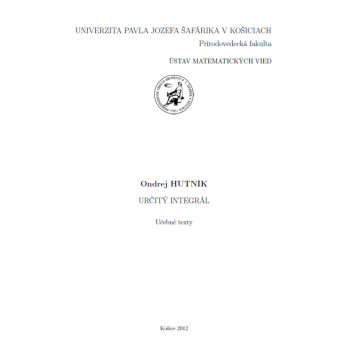
Určitý integrál

Určitý integrál

E-book

E-book

Ondrej Hutník

The concept of the integral is one of the most significant concepts in mathematics as a whole. In its most primitive form, it was already used by the ancient Greeks in the creation of Euclidean geometry. However, it was only after Descartes' work on analytical geometry in 1637 that mathematicians could begin to consider the integral as a subject of analysis. Descartes' work laid the groundwork for the discovery of infinitesimal calculus by Leibniz and Newton around 1665. At that time, a great dispute arose over the priority of this discovery, dividing scholars of Germany and England into two opposing camps, each favoring their own champion. Today, we know that Newton's work on fluxions and fluents was somewhat earlier, but Leibniz's notation and approach have gained more acceptance in the mathematical world, and the symbols ∫ ∫ and d d are still used today. A brief overview of the history of the integral will be presented in Chapter 1.

Today, there is a plethora of scripts, textbooks, and books dedicated to explaining the concept of the integral. Therefore, every potential author faces the initial question of whether to write another text on this topic. Our affirmative answer to this question was driven by the students' request to find the subject matter of a part of the winter semester of the second year presented in a coherent form. The second motivation is a slightly different approach to the topic. If we consider the methods typically used in solving problems and gaining routine with a certain integral, it mainly involves the Newton-Leibniz formula, and often there is little time left to compute the definite (Riemann) integral using its definition. Therefore, we included a discussion of the Newton integral in Chapter 2, which reflects this fact and is directly related to the indefinite integral, whose various calculation methods receive relatively much attention in the previous semester. Only after that, in Chapter 3, do we build the theory of the Riemann integral, present criteria for its existence, classes of integrable functions, basic properties, and finally its relationship with the Newton integral. Questions primarily concerning geometric applications are addressed in Chapter 4, and in the final chapter, we focus on extending the Riemann integral to unbounded functions and unbounded intervals.

Download the e-book for free (pdf)

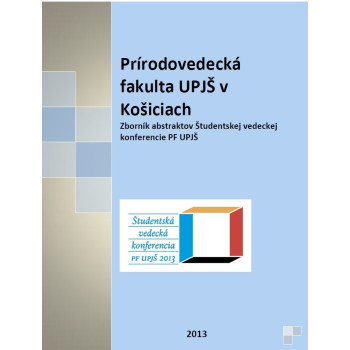
Študentská vedecká konferencia PF UPJŠ 2013

Študentská vedecká konferencia PF UPJŠ 2013

E-book

E-book

Vladimír Zeleňák (ed.)

The publication contains abstracts of contributions presented at the Student Scientific Conference of the Faculty of Natural Sciences at UPJŠ in Košice, held on April 25, 2013. The event was marked by the celebration of the 50th anniversary of the Faculty of Natural Sciences at UPJŠ and was part of a series of events called ScienceFest.

Download the e-book for free (pdf)

This website uses cookies to ensure you get the best experience on our website