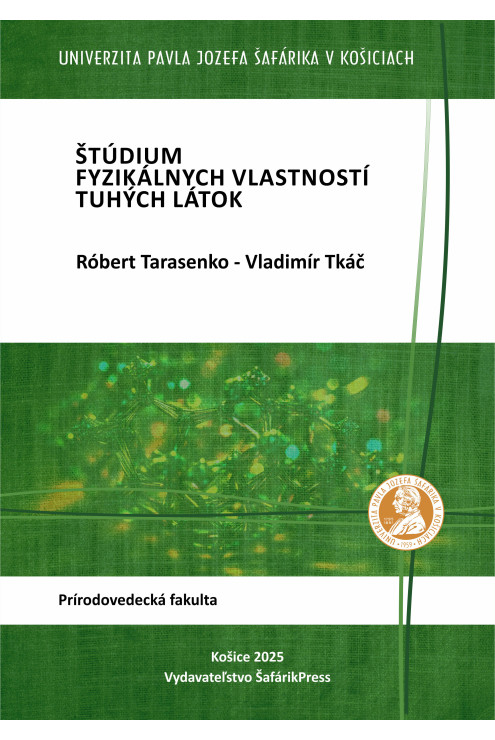
Štúdium fyzikálnych vlastností tuhých látok

E-book

Róbert Tarasenko - Vladimír Tkáč

The presented university textbook is intended for all students engaged in the field of condensed matter physics who, while working on their final theses, come into contact with the experimental device known as the Physical Properties Measurement System (PPMS). The main purpose of this textbook is to facilitate, in a certain way, the students' work with the complex manuals provided with this experimental device. At the same time, through this textbook and its clear instructions, students acquire the necessary experimental skills essential in the field of condensed matter physics.

Download the e-book for free (pdf)

Quantity

978-80-574-0282-4

Data sheet

Method of publication:
E-book (pdf)
Authors:
Róbert Tarasenko - Vladimír Tkáč
Document type:
Course Notes
Number of pages:
155
Available from:
11.06.2025
Year of publication:
2025
Edition:
1st edition
Publication language:
Slovak
Faculty:
Prírodovedecká fakulta
License:
CC BY NC SA (Uveďte autora - Nepoužívajte komerčne - Zachovajte licenciu )
- Free for download

16 other products in the same category:

Jarná škola doktorandov 2020

Jarná škola doktorandov 2020

E-book

E-book

Peter Fedoročko (ed.)

Proceedings of the 7th Annual Doctoral Spring School 2020

From November 10 to November 11, 2020, the 7th annual Spring School for Doctoral Students at Pavol Jozef Šafárik University in Košice will take place in Košice in a modified mode in the on-line space. The scientific program of the spring school will comprise 2 plenary lectures by leading scientific experts of Pavol Jozef Šafárik University in Košice. Doctoral students will present their research papers in two sections: 24 doctoral students of Faculty of Public Administration, Faculty of Law and Faculty of Arts, and 22 doctoral students of Faculty of Medicine and Faculty of Science.

The scientific programme of the spring school will also include a panel discussion with the management of Pavol Jozef Šafárik University in Košice.

Download the e-book for free  (pdf)

Študentská vedecká konferencia PF UPJŠ 2015

Študentská vedecká konferencia PF UPJŠ 2015

E-book

E-book

Vladimír Zeleňák(ed.)

The proceedings contain abstracts of contributions from participants of the Student Scientific Conference of the Faculty of Science, Pavol Jozef Šafárik University in Košice, which took place on April 22, 2015.

The Student Scientific Conference (SSC) enjoys long-term popularity among the faculty's students and teachers, and we are pleased that this was no different this year, with 128 contributions submitted to the SSC.

The contributions were organized into 19 sections, additionally complemented by an open programming competition and the final of the IHRA contest. For many students, presenting at the SSC is one of the first opportunities to gain experience in presenting their results before a professional audience. Considering the number of submitted contributions, along with the members of the expert juries from the faculty's teaching staff and the audience who came to support their classmates' presentations, the SSC is an event where a large part of the student and academic community of the faculty meets at one place and time. Many abstracts presented in this proceedings were developed as part of students' work on partial tasks that are components of research projects at the departments of the Faculty of Science, Pavol Jozef Šafárik University.

The abstracts represent, in a way, an overview of research topics at the individual workplaces of the faculty. The SSC proceedings thus serve as a useful tool that students and faculty teachers can use to present the faculty externally to partners, employers, and potential collaborators. Partners from practice have shown interest in cooperating in organizing the SSC for a long time. Since 2005, the association of IT companies has awarded a Prize for the Most Original Work and a Prize for the Work with the Best Prospects for Practical Application.

Download the e-book for free (pdf)

The 4th International Conference on Nanomaterials: Fundamentals and Applications

The 4th International Conference on...

E-book

E-book

Jana ShepaIvana Šišoláková (eds.)

Abstracts of the 4th International Conference Nanomaterials: Fundamentals and Applications (NFA) 2020 is the contributions summary of the conference participants. The conference will feature three invited lectures and eight registered lectures. This conference is a tool for creating a dialogue between experts in the field of nanomaterials, their use and overall application in various fields. Papers in the proceedings are thematically divided into 6 areas. All contributions are highly professional and interesting and can contribute to further creative scientific work.

Download the e-book for free  (pdf)

Študentská vedecká konferencia PF UPJŠ 2016

Študentská vedecká konferencia PF UPJŠ 2016

E-book

E-book

Vladimír Zeleňák (ed.)

Proceedings of Abstracts of the Student Scientific Conference of the Faculty of Science, Pavol Jozef Šafárik University in Košice

A characteristic feature of education at high-quality universities — among which the Faculty of Science at Pavol Jozef Šafárik University (UPJŠ) in Košice proudly belongs — is the close connection between education and scientific research. Students gain knowledge in their field of study not only through theoretical coursework in individual disciplines, but also through active involvement in solving specific scientific tasks as part of research teams. This can occur during the development of final theses or through participation in the Student Research Assistant Program (ŠPVS), which was revitalized at the faculty in 2015.

The Student Scientific Conference (ŠVK) is one of the faculty’s traditional events, organized during the Faculty’s Science Days as part of Sciencefest. By its very nature, it fits seamlessly into the aforementioned framework of combining education with research, and it has long enjoyed great popularity and student interest. In 2016, the conference featured presentations by 125 students of the Faculty of Science at UPJŠ in Košice, across 16 thematic sections. This collection of abstracts provides an overview of the focus and goals of the student projects. We believe it will serve as inspiration for other potential participants of future conferences and will also be of interest to the broader public, offering additional insight into the faculty's activities.

Download the e-book for free (pdf)

Spring Electrochemical Meeting. Book of Abstracts.

Spring Electrochemical Meeting. Book of Abstracts.

E-book

E-book

Jana Shepa (ed.)

The book of abstracts from the second year of the international conference Spring electrochemical meeting is composed of contributions from the participants of this student conference.

The conference consisted of one invited lecture and ten competing student lectures. The message of this meeting is to create a dialogue between students of electrochemistry and the mutual exchange of knowledge. All contributions are professionally processed and inspiring.

Download the e-book for free (pdf)

Prehľad dejín biológie, lekárstva a farmácie

Prehľad dejín biológie, lekárstva a farmácie

E-book

E-book

Martin BačkorMiriam Bačkorová

The proposed text focuses on the history of studying biology, medicine, and pharmacy as scientific disciplines from prehistoric times through antiquity, the Middle Ages, and the modern era. The text chronologically organizes the most significant figures in the history of biological scientific disciplines, outlines key characteristics of major historical discoveries, and reevaluates their significance from the perspective of 21st-century science.

The educational text is chronologically divided into the most significant periods of civilization development. The last two completed centuries—the 19th and 20th—are subdivided into major life science fields due to the unprecedented growth of biological disciplines and the resulting volume of acquired information.

Since it can sometimes be challenging in science to define what constitutes the past versus the present of a particular discipline, we have excluded significant biological discoveries from the early 21st century, which are typically regarded as the “present” of biology.

Download the e-book for free (pdf)

Teória efektívneho poľa pre lokalizované spinové modely

Teória efektívneho poľa pre lokalizované...

E-book

E-book

Michal Jaščur

This monograph is devoted to the discussion of effective field theory based on the differential operator method, originally introduced by Honmura and Kaneyoshi in 1979, which remains actively used for theoretical studies of localized spin models of magnetism—particularly variants of the Ising model. To date, this methodology has been applied by numerous authors to investigate a wide range of systems, including crystalline systems, diluted magnetic systems, systems with random exchange interactions, amorphous magnetic materials, systems under random magnetic and crystalline fields, thin magnetic layers, magnetic systems with free surfaces, binary and ternary magnetic alloys, among others.

During my scientific career, I have collaborated with several leading experts in this field—including Prof. Kaneyoshi, with whom I completed two long-term research stays—to advance the development of the differential operator method (and consequently effective field theory). Within this research area, I have published over 40 scientific papers in prominent international physics journals. These works include both methodological advancements and significant applications that predict intriguing physical phenomena, such as multicompensation phenomena in ferrimagnets.

Download the e-book for free

Novel Trends in Chemistry, Research and Education 2025

Novel Trends in Chemistry, Research and...

E-book

E-publication
Soňa Király

The Book of Abstracts of the institutional conference Novel Trends in Chemistry, Research and Education 2025 consists of 88 contributions that reflect the current scientific direction and disciplinary diversity of chemical research at our faculty. The publication is divided into several chapters, including abstracts of 6 invited lectures, 4 plenary lectures, and thematically oriented sessions covering a broad spectrum of chemical disciplines. A total of 78 abstracts are included within the sections.

Download the e-book for free

Workshop on Quantum Magnetism: Theoretical Challenges and Future Perspectives

Workshop on Quantum Magnetism: Theoretical...

E-book

E-book

Jozef StrečkaHana ČenčarikováAndrej Gendiar (eds.)

The proceeding involves programme and abstracts of Workshop on Quantum Magnetism: Theoretical Challenges and Future Perspectives, which was held on June 7th – June 8th, 2019, in Košice, Slovakia.

The workshop is organized by Faculty of Science of Pavol Jozef Šafárik University in Košice and Institute of Experimental Physics of Slovak Academy of Sciences in Košice under the financial support of Slovak Research and Development Agency.

The main conference topics are devoted to state-of-the-art problems of Quantum Theory of Magnetism inncluding molecular magnetism, highly frustrated magnetism, magnetic phase transitions, quantum spin liquids, strongly correlated systems, exotic quantum states, flat-band systems and quantum entanglement.

Download the e-book for free  (pdf)

NOVEL TRENDS IN CHEMISTRY, RESEARCH AND EDUCATION at the Faculty of Science of Pavol Jozef Šafárik University in Košice 2024

NOVEL TRENDS IN CHEMISTRY, RESEARCH AND...

E-book

Jana Šandrejová - Andrea Gajdošová (eds.)

The scientific book of abstracts from the conference „Novel Trends in Chemistry, Research and Education 2024“ is a summary of the contributions of conference participants, which contain the original results of their scientific and research activities. The contributions published in this volume are divided according to content into the fields of analytical, inorganic, organic, physical chemistry, biochemistry and didactics of chemistry.

Download the e-book for free (pdf)

Úvod do porovnávacej morfológie živočíchov

Úvod do porovnávacej morfológie živočíchov

E-book

E-book

Andrej Mock

The structure of the animal body is extremely varied. Each species has its distinctive morphological features, which bears as a testimony to long-term development and belonging to the developmental lineage. At the same time, the body has been tested for a long time by natural conditions, resulting in unique adaptations to the environment and life strategy. Despite this admirable variety - which includes both recent and fossil animals and which we have far from mapped – a comparison of body parts brings knowledge we can generalize: the main building principles, and boundaries within which phenotypic diversity is realized.

Comparative animal morphology today uses the latest methodological material and knowledge from other disciplines, from genetics, molecular biology and experimental embryology, through progressive imaging methods (e.g. electron microscopy, computer micro-tomography) and the possibilities of subsequent software processing of image material (measurement, staining, etc.) to the view of physics, chemistry, statics and geometry on the structures (to nanostructures) of the living body. Detailed knowledge of historical and contemporary conditions on Earth is an important interpretative context in the study of animal morphology. Surprisingly, the knowledge accumulated after centuries of research is now rapidly supplemented by new knowledge, and often the traditional knowledge is subsequently reinterpreted. Finally, and no less important, in studying animal (and human) morphology, we learn surprising knowledge about ourselves.

The author of the presented textbook had the ambition in a simplified form to introduce the reader, especially the student of biological studies, into a dynamic and fascinating scientific discipline, as the current comparative animal morphology is.

Stiahnite si e-knihu zadarmo (pdf)

Praktikum z nukleárnej magnetickej rezonancie. Časť 2: Kvantitatívna analýza a fyzikálno-chemické štúdie

Praktikum z nukleárnej magnetickej rezonancie....

E-book

E-publication
Mária Vilková-Zuzana Kudličková-Ján Elečko
This study material is intended for students of chemistry and related disciplines interested in applied nuclear magnetic resonance (NMR) and physical chemistry. It offers practice-oriented tasks designed to develop skills in NMR spectroscopy, quantitative analysis, and data interpretation. Students learn modern approaches to determining physicochemical parameters (e.g., partition coefficients, pKa values, keto–enol equilibria, or enantiomeric excess) and gain experience with software tools for spectrum processing.
Download the e-book for free (pdf)

Vybrané úlohy a výpočty z biochémie – metabolizmus

Vybrané úlohy a výpočty z biochémie – metabolizmus

E-book

E-book

Nataša Tomášková

Selected tasks and problems from biochemistry – metabolism follow biochemistry lectures on metabolism and individual metabolic pathways for students of the second and third year of the bachelor’s degree in the fields of chemistry, biology and their combinations with other fields. Scripts provide an opportunity to better understand the lectured subject matter of metabolism through the solution of tasks and problems as serve as a basis for one-hour exercises. The scripts are divided thematically into eleven chapters, and each chapter contains 10 tasks and 7 problems. At the beginning of the chapters there is a short description and explanation of the given metabolic pathway. However, when solving the tasks, the student must focus mainly on the curriculum that was presented on the given topic in the lecture. Subsequently, at the end of chapter, answers to problems are also presented. These scripts are intentionally accessible only in electronic form. The reason is the effort to continuously update and modernize individual tasks.

Download e-book for free (pdf)

Zbierka úloh z matematickej analýzy III.
  • On sale!
  • -€12.62

Zbierka úloh z matematickej analýzy III.

€13.62 €1.00 -€12.62
Availability: 9 In Stock

Ondrej Hutník a kol. 

Zbierka úloh z matematickej analýzy III. je pokračovaním predchádzajúcich dvoch vydaných zbierok autorov Kulcsár a Kulcsárová. Táto časť obsahuje príklady na zopakovanie a precvičenie učiva stredných škôl, ako aj časti prvého semestra kurzu matematická analýza určeného pre študentov matematiky, fyziky, informatiky a učiteľského štúdia v kombinácii s matematikou. Zbierka môže tiež pomôcť všetkým učiteľom, ktorí chcú použiť rôzne úlohy vo svojom vyučovaní. Zbierka zahŕňa oblasť postupností reálnych čísel: aritmetické a geometrické postupnosti, všeobecne a rekurentne zadané postupnosti, nachádzajú sa tu úlohy na vyšetrovanie vlastností postupností (monotónnosť, ohraničenosť, konvergencia) a výpočet rôznych typov limít. Všetky zadané úlohy sú vyriešené na konci každej kapitoly s podrobným komentárom.

Autori

Študentská vedecká konferencia PF UPJŠ 2019

Študentská vedecká konferencia PF UPJŠ 2019

E-book

E-book

Katarína Cechlárová (ed.)

This year, the Student Scientific Conference was held on April 24, 2019, across 17 sections in disciplines such as biology and ecology, chemistry, physics, geography, mathematics, informatics, and their didactics. Bachelor’s and master’s students presented a total of 124 contributions. The most successful participants advanced to national or traditional Czech-Slovak student scientific showcases in fields like physics, chemistry, mathematics, informatics, and mathematics didactics.

In addition to faculty students, 10 high school students participated outside the competition. They were invited based on their achievements in subject-specific Olympiads or because they were already engaged with the faculty under the guidance of dedicated teachers in laboratory work as part of their preparation for future studies. The day also featured a programming competition with 23 participants, an IHRA contest involving 16 teams of high school students and 15 teams from elementary schools, and a new Puzzle section where 72 high school students from the region competed.

The abstracts from the Student Scientific Conference demonstrate that our faculty's students not only absorb theoretical knowledge delivered in lectures but also actively engage in solving partial scientific problems that align with research objectives at the institutes of PF UPJŠ. This collection serves as both a record of scientific activity at the faculty and a dignified presentation for the broader public.

Prof. RNDr. Katarína Cechlárová, DrSc.

Vice-Dean for Education

Doc. RNDr. Gabriel Semanišin, PhD.

Dean of the Faculty

Download the e-book for free  (pdf)

Doménové steny a ich dynamika

Doménové steny a ich dynamika

E-book

E-book

Rastislav Varga

The movement of domain walls in ferromagnetic materials is utilized in various magnetic devices for storing, processing, or transmitting signals and information. This mainly includes transformer cores, various sensors, memory devices (e.g., HDDs in PCs), as well as modern spintronic devices such as Racetrack memories, domain wall motion-based electronics, and so on.

This book is intended to serve as a textbook for advanced courses in the field of magnetic materials. It is primarily aimed at students interested in studying magnetic materials, as well as professionals from various fields who wish to understand the basics of domain structure and its changes. It is divided into nine chapters. The first chapter deals with a brief history of the study of domain structure in magnetic materials. The second chapter provides an introduction to the causes and manifestations of magnetic anisotropies. The third and fourth chapters are devoted to the causes of domain structure formation and domain walls. The fifth chapter discusses the structure of domain walls, their potential, and the critical field required for domain wall movement. The sixth chapter is dedicated to magnetization processes, one of which - domain wall movement - is discussed in detail in chapter 7. The eighth chapter contains a theoretical solution for domain wall movement. The final ninth chapter presents a modern method of domain wall movement induced by electric current.

The presented work assumes that the reader has at least basic knowledge in the field of magnetism. Otherwise, the author refers the reader to basic literature (e.g., [2.1 - 2.6]).

Download the e-book for free (pdf)

This website uses cookies to ensure you get the best experience on our website