- On sale!
- -€11.49

Zavolajte nám:
+421 55 234 1635Peter Fedoročko a kol.
Vysokoškolský učebný text Prírodovedeckej fakulty UPJŠ.
Data sheet
Specific References
E-book
Stanislav Lukáč - Ľubomír Šnajder - Ján Guniš - Zuzana Ješková
The publication is intended for researchers in didactics and teachers of mathematics and computer science. Our aim is to provide readers with a basic orientation in the issue of inquiry-based teaching, to explain and demonstrate several levels of student inquiry through examples, and to offer a classification of inquiry skills.
The core part of the publication consists of methodologies for inquiry-based teaching of specific topics from school mathematics and computer science. We present ideas for implementing inquiry activities, active work with information in solving various types of problems, and the application of modern digital technologies in exploring and discovering patterns.
The publication includes seven methodologies for teaching mathematics and eight methodologies for teaching computer science in the 1st and 2nd years of secondary school.
Učebný text je určený poslucháčom medziodborového štúdia v kombinácii s matematikou, jednoodborového štúdia matematiky ako aj rozširujúceho štúdia matematiky. Je zameraný na základné poznatky o deliteľnosti celých čísel, kongruenciách a aritmetických funkciách.
Autor
E-book
The textbook "Structure and reactivity - solved examples and tasks, part 1" is the basis for teaching the subject "Structure and reactivity" for students of the 1st year of master's studies at the Faculty of Science, UPJŠ, department of Organic Chemistry. The textbook is divided into individual chapters, each chapter offering students examples of chemical reactions, where their course is explained on the basis of appropriate reaction mechanisms. A substantial part of the textbook consists of unresolved tasks, the main goal of which is the development of students' knowledge and skills. Due to the fact that the textbook is focused on only one semester of study, it cannot cover all reactions, rather it is only representative examples of different types of reactions, such as: addition reactions, elimination reactions, aromatic substitution, addition-elimination reactions, radical reactions and pericyclic reactions.
E-book
Vasyl Cherlinka - Michal Gallay - Yuryi Dmytruk
The textbook is a practical guide to predictive mapping of soil types and properties in R. It bridges digital soil mapping theory with hands-on practice, covering the full workflow from data acquisition and preprocessing to validation and uncertainty quantification. Early chapters introduce the tidyverse ecosystem and the sf and terra packages for spatial data handling. Subsequent parts address modelling of categorical variables (soil types/WRB) and continuous variables (soil organic carbon) using Random Forest, Cubist, and Quantile Regression Forests. Step-by-step code examples show training/testing, feature selection, accuracy metrics, and model interpretation. Reproducibility and cartographic best practice are emphasised. A Slovakia case study demonstrates real-world application while outlining limits and generalisability. The book targets bachelor’s, master’s, and PhD students in geography, geoinformatics, environmental and agricultural sciences, as well as practitioners. Written in English, it fits international courses and mobility programmes.
E-book
Zuzana Orságová Králová (ed.)
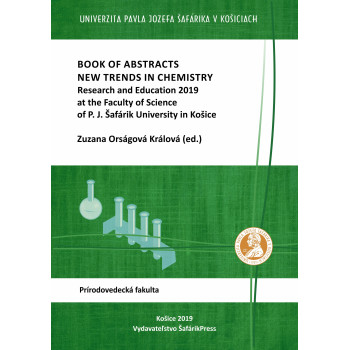
The scientific book of abstracts is a summary of the contributions of teachers, scientists and other conference participants, which contain the original results of their scientific and research activities. Their work will be the subject of the next domestic conference „New Trends in Chemistry, Research and Education at Faculty of Science of P. J. Šafárik University in Košice 2020“. The conference is a space for dialogue between scientific academics on the one hand and professional staff and students on the other.
The contributions published in this volume can be divided according to content into the field of analytical, inorganic, physical, organic chemistry, biochemistry and didactics of chemistry. All contributions are interesting and can be used in further creative scientific and research work, in the process of education and in practical work.
E-book
The current teaching of chemistry has its specific problems. On one hand, due to the shift of the focus of chemistry curriculum towards theoretical content, the difficulty of chemistry material has increased, and in connection with this, students' interest in chemistry has decreased.
The lack of student interest in chemistry is mostly supported by the opinion that it is precisely chemistry that significantly contributes to the deterioration of environmental quality. On the other hand, we live in an era where we encounter chemical products practically everywhere. It is necessary to learn the basics of chemistry as well as possible, which makes the question of increasing interest in chemistry education and improving its effectiveness very relevant. State educational programs have been introduced into Slovak schools as a foundation for the creation of school educational programs. These emphasize not only acquiring a certain amount of knowledge but also the development and enhancement of key and specific competencies of students, preparing them for lifelong learning and their application in life.
Therefore, increasing attention is being paid to one of the fundamental didactic tools for raising student activity in teaching, and thus improving the effectiveness of chemistry education – learning tasks. From both theory and practice of chemistry teaching, we know that learning tasks, questions, examples, exercises, etc., are among the important components of every teaching lesson. Learning tasks are applied in all phases of teaching – in the motivational phase, the phase of acquiring knowledge, the phase of consolidating knowledge, and the phase of checking the acquired knowledge. It is therefore clear that every teacher will sooner or later find themselves in a situation where they will have to select learning tasks from textbooks, workbooks, collections of problems and examples, or create them themselves.
This scientific monograph is intended for educational specialists and chemistry teachers, aiming to familiarize them with examples of various types and forms of learning tasks and the basics of their creation in chemistry. It can also be helpful for them in preparing certification works focused on test creation and their statistical evaluation.
E-book
Stela Csachová - Ján Kaňuk - Alena Gessert - Ladislav Novotný - Štefan Gábor - Jozef Šupinský
This book addressed the inquiry-based learning and teaching with the support of geospatial technologies. Today, geospatial technologies are influencing geography teaching learning, particularly in secondary education. Theoretical framework gives the reader the insight to inquiry-based learning, with special focus on inquiry in geography. The one-by-one step of inquiry is analysed in detail. The major part of the book presents the eleven models of geography lessons, representing the subject content of physical, human and regional geographies, various levels of inquiry and use of different geospatial technologies. The readers are acquainted with the use of geographic information system (particularly Google Earth and ArcGIS online), web portals, webGIS, open data, mobile applications and new forms of 3D cartographic visualisation (virtual reality, 3D print, dynamic 3D map) in teaching geography. The lesson models were tested with the students to be geography teachers in school year 2021/2022. This books serves as resource mainly for undergraduate teacher students and in-service geography teachers.
Download e-book for free (pdf)
E-book
Jozef Bednarčík - Hana Vargová (eds.)
The Czech and Slovak Conference on Magnetism (CSMAG) is a scientific meeting that honors a longstanding tradition initiated in Košice in 1960. Evolving from a regional gathering of the Czechoslovak magnetic community into a prominent international forum, CSMAG brings together researchers from diverse fields of magnetism. The conference covers a wide range of topics including theoretical and experimental magnetism, magnetic materials for energy and spintronics applications, low-dimensional and molecular magnets, rare-earth and actinide systems, and multifunctional materials. With contributions from over 20 countries, CSMAG’25 fosters cross-disciplinary collaboration and showcases the latest advances in both fundamental studies and practical applications of magnetic phenomena.
E-book
One of the fundamental characteristics of the magnetic state of ferromagnetic materials is the existence of a domain structure. The university textbook "MAGNETIC DOMAINS: SPECIAL PHYSICAL PRACTICE 1" is intended primarily for students of the Master's programme in Physics of Condensed Matter FKLm and for the PhD programme in Progressive Materials PMd within the profile subject Special Practice 1 at the Institute of Physical Sciences of the Faculty of Sciences of the Pavol Jozef Šafárik University in Košice. The textbook is divided into seven chapters. The first chapter is devoted to the basics of domain theory, including the history of domain observation and the specification of different types of energies in ferromagnetic body. The second chapter presents the relationship between domain structure and magnetisation processes in ferromagnetic materials The third chapter describes the different types of domain-wall interactions with the defect. The fourth chapter illustrates examples of domain structure in selected ferromagnetic body such as grain oriented and non-grain oriented electrical steels, amorphous and nanocrystalline ribbons. The fifth chapter summarises an overview of the different experimental methods used to visualise the domain structure and their advantages or disadvantages with respect to the structure of ferromagnetic materials. The last two chapters, the sixth and the seventh, are devoted to specific experimental tasks for observing the domain structure of a selected polycrystalline sample using the optical microscope Bitter powder method and the MFM (magnetic force microscopy) method. During the preparation of this undergraduate text, its individual parts were developed using the foreign language literature listed in the recommended references.
E-book
The university textbook entitled: Host-guest and supramolecular chemistry provides basic information about this scientific field as well as the types of compounds that belong to it. It provides basic characteristics of non-bonded interactions as well as methods of characterization and classification for these compounds. It summarizes knowledge about various types of host-guest systems from the oldest such as Hofmann clathrates to inclusive compounds such as cyclodextrins and calixarenes. In addition to structural and synthetic information, which is supplemented with images, the textbook also addresses the possibilities of application or practical use of compounds. The conclusion of each chapter is supplemented with tasks for elaboration on a given topic.
E-publication
Beáta Valkay ed.
Ivana Slepáková-Lenka Maliničová a kol.
The publication EFFUSE – Educational Materials for the Public was developed within the EFFUSE project and focuses on current environmental issues of river landscapes. It emphasizes the importance of water as an irreplaceable resource and the need to protect it. Special attention is given to bioindicators – organisms whose presence or absence reflects the state of the environment. Monitoring bioindicators makes it possible to detect ecosystem changes before serious damage occurs. The publication highlights that biodiversity is essential for ecosystem stability and health. As such, it serves as a valuable educational resource for the public, raising environmental awareness and encouraging active involvement in nature conservation.
E-book
Gabriela Andrejková - Ľubomír Antoni
Machine learning addresses the issues of how computer programs recognize complex patterns and make decisions based on data. In these university textbooks, we focus on theoretical knowledge in the field of machine learning in which we present the creation of concepts for objects, the preparation of concepts, hypotheses and the process of learning from examples. We describe Boolean formulas and their representations, probabilistic learning, linear and logistic regression, linear modeling and classification. Clustering and the Bayesian approach to machine learning conclude this publication.
University textbooks are intended for students of master's degree programs in computer science.
Download e-book for free (pdf)
E-book
Today, scanning probe microscopes are standard tools in materials science, physics, chemistry, biology, and engineering. Thousands of these microscopes are in operation worldwide and are at least as common and popular as scanning electron microscopes.
Despite the vast number of newer scanning probe microscopy techniques, classical STM remains a significant and irreplaceable method, widely used, for example, in solid-state research. In this text, we will focus on both traditional and innovative STM techniques that are available and utilized in the laboratories of the Center for Low Temperature Physics in Košice.
Download e-book for free (pdf)
E-book
Jana Shepa - Ivana Šišoláková (eds.)
Abstracts of the 4th International Conference Nanomaterials: Fundamentals and Applications (NFA) 2020 is the contributions summary of the conference participants. The conference will feature three invited lectures and eight registered lectures. This conference is a tool for creating a dialogue between experts in the field of nanomaterials, their use and overall application in various fields. Papers in the proceedings are thematically divided into 6 areas. All contributions are highly professional and interesting and can contribute to further creative scientific work.
Učebný text „Zoogeografia“ objasňuje základné princípy a historický vývoj rozšírenia živočíchov na Zemi, a ďalej analyzuje faktory, ktoré ho ovplyvňujú. Vďaka moderným vedeckým metódam a technikám výskumu je zoogeografia veľmi dynamicky sa rozvíjajúcou disciplínou. Z geologických etáp je podrobnejšie spracovaná problematika paleoklimatických cyklov kvartéru, holocénu a vývoja postglaciálnej klímy, ktoré zohrali významnú úlohu pri dynamike vývoja živočíšnych areálov. Areálová analýza charakterizuje a triedi areály živočíchov a ich dynamiku v nadväznosti na speciáciu. Podrobne je spracovaná problematika zoogeografických oblastí s dôrazom na palearktickú oblasť. Časť zameraná na dynamickú zoogeografiu rieši najmä problematiku refúgií a reliktov v súvislosti s vývojom pleistocénnej paleoklímy. Text stručnou formou sumarizuje základné antropogénne faktory, ktoré v recentnej dobe drastickým spôsobom limitujú rozšírenie živočíchov v rýchlo ubúdajúcom prírodnom prostredí na Zemi. Text ďalej prehľadným spôsobom charakterizuje biogeografiu Karpát a faunu územia Slovenska. Záverečná časť prezentuje fylogeografiu ako modernú vednú disciplínu zameranú na rekonštrukciu migračných ciest v postglaciáli, ktorá je podložená analýzou molekulárnych markerov populácií živočíchov v širšom geografickom kontexte.
Autor
E-book
The aim of this textbook is to acquaint students in physics, chemistry and material science on both undergraduate and graduate level, with the techniques used to prepare micro-electromechanical devices, nanoobjects and nanostructures using the so called top down methodologies. The is no requirement for this course to pass any prior courses. The introduction part of the text defines the forces that affect nanoobjects and the interactions between them. Reader can understand in detail why properties of nanomaterials and nanostructures are so different when comprared to their macroscopic counterparts. Text gives also an overview of thin film preparation technologies as precursors for the preparation of nanostructures. The main emphasis in Volume I is on conventional lithographic technologies for the preparation and shaping of nanostructures, methods for characterization of thin films, nanoparticles and nanomaterials. Unconventional lithographic methods will also be discussed in the prepared upcoming Volume II. Student will also get acquainted with the applications of nanostructures in research focused on nanophysics, nanocatalysis and nanoelectronics. The textbook is used as a study material for the course ÚFV / MPN / 14 - Methods of preparation and characterization of nanostructures. Part of the course is also a laboratory exercise in which the student gets acquainted with the techiques used for the preparation and characterization of thin films and top-down technologies used for the preparation of nanostructures.
This website uses cookies to ensure you get the best experience on our website