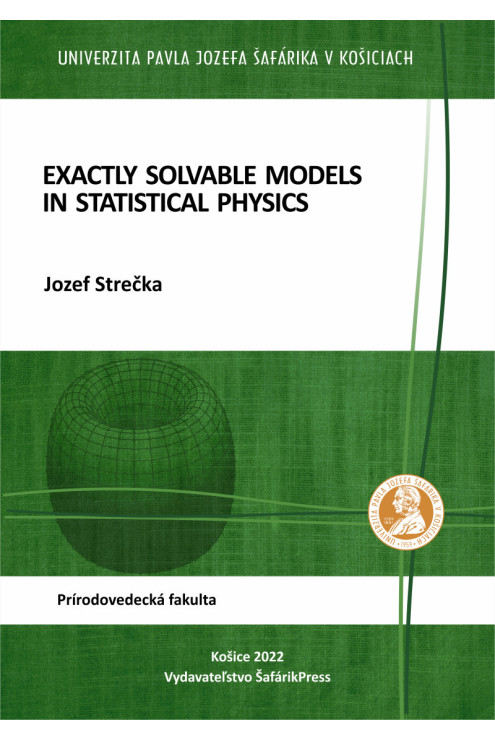
Exactly Solvable Models in Statistical Physics

E-book

Jozef Strečka

Over the past fifteen years, the course on ’Exactly Solvable Models in Statistical Physics’ has become an indispensable ground of the study programme ’Theoretical Physics’ at Faculty of Science of Pavol Jozef Šafarik University in Košice. At first, the course based on the first edition of this textbook was intended for undergraduate students only, however, I have later prepared follow-up course taught at a postgraduate level on demand of several ambitious students who wished to continue in studying this exciting research field.

It is already more than decade when our students enrolled in the study programme ’Theoretical Physics’ graduate from ’Introduction to Exactly Solvable Models in Statistical Physics’ at a master level and ’Exactly Solvable Models in Statistical Physics’ at a postgraduate level. Of course, it was necessary somehow to rearrange topics for the courses of undergraduate and postgraduate students.

More specifically, a few more challenging topics concerned with exact solutions of 2D Ising model (chapter 3) were moved to a more advanced course intended for the postgraduate students, while an introductory course intended for the undergraduate students was contrarily supplemented with a few new topics requiring the second edition of this textbook.

The second edition of this textbook thus contains a completely new chapter 4 devoted to the exact solution of the Ising model on the Bethe lattice using the method of exact recursion relations, while the chapter 5 was supplemented by exact results for ground state of a few frustrated Heisenberg spin models using the variational method. It is my hope that the next edition of this textbook will come soon and it will involve all topics specifically taught within the postgraduate course as well. 

Download the e-book for free  (pdf)

Quantity

978-80-574-0124-7

Data sheet

Method of publication:
E-book (pdf)
Author:
Jozef Strečka
Document type:
Course Notes
Number of pages:
136
Available from:
28.09.2022
Year of publication:
2022
Edition:
2nd edition
Publication language:
English
Faculty:
Prírodovedecká fakulta
- Free for download

16 other products in the same category:

Geografické poznatky bez hraníc - výber z maďarských a slovenských príspevkov z fyzickej a humánnej geografie.

Geografické poznatky bez hraníc - výber z...

E-book

E-book

Dušan Barabas a kol.

The presented text is the final product of work within the project "Tanuljunk egymástól!/Let’s Learn from Each Other!" The project emerged from long-standing contacts between the staff of the Centre for Regional Studies of the Hungarian Academy of Sciences and the Institute of Geography at the Faculty of Science, Pavol Jozef Šafárik University in Košice, as a natural effort to expand mutual cooperation. The first step was collaboration within Interreg II projects, involving a broad range of institutions from both academic and non-academic environments. This initial attempt was unsuccessful due to administrative errors. Consequently, a project titled HUSK/0801/1.6.1/0003 "Tanuljunk egymástól!/Let’s Learn from Each Other!" was prepared and developed in agreement with the Hungarian side. It was approved and co-financed by the European Regional Development Fund under the Hungary-Slovakia Cross-Border Cooperation Program 2007–2013.

Download the e-book for free (pdf)

Špeciálne praktikum školských pokusov z organickej chémie

Špeciálne praktikum školských pokusov z...

E-book

E-book

Jana Špaková Raschmanová - Zuzana Kudličková - Kvetoslava Stanková

Organic chemistry plays a key role in our lives, from the pharmaceutical industry to the production of plastics and food additives. Additionally, it is essential in biochemistry, as it deals with the basic building blocks of living organisms, such as carbohydrates, lipids, proteins, and nucleic acids. One of the best ways to teach organic chemistry and increase students' interest in the subject is through conducting school experiments. This study material presents a collection of visually striking practical experiments in organic chemistry that will help students better understand the chemical processes and techniques used in the field. This electronic study material is supplemented with visual material, allowing students to verify the results of experiments and better understand the individual procedures. At the end of each section, there are questions to help assess the acquired knowledge and encourage deeper understanding of the experiments conducted.

Download the e-book for free (pdf)

Študentská vedecká konferencia PF UPJŠ 2017

Študentská vedecká konferencia PF UPJŠ 2017

E-book

E-book

Katarína CechlárováEva Pitoňáková (eds.)

Proceedings of Abstracts from Contributions by Participants of the Student Scientific Conference at the Faculty of Science, UPJŠ in Košice, Held on April 26, 2017

This is the fifth edition of the proceedings from the Student Scientific Conference (ŠVK) at the Faculty of Science, Pavol Jozef Šafárik University in Košice. We are pleased that ŠVK has become an integral part of faculty life and a showcase for the quality of education provided. In 2017, ŠVK took place as part of the traditional Science Days on April 26, 2017. 105 students from the Faculty of Science presented their work. Contributions were organized into 15 sections, supplemented by an open programming competition involving 17 students and the final round of the IHRA competition, which included 27 teams from across Slovakia.

The abstracts in this proceedings demonstrate that students at the Faculty of Science, UPJŠ, acquire knowledge and skills in their field not only through theoretical study of disciplines but also through active engagement in solving partial scientific problems aligned with research goals at the faculty’s institutes. These abstracts also provide an overview of the faculty’s scientific activity, which we believe will be of interest to the broader public.

doc. RNDr. Gabriel Semanišin, PhD.

Dean of the Faculty

Download the e-book for free (pdf)

Metodika tvorby učebných úloh a didaktických testov pre chémiu

Metodika tvorby učebných úloh a didaktických...

E-book

E-book

Mária Ganajová

The current teaching of chemistry has its specific problems. On one hand, due to the shift of the focus of chemistry curriculum towards theoretical content, the difficulty of chemistry material has increased, and in connection with this, students' interest in chemistry has decreased.

The lack of student interest in chemistry is mostly supported by the opinion that it is precisely chemistry that significantly contributes to the deterioration of environmental quality. On the other hand, we live in an era where we encounter chemical products practically everywhere. It is necessary to learn the basics of chemistry as well as possible, which makes the question of increasing interest in chemistry education and improving its effectiveness very relevant. State educational programs have been introduced into Slovak schools as a foundation for the creation of school educational programs. These emphasize not only acquiring a certain amount of knowledge but also the development and enhancement of key and specific competencies of students, preparing them for lifelong learning and their application in life.

Therefore, increasing attention is being paid to one of the fundamental didactic tools for raising student activity in teaching, and thus improving the effectiveness of chemistry education – learning tasks. From both theory and practice of chemistry teaching, we know that learning tasks, questions, examples, exercises, etc., are among the important components of every teaching lesson. Learning tasks are applied in all phases of teaching – in the motivational phase, the phase of acquiring knowledge, the phase of consolidating knowledge, and the phase of checking the acquired knowledge. It is therefore clear that every teacher will sooner or later find themselves in a situation where they will have to select learning tasks from textbooks, workbooks, collections of problems and examples, or create them themselves.

This scientific monograph is intended for educational specialists and chemistry teachers, aiming to familiarize them with examples of various types and forms of learning tasks and the basics of their creation in chemistry. It can also be helpful for them in preparing certification works focused on test creation and their statistical evaluation.

Download the e-book for free (pdf)

Praktické cvičenia z biochémie

Praktické cvičenia z biochémie

E-book

E-book

Erik Sedlák - Rastislav Varhač -  Patrik Danko - Helena Paulíková - Dušan Podhradský

The presented scripts were created in an effort to update and especially clarify the tasks that are solved in the basic practical exercises in biochemistry students of the 2nd and 3rd year of the bachelor's degree in chemistry, biology and their combinations with other disciplines. Most of the tasks come from the original scripts "Podhradský, Mihalovová: Praktické cvičenia z biochémie, Košice 1989".

Some of them have been modified to a greater or lesser extent and adapted to current conditions in the laboratory. New tasks were also added, such as those dedicated to nucleic acids. The scripts are thematically divided into six separate units, each of which consists of several tasks. The names of the units correspond to the nature of the biomacromolecules, which form their central theme. Theoretical introductions at the beginning of the unit are newly constructed and their main goal is to provide a brief overview of the basic biochemical methods used in the study of biomacromolecules.

These scripts are intentionally only available in electronic form. The reason is the effort to continuously update and modernize individual tasks according to the changing possibilities of our laboratory. We hope that the scripts will fulfill their role and that students will have sufficient theoretical knowledge and practical skills in the field of basic biochemical methods after completing these laboratory exercises.

Download e-book for free (pdf)

Doménové steny a ich dynamika

Doménové steny a ich dynamika

E-book

E-book

Rastislav Varga

The movement of domain walls in ferromagnetic materials is utilized in various magnetic devices for storing, processing, or transmitting signals and information. This mainly includes transformer cores, various sensors, memory devices (e.g., HDDs in PCs), as well as modern spintronic devices such as Racetrack memories, domain wall motion-based electronics, and so on.

This book is intended to serve as a textbook for advanced courses in the field of magnetic materials. It is primarily aimed at students interested in studying magnetic materials, as well as professionals from various fields who wish to understand the basics of domain structure and its changes. It is divided into nine chapters. The first chapter deals with a brief history of the study of domain structure in magnetic materials. The second chapter provides an introduction to the causes and manifestations of magnetic anisotropies. The third and fourth chapters are devoted to the causes of domain structure formation and domain walls. The fifth chapter discusses the structure of domain walls, their potential, and the critical field required for domain wall movement. The sixth chapter is dedicated to magnetization processes, one of which - domain wall movement - is discussed in detail in chapter 7. The eighth chapter contains a theoretical solution for domain wall movement. The final ninth chapter presents a modern method of domain wall movement induced by electric current.

The presented work assumes that the reader has at least basic knowledge in the field of magnetism. Otherwise, the author refers the reader to basic literature (e.g., [2.1 - 2.6]).

Download the e-book for free (pdf)

Aproximačné a pravdepodobnostné algoritmy

Aproximačné a pravdepodobnostné algoritmy

E-book

E-book

Ondrej KrídloGabriel Semanišin

For computer scientists, the constant challenge is to seek efficient algorithms and various technical and implementation possibilities to improve the computational complexity of currently known algorithms. Partial solutions are offered by approaches such as grid-based methods and parallelization of computation. Quantum computers represent a significant but still unfulfilled promise. From a theoretical perspective, probabilistic and approximation approaches provide very effective solutions, and these are the methods we aim to explore in detail.

These electronic university textbooks serve as supplementary materials for the course Approximation and Probabilistic Algorithms. They were developed from the authors' materials and contributions by Prof. RNDr. Viliam Geffert, DrSc., whom the authors thank for providing the manuscript. Acknowledgments also extend to RNDr. Ján Katrenič, PhD., who prepared the first set of exercises for the course, and Žaneta Semanišinová, who reviewed large portions of the text and contributed suggestions for its improvement.

Download the e-book for free (pdf)

Základy znalostných systémov

Základy znalostných systémov

E-book

E-book

Ondrej Krídlo

University textbooks present the basics of knowledge systems, which are divided into two parts. The first part of the publication is devoted to the basis of Formal Concept Analysis, ie the method of data analysis, knowledge representation and information processing, which is based on the formalization of the concept. In the second part we deal with the basics of logic programming, procedural semantics of logic programming, ie programs - theories, questions, SLD-derivation, SLD-tree, search strategies.

University textbooks are intended for students of master's degree programs in computer science.

Download e-book for free (pdf)

UNINFOS 2014 • Univerzitné informačné systémy (Zborník príspevkov)

UNINFOS 2014 • Univerzitné informačné systémy...

E-book

E-book

Gabriel Semanišin - Emil HutňanJana Oleničová

The proceedings contain contributions from participants of the UNIFOS 2014 conference, University Information Systems in Košice, which took place from October 27 to 29, 2014.

ICT centers are important element that provide functioning and development hardware and software infrastructure at Slovak Universities. There are more differences between them in real position, management, personal sources and financing. ICT centers provide a wide range of services to large number of university users and they implement the policy of information security recently.

Download the e-book for free (pdf)

Praktické cvičenia z röntgenovej difraktometrie

Praktické cvičenia z röntgenovej difraktometrie

E-book

E-book

Karel Saksl

The aim of these study texts is to provide students in the second and third levels of higher education with specific guidance on processing 2D diffraction data, performing phase analysis from X-ray diffraction data, and refining microstructural parameters of identified phases using the Rietveld refinement method.

This guide is designed in the form of real-world tasks from materials research and leads the reader step by step through the processes of processing, evaluating, and interpreting the measured data. For this purpose, freely accessible programs such as Fit2D, QualX, POV-Ray, and GSAS II will be used, as well as a freely downloadable commercial program (Diamond) that allows for task execution in demonstration mode. Phase analysis will be conducted exclusively using the freely distributable crystallographic database Crystallography Open Database (COD).

Download the e-book for free  (pdf)

FORMATÍVNE 2025. Spoločne pri implementácii formatívneho hodnotenia do škôl

FORMATÍVNE 2025. Spoločne pri implementácii...

E-book

E-publication

Mária Ganajová-Ivana Sotáková-Petra Letošníková

The conference proceedings FORMATIVE 2025 – Implementing Formative Assessment in Schools Together constitute the output of an online conference organised by the Institute of Chemical Sciences, Faculty of Science, Pavol Jozef Šafárik University in Košice, in cooperation with the National Institute of Education and Youth in Bratislava, within the framework of the KEGA project No. 001UPJŠ-4/2023. These proceedings present current knowledge, experience, and examples of good practice in implementing formative assessment in primary, secondary, and university teaching, with an emphasis on the use of digital tools. The papers address the foundations of formative assessment in the context of curricular changes and the ongoing educational reform, as well as specific didactic procedures for its implementation in the teaching of science and social science subjects, including mathematics, Slovak language, and foreign languages. Particular attention is paid to the development of professional teaching competences, formative assessment strategies, providing targeted feedback, and promoting students’ active participation in the assessment process. These proceedings also present the Digilib digital library, a tool developed to support the creation and management of formative assessment processes within the school environment. This publication is intended for experts in pedagogy and didactics, teachers at all levels of education, student teachers, digital coordinators, and all those interested in educational innovation and in improving the quality of teaching through formative assessment.

Download the e-book for free

Návody na praktické cvičenia z biotechnológie

Návody na praktické cvičenia z biotechnológie

E-book

E-book

Danica Sabolová

This university textbook is intended for students of the Faculty of Science of the University of Applied Sciences in Košice who have enrolled in practical exercises in Biotechnology, but also for all other students who are interested in learning about the practical applications of biotechnology.

The aim of the practical course is to familiarize students with basic biotechnological methods and their applications. The students will verify in practice the theoretical knowledge acquired in the Biotechnology lectures such as the course of fermentation processes, wine production, preparation of fermented milk products and cheese, preparation of culture media, inoculation and cultivation of microorganisms, etc. The practical exercises also include the use of analytical and spectral methods, which are an integral part of biochemistry.

The scripts are published only in electronic form and are available on the University's website: http://kosice.upjs.sk/~kbch/sk, for the reason that it will always be possible to update and modernize the content of the laboratory exercises.

Download the e-book for free (pdf)

MAGNETIC DOMAINS: SPECIAL PHYSICAL PRACTICE 1

MAGNETIC DOMAINS: SPECIAL PHYSICAL PRACTICE 1

E-book

E-book

Adriana Zeleňáková

One of the fundamental characteristics of the magnetic state of ferromagnetic materials is the existence of a domain structure. The university textbook "MAGNETIC DOMAINS: SPECIAL PHYSICAL PRACTICE 1" is intended primarily for students of the Master's programme in Physics of Condensed Matter FKLm and for the PhD programme in Progressive Materials PMd within the profile subject Special Practice 1 at the Institute of Physical Sciences of the Faculty of Sciences of the Pavol Jozef Šafárik University in Košice.  The textbook is divided into seven chapters. The first chapter is devoted to the basics of domain theory, including the history of domain observation and the specification of different types of energies in ferromagnetic body. The second chapter presents the relationship between domain structure and magnetisation processes in ferromagnetic materials The third chapter describes the different types of domain-wall interactions with the defect. The fourth chapter illustrates examples of domain structure in selected ferromagnetic body such as grain oriented and non-grain oriented electrical steels, amorphous and nanocrystalline ribbons. The fifth chapter summarises an overview of the different experimental methods used to visualise the domain structure and their advantages or disadvantages with respect to the structure of ferromagnetic materials. The last two chapters, the sixth and the seventh, are devoted to specific experimental tasks for observing the domain structure of a selected polycrystalline sample using the optical microscope Bitter powder method and the MFM (magnetic force microscopy) method. During the preparation of this undergraduate text, its individual parts were developed using the foreign language literature listed in the recommended references.

Download the e-book for free (pdf)

The XIV. European Magnetic Sensors and Actuators Conference – EMSA2024 - Book of Abstracts

The XIV. European Magnetic Sensors and...

E-book

E-book

Jozef Bednarčík (ed.)

The European Magnetic Sensors and Actuators Conference (EMSA) is a consolidated European forum that serves to assess the status, recent progress, and development in the field of magnetic sensor technology and magnetic actuators. It was first held in 1996 in Iasi (Romania) and since then has continued every two-three years in different European cities. The aim of the conference is to generate an overview of research in magnetic sensors and actuators, to recognize their relevance in modern industry and to identify potential future collaborations. EMSA 2024 will provide an excellent opportunity to bring together scientists and engineers from universities, research institutes and industry to present and discuss their most recent results covering both fundamental and applied aspects of magnetic sensors and actuators.

Download e-book for free (pdf)

Základy astronómie a astrofyziky

Základy astronómie a astrofyziky

E-book

E-book

Rudolf Gális

The presented work provides basic knowledge of astronomy and astrophysics in a completely new multimedia format. The scope of the knowledge presented is mainly focused on stellar astrophysics and supplemented by cosmology beyond the title of the work.

A new approach in this work is the large proportion of visual materials, graphs, and video clips, contrasted with the brevity of the accompanying text. Such a form of presenting knowledge in this field is unprecedented in Slovakia, and therefore this work can be considered a completely innovative piece. It should be emphasized that the engaging form of the presented knowledge does not come at the expense of its content. The work contains all the necessary information that a physics student, especially one with a pedagogical focus, should master. The work can also be an invaluable aid to teachers in secondary and even primary schools, as well as professional astronomers in popularizing astronomical knowledge.

This suggests that the work covers a relatively wide range of needs at various institutions dealing with astronomy, from universities, through faculties of education and grammar schools, to observatories, planetariums, and astronomy clubs.

Download the e-book for free (pdf)

This website uses cookies to ensure you get the best experience on our website