Slovenčina


E-book
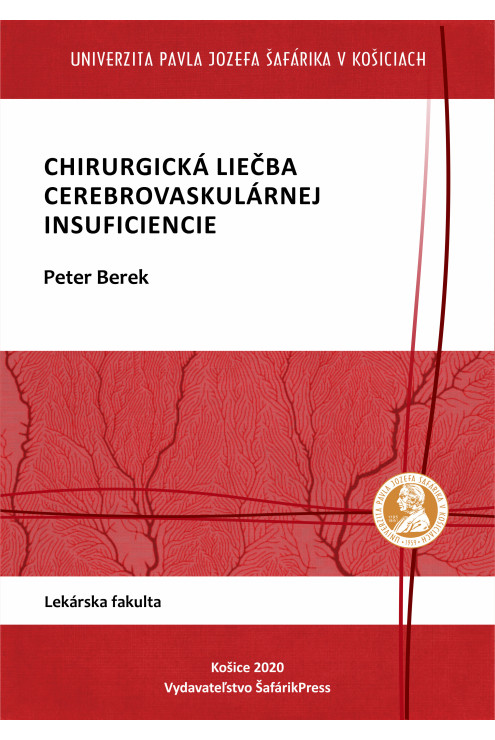
With the development of endovascular surgery, there is a gradual advancement in ACI stenting. The minimally invasive approach has made this methodology suitable for patients with serious concomitant cardiac or pulmonary diseases. Another advantage compared to surgical treatment was better access to the ICA in patients after radiotherapy, after previous neck surgeries, as well as in patients with stenoses close to the skull base.
The comparison of CEA vs CAS is an interesting and debatable topic in many studies. However, despite the massive global development of endovascular treatment, carotid endarterectomy remains the gold standard for treating ICA stenosis in both symptomatic and asymptomatic patients. In this monograph, we would like to accentuate and systematize the issue of surgical stroke prevention from the perspective of a vascular surgeon.

Data sheet
E-book
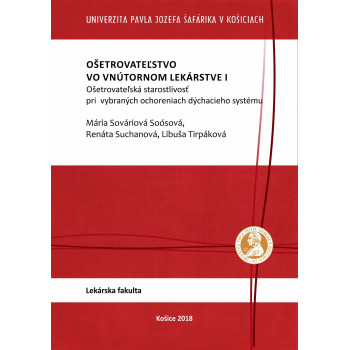
Mária Sováriová Soósová - Renáta Suchanová - Libuša Tirpáková
The presented university textbook provides knowledge in the field of nursing in internal medicine, specifically addressing the specifics of nursing care for patients with respiratory system diseases. It is intended for students of nursing as well as nurses working in this field.
The textbook is divided into six chapters and supplemented with bibliographic references, a list of abbreviations and symbols, a list of tables, and nursing diagnoses according to the NANDA International Taxonomy II classification (North American Nursing Diagnosis Association, NANDA-I). For the correct interpretation of new knowledge, its modification, and effective application in specific situations in nursing practice, it is essential to utilize interdisciplinary relationships and apply the latest scientific evidence.
Those interested in further deepening their knowledge are referred to professional and scientific publications, primarily in nursing, clinical propedeutics, internal medicine, pharmacology, psychology, and other medical and humanities disciplines.
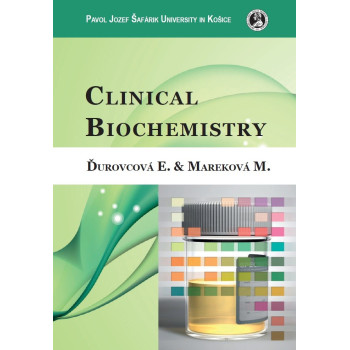
Eva Ďurovcová - Mária Mareková
The presented textbook is intended for students of general medicine and should support their knowledge about indication and interpretation of basic biochemical tests. Clinical biochemistry continues to be one of the most rapidly advancing areas of laboratory medicine, which in line with using of modern technology more and more emphasizes the evidence-based medicine in order to improve diagnosis and monitoring of patients. Selected topics have an ambition to outline and explain the most common issues of biochemical diagnosis of in internal medicine. Individual chapters are devoted to disorders of water, electrolyte and acid-base balance, kidney and liver disease, diabetes mellitus, and biomarkers used in the diagnosis of cardiac necrosis and heart failure. Given the limited range, the textbook merely summarizes the basic knowledge that students have obtained during the study of other subjects, such as medical biochemistry, pathophysiology and internal medicine, and emphasis is given to laboratory diagnosis in accordance with the newer guidelines of professional societies. We hope that the textbook will be helpful in the study of clinical subjects and encourage students' interest in laboratory medicine.
Authors
E-book
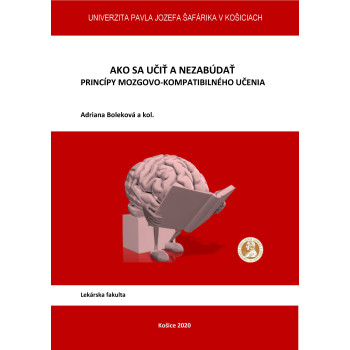
Adriana Boleková a kol.
The book is primarily intended for first-year university students, but it is suitable for anyone who needs to learn. Students can find here the basic principles of learning, principles of how to preserve knowledge, how to concentrate without wasting time, how not to stress before a test or exam and many other practical tips. By acquiring simple knowledge, students will be able to learn effectively with the principles of brain-compatible learning in a way that they will acquire as much information as possible in the shortest period of time with maximum retention; that is minimal forgetting.
The book can serve not only as a theoretical background, but also as a practical tool for mastering university education. The goal was to create a balanced material that would be an interesting source not only for first-year university students, but also for students of higher years and for everyone with a need of lifelong learning.
E-publication
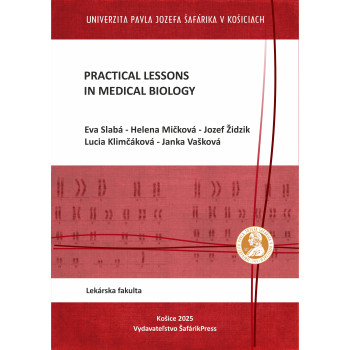
Eva Slabá-Helena Mičková-Jozef Židzik-Lucia Klimčáková-Janka Vašková
Teaching texts „Practical Lessons in Medical biology“ provide the theoretical foundations of microscopy, various microscopic techniques and preparation of microscopic slides in an understandable form. The chapters of the teaching texts contain model questions and tasks from cytology, molecular biology and genetics enabling students to acquire new knowledge from individual thematic areas and provide instructions for the implementation of tasks during laboratory lessons in medical biology. Teaching texts are primarily intended for the practical lessons in the subjects Biology 1 and Biology 2 for foreign students of the first year of General Medicine and the subjects Medical Biology and Genetics and Regenerative Medicine for foreign students of the first and second year of Dental Medicine at P. J. Šafárik University in Košice – Faculty of Medicine.