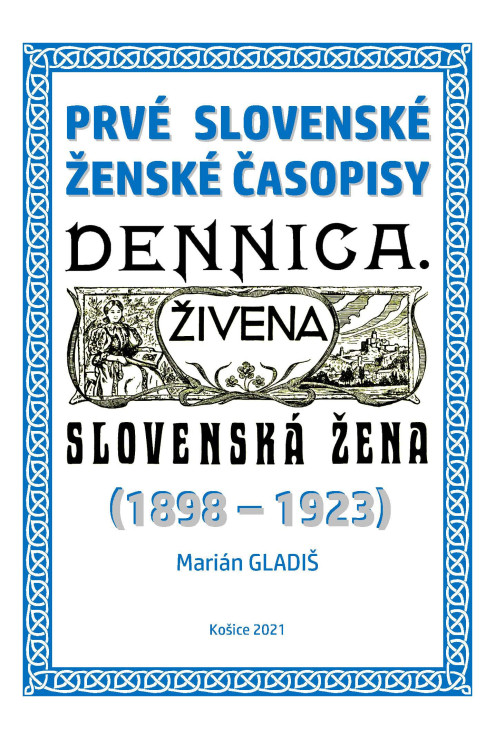
Prvé slovenské ženské časopisy: Dennica, Živena, Slovenská žena (1898 – 1923)

E-book

Marián Gladiš

The monograph entitled The first Slovak women’s magazines: Dennica, Živena, Slovenská žena (1898–1923) provides a general view of the initial stage of the formation of women’s magazine production in Slovakia, defined by a period of 25 years at the turn of the 19th and 20th centuries between 1898 and 1923, in the context of the historical and social development, to which the Slovak journalistic milieu inevitably responded.

The publication is a result of detailed material research of Slovak historical periodicals, implemented mainly from the perspective of the mediological methods and standards of research work.

Download the e-book for free  (pdf)

Quantity

978-80-574-0062-2

Data sheet

Method of publication:
E-book (pdf)
Author:
Marián Gladiš
Document type:
Monograph
Number of pages:
184
Available from:
21.12.2021
Year of publication:
2021
Edition:
1st edition
Publication language:
Slovak
Faculty:
Faculty of Arts
License:
Creative Commons BY NC ND (Uveďte autora - Nepoužívajte komerčne - Nespracovávajte)
- Free for download

16 other products in the same category:

Základy metodológie pedagogicko-psychologického výskumu. Sprievodca pre študentov učiteľstva.

Základy metodológie pedagogicko-psychologického...

E-book

E-book

Mária BačíkováAnna Janovská

The textbook "Foundations of Methodology in Pedagogical-Psychological Research" is primarily intended for students of teaching academic subjects, but it will enrich anyone who needs to familiarize themselves with research methodology focusing on psychological and pedagogical sciences. In the textbook, students become acquainted with the basic principles of conducting research, the process of research implementation, and the basic methods of quantitative or qualitative approaches. The examples used in the textbook are mostly focused on research conducted in a school environment.

By mastering the basic knowledge presented in the textbook, the reader will be able to conduct simple research in school conditions. At the same time, understanding the principles of research methodology helps with the critical evaluation of information from various sources. In preparing the textbook, we utilized our long-term experience with teaching the subject of research methodology, as well as with implementing many research projects. We believe that the simple language of the textbook and the abundance of practical examples will help students understand the basics of such complex issues as research methodology.

We would like to take this opportunity to thank the students of the Faculty of Arts and Natural Sciences at P. J. Šafárik University in Košice who attended the course "Foundations of Methodology in Pedagogical-Psychological Research" in the previous academic year for their inspiration, constructive comments on previous versions of the text, and ideas (or mistakes) that we drew upon in the textbook. We also thank other students who allowed us to use examples from their final theses in the textbook. The conclusion of the work is open because, as it turns out, we do not have a common denominator for both concepts that could decide on the correctness of one or the other concept. It is precisely in this that the Socratic question remains a serious philosophical problem today.

Download the e-book for free (pdf)

Voľby 2023/2024: výsledky - hodnotenia - dôsledky (2025)

Voľby 2023/2024: výsledky - hodnotenia -...

E-book

E-book

Alexander Onufrák, Peter Dubóczi, Lukáš Jakabovič

The submitted publication entitled Voľby 2023/2024: výsledky – hodnotenia – dôsledky reflects a wide range of topics related to the electoral processes that took place in 2023 and 2024 in Slovakia and abroad. The publication deals with both the evaluation of the currently valid electoral legislation, including proposals for its further improvement, and the broader socio-political consequences of the elections in connection with democratization and integration processes. The submitted publication is published as an output of the VEGA project No. 1/0474/24 Audit of Slovak electoral and referendum legislation, the project leader of which is prof. JUDr. Ladislav Orosz, CSc. from the Faculty of Law of the Pavol Jozef Šafárik University in Košice and in which the Department of Political Science of the Faculty of Arts of the Pavol Jozef Šafárik University in Košice also participates. The authors of the individual contributions analyze all types of elections, from municipal and regional, through parliamentary and presidential, to elections to the European Parliament. While some authors focused primarily on the local or regional level, others chose an approach focused on the national or supranational level, and the geographical scope of the cases examined was extremely diverse. 

Download the e-book for free (pdf.)

Študentská vedecká konferencia XIII.

Študentská vedecká konferencia XIII.

E-book

E-kniha

Mikuláš Jančura - Maroš Melichárek (eds.)

Predkladaný zborník je publikovaným výstupom zo Študentskej vedeckej konferencie, ktorá sa na pôde Katedry histórie FF UPJŠ uskutočnila dňa 02.12.2024. Bolo to už po trinásty krát. Zborník z tohto ročníka (už tretí v poradí) sa tak zaradil do tejto úspešnej série. Obsiahnuté príspevky, podobne ako aj v starších zborníkoch z tejto konferencie, približujú stav bádania korelujúci so záverečnými prácami študentov na bakalárskom a magisterskom stupni štúdia.

Stiahnite si e-knihu zadarmo (pdf)

Význam a miesto resocializácie a reedukácie v sociálnej práci

Význam a miesto resocializácie a reedukácie v...

E-book

E-book

Eva Žiaková (ed.) 

The 5th edition of the Košice Days of Social Work

Proceedings of the scientific conference with international participation held on November 25, 2016, in Košice

The issue of re-education and resocialization is not new, but it is an increasingly urgent problem as various types of dependencies grow in both scope and content. It can be said that this issue represents one of the central themes of social work in its theoretical foundations as well as practical contexts.

This was the main reason for selecting this topic as the central theme of the 5th edition of the Košice Days of Social Work, which was the sixth continuation of the professional community’s gatherings to address social problems currently troubling our society. The presented proceedings include nearly three dozen contributions from more than twenty authors from Slovakia, as well as Poland and the Czech Republic. The content of the contributions deals not only with theoretical foundations and perspectives on the issue of resocialization and re-education but also with the consequences of these processes in various client social risk groups—whether it involves the addicted, aggressive, chronically ill, convicted, divorced, bullied, cyberbullied, etc.

I believe that such a wide range of contributions will enrich all those who work and study in the theoretical, research, and practical fields of social work.

Download the e-book for free (pdf)

NOVÁ EURÓPA: Návrat do budúcnosti

NOVÁ EURÓPA: Návrat do budúcnosti

E-book

E-book

Martina Hurčalová - Sergej Sinicyn - Maroš Čupka (eds.)

Proceedings from the 13th International Scientific Conference of Students and Young Researchers, organized on May 16, 2024, by the Department of Political Science of the Faculty of Arts at Pavol Jozef Šafárik University in Košice, the Institute of Political Science and Public Administration of the Faculty of Political Science and Journalism at Maria Curie-Skłodowska University in Lublin, the Department of Political Science of the Faculty of Arts at the University of Miskolc, the Institute of Social Studies of the Faculty of Regional Development and International Studies at Mendel University in Brno, the Faculty of Political Science and Diplomacy at Vytautas Magnus University in Kaunas, and the civic association Respublica.

The aim of the translated publication NEW EUROPE: Back to the Future is to reflect on the challenges in the fields of international security, the fight against climate change, and environmental protection, and to highlight selected global phenomena.

The proceedings consist of 12 contributions in Slovak, English, and Czech. The authors primarily addressed selected current issues from the international environment in the context of deteriorating international relations and global security.

The topics of the contributions mainly include questions of international security (for example, in Germany or Hungary), environmental issues and the fight against the climate crisis. Furthermore, the proceedings include topics such as the European Parliament elections, selected narratives related to the war in Ukraine, migration to Europe and its security aspects, self-reflection of the European political system, and public space and public discourse. The proceedings also include a part of an upcoming utopian novel.

Download the e-book for free (pdf)

Theories of Intercultural Communication

Theories of Intercultural Communication

E-book

E-book

Renáta Panocová

The university textbook "Theories of Intercultural Communication" is primarily intended for master's degree students of translation and interpreting, as well as doctoral students of British and American Studies.

The goal of the textbook is to familiarize students with key theories in the field of intercultural communication. Eight chapters cover a selection of current theories focused on defining cultural dimensions, identity management and negotiation, accommodation and adaptation, anxiety and uncertainty management, and current research on the Sapir-Whorf hypothesis.

The final chapter provides a historical overview of intercultural communication theories and outlines key research questions for the future.

Download the e-book for free (pdf)

Sociálna práca so skupinou

Sociálna práca so skupinou

E-book

E-book

Lucia Tóthová

Social work with a group, along with social work with individuals, social work with the community and social work with society, is one of the basic methods used in the field of social work, but also in other helping professions. The work of a social worker requires knowledge of these methods but also of the techniques through which these methods are implemented and fulfilled. Understanding and acquiring individual methods for the needs of social practice requires the theoretical mastery of those institutes that are the basis of the method and the interrelationships between these institutes. Therefore, the author proceeded to elaborate a university textbook in which she focuses on one of the basic methods of social work, namely social work with a group.

The university textbook is designed for university students who are focused on social work studies, but also psychology, ethics and other disciplines using the method of working with a group, as it aims to present some facts about social groups and behaviour in them.

The author offers an insight into social work with the group from its historical foundations to today's latest knowledge of this method in accordance with the latest research of work with the group.

Download the e-book for free (pdf)

Cez osamelosť k abstinencii: alebo prečo sú závislí ľudia osamelí

Cez osamelosť k abstinencii: alebo prečo sú...

E-book

E-book

Ján KahanEva Žiaková

The monograph focuses on the issue of loneliness among substance-addicted people in the context of abstinence prospects and re/lapse prevention. In the monograph these phenomena, several theories were integrated and applied in the context of the ecosystem meta-framework of social work and practical contexts. The ecosystem meta-theory serves as a meta-construct with the ability to encompass the complexity of social phenomena as well as that of human beings within the structure of their living and social environment, formal and informal networks, and close intimate relationships.

In this monograph are presented research sample consisted of 235 respondents – hospitalised addicts undergoing urgent treatment, abstaining A-club members as well as members of psychotherapy and self-help groups. The research showed that abstainers were statistically less lonely than the hospitalised respondents. Quantitative data of research are complemented by qualitative data collected in four case studies; two of them focused on two long-term abstainers from alcohol and drugs, while the other two case studies dealt with two respondents in post-hoc treatment undergoing the resocialization process. The research also showed that respondents who broke abstinence felt lonelier than their successfully abstaining counterparts.

The results were supported also by the fact that a statistically significant inversely proportional relationship was identified between the duration of abstinence and loneliness rate. Gender differences were found between the hospitalised addicts in all loneliness dimensions. Naturally, the combined research was limited in certain aspects, mainly in terms of the size and proportional distribution of the research sample and its subgroups, test battery extent, and general nature of the population studied. Triangulation among quantitative and qualitative with the theoretical starting points confirmed the existence of a relationship among loneliness, addiction, and prospect of abstinence.

Download the e-book for free (pdf)

Pavol Jozef Šafárik v kontinuite

Pavol Jozef Šafárik v kontinuite

E-book

E-book

Marianna SedlákováMarián Gladiš (eds.)

The content of the book publication Pavol Jozef Šafárik in Continuity consists of contributions from two events organized by the Department of Slovak Studies, Slavic Philologies, and Communication at the Faculty of Arts of Pavol Jozef Šafárik University in Košice during its short existence.

The first event was a scientific seminar held on the occasion of the 150th anniversary of the death of P. J. Šafárik, titled Pavol Jozef Šafárik – Scientist and Artist, which took place on January 27–28, 2012, in Košice and Kobeliarovo. The second event was an internal scientific seminar on the occasion of the 220th anniversary of Šafárik’s birth, held on December 15, 2015, under the title In the Quiet Home Circle. Symbolically—beginning with death and ending with birth (thus indicating the living continuity of Šafárik’s research legacy)—we aim to continue the study of Pavol Jozef Šafárik’s scientific work and increasingly involve the youngest generation of researchers (represented by doctoral students of the department in the field of literary studies). This is despite the fact that the literature on the life and work of this scholar and poet, who stood at the birth of Slavic studies, is very rich, and most of his works have already been scientifically analyzed. However, it appears that even seemingly outdated views of Šafárik still deserve scientific attention in the new context of humanities and natural sciences, as can be read in the contributions published in this volume.

Through the continuous publication of the Collected Works of Pavol Jozef Šafárik, both mentioned seminars, and the publication of this volume, the Faculty of Arts of Pavol Jozef Šafárik University in Košice has continued the activities of the Prešov Faculty of Arts from the time before its separation from the union of faculties of Pavol Jozef Šafárik University in Košice in 1997. The selection and arrangement of contributions in the volume symbolize the "passing of the baton" in research and publishing activities related to Pavol Jozef Šafárik—a scientific personality of global stature, who in 1959 gave his name to our university.

Compiled by the editors.

Download the e-book for free  (pdf)

Patočkova filozofia dejín

Patočkova filozofia dejín

E-book

E-book

Róbert Stojka

The aim of the presented monograph is primarily to introduce Patočka's concept of the philosophy of history as comprehensively as possible, although I am aware that this is by no means an easy task. This difficulty arises not only because, as already mentioned, there is currently no extensive and exhaustive work on this topic.

While there is a relatively large number of studies devoted to Patočka's concept of the philosophy of history, none of them, however, examine this concept from a comprehensive perspective as a unified whole – most focus on specific partial issues (and there are many) stemming from this concept. This fact, incidentally, serves as clear evidence to me that this is undoubtedly a highly demanding topic.

Download the e-book for free (pdf)

VARIA XXXI

VARIA XXXI

E-book

Lucia Jasinská

Tradícia organizovania kolokvií na Slovensku už štandardne prináleží vždy inému akademickému slovakistickému pracovisku. Jeho XXXI. ročník sa realizoval pod organizačnou taktovkou Katedry slovakistiky, slovanských filológií a komunikácie Filozofickej fakulty UPJŠ v Košiciach, ako aj košickej pobočky Slovenskej jazykovednej spoločnosti a Slovenskej jazykovednej spoločnosti pri Jazykovednom ústave Ľ. Štúra SAV, v. v.i. V univerzitných priestoroch Učebno-výcvikového zariadenia Danišovce sa počasdvojdňového podujatia stretli nádejní mladí jazykovedci nielen zo Slovenska, ale aj z Českej republiky. Výstupom kolokvia mladých jazykovedcov býva najprv zborník abstraktov, publikovaný už v čase realizovania podujatia, a neskôr zborník príspevkov ako pripomienka tejto udalosti a tiež ako odraz vedeckých záujmov mladých lingvistov. Kolokvialisti prezentovali svoje príspevky venované výskumným problémom z rôznych oblastí jazykovedy, a to z oblasti korpusovej lingvistiky, onomastiky, morfológie, dialektológie, syntaxe, štylistiky, lexikológie, frazeológie aj didaktiky, niektorí dokonca s presahom do literárnych textov.

Download e-book for free(pdf)

Sociálne a politické analýzy 1-2014

Sociálne a politické analýzy 1-2014

E-book

E-journal

Juraj Schenk et al.

The scientific journal Sociálne a politické analýzy (Social and Political Analyses) serves as an interactive electronic platform for communication and the presentation (publication) of experts and their work in the fields of basic and applied research and analyses within sociological, psychological, political, and methodological contexts. It is a medium focused on intensively supporting research activities and analyses within an interdisciplinary framework, facilitating the exchange of experiences, fostering collaboration, and revitalizing the production of scientific work in this area.

The publication section of the journal offers space for works such as:

- Original sociological, psychological, and political studies and analyses in any areas of social life

- Methodological studies

- Research reports

- Studies from qualification theses Research and analysis projects

- Reviews

Download the e-journal for free (pdf)

Bedeker onkologickej liečby

Bedeker onkologickej liečby

E-book

E-book

Lucia TóthováKatarína ŠiňanskáEva Žiaková

Here is the translation of the provided text into English: A guide to oncological treatment was created at a time when the importance of health became even more emphasized, becoming a kind of mega-value for the new modern "pandemic" human. The use of the term "pandemic" person arose, of course, in connection with the emergence of the coronavirus pandemic worldwide, but primarily because other dangerous long-term diseases that threaten contemporary humans are somehow being pushed into the background.

The severity of such diseases (including cancer) does not diminish just because attention has shifted to something more acute. It is very important to realize this and not fall under the illusion that if we overcome an acute danger, then automatically improve conditions for chronic diseases as well. We believe it's quite the opposite; prolonged stress and social negative factors constantly affecting us—among which undoubtedly includes pandemic situations—worsen not only psychological but also somatic states.

The guide to oncological treatment aims precisely at highlighting those psychological and social factors that negatively "support" cancer development in any form and can positively influence treatment and coping with illness. The guide offers opportunities for social engagement with groups of people undergoing similar oncological treatments, allowing them to share psychologically as well as professionally similar situations with those facing similar problems in treatment. The authors hope that this guidebook will reach those who will become more self-sufficient in overcoming such a formidable enemy as cancer.

Authors

Download the e-book for free (pdf)

Komunita a komunitná práca

Komunita a komunitná práca

E-book

E-book

Katarína ŠiňanskáDušan Šlosár

The presented monograph deals with various views on of the community issue and community work, with which  area of social work or other helping professions is closely connected. It offers theoretical analysis as a basic theoretical framework of the issue, which is necessary to know in the study and in the performance of the practice in the helping profession. The authors consider community work to be one of the possibilities for fully involving the inhabitants in co-responsible decision-making on things that fundamentally affect their lives.

The monograph characterizes in  fifteen chapters the community and the processes that takes place in it, outlines a brief history and approaches in community work. It offers theoretical background, which is used in community work as a necessary prerequisite for a professional approach practice. The monograph also points to the important position of professional help in community.

Download the e-book for free (pdf)

Homosexualita a homofóbia v kontexte sociálnej práce

Homosexualita a homofóbia v kontexte sociálnej...

E-book

E-book

Ján ŠimkoDušan Šlosár

The monograph is dealing with the issue of homosexuality and homophobia in the context of social work and it is divided into five chapters, which are devoted to individual fields of the tackled issue. The first chapter is describing the phenomenon of homosexuality in the society; the focus is put on human sexuality and sexual orientation. The following chapter is clarifying the formation of homosexual identity in connection to coming out and it describes its frequently utilized models. The third chapter is devoted to the concepts of heteronormativity and heterosexism in the social context.

Furthermore, the chapter is dealing with the formation of attitudes towards this issue from the point of view of religion and masculinity. Another chapter is describing homophobia as the result of heteronormativity, stereotypes and prejudice.

In the last chapter, the authors are introducing selected social work theories dealing with the homosexual minority, the approaches to LGBT+ community and suggestions towards elimination of homophobia within the social work environment.

Download the e-book for free (pdf)

Probácia v systéme trestnej politiky a sociálnej práce

Probácia v systéme trestnej politiky a...

E-book

E-book

Vladimír LichnerDušan Šlosár

Issues of punishment are directly linked to a state’s criminal policy, which is an inseparable part of its social policy. Historically, the state has held a unique dominant position in the realm of punishment. Once the conditions for imposing a penalty are met, the state fulfills its obligation by sentencing through independent courts. However, it does not address questions of satisfaction, which belong to the victim. The victim may be a specific physical person or legal entity that suffered harm due to the criminal act. This harm simultaneously affects civil society as a whole. The state prioritizes its duty to punish and decide on the matter over compensating the harmed individual or civil society.

By mediation in criminal cases, we mean extrajudicial facilitation of resolving disputes between the offender and the harmed party, with the assistance and personal participation of a mediator. The mediator, as an independent and impartial person, helps parties identify their interests and supports them in finding shared, practical, and realistic solutions to the points causing their conflict. Probation refers to monitoring, supervising the accused, defendant, or convicted individual, as well as providing individual assistance to the offender and encouraging them to lead a lawful life. This reduces the risk of recidivism, or repeated criminal behavior.

Download the e-book for free (pdf)

This website uses cookies to ensure you get the best experience on our website