Slovenčina


E-book
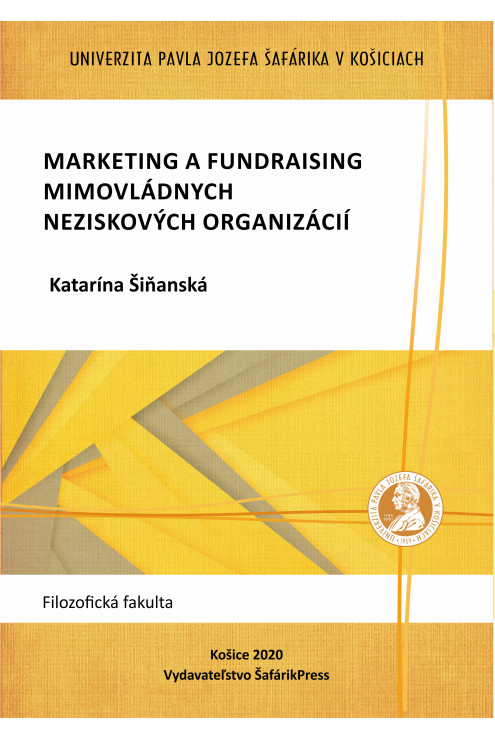
For a non-governmental organization to be successful, it must focus, among other things, on its main goal of spreading its vision and mission to another area. It can achieve success by increasing its visibility and raising awareness about its activities in society, sending a clear message, and maintaining transparency.
The monograph deals with specific areas in which non-profit NGOs are active, i.e. marketing and fundraising. Both these areas are of key importance for the NGO’s success, therefore they require particular attention. It is well known that NGOs lack proper support in Slovakia and their funding is insufficient given the demand for their services. NGOs therefore search for multiple sources of funding and use marketing as a tool.
The monograph explains the importance of NGOs in the non-profit sector and justifies the tools they employ when navigating the commercial space.

Data sheet
E-book
Iveta Bónová - Ivica Hajdučeková - Lucia Jasinská (eds.)
The proceedings maps three significant events organised in 2018 – 2019 within the project KEGA No. 008UPJŠ-4/2017 Science without barriers (Interdisciplinary inspirations of contemporary literary scholarship and linguistics in university educational practice; principal investigator prof. PhDr. J. Gbúr, CSc.) at the Department of Slovak Studies, Slavonic Philologies and Communication, Faculty of Arts, Pavol Jozef Šafárik University in Košice.
The first activity was a scholarly and artistic symposium Science without barriers held in March 6 – 8, 2019 on the occassion of the 80th birthday of Dr. h. c. prof. PhDr. Ján Sabol, DrSc. It brought extended abstracts of participants in two sections (Slovak studies and literary scholarship in interdisciplinary contexts) as its outcome. The next two parts describe artistically oriented events: Interpretational afternoon (a competition for the best interpretation of Ján Sabol´s book of verse Love in Blue) with the winning works added, and the vernissage Literature through an objective lens with the share of students of the School of Industrial Visual Arts in Košice.
E-book
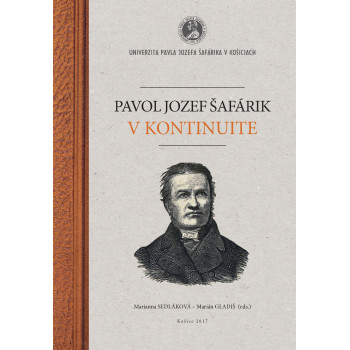
Marianna Sedláková - Marián Gladiš (eds.)
The content of the book publication Pavol Jozef Šafárik in Continuity consists of contributions from two events organized by the Department of Slovak Studies, Slavic Philologies, and Communication at the Faculty of Arts of Pavol Jozef Šafárik University in Košice during its short existence.
The first event was a scientific seminar held on the occasion of the 150th anniversary of the death of P. J. Šafárik, titled Pavol Jozef Šafárik – Scientist and Artist, which took place on January 27–28, 2012, in Košice and Kobeliarovo. The second event was an internal scientific seminar on the occasion of the 220th anniversary of Šafárik’s birth, held on December 15, 2015, under the title In the Quiet Home Circle. Symbolically—beginning with death and ending with birth (thus indicating the living continuity of Šafárik’s research legacy)—we aim to continue the study of Pavol Jozef Šafárik’s scientific work and increasingly involve the youngest generation of researchers (represented by doctoral students of the department in the field of literary studies). This is despite the fact that the literature on the life and work of this scholar and poet, who stood at the birth of Slavic studies, is very rich, and most of his works have already been scientifically analyzed. However, it appears that even seemingly outdated views of Šafárik still deserve scientific attention in the new context of humanities and natural sciences, as can be read in the contributions published in this volume.
Through the continuous publication of the Collected Works of Pavol Jozef Šafárik, both mentioned seminars, and the publication of this volume, the Faculty of Arts of Pavol Jozef Šafárik University in Košice has continued the activities of the Prešov Faculty of Arts from the time before its separation from the union of faculties of Pavol Jozef Šafárik University in Košice in 1997. The selection and arrangement of contributions in the volume symbolize the "passing of the baton" in research and publishing activities related to Pavol Jozef Šafárik—a scientific personality of global stature, who in 1959 gave his name to our university.
Compiled by the editors.
E-book
Ľubov Vladyková - Marián Bednár a kol.
The university textbook Ethics of Science and Technique (Selected Problems) is a collection of contributions by various authors who deal with selected problems and areas of science and technique. For the last hundred years, we can observe the rapid development of science and technique (technology). The transition of society in the 20th century into the information age and in the current 21st century into the digital age brings radical challenges and changes in all areas of human life, but especially in the moral field.
Ethical discussions, responding to the development of science and technique (technology), have stimulated the emergence of ethics of science and technique, which as a subdiscipline of applied ethics is a way out of the conflict between professional autonomy, social control and self-regulation of action and behaviour; not only in science and technique, but also in economy and politics. In the digital age, technique, technology and science are fundamentally changing our lives; from the way we work to the way we communicate, how we fight local and global problems, and how we try to solve societal problems.
These radical changes are not without controversy, and many provoke intense debates that are often polarized or associated with scientific ambiguities or dishonest demagoguery and ideology.
E-book
Jana Balegová-Erika Brodňanská (eds.)
It has been eleven years since the Department of Classical Philology of the Faculty of Arts of the University of Pavol Jozef Šafárik in Košice opened the gates of its imaginary colourful garden for the first time. At that time, the Hortus Graeco-Latinus Cassoviensis provided a space to present the results of work from all fields of the classical, Latin medieval, and Neo-Latin studies to colleagues from Slovakia. Five years later, the "garden" was enriched by colleagues from Bohemia and Moravia, and this time, at its fourth opening, colleagues from Greece and Germany also honoured it with their works. Variety remained its characteristic feature. Papers on ancient history, the linguistics of classical languages, ancient and medieval literature, ancient philosophy, the history of ancient medicine and Neo-Latin studies, as well as contributions on the teaching of classical languages, are presented in the proceedings. Moreover, the volume is published as an output of two seemingly disparate VEGA projects carried out at the department: No. 1/0109/21 Poemata de se ipso by Gregory of Nazianzus and No. 1/0255/22 Medicus poeta. Neo-Latin literature of medical authors associated with Slovakia. However, appearances are deceptive, because Gregor of Nazianzus, although a church father, also wrote poetry, his works contain numerous allusions to the medical milieu, and he had a brother who was a physician. His entire work is characterised by the variety of the themes he explores. References to the Bible are not uncommon in the works of medical poets. Just as the projects differ and simultaneously overlap with each other, the themes of the individual contributions also differ and overlap.