E-journal
Juraj Schenk et al.
The scientific journal Sociálne a politické analýzy (Social and Political Analyses) serves as an interactive electronic platform for communication and the presentation (publication) of experts and their work in the fields of basic and applied research and analyses within sociological, psychological, political, and methodological contexts. It is a medium focused on intensively supporting research activities and analyses within an interdisciplinary framework, facilitating the exchange of experiences, fostering collaboration, and revitalizing the production of scientific work in this area.
The publication section of the journal offers space for works such as:
- Original sociological, psychological, and political studies and analyses in any areas of social life
- Methodological studies
- Research reports
- Studies from qualification theses Research and analysis projects
- Reviews
Data sheet
E-book
Miroslava Köverová - Margita Mesárošová (eds.)
The publication „Helping professions and self-care from the perspective of psychology and social work“ includes research studies focused on self-care, and the positive and negative effects of helping among specific groups of helping professionals – psychologists and social workers.
A number of Slovak as well as foreign authors contributed to the book of proceedings. The contributions are theoretical studies, research studies and case studies. The theoretical and research studies are focused on important issues of professional helping: self-care, compassion satisfaction, compassion fatigue, burnout, perceived stress, secondary traumatic stress, mindfulness, empathy, job satisfaction and turnover among psychologists and social workers.
Research interest in the phenomena is especially important in the context of the mental health of helping professionals and in reducing the negative consequences of helping.
E-book
Ľubov Vladyková - Marián Bednár a kol.
The university textbook Ethics of Science and Technique (Selected Problems) is a collection of contributions by various authors who deal with selected problems and areas of science and technique. For the last hundred years, we can observe the rapid development of science and technique (technology). The transition of society in the 20th century into the information age and in the current 21st century into the digital age brings radical challenges and changes in all areas of human life, but especially in the moral field.
Ethical discussions, responding to the development of science and technique (technology), have stimulated the emergence of ethics of science and technique, which as a subdiscipline of applied ethics is a way out of the conflict between professional autonomy, social control and self-regulation of action and behaviour; not only in science and technique, but also in economy and politics. In the digital age, technique, technology and science are fundamentally changing our lives; from the way we work to the way we communicate, how we fight local and global problems, and how we try to solve societal problems.
These radical changes are not without controversy, and many provoke intense debates that are often polarized or associated with scientific ambiguities or dishonest demagoguery and ideology.
E-book
Pavol Kačmár - Margita Mesárošová - Ladislav Lovaš (eds.)
This publication introduces a selected body of papers presented at scientific conference School psychology: History and perspectives that took place on October 17 and 18 in Košice.
The conference commemorated two important jubilees. The first was the birth anniversary of prof. Ján Hvozdík (100 years), the second jubilee was related to the opening of the study of psychology at the University of Pavol Jozef Šafárik (50 years).
The contributions have undergone peer review.
E-book
The presented monograph aims to critically map the understanding of the concept of possible worlds.
The first chapter describes the formation of the semantics of possible worlds, along with indicating some problems it brings, which were incisively revealed primarily by W. V. O. Quine. In the next two chapters, the work focuses on more modern views on the nature of possible worlds, with the main attention given to the dichotomy between the possibilist and actualist approach to the question of modalities, alongside which it is necessary to assess other distinctions (essentialism - anti-essentialism, realism - reductionism (or ersatzism or fictionalism), naturalism - non-naturalism, etc.). Increased attention in the work is specifically devoted to the possibilism of D. Lewis and the actualist concepts of S. Kripke, A. Plantinga, R. M. Adams, N. Rescher, D. Armstrong, and J. Hintikka.
An unconventional approach to the issue of possible worlds is captured in the fourth chapter. It is primarily dedicated to the significant concept of Jaakko Hintikka, which works with the notion of epistemic possible worlds and documents the inclination towards the modification and relativization of modal discourse. The conclusion provides an evaluation of the discussion that touches on the main problems associated with considerations of possible worlds.
In the presented monograph, some representative concepts of possible worlds, or possible individuals, are clarified, and the overall process is indicated from assessing possible worlds as ideal logical constructs through their relativization by separate domains of individuals for individual worlds and further through the relationship of attainability to financial, impossible, and non-standard possible worlds.
E-book
The textbook "Literary Story as a Tool for Moral Education" aims to contribute to the preparation of future teachers of ethical education, as well as students from other fields, particularly in the humanities. It focuses on an area that remains trivialized and marginalized—gender-sensitive education and training. The author operates under the assumption that applying a gender-sensitive approach in education requires an understanding of what a gender perspective entails.
Experience from interdisciplinary and transdisciplinary research, along with teaching experiences where ethical questions and themes—such as those related to gender, gender equality, gender justice, and gender relations—are presented, taught, and explored through various media or texts (not only traditional scientific and professional ones but also artistic, especially literary), inspired the author to present such an approach in a relatively coherent form.
This includes summarizing existing knowledge and experiences on the topic so that they can serve as a suitable starting point for enhancing the competencies of future teachers (not only) in ethical education when applying a gender-sensitive approach in education and teaching issues related to gender and gender relations in the context of applied ethics and ethical education.
Autor
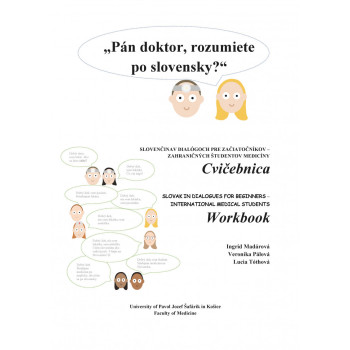
SLOVAK IN DIALOGUES FOR BEGINNERS – INTERNATIONAL MEDICAL STUDENTS - Workbook
E-book
Ingrid Madárová - Veronika Pálová - Lucia Tóthová
Audio attachments - format RAR
The audio-exercise workbook “Pán doktor, rozumiete po slovensky?”is a follow-up to the textbook “Pán doktor, hovoríte po slovensky?” (Madárová et al.)and is intended for international students of Slovak as a foreign language in the medical environment.
This workbook provides the students with an opportunity to practise and enhance mostly their listening skills and pronunciation through various short dialogues between doctors and patients in the Slovak language. Dialogues contain the vocabulary used in the textbook Pán doktor, hovoríte po slovensky?. Students are encouraged to build their confidence in speaking Slovak by practising these dialogues in the new workbook.
The audio-exercise workbook is comprised of 16 units. Each unit offers short dialogues and recordings
A number of dialogues enable its wide use for self-studying while the most frequent phrases related primarily to body parts, signs and symptoms of illnesses, diseases or various medical conditions are practised in different contexts in a variety of exercises.
Original illustrations enable students to understand dialogues more easily and the correct answers of the exercises and the scripts of the recordings can be found in the Answer key at the end of the workbook.
E-book
For a non-governmental organization to be successful, it must focus, among other things, on its main goal of spreading its vision and mission to another area. It can achieve success by increasing its visibility and raising awareness about its activities in society, sending a clear message, and maintaining transparency.
The monograph deals with specific areas in which non-profit NGOs are active, i.e. marketing and fundraising. Both these areas are of key importance for the NGO’s success, therefore they require particular attention. It is well known that NGOs lack proper support in Slovakia and their funding is insufficient given the demand for their services. NGOs therefore search for multiple sources of funding and use marketing as a tool.
The monograph explains the importance of NGOs in the non-profit sector and justifies the tools they employ when navigating the commercial space.
E-book
Miroslava Köverová - Simona Ďurbisová (eds.)
Proceedings present abstracts of contributions registered for the scientific conference Work and Organizational Psychology 2023. Conference date and venue: 8-9 June 2023, Department of Psychology, Faculty od Arts, Pavol Jozef Šafárik University in Košice.
E-book
Linda Babušík Adamčíková - Gabriel Koscelanský - Mária Petriková (eds.)
Proceedings of the VI. Annual International Scientific Conference of Students and Young Researchers organized on May 11–12, 2017 by the Department of Political Science of the Faculty of Arts at Pavol Jozef Šafárik University in Košice, the Department of Political Sciences and Public Administration at Uzhhorod National University, the Research Institute of Central Europe, and the Res publica Association.
Presented publication is an outcome from the international scientific conference for students and young scientists that took place on 11th and 12th May 2017 at the Department of Political science, Faculty of Arts, Pavol Jozef Šafárik University in Košice. The main aim of the presented is to bring up outcomes of research of young scientists and students from Slovakia, as well as from abroad.
This conference proceedings contains 19 papers in Slovak, Czech and English language. Papers are dealing with current issues of theory and practice of politics and international relations. We can find paper analyzing globalization, international terrorism, topic of EU or development of European states. The conference proceedings contents also papers regarding the far-right parties, role of women in politics and integration migrants in Slovak republic.
E-book
The monograph offers an insight into radicalization pull and push factors, influencing which is the competence of helping professionals.Radicalization is conditioned by the current social, economic, cultural and political context, i.e. the time-space in which radicalization occurs.It is this fact that directs the content of the monograph to factors that can be considered triggering and influencing factors of radicalization processes as well as radicalization itself.
The monograph systematizes knowledge about radicalization from the point of view of pull and push factors, which have been identified as factors of radicalization in professional literature, research reports and other verified sources, including Internet resources focused on radicalization and processes of radicalization, as well as available interventions to influence or prevent radicalization.The monograph mainly focuses on the analysis of pull and push factors that are related to radicalization and radicalization processes.
The monograph offers the results of research carried out through qualitative methodology.The research focused on issues related to radicalization in the research sample consisting of radicalized and non-radicalized respondents.The research focused on the investigation of pull and push factors related to radicalization, which can occur in the family, school or work environment, among peers, in the wider social environment related to the social and political climate in society and the influence of mass media.
E-book
Despite the fact that a psychologist may have a good moral background, it is necessary for everyone to know and act in accordance with ethical professional principles in order not to harm the clients with whom they work in the course of psychological practice. There are many case studies in the professional literature that describe serious situations of violations of psychological ethics. On the one hand, they depict conscious professional misconduct or ignorance. On the other hand, they have contributed to the introduction of even legal standards for the ethical behavior of psychologists as professionals. Completion of a course or training in the topic of psychological ethics is required by several professional associations abroad, especially in the last years of undergraduate studies. Their goal is to supervise the quality and preparation of future psychologists. The university textbook Do I Have It or Not: Ethics in Psychological Practice provides a summary of essential information on the ethics of conducting psychological practice, the boundaries of the relationship with the client, and the rules of confidentiality. The goal is not for the student, as a future psychologist, to know ethical rules word for word, but for them to be sufficiently ethically sensitive.
E-book
Renáta Orosová - Katarína Petríková - Lucia Diheneščíková
Based on the analysis of self-reflection competences in future teachers, opinions of the mentor teachers and their recommendations and the set of pupil-oriented and educational process-oriented competences, a protocol for using self-reflection methods has been created. More precisely, it is a self-reflection teaching diary. It is an innovative method of self-reflection competence development in teaching students in their practical specialized preparation, particularly the self-reflective observation practice and conversation.
The Self-Reflection Teaching Diary is the outcome of the VVGS “Innovation in self-reflection competence development teaching methods in the practical specialized training of future teachers” grant project solving. It is an innovative and creative text-based tool not only for teaching students but also for university teachers specializing in their practical preparation as well as mentor teachers in primary and secondary schools. Its English version can be used by teaching students on their study stays abroad. It is also a transparent and unified tool in the practical preparation of future teachers aiming at the development of their self-reflection competences.
E-book
Vladimír Leško - Pavol Tholt (eds.)
Proceedings of the Third International Philosophical Conference Hegel in the Contexts of Heidegger's and Patoček's Philosophy, held on 1-2 October 2009.
The Philosophical Proceedings is a presentation of the results of the work of the research teams of the research projects VEGA 1/0650/08 - Heidegger and the History of Philosophy and VEGA 1/4679/07 - Jan Patočka's Asubjective Phenomenology and the History of Philosophy solved at the Department of Philosophy and the History of Philosophy of the Faculty of Philosophy of the University of Applied Sciences in Košice.
E-book
The following material has been created during the two years of teaching English for Chemists at the Faculty of Science of the Pavol Jozef Šafárik University and is therefore designed to meet the needs of this course. The main motivation was the lack of appropriate materials, especially as the groups generally comprise students with a very diverse level of English. This diversity therefore became the main criterion determining both the form and the content of this text.
In the ten units that provide material for a one semester course, the emphasis is put on teaching the students vocabulary and terminology, which is introduced via authentic texts, depending on the topic of each unit. Students are encouraged to learn the meaning of new words in context. Grammar is included too, with the aim of demonstrating and explaining grammatical rules by means of examples taken directly from the texts. For the more advanced students, grammatical exercises in this material can serve for revision while the beginners might need more supplementary materials.
I hope that this material, the preparation of which has been a challenging as well as enjoyable experience will be useful for future teachers and the students of this course.
Renáta Orosová (výkonný redaktor)
Vedecko-odborný časopis Edukácia je zameraný na problematiku vzdelávania a výchovy v oblasti základného, stredného a vysokého školstva. Zreteľ kladie na súčasný stav a perspektívy edukačnej praxe, aktuálne aspekty pregraduálnej prípravy učiteľov, sociálnej pedagogiky, špeciálnej pedagogiky, ako aj pedagogické a psychologické aspekty výchovy v základných výchovných inštitúciách z pohľadu širokej pedagogickej verejnosti. Je určený vedeckým pracovníkom, mladým vysokoškolským učiteľom, doktorandom, ako aj odborným a pedagogickým pracovníkom, s cieľom prezentovať trendy v edukácii a vyvolať diskusiu k aktuálnym otázkam prezentovaných oblastí výchovy a vzdelávania.
E-book
The goal of the monograph is to highlight the significant problem of interpreting the Socratic question, as its approach represents a method of interpreting the history of philosophy, specifically in our case, the interpretation of Socrates and Plato. The Socratic question can be grasped in diametrically different ways, as shown by Patočka and Nietzsche, among others. The former aligns with Socrates and innovatively updates his question for the present. The latter is ambivalent towards Socrates but ultimately labels him a decadent.
In the first part of the monograph, Patočka's characterization of human existence is presented, which he formulates as unified and morally firm. Patočka interprets the Socratic question as care for the soul, for its well-being, without deriving the concept of good from something positively defined but from the whole world, which can only be defined negatively due to its constant openness. This sphere of negativity is for Patočka something immensely positive because transcendence lifts humans from relative goods to the overall meaning, making them morally capable in the true sense. The good, i.e., the requirement for a surge, for a turn of humans from the world of things to the whole world, is for him a program that Socrates first formulated through his knowing ignorance.
The second part of the work is dedicated to Nietzsche's concept based on the non-unified nature of human existence, which is not derived from the whole world or overall meaning but from situational meaning. Nietzsche strives to prove that in every situation, human existence is exposed to two opposing perspectives, between which it is impossible to decide which is correct. He concludes that both perspectives are equally valid and mutually conditioned, meaning that the opposite of good, what threatens meaning, is a beneficial condition for situational meaning. He labels this level as immoral, as a sphere where human existence creates meaning outside the thinking of good and evil in opposition.
The conclusion of the work is open because, as it turns out, we do not have a common denominator that could decide on the correctness of one or the other concept. Precisely in this lies the fact that the Socratic question remains a serious philosophical problem even today.
This website uses cookies to ensure you get the best experience on our website