Slovenčina



E-book
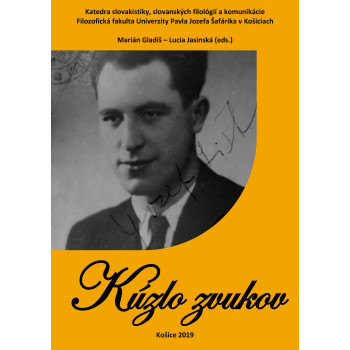
Marián Gladiš - Lucia Jasinská (eds.)
This peer-reviewed collection of papers is a publication output of the scientific colloquium named The Magic of Sounds, which was organized by the Department of Slovak Studies, Slavonic Philologies and Communication at the Faculty of Arts of the Pavol Jozef Šafárik University in Košice, and by the Košice Branch of the Slovak Linguistic Society at the Ľudovít Štúr Linguistic Institute of the Slovak Academy of Sciences in Bratislava, on the occasion of the 100th anniversary of birth of Associate Professor PhDr. Jozef Liška, PhD., the founder of the Slovak logopaedics.
Participants focused their papers on the analysis of the linguistic and speech therapy work of J. Liška, his contribution to Slovak dialectology and orthoepy, presented him as an Anglicist, and they also dealt with the audio aspect of children's speech, exact methods of disturbances and low voice quality measuring, or machine speech processing.
An interpretative paper of the documentary They Will Speak Well, a socially important piece of film work, which was made in 1958 under the supervision of J. Liška, is also included in the proceedings.

Data sheet
E-book
This textbook has been designed as supporting material for the postgraduate course on modern trends in European literature. It focuses on the presentation of five modern literary modes of writing: the realistic mode which was brought to its prominence by the nineteenth-century Realist movement; the stream-of-consciousness and ‘absurdist’ modes which were developed in the context of modernism; and the magical realist and metafictional modes which are associated mainly with postmodernist literary trends. Each mode is represented by a well-known text which demonstrates the formal aspects of each mode and deals with the thematic concerns typical of the literary movement that influenced its production.
The textbook adopts an interdisciplinary approach, placing the chosen literary texts into the historical, philosophical and cultural contexts that shaped their characters, and thereby providing the background knowledge necessary for a deeper understanding of their formal and thematic aspects.
E-bool
When studying the Renaissance, researchers utilize various critical and core terms and concepts which it is necessary to characterize.
However, many such points, notably the following, are problematic: The relationship between the Renaissance and the antiquity; The connection with the Middle Ages; The transformation to Mannerism and Baroque; Realism and Secularism in Renaissance art; The individualism of the Renaissance artist; The reasons for the creation of Renaissance art in Italy, its determinants and stimulators; Distinguishing between the analysis of the genesis of the Renaissance and the analysis of the creation of the period’s art generally; Regional differences in Italy and their impact on the art; Chronological limits of the Renaissance and its milestones; The terms “Medieval Ages” and “Early Modern Period”; The impact, and its extent, of the artistic influences of the Byzantine, Gothic and Romanesque arts on the Renaissance. The term “Renaissance” itself, its content and existence, are also the subject of the discussion with students, alongside learning how such terms and definitions came about and continue to evolve, how they attain their content, how this content morphs in the historical discourse, what academical pluralism and freedom of thinking look like in the discourse led by historians, what the differences are between scientists and schools of thought on the same subject and how it is possible that they are so numerous.
The students will come to recognize the leading scholars in the field, and follow their arguments and methodological approaches. They shall be invited to closely trace and scrutinize the logic which those historians use in building their argumentation. It shall be seen that the freedom to create terms, concepts and new definitions cannot stand on an ignorance of the (historical) facts, as becomes clear with expanding knowledge of those historical facts, the variability of their interpretation growing in tandem. This approach, actually used across the whole range of seminars and lectures, shall drive discussion on the topics covered, students being invited to formulate their own theses and antitheses.
E-book
The scientific and professional journal Edukácia focuses on issues related to education and upbringing in the areas of primary, secondary, and higher education. It emphasizes the current state and perspectives of educational practice, current aspects of pre-graduate teacher training, social pedagogy, special pedagogy, as well as pedagogical and psychological aspects of upbringing in basic educational institutions from the perspective of the broader pedagogical public. It is intended for scientific workers, young university teachers, doctoral students, as well as professional and pedagogical staff, with the aim of presenting trends in education and stimulating discussion on current issues in the presented areas of education and upbringing.
Download e-book for free (pdf)
E-book
The development of this bilingual coursebook evolved as part of project KEGA Nr. 020UPJŠ-4/2013 headed by prof. PhDr. Ján Gbúr, CSc., and emerged from earlier research which had successfully analysed realist and modernist Slovak literature from a gender perspective. Based on initial interpretations which drew from philosophical, sociological and historiographical approaches, we were able to anticipate the issues which could be raised in other texts and thus establish a hypothesis for the subsequent literaryscientific research. Our research has also been influenced by the continually evolving nature of gender studies, and we have therefore decided to adopt a somewhat unusual approach in this coursebook and briefly examine some contemporary texts thereby creating an intentional shift in our timeline. The modern works of Z.Kepplová and U. Kovalyk have raised a number of interesting issues, and a study of the interwar work of M. Urban reveals further interpretations on the basis of gender. After this brief overview, we return to the main focus of the study: gender approaches to Slovak literature of the late 19th and early 20th centuries.
The study focuses on the complexity of male-female relationships in the work of both male and female authors of realist and modernist literature at the end of the 19th and the beginning of the 20th century. Works by the founding generation of realism and late realism were analysed, with particular attention being paid to the fiction of M. Kukučín, J. Čajak, J. G. Tajovský, J. Jesenský, E. M. Šoltésová, T. Vansová, Ľ. Podjavorinská and B. S. Timrava. The works of H. Gregorová and Ľ. Groeblová were also studied as prime examples of Slovak literary modernism.
We hope that this bilingual coursebook will allow realist and modernist Slovak fiction, and the Slovak national literary tradition in general, to receive wider critical renown beyond the borders of Slovakia and also to demonstrate its place in contemporary literary theory.