Active filters

  • Year of publication:: 2011
  • Year of publication:: 2015
  • Year of publication:: 2017
  • Year of publication:: 2019
  • Year of publication:: 2019
  • Year of publication:: 2019
  • Year of publication:: 2019
  • Year of publication:: 2019
  • Year of publication:: 2022
  • Faculty:: Faculty of Arts
American Ethnic Literatures and Cultures

American Ethnic Literatures and Cultures

E-book

E-book

Zuzana BurákováPetra Filipová

The canon of American literature has undergone constant revision with many authors who were long excluded from wider recognition now being accepted as significant figures. With the emergence of postcolonial and ethnic studies after the 1960s, the diversity of the literary canon has become greater than ever, and we can now see American literature as remarkably distinctive in this respect.

The question of how to define ethnicity and how far an immigrant should go to preserve their ethnic heritage have always been addressed by writers, together with larger issues such as the definition of national identity and national literature, and where we should draw the lines between local and global identities. We understand that a single course in American ethnic literature cannot hope to answer all these complex questions, but we firmly believe that discussing these questions in classes can help us to be more understanding and tolerant of ethnic diversity.

For this reason, the main aim of this textbook is to provide an interdisciplinary introduction to American ethnic literatures with an emphasis on their historical and cultural background, to expand students’ knowledge of American literatures and cultures at the master’s level and familiarize them with specific features of ethnic literatures in the contemporary USA. The textbook contains information on Native American, African American, Asian American, Jewish American, and Hispanic American literature, history and culture.

Download e-book for free (pdf)
Cursus Latinus - učebnica

Cursus Latinus - učebnica

E-book

E-book

Jana Balegová

University textbook „Cursus Latinus - textbook“ is intended for students of the study program Latin language and literature. It is divided into „Introduction“ and 37 lessons. The content of lessons is morphology, sentence syntax and selected phenomena of case syntax of the Latin language. Each of the lessons contains a grammatical explanation, followed by sentences designed to demonstrate the forms of grammatical phenomena and the required vocabulary (Dictionary). Using these examples, students learn the basic principles of translation from Latin into Slovak and from Slovak into Latin. The textbook also includes a Latin-Slovak dictionary containing the entire vocabulary used in the textbook. The „Cursus Latinus - textbook“ is intended for the interpretation of grammar and the acquisition of grammatical phenomena of the Latin language under the guidance of the teacher. A parallel exercise book (Cursus Latinus – exercise book) is used to practice Latin grammar at home. The exercise book includes a key to the exercises and a Latin-Slovak dictionary containing vocabulary from the textbook and the exercise book. University textbook „Cursus Latinus - textbook“ is available electronically in PDF format.

Download the e-book for free  (pdf)

Cursus Latinus - cvičebnica

Cursus Latinus - cvičebnica

E-book

E-book

Jana Balegová

The university textbook „Cursus Latinus – exercise book“ is a parallel study material to the textbook „Cursus Latinus – textbook“. It is designed for practicing grammar at home. The content of the exercises corresponds in its focus to the lessons of the mentioned textbook, both in terms of the grammatical phenomena, as well as the vocabulary. For this reason, only vocabulary that was not included in the lessons of the textbook is included in the exercises. The Latin-Slovak dictionary at the end of the exercise book contains the entire vocabulary from the exercise book and the textbook. Part of the exercise book is a key that allows students to immediately check the correctness of their work. „Cursus Latinus - exercise book“ is available electronically in PDF format.

Download the e-book for free  (pdf)

Comparative Phonetics and Phonology of the English and the Slovak Language

Comparative Phonetics and Phonology of the...

E-book

E-book

Renáta Gregová

The book is primary designed for the first-year students of the study programme “English Language for European Institutions and Economy” and its subject “Comparative Phonetics and Phonology”. Following the structure of this subject, the textbook is divided into eleven chapters whose content provides the reader with the essential theoretical information about the given issue from the sound subsystems of the English and the Slovak languages. The structure of each chapter is as follows: (1) theoretical explanation of the topic, (2) Suggestions for further reading recommending additional sources that develop the topic, (3) exercises whose aim is to evaluate students’ theoretical knowledge of the theme presented in the particular chapter, as well as its practical application in the process of communication. Considering the content of the book, it can be also used a study material for the students of all philological study programmes whose content encompasses the sound system of the English and/or the Slovak language.

Download the e-book for free  (pdf)

e-Slovenčina pre zubárov v praxi – kazuistiky

e-Slovenčina pre zubárov v praxi – kazuistiky

E-book

E-book

Beáta JurečkováLívia Barnišinová

The e-Slovak textbook for dentists in practice - case studies is intended for foreign students of dentistry. It is primarily intended for students of the Slovak language as a foreign language, but the knowledge of the grammatical and lexical basics of the Slovak language at the A1, A2 level is needed.

The textbook consists of eight lessons, which are focused on listening comprehension (audio recordings), vocabulary expansion, systematisation of grammar and development of speech skills (case studies). The two lessons consist of repetitive, concluding exercises. The primary goal of the textbook is to connect language training with professional dental practice.

Download the e-book for free  (pdf)

GENDER PERSPECTIVES IN SLOVAK LITERATURE OF THE LATE 19th AND EARLY 20th CENTURIES (Interpretation Studies)

GENDER PERSPECTIVES IN SLOVAK LITERATURE OF THE...

E-book

E-book

Ivica Hajdučeková

The second (supplemented and expanded) edition of the bilingual textbook Rodový aspekt v slovenskej literatúre na prelome 19. a 20. storočia (Interpretačné etudy) / Gender Perspectives in the Slovak Literature of the Late 19th and Early 20th Centuries (Interpretation Studies) offers to a wider range of recipients – students of Teaching of Academic Subjects and teachers in practice – a didactic transformation of current research issues (supported by e-literacy using online approaches and QR codes), which was developed in cooperation with the School of Applied Arts in Košice (since 2019/20 the so-called School of Art Industry) ) in the academic year 2018/2019.

Professional cooperation within the KEGA project No. 008UPJŠ-4/2017 – Science Without Barriers (Interdisciplinary Inspirations of Contemporary Literary Scholarship and Linguistics in Educational Practice at University) with teacher of Slovak Language and Literature, PaedDr. Jana Valicová, and Mgr. Renáta Novotná Markovičová of ŠUP took place in project teaching. It yielded results in two interdisciplinary outcomes:

1. Creation of the Literary Lounge in the Student Café Minerva in the premises of the UPJŠ Faculty of Arts;

2. Illustrations of the 2nd edition of the textbook Gender Aspect in the Slovak Literature at the Turn of the 19th and the 20th Centuries (2019).

Download the e-book for free (pdf)

Lingua Latina – cvičebnica pre historikov

Lingua Latina – cvičebnica pre historikov

E-book

E-book

Jana Balegová

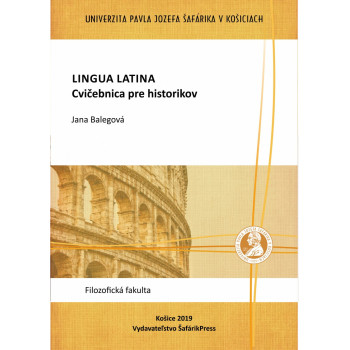
University textbook Lingua Latina – Exercise Book for Historians is a parallel study material to the textbook Lingua Latina – Cursus Communis. It is designed for practicing grammar at home. The content of the exercises corresponds to the focus of the individual lessons in the mentioned textbook, both in terms of the covered grammatical phenomena and vocabulary. For this reason, only vocabulary not covered in the textbook's lessons is included in the exercises.

The Latin-Slovak dictionary at the end of the exercise book contains all the vocabulary from both the exercise book and the textbook. The Slovak-Latin dictionary includes the vocabulary from exercises that require translation into Latin. The vocabulary in this exercise book is oriented towards the needs of history students and, given the selection of source materials, also includes non-classical lexicon or non-classical meanings of classical words (this lexicon is marked with the symbol *).

The exercise book includes a key that allows students to directly verify the correctness of their work. The textbook Lingua Latina – Exercise Book for Historians is available electronically in PDF format. As part of the teaching program, online tests available on the KKF FF UPJŠ website (https://www.upjs.sk/filozoficka-fakulta/katedra-klasickejfilologie/katedra/) also serve to practice the covered material.

Download the e-book for free (pdf)

Lingua Latina – cvičebnica pre filológov

Lingua Latina – cvičebnica pre filológov

E-book

E-book

Jana BalegováAnabela Katreničová

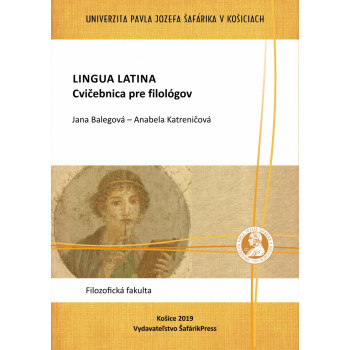
The university textbook Lingua Latina – a workbook for philologists is a parallel study material to the textbook Lingua Latina – cursus communis. It is designed for practicing grammatical material at home. The content of the exercises corresponds to the focus of individual lessons in the mentioned textbook, both in terms of the covered grammatical phenomena and vocabulary. For this reason, only vocabulary that was not part of the lessons covered in the textbook is included in the exercises.

A Latin-Slovak dictionary at the end of the workbook contains the entire vocabulary from both the workbook and the textbook. A Slovak-Latin dictionary includes the vocabulary from exercises that require translation into Latin. The vocabulary of this workbook is oriented towards the needs of students specializing in philology and, with regard to the selection of source materials, also includes non-classical lexicon or non-classical meanings of classical words (this lexicon is marked with an asterisk). The workbook includes a key that allows students to directly verify the correctness of their work.

The textbook Lingua Latina – a workbook for philologists is available electronically in PDF format. As part of the educational program, online tests available on the KKF FF UPJŠ website (https://www.upjs.sk/filozoficka-fakulta/katedra-klasickejfilologie/katedra/) also serve to practice the covered material.

Download the e-book for free (pdf)

Lingua Latina – cvičebnica pre filozofov

Lingua Latina – cvičebnica pre filozofov

E-book

E-book

Jana BalegováFrantišek Šimon

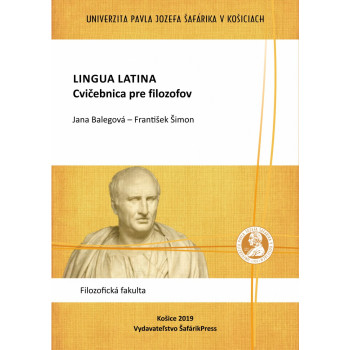
The university textbook "Lingua Latina – Exercise Book for Philosophers" is a parallel study material to the textbook "Lingua Latina – Cursus Communis." It is designed for practicing grammatical lessons at home. The content of the exercises corresponds to the focus of each lesson in the mentioned textbook, both in terms of the covered grammatical phenomena and vocabulary. For this reason, only vocabulary not included in the lessons of the textbook is presented in the exercises.

The Latin-Slovak dictionary at the end of the exercise book contains the entire vocabulary from both the exercise book and the textbook, while the Slovak-Latin dictionary includes the vocabulary from exercises that require translation into Latin. The vocabulary in this exercise book is oriented towards the needs of philosophy students and, with regard to the selection of source materials, also includes non-classical lexicon or non-classical meanings of classical words (this lexicon is marked with an asterisk *).

The exercise book includes a key that allows students to directly verify the correctness of their work. The textbook "Lingua Latina – Exercise Book for Philosophers" is available electronically in PDF format. As part of the educational program, online tests available on the website of the Department of Classical Philology at the Faculty of Arts, UPJŠ (https://www.upjs.sk/filozoficka-fakulta/katedra-klasickejfilologie/katedra/) also serve to practice the covered material.

Download the e-book for free (pdf)

Lingua Latina – cursus communis

Lingua Latina – cursus communis

E-book

E-book

Jana Balegová

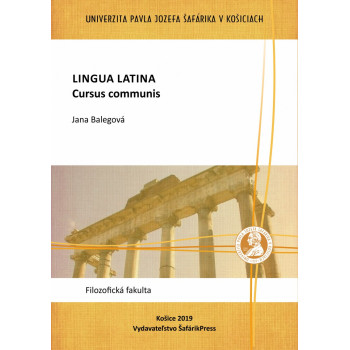
The university textbook Lingua Latina – cursus communis is designed for students of all study programs at the Faculty of Arts, where Latin is included as a subject related to the main field of study or specialization (history, philosophy, philological specializations, etc.).

The textbook contains Latin grammar, exercise sentences intended for practicing the grammatical phenomena covered in seminars under the guidance of an instructor, and a Latin-Slovak dictionary. To practice Latin grammar at home, parallel workbooks are available, which are tailored to meet the needs of students from specific study fields and specializations (e.g., Lingua Latina – workbook for historians, Lingua Latina – workbook for philosophers, Lingua Latina – workbook for philologists).

The textbook Lingua Latina – cursus communis is accessible electronically in PDF format. As part of the educational program, online tests available on the KKF FF UPJŠ website serve to reinforce the learned material. This textbook is a product of the grant project KEGA 010UPJŠ-4/2017.

Download the e-book for free (pdf)

Zlomové osmičky

Zlomové osmičky

E-book

E-book

Tomáš DvorskýLucia LaczkóMária Petriková  (eds.)

The collection of articles from the VII. International Scientific Conference for Students and Young Scientists, organized by the Department of Political Science of the Faculty of Arts of the Pavol Jozef Šafárik University in Košice, in cooperation with the Res Publica Civic Association the Faculty of Social Sciences of the University of Saints Cyril and Methodius in Trnava, held on 17 May 2019 in Košice.

The aim of this publication, entitled The Turning Eights, is to point out the importance of the years ending with number eight, which have significantly affected historical development and appear to be justified in the current political context.

The almanac consists of 11 articles, which are primarily in the Slovak language. The individual contributions deal with aspects of national and foreign policies that are united in theme called The Turning Eightswith the individual interest of each author.

The topics of the almanac are the municipal elections, the position of municipalities at the public administration system, development in self-governing regions and the non-governmental organizations. The presented publication also contains articles that deal with topics in specific countries, such as China, Israel and Russia.

Download the e-book for free  (pdf)

Emigration intentions and risk behaviour among university students

Emigration intentions and risk behaviour among...

E-book

E-book

Oľga OrosováBeáta Gajdošová (eds.)

This publication considers social, economic, political, and psychological indicators of emigration behavior and emigration intentions as appropriate predictors of future behavior.

Theories of motivation and theories of behavioral intentions and their effectiveness are popular in migration research. On the other hand, the Health Belief Model and its adaptation in the research of emigration intentions bring a relatively new and perspective view on this topic.

According to the results presented in this publication, the factors that attract students to emigration (pull factors) are language skills and career opportunities abroad, the desire for change and new experiences, perceived feasibility of emigration, and self-efficacy.

Download the e-book for free (pdf)

Myths and Manipulation in Political Discourse

Myths and Manipulation in Political Discourse

E-book

E-book

Jaroslav Marcin - Viktória Marcinová a kol.

This little book started out in a way that probably many other scholarly publications do: When the five of us met as doctoral students and instructors in the Department of British and American Studies, we soon realized that our research overlapped on a number of points. Most prominent among those was our interest in political or politicallymotivated discourse and the study of myths and manipulation that it employed. 

In the end, we decided to pool the results of our research together in order to create a more complex picture, providing a variety of perspectives and voices. In our endeavor, we were greatly aided by the financial support we received from a grant offered by the Šafárik University. The outcome of these efforts is the five chapters of this brief, but hopefully informative and insightful monograph.

In Chapter 1, Viktória Marcinová deals with the impact of totalitarian ideology on the translation of so-called “capitalist” drama during the first stage of normalization in Slovakia (1948-1968). In Chapter 2, the focus shifts to political discourse and manipulation in a democracy, as Jaroslav Marcin takes a closer look at the wartime rhetoric of American presidents. USA remains the focus also in Chapter 3, but this time the question, addressed by Martina Martausová, will be one of the myth of the American Dream and its presentation in post-9/11 United States. A similar idea, though in a different geographical-cultural context, is dealt with in Chapter 4, where Božena Velebná identifies myths of Scottish identity as portrayed in historic films. Finally, in Chapter 5, Eduard Soták will take a look at the role of the mass media within the topic of politically-motivated discourse and spread of political ideology.

Download the e-book for free (pdf)

Philosophy of the history of philosophy

Philosophy of the history of philosophy

E-book

E-book

Vladimír Leško

The book is the result of long-term contemplation on the relationships between the history of philosophy and its reflection in more or less systematic, or non-systematic forms of philosophizing of the most significant philosophical teachings of the 19th and 20th centuries (Hegel, Schelling, Marx, Nietzsche, Husserl, Heidegger, Fink, Patočka, and Gadamer).

The primary goal of the work is to present the most significant historical-philosophical teachings of the 19th and 20th centuries in the formation and fulfillment of strong and weak models of the philosophy of the history of philosophy in the concepts of Hegel, Schelling, Marx, Nietzsche, Husserl, Heidegger, Fink, Patočka, and Gadamer.

The results of the philosophy of the history of philosophy are presented here as a metatheoretical movement within historical-philosophical thinking, whose aim is not to empirically describe the historical-philosophical process, but to understand and explain it as an inseparable part of the most significant philosophical problems – what is philosophy, what is metaphysics, and the question of being.

Download the e-book for free (pdf)


Realism, Modernism, Postmodernism: Five Modern Literary Texts in Context

Realism, Modernism, Postmodernism: Five Modern...

E-book

E-book

Soňa Šnircová

This textbook has been designed as supporting material for the postgraduate course on modern trends in European literature. It focuses on the presentation of five modern literary modes of writing: the realistic mode which was brought to its prominence by the nineteenth-century Realist movement; the stream-of-consciousness and ‘absurdist’ modes which were developed in the context of modernism; and the magical realist and metafictional modes which are associated mainly with postmodernist literary trends. Each mode is represented by a well-known text which demonstrates the formal aspects of each mode and deals with the thematic concerns typical of the literary movement that influenced its production.

The textbook adopts an interdisciplinary approach, placing the chosen literary texts into the historical, philosophical and cultural contexts that shaped their characters, and thereby providing the background knowledge necessary for a deeper understanding of their formal and thematic aspects.

Download the e-book for free(pdf)

Gender perspectives in slovak literature of the late 19th and early 20th centuries (Interpretation Studies)

Gender perspectives in slovak literature of the...

E-book

E-book

Ivica Hajdučeková

The development of this bilingual coursebook evolved as part of project KEGA Nr. 020UPJŠ-4/2013 headed by prof. PhDr. Ján Gbúr, CSc., and emerged from earlier research which had successfully analysed realist and modernist Slovak literature from a gender perspective. Based on initial interpretations which drew from philosophical, sociological and historiographical approaches, we were able to anticipate the issues which could be raised in other texts and thus establish a hypothesis for the subsequent literaryscientific research. Our research has also been influenced by the continually evolving nature of gender studies, and we have therefore decided to adopt a somewhat unusual approach in this coursebook and briefly examine some contemporary texts thereby creating an intentional shift in our timeline. The modern works of Z.Kepplová and U. Kovalyk have raised a number of interesting issues, and a study of the interwar work of M. Urban reveals further interpretations on the basis of gender. After this brief overview, we return to the main focus of the study: gender approaches to Slovak literature of the late 19th and early 20th centuries.

The study focuses on the complexity of male-female relationships in the work of both male and female authors of realist and modernist literature at the end of the 19th and the beginning of the 20th century. Works by the founding generation of realism and late realism were analysed, with particular attention being paid to the fiction of M. Kukučín, J. Čajak, J. G. Tajovský, J. Jesenský, E. M. Šoltésová, T. Vansová, Ľ. Podjavorinská and B. S. Timrava. The works of H. Gregorová and Ľ. Groeblová were also studied as prime examples of Slovak literary modernism. 

We hope that this bilingual coursebook will allow realist and modernist Slovak fiction, and the Slovak national literary tradition in general, to receive wider critical renown beyond the borders of Slovakia and also to demonstrate its place in contemporary literary theory.

Download the e-book for free (pdf)

This website uses cookies to ensure you get the best experience on our website