Active filters

  • Year of publication:: 2009
  • Year of publication:: 2013
  • Year of publication:: 2019
  • Year of publication:: 2019
  • Year of publication:: 2019
  • Year of publication:: 2019
  • Year of publication:: 2019
  • Year of publication:: 2023
  • Faculty:: Faculty of Arts
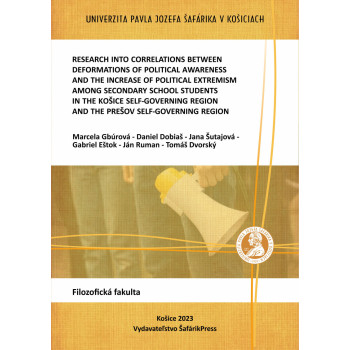
Research Into Correlations Between Deformations of Political Awareness...

Research Into Correlations Between Deformations...

E-book

E-book

Marcela Gbúrová - Daniel Dobiaš - Jana Šutajová - Gabriel Eštok - Ján Ruman - Tomáš Dvorský

Research Into Correlations Between Deformations of Political Awareness and the Increase of Political Extremism Among Secondary School Students in the Košice Self-governing Region and the Prešov.

Self-governing Region The issue of political extremism has a relatively long research period, and it should be emphasised that, especially in the recent period, it has received increased attention in the political science community not just in Slovakia but also abroad. Given the specifics of this anti-democratic form of political discourse, which has not only explicit forms, but also highly sophisticated manifestations against democracy (extremism of the centre, or centrist extremism), it is also addressed by experts of other humanities and social disciplines: history, psychology, anthropology, sociology, etc.

The common interest of this professional community is both to analyse different forms of extremist discourses and narratives, to search for national specificities of extremism that are anchored in their historical, social and cultural contexts, but at the same time to reveal transnational extremist influences within a globalizing world and to propose evidence-based strategies to counter extremist discourses.

Download e-book for free (pdf)
Mentor a mentee v profesijnej praktickej príprave /Príručka mentoringu študenta učiteľstva cvičným učiteľom

Mentor a mentee v profesijnej praktickej...

E-book

E-book

Renáta Orosová - Michal Novocký - Katarína Petríková

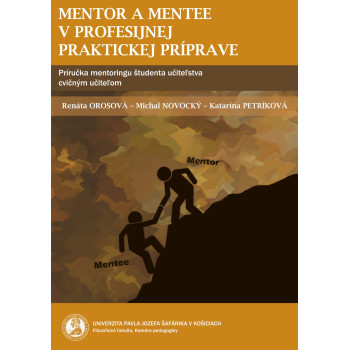
An integral part of the process of becoming a teacher is the mentoring of student teachers by mentor teachers, serving as guidance and support for future teachers. Developing mentoring skills and fostering reflective mentoring practices are means of enhancing the practical training of student teachers, their professional development, and improving the quality of their future educational practice.

The foundation of the mentoring relationship between the mentor teacher as a mentor and the student teacher as a mentee is not to evaluate the student, but to analyse their learning and teaching and contemplate ways to enhance these processes. The university textbook represents a creative textual tool focused on innovations in strategies for supporting the development of mentoring abilities in mentors and mentees during professional practical training. This university textbook, intended for student teachers in the role of mentees and mentor teachers in the role of mentors, systematizes the theoretical foundations of mentoring, provides guidance and directives for mentoring in professional practical training. Furthermore, it offers the university teacher, in the role of supervising the student's teaching practice, an overview of techniques and methods pertaining to the mentoring relationship between mentor and mentee. It is applicable as a university textbook for student teachers, students pursuing supplementary pedagogical studies or advanced studies, as well as for mentor teachers in primary and secondary schools, and university educators involved in professional practical training.

Its English version provides opportunities for utilization during study stays of student teachers abroad and for foreign students in Slovakia.

Download the e-book for free  (pdf)

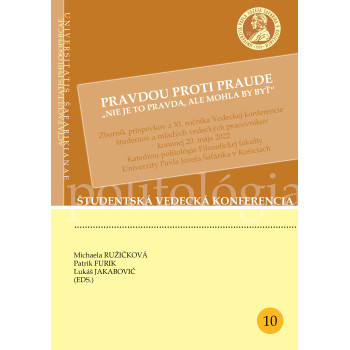
Truth vs. Post-Truth. „It is not true, but it could be.”

Truth vs. Post-Truth. „It is not true, but it...

E-book

E-book

Michaela Ružičková - Patrik Furik - Lukáš Jakabovič (eds.)

The collection of articles from the XI. International Scientific Conference for Students and Young Scientists, organized by the Department of Political Science of the Faculty of Arts of the Pavol Jozef Šafárik University in Košice, in cooperation with the Res Publica Civic Association, the Department of Security Studies of the Faculty of Political Science and International Relations of the Matej Bel University in Banská Bystrica, Institute of Political Sciences and Administration, Faculty of Political Science and Journalism, Marie Curie-Sklodowska University in Lublin, Institute of Social Studies, Faculty of Regional Development and International Studies, Mendel University in Brno, and the Department of Political Science, Faculty of Arts, University of Miskolc, held on 20 May 2022 in Košice.

The aim of this publication, entitled Truth vs. Post-Truth. „It is not true, but it could be.”, is to highlight the threats arising from the issue of the spread of disinformation, conspiracies and hoaxes today, reflecting not only on the national context, but also on the impact of these elements in the international environment.

The proceedings consist of 12 articles written in Slovak and English. The individual contributions deal with selected topics and aspects of the spread of disinformation, conspiracy theories or hoaxes, among others in the context of elections, media landscape and politics.

The topics of the contributions are the limits of freedom of expression, media freedom and regulation in the media space, the issue of propaganda or information warfare. The present volume also includes papers focusing on issues in the field of political ideologies or the issue of false narratives about the COVID-19 disease.

Download the e-book for free  (pdf)

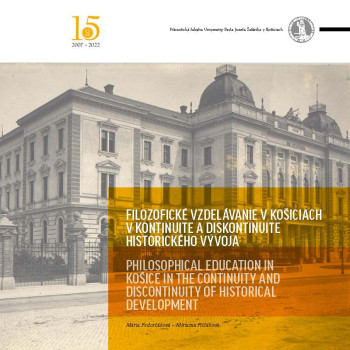
Philosophical Education in Košice in the Continuity and Discontinuity of Historical Development

Philosophical Education in Košice in the...

E-book

E-book

Mária Fedorčáková - Miriama Filčáková

Current publication is dealing with the history of philosophical education in Košice since the beginning to the foundation of the Faculty of Arts at Pavol Jozef Šafárik University in Košice in 2007. Beginnings of philosophical education in Košice are connected to the fundation of the University of Košice in 1657, which was originally founded as Jesuit university with two faculties – Faculty of Theology and Faculy of Arts.

The publication is dealing with the philosophy teaching in the Faculty of Arts and examines the philosophy teachers and students. Another interest is given to decline of philosophy teaching caused by transformation of the University into the Royal Academy and the Academy of Law at the end of the 18 and during 19 century. The second part of the publication is dealing with the history of higher education after the second world war and the foundation of the University of Pavol Jozef Šafárik in Košice.

The authoress focuses on circumstances of the foundation of the Faculty of Arts in Prešov and its history and later development after 1989, which included also division of the university in 1997. The last part of publication presents the history of the university buildings, in which the Faculty of Arts is situated.

Download the e-book for free  (pdf)

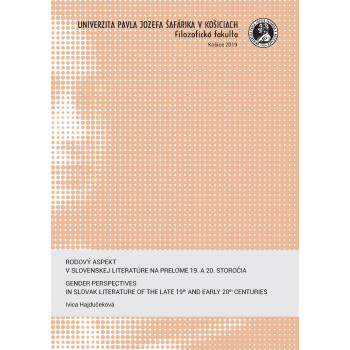
GENDER PERSPECTIVES IN SLOVAK LITERATURE OF THE LATE 19th AND EARLY 20th CENTURIES (Interpretation Studies)

GENDER PERSPECTIVES IN SLOVAK LITERATURE OF THE...

E-book

E-book

Ivica Hajdučeková

The second (supplemented and expanded) edition of the bilingual textbook Rodový aspekt v slovenskej literatúre na prelome 19. a 20. storočia (Interpretačné etudy) / Gender Perspectives in the Slovak Literature of the Late 19th and Early 20th Centuries (Interpretation Studies) offers to a wider range of recipients – students of Teaching of Academic Subjects and teachers in practice – a didactic transformation of current research issues (supported by e-literacy using online approaches and QR codes), which was developed in cooperation with the School of Applied Arts in Košice (since 2019/20 the so-called School of Art Industry) ) in the academic year 2018/2019.

Professional cooperation within the KEGA project No. 008UPJŠ-4/2017 – Science Without Barriers (Interdisciplinary Inspirations of Contemporary Literary Scholarship and Linguistics in Educational Practice at University) with teacher of Slovak Language and Literature, PaedDr. Jana Valicová, and Mgr. Renáta Novotná Markovičová of ŠUP took place in project teaching. It yielded results in two interdisciplinary outcomes:

1. Creation of the Literary Lounge in the Student Café Minerva in the premises of the UPJŠ Faculty of Arts;

2. Illustrations of the 2nd edition of the textbook Gender Aspect in the Slovak Literature at the Turn of the 19th and the 20th Centuries (2019).

Download the e-book for free (pdf)

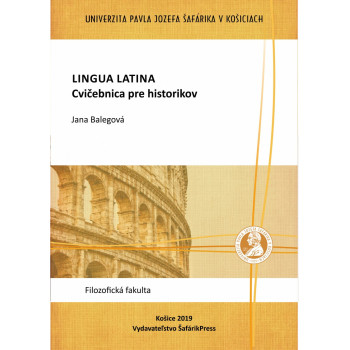
Lingua Latina – cvičebnica pre historikov

Lingua Latina – cvičebnica pre historikov

E-book

E-book

Jana Balegová

University textbook Lingua Latina – Exercise Book for Historians is a parallel study material to the textbook Lingua Latina – Cursus Communis. It is designed for practicing grammar at home. The content of the exercises corresponds to the focus of the individual lessons in the mentioned textbook, both in terms of the covered grammatical phenomena and vocabulary. For this reason, only vocabulary not covered in the textbook's lessons is included in the exercises.

The Latin-Slovak dictionary at the end of the exercise book contains all the vocabulary from both the exercise book and the textbook. The Slovak-Latin dictionary includes the vocabulary from exercises that require translation into Latin. The vocabulary in this exercise book is oriented towards the needs of history students and, given the selection of source materials, also includes non-classical lexicon or non-classical meanings of classical words (this lexicon is marked with the symbol *).

The exercise book includes a key that allows students to directly verify the correctness of their work. The textbook Lingua Latina – Exercise Book for Historians is available electronically in PDF format. As part of the teaching program, online tests available on the KKF FF UPJŠ website (https://www.upjs.sk/filozoficka-fakulta/katedra-klasickejfilologie/katedra/) also serve to practice the covered material.

Download the e-book for free (pdf)

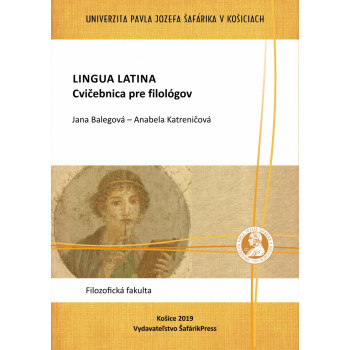
Lingua Latina – cvičebnica pre filológov

Lingua Latina – cvičebnica pre filológov

E-book

E-book

Jana BalegováAnabela Katreničová

The university textbook Lingua Latina – a workbook for philologists is a parallel study material to the textbook Lingua Latina – cursus communis. It is designed for practicing grammatical material at home. The content of the exercises corresponds to the focus of individual lessons in the mentioned textbook, both in terms of the covered grammatical phenomena and vocabulary. For this reason, only vocabulary that was not part of the lessons covered in the textbook is included in the exercises.

A Latin-Slovak dictionary at the end of the workbook contains the entire vocabulary from both the workbook and the textbook. A Slovak-Latin dictionary includes the vocabulary from exercises that require translation into Latin. The vocabulary of this workbook is oriented towards the needs of students specializing in philology and, with regard to the selection of source materials, also includes non-classical lexicon or non-classical meanings of classical words (this lexicon is marked with an asterisk). The workbook includes a key that allows students to directly verify the correctness of their work.

The textbook Lingua Latina – a workbook for philologists is available electronically in PDF format. As part of the educational program, online tests available on the KKF FF UPJŠ website (https://www.upjs.sk/filozoficka-fakulta/katedra-klasickejfilologie/katedra/) also serve to practice the covered material.

Download the e-book for free (pdf)

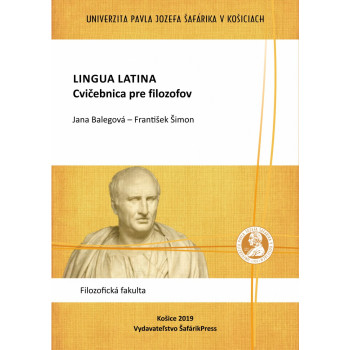
Lingua Latina – cvičebnica pre filozofov

Lingua Latina – cvičebnica pre filozofov

E-book

E-book

Jana BalegováFrantišek Šimon

The university textbook "Lingua Latina – Exercise Book for Philosophers" is a parallel study material to the textbook "Lingua Latina – Cursus Communis." It is designed for practicing grammatical lessons at home. The content of the exercises corresponds to the focus of each lesson in the mentioned textbook, both in terms of the covered grammatical phenomena and vocabulary. For this reason, only vocabulary not included in the lessons of the textbook is presented in the exercises.

The Latin-Slovak dictionary at the end of the exercise book contains the entire vocabulary from both the exercise book and the textbook, while the Slovak-Latin dictionary includes the vocabulary from exercises that require translation into Latin. The vocabulary in this exercise book is oriented towards the needs of philosophy students and, with regard to the selection of source materials, also includes non-classical lexicon or non-classical meanings of classical words (this lexicon is marked with an asterisk *).

The exercise book includes a key that allows students to directly verify the correctness of their work. The textbook "Lingua Latina – Exercise Book for Philosophers" is available electronically in PDF format. As part of the educational program, online tests available on the website of the Department of Classical Philology at the Faculty of Arts, UPJŠ (https://www.upjs.sk/filozoficka-fakulta/katedra-klasickejfilologie/katedra/) also serve to practice the covered material.

Download the e-book for free (pdf)

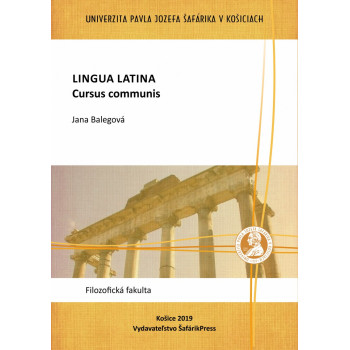
Lingua Latina – cursus communis

Lingua Latina – cursus communis

E-book

E-book

Jana Balegová

The university textbook Lingua Latina – cursus communis is designed for students of all study programs at the Faculty of Arts, where Latin is included as a subject related to the main field of study or specialization (history, philosophy, philological specializations, etc.).

The textbook contains Latin grammar, exercise sentences intended for practicing the grammatical phenomena covered in seminars under the guidance of an instructor, and a Latin-Slovak dictionary. To practice Latin grammar at home, parallel workbooks are available, which are tailored to meet the needs of students from specific study fields and specializations (e.g., Lingua Latina – workbook for historians, Lingua Latina – workbook for philosophers, Lingua Latina – workbook for philologists).

The textbook Lingua Latina – cursus communis is accessible electronically in PDF format. As part of the educational program, online tests available on the KKF FF UPJŠ website serve to reinforce the learned material. This textbook is a product of the grant project KEGA 010UPJŠ-4/2017.

Download the e-book for free (pdf)

Zlomové osmičky

Zlomové osmičky

E-book

E-book

Tomáš DvorskýLucia LaczkóMária Petriková  (eds.)

The collection of articles from the VII. International Scientific Conference for Students and Young Scientists, organized by the Department of Political Science of the Faculty of Arts of the Pavol Jozef Šafárik University in Košice, in cooperation with the Res Publica Civic Association the Faculty of Social Sciences of the University of Saints Cyril and Methodius in Trnava, held on 17 May 2019 in Košice.

The aim of this publication, entitled The Turning Eights, is to point out the importance of the years ending with number eight, which have significantly affected historical development and appear to be justified in the current political context.

The almanac consists of 11 articles, which are primarily in the Slovak language. The individual contributions deal with aspects of national and foreign policies that are united in theme called The Turning Eightswith the individual interest of each author.

The topics of the almanac are the municipal elections, the position of municipalities at the public administration system, development in self-governing regions and the non-governmental organizations. The presented publication also contains articles that deal with topics in specific countries, such as China, Israel and Russia.

Download the e-book for free  (pdf)

Slovenčina pre cudzincov (Pracovné listy)

Slovenčina pre cudzincov (Pracovné listy)

E-book

E-book

Marianna Sedláková a kol. 

The worksheets, based on the direct specific needs of teaching medical students in Košice, respect the real situation of teaching Slovak as a foreign language at UPJŠ.

They also reflect the relatively high number of Slavic students, especially from neighboring countries, who, although just beginning with the Slovak language, are at a higher communicative level compared to students from non-Slavic countries. Therefore, a special part of the worksheets with exercises is dedicated to them, which includes special exercises and dictionaries aimed at eliminating Slovak-Polish or Slovak-Ukrainian interference phenomena. Since some non-Slavic students come from the Czech language environment, we also add a glossary of the most common different expressions in Slovak, Czech, and, for the aforementioned reasons, Polish and Ukrainian. In the part intended for all students, both Slavic and non-Slavic, communicatively focused exercises for practicing grammatical phenomena predominantly at the A1 and A2 communication skill levels (according to the Common European Framework of Reference) prevail, and last but not least, exercises thematically focused on medicine and healthcare.

The texts from the thematic area are, of course, supplemented with realia of the city of Košice. As a functional supplement in the working material, we also publish test samples.

Download the e-book for free (pdf)

English for Chemists

English for Chemists

E-book

E-book

Božena Velebná

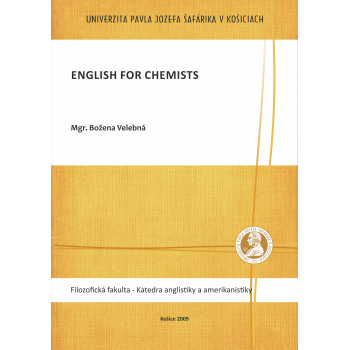
The following material has been created during the two years of teaching English for Chemists at the Faculty of Science of the Pavol Jozef Šafárik University and is therefore designed to meet the needs of this course. The main motivation was the lack of appropriate materials, especially as the groups generally comprise students with a very diverse level of English. This diversity therefore became the main criterion determining both the form and the content of this text.

In the ten units that provide material for a one semester course, the emphasis is put on teaching the students vocabulary and terminology, which is introduced via authentic texts, depending on the topic of each unit. Students are encouraged to learn the meaning of new words in context. Grammar is included too, with the aim of demonstrating and explaining grammatical rules by means of examples taken directly from the texts. For the more advanced students, grammatical exercises in this material can serve for revision while the beginners might need more supplementary materials.

I hope that this material, the preparation of which has been a challenging as well as enjoyable experience will be useful for future teachers and the students of this course.

Download the e-book for free (pdf)

English for Students of Geography and Ecology

English for Students of Geography and Ecology

E-book

E-book

Zuzana Buráková

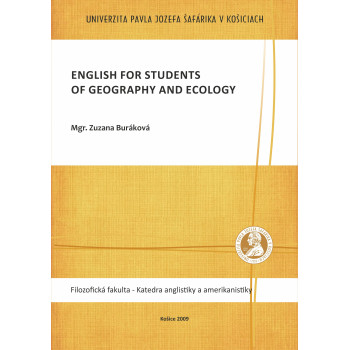
The English language study materials are intended for students of geography and general ecology at the Faculty of Science of Pavol Jozef Šafárik University. Their aim is to broaden communicative language competencies at an intermediate level of English proficiency, with an emphasis on the students’ field of study.

The individual chapters are based on the need for specialization within the various natural science disciplines and on preparing students to present their academic results not only at home, but also abroad. The study material contains a variety of texts, quizzes, exercises, maps, etc., which further illustrate the issues relevant to the field.

This material is intended to serve as a foundation for the future creation of even more precise materials needed for teaching specialized foreign language courses.

Download the e-book for free (pdf)

This website uses cookies to ensure you get the best experience on our website