 English
 Slovenčina


History (e-books)
There are 11 products.
Active filters
Historik, archivár a univerzitný profesor...
E-book
E-book
Drahoslav Magdoško (ed.)
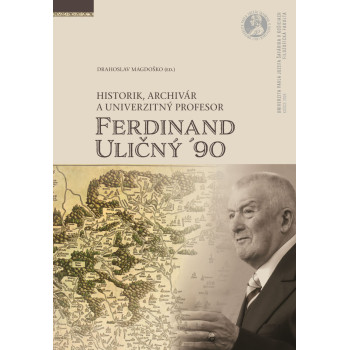
Hlavný zámer zborníka, ktorý držíte v rukách, predstavuje práve vzdanie pocty historikovi, ktorý svojim úctyhodným vedeckým dielom výrazne prispel k utváraniu slovenskej historiografie, predovšetkým medievalistiky. Zároveň sa tu vyslovuje uznanie za rozsiahlu a v nemalej miere priekopnícku prácu archivára, ktorý pomáhal rozvíjať moderné archívnictvo na východe Slovenska. A v neposlednom rade ide o formu poďakovania za prácu vysokoškolského pedagóga, ktorého predmety absolvovali stovky študentov, a ktorý si svojim podnetným prístupom získal ich srdcia. Na všetkých týchto troch rovinách má cenné zásluhy prof. PhDr. Ferdinand Uličný, DrSc. (*18. 8. 1933, Ploštín), ktorý v lete roku 2023 oslávil životné jubileum 90. rokov.
Študentská vedecká konferencia XII.
E-book
E-book
Mikuláš Jančura - Maroš Melichárek
The Textbook is based on the output of the twelveth year of the student scientific conference held in December 2023. The student scientific conference is a study subject included in the study plans of the Department of History, Faculty of Arts, UPJŠ, implemented since 2011 and aims to offer space for Bc. and Mgr. degree students to present fragments of their primary research as part of the creation of their bachelor and master thesis. The aim of the presented Textbook is not only to publish these thematically broad-spectrum texts, but also to target the effort for above-standard pedagogical activities and the added value of university studies towards students in the form of publication output.This year's anthology contains 6 texts with a chronological framing from the Middle Ages to the history of the 20th century.
Moc v dejinách ľudskej spoločnosti. Stretnutie...
E-book
E-book
Simona Bilecová-Monika Tresová
Proceedings of the 13th Scientific Conference of Young Historians, organized by the Department of History of the Faculty of Arts of the University of Pavol Jozef Šafárik in Košice in cooperation with the State Archives in Košice and the Slovak Historical Society at the Slovak Academy of Sciences on 24 October 2023 The central theme of the conference proceedings of the scientific conference of doctoral students is the issue of power as an instance that is an inherent part of human existence and has been present in society de facto since its beginning. Since power and the desire for power are present even today, perhaps more than at any other time in the history of human society, the proceedings provide adequate answers to the questions: where is power born and from what does it originate? How do social science disciplines view those social groups that do not hold power? The publication consists of eight contributions by authors working at Slovak and Czech universities. The volume opens with a paper by Dávid Nykodým on power in the city of silver in the era of Jiří of Poděbrady. The administration of estates in the hands of widows in the 17th century (on the example of Judith Balassa) was discussed by Sabina Danková. The issue of the role of the university grand master in the monopolization of education during the First Empire 1808-1815 in France was examined by Michael Dudzik. The period between the two world wars on the territory of Czechoslovakia was mapped in their contributions by two authors: Simona Bilecová, who characterized the emergence and creation of the political elite on the example of the Rožňava region, and Dominik Šípoš, who evaluated the power of the party as an ideological problem of the Czechoslovak National Democracy. This line was continued by Patrik Beňuš, who analysed in detail the crisis in railway transport in the southern territory of Slovakia after 1938. Monika Tresová dealt with the activities of Catholic associations in Košice and their disappearance under the pressure of the communist power after 1948. Miriama Balvirčáková dealt with the power and its legitimacy, judicial rehabilitation of the victims of the communist regime in Eastern Slovakia in 1968-1971.
Download e-book for free (pdf)
Výmena obyvateľstva medzi Československom a...
E-book
E-book
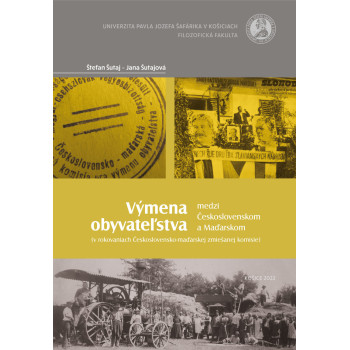
The population exchange between Czechoslovakia and Hungary was carried out on the basis of the Agreement on the Exchange of Populations between Czechoslovakia and Hungary, which was signed on February 27, 1946. Its adoption was not only part of Czechoslovak solutions to the status of national minorities, but also part of the strategic concept of building a state of Czechs and Slovaks without Germans and Hungarians.
The agreement was part of the postwar resolution of mutual disputes and misunderstandings and was intended to be one of the solutions that, in the postwar period, would eliminate a factor which, according to Czechoslovak political leaders, had caused the war conflict.
The population exchange between Czechoslovakia and Hungary was therefore not an isolated historical event, but part of migratory movements that had begun in Europe already after the First World War, and can be seen as a continuation of previous developments as part of migration patterns in Europe.
Download e-book for free (pdf)
Študentská vedecká konferencia X. Zborník...
E-book
E-book
Mikuláš Jančura - Maroš Melichárek (eds.)
The Student Scientific Conference is defined as a compulsory elective subject within the accredited study programs of the Department of History at the Faculty of Arts, UPJŠ. It was organized for the first time at the department in 2011.
The primary goal of this already traditional event is the presentation of partial results of student-authored research, primarily linked to selected factual parts or theoretical foundations of bachelor’s and master’s theses. This also explains the broad thematic spectrum of the internal content of each conference. Besides awarding credits for participation, the conference offers students a range of added values, which can be understood as its secondary objectives.
On this basis, as organizers, we considered it beneficial to qualitatively elevate the “round” anniversary edition of the Student Scientific Conference and give students the opportunity to publish their contributions. Within the submitted proceedings, 7 texts are published, of which 4 are from the bachelor’s level and 3 from the master’s level of study. The contributions cover a wider spectrum, mainly cultural-historical topics spanning from the Early Middle Ages to the second half of the 20th century, which also demonstrates the wide range of thesis topics processed at the department.
As organizers of the event, we have the ambition for publishing the proceedings to become as much a tradition as the Student Scientific Conference itself, as we consider this meaningful in relation to our work with students. Last but not least, we would like to express our gratitude to our colleague and friend Mgr. Henrich Hrehor, PhD., who has been the long-term main organizer and the “spiritual father” of the entire event since 2011. Thanks are also due to the head of the department for annual support and to the colleagues who undertook the reviewing of contributions within the submitted proceedings.
Poznanie, spoločnosť, dejiny. Stretnutie...
E-book
E-book
Miriama Filčáková (ed.)
Proceedings of the 11th Scientific Conference of Young Historians, organized by the Department of History at the Faculty of Arts, Pavol Jozef Šafárik University in Košice, in cooperation with the Slovak Historical Society at the Slovak Academy of Sciences, on October 19-20, 2021.
Currently, these histories are often presented as an extension of the history of science. The history of knowledge not only expands the boundaries of the history of science but also explores the boundaries between different forms of knowledge and ignorance. Just as studies of historical memory have expanded and complemented their interest in researching forgetting, the history of knowledge includes studies of ignorance. They focus on the change that has occurred over the past decades: from the sacralization of science and respect for professional knowledge to the rejection of science and constant questioning of professional knowledge, to which the history of knowledge must also respond. Findings as a product form the basis of human interactions and have their own past. What was the significance of knowledge and cognition in different historical periods? How did state power influence the development of knowledge and cognition? What can be considered knowledge in a particular historical era or culture? Finally, is there any human activity that cannot be considered knowledge?
Currently, in the field of the history of knowledge, a significant surge in research, publishing, and the emergence of new institutions can be observed. The eleventh doctoral conference—Meeting of Young Historians XI, organized by the Department of History at Pavol Jozef Šafárik University in cooperation with the Slovak Historical Society at the Slovak Academy of Sciences—will contribute to expanding the perspective on the past of knowledge and cognition. The conference, intended for Slovak and foreign doctoral students, aims to provide a space for presenting the latest results of scientific research, professional discussion, establishing contacts, developing cooperation, and exchanging experiences among the broader historical community. The starting point for the conference is a peer-reviewed proceedings volume consisting of publication outputs from active participants.
Prvé decénium Filozofickej fakulty Univerzity...
E-book
E-book
Iveta Bónová - Marián Gladiš (eds.)
The Foundation of the Faculty is a major “thing” created and developed by many personalities. The collected information, opinions, and critical judgements have led me to the conclusion that there exist among us plenty of narratives on the formation of this Faculty.
What is appealing about this fact is that from each party concerned, specifically teachers of Philosophy, Psychology and Education at the UPJŠ Faculty of Science, teachers of Psychology at the UPJŠ Faculty of Public Administration in Košice, teachers of the Department of Foreign Languages at UPJŠ, teachers at Prešov University who were approached with a bid to create the conditions of and opportunities for the development of their study branches at the new UPJŠ Faculty of Arts in Košice, there is a significant clue reflected in the inception of the new Faculty of this University.
It is necessary to say that it is a justifiable reflection, because without this, it would not be possible to develop exploration and offer the students courses in the field of Humanities, in social and behavioural sciences, educational sciences, and in the field of History and Ethnology.
Transformation of Central European Cities in...
E-book
E-book
Henrich Hrehor - Martin Pekár (eds.)
(Košice, Kraków, Miskolc, Opava) : From the Middle Ages to the End of the 18th Century.
Proceedings of the International Scientific Conference, Košice, June 28–29, 2012
Vybrané kapitoly z dejín Grécka a Ríma
E-book
E-book
The history of ancient Greece and Rome represents the culmination of achievements made by ancient civilizations in political, economic, and social spheres, as well as in understanding humanity and the world, and in art. The Greeks were the first in human history to establish a system where a certain part of society—full-fledged citizens—had the opportunity to freely participate in political decisions. They could vote, be elected to offices within the political system, and discuss issues affecting community life.
A high level of education and the pursuit of rational explanations for natural phenomena enabled the Greeks to reach a level of knowledge that European nations only achieved in the modern era. Greek accomplishments in sculpture, architecture, and literature remain an inspiration to this day.
Despite a gap of more than two millennia, their thinking and actions are relatable; their victories and defeats resonate with us, offering lessons even today.
Stretnutie mladých historikov II. Priesečníky...
E-book
E-book
Bernadeta Fabová - MikulአJančura (eds.)
Collection of Studies from the 2nd Scientific Conference of Young Historians (Doctoral Students and Researchers), organized by the Department of History of the Faculty of Arts at Pavol Jozef Šafárik University in Košice, in cooperation with the Faculty of Arts at Masaryk University in Brno, the Faculty of Arts and Sciences at Silesian University in Opava, and the Faculty of Arts at the University of Miskolc, held on October 29-30, 2012 in Košice.
The collection is the output of the second annual scientific conference of young historians (doctoral students and researchers), organized at Pavol Jozef Šafárik University in Košice. The central theme of the event was the focus on intersections of shared history. The ten studies map various intersections of the history of the V4 countries, as well as the broader Central European region, in the time span from the 13th to the 20th century. The individual studies cover a wide range of areas from the medieval road network, military and urban history, through economy, education, issues of national identity, the relationship between the state and the church, to demographic questions.