Filter By

Year of publication:

Year of publication:

Publication language:

Publication language:

Active filters

  • Year of publication:: 2012
  • Year of publication:: 2014
  • Year of publication:: 2018
  • Year of publication:: 2018
  • Year of publication:: 2020
  • Year of publication:: 2025
  • Year of publication:: 2025
  • Year of publication:: 2025
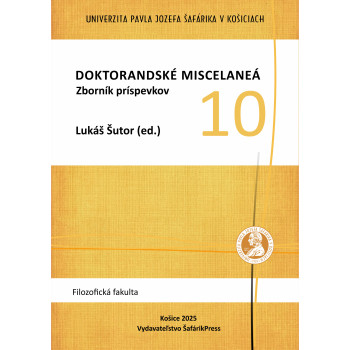
Doktorandské miscelaneá 10

Doktorandské miscelaneá 10 (2025)

E-book

E-book

Lukáš Šutor (ed.)

Okrúhle číslo Doktorandských miscelaneí nás vyzýva na krátke bilancovanie. V desiatich zväzkoch zborníka sme uverejnili spolu 116 príspevkov zo siedmich doktorandských študijných odborov. V každom čísle boli zastúpené štúdie z literárnej vedy (v prvých šiestich zväzkoch bol pre interdisciplinárne filologické štúdie používaný názov literárna veda/slovakistika). Z ostatných odborov boli najčastejšie uverejňované texty z filozofie a sociálnej práce, pričom štúdie z filozofie chýbali iba v posledných dvoch zväzkoch a štúdie zo sociálnej práce v prvých dvoch a v siedmom zväzku.

V zborníku sa snažíme udržiavať prvotnú myšlienku, ktorou bolo kultivovať domáci výskumný priestor najmladšej generácie bádateľov v interdisciplinárnom dialógu, čo si vyžaduje dosahovanie medzinárodných štandardov kvality, no na druhej strane aj zachovanie identity zborníka ako jedinečnej domácej publikačnej platformy.

Download the e-book for free (pdf.)

Heidegger a metafyzika v 20. storočí

Heidegger a metafyzika v 20. storočí

E-book

E-book

Vladimír Leško, Katarína Mayerová a kol.

Kolektívna monografia Heidegger a metafyzika v 20. storočí je zavŕšením bádateľského úsilia Katedry filozofie a dejín filozofie Filozofickej fakulty UPJŠ v Košiciach v riešení grantového projektu APVV-14-0706. Monografia predstavuje pokus o vyrovnanie sa s uchopením problému Heidegger a metafyzika v kritickej konfrontácii s jeho najvýznamnejšími filozofickými súčasníkmi v chápaní a riešení daného problému. V prvom rade ide o snahu vyrovnať sa s otázkou metafyziky ako filozofického problému vo vlastnej Heideggerovej tvorbe tak, aby čitateľ mal možnosť najprv sa zoznámiť s jeho vlastným riešením tejto otázky v priereze celej jeho tvorby. To skúmajú prvé tri kapitoly našej práce, ktorých autormi sú Vladimír Leško a Richard Capobianco.

Download the e-book for free (pdf) 

Heidegger, metafyzika a Gréci

Heidegger, metafyzika a Gréci

E-book

E-book

Vladimír Leško, Róbert Stojka a kol.

Kolektívna monografia Leško, V. – Róbert Stojka a kol.: Heidegger, metafyzika a Gréci (Košice: UPJŠ 2016, 695 s.) je prvým historicko-filozofickým pokusom na Slovensku, ale aj v širších zahraničných kontextoch, vysporiadať sa s takto zvolenou ústrednou témou Heideggerovho diela. Práca je členená do troch základných časti. V prvej, ktorá je nazvaná od Augustína k Aristotelovi, autori jednotlivých kapitol skúmajú genézu Heideggerovho vzťahu ku gréckej filozofii a skúmanie hlavnej Heideggerovej otázky – otázky bytia - od jeho prvých prednáškových kurzov k Aristotelovej filozofii z rokov 1921/1922 až do roku 1929, keď mu vychádza práca k Aristotelovej Metafyzike. Naše skúmanie jednoznačne potvrdzuje skutočnosť, že v týchto Heideggerových raných textov (prednáškových cyklov) sa postupne rodia všetky dôležité filozofické pozície, ktoré mali svoje zavŕšenie v práci Bytie a čas.

Download the e-book for free (pdf)

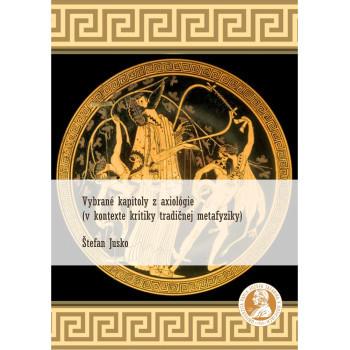
Vybrané kapitoly z axiológie (v kontexte kritiky tradičnej metafyziky)

Vybrané kapitoly z axiológie (v kontexte...

E-book

E-book

Štefan Jusko

Selected chapters from axiology are the result of the author's multi-year research work and also a certain fulfillment of the requirements from pedagogical practice in this subject. The chapters in this synthesizing form have not been published yet, and I am convinced that precisely in this form they can acquire higher value and greater real impact on our philosophy students.

Individual chapters focus on the problem of the collapse of traditional values, often leading to nihilism and loss of meaning in human existence. It is no coincidence that Friedrich Nietzsche, a philosopher who first called for a reevaluation of all values, is a common denominator among these texts. Another key figure is F. Dostojevskij, a Russian philosophising writer who views nihilism—the problem of value destruction—differently. The goal of these texts is literally to provoke our students so that they independently and creatively address questions related to the meaning of their own existence.

As I am convinced, our time presents a great challenge for new, original ideas and axiological judgments that have always preceded cognitive ones. To what extent my intentions and goals have been fulfilled remains up to the reader to decide.

Autor

Download the e-book for free (pdf)

Vybrané kapitoly z epistemológie (v kontexte postmetafyzického myslenia)

Vybrané kapitoly z epistemológie (v kontexte...

E-book

E-book

Štefan Jusko

Selected Chapters in Epistemology" is a work resulting from the author's multi-year research and also represents a fulfillment of the requirements from pedagogical practice in this subject. The chapters, presented in this synthesized form, have not been published before, and I am convinced that precisely in this form they can gain higher value and greater real impact on our philosophy students.

The individual chapters focus on the problem of knowledge today, primarily on the problem of criticizing metaphysics and questions related to creating post-metaphysical thinking. It is no coincidence that Friedrich Nietzsche is a common denominator for the presented texts; he is a philosopher who has fundamentally influenced and continues to influence current philosophical discussions and intellectual movements. The chapters are written to lead our students or other readers toward reflection, i.e., critical thinking, personal growth, and professional independence.

To what extent I have succeeded in fulfilling my intentions and goals remains for the reader to decide.

Autor

Download the e-book for free (pdf)

Sokratovská otázka ako filozofický problém

Sokratovská otázka ako filozofický problém

E-book

E-book

Štefan Jusko

The goal of the monograph is to highlight the significant problem of interpreting the Socratic question, as its approach represents a method of interpreting the history of philosophy, specifically in our case, the interpretation of Socrates and Plato. The Socratic question can be grasped in diametrically different ways, as shown by Patočka and Nietzsche, among others. The former aligns with Socrates and innovatively updates his question for the present. The latter is ambivalent towards Socrates but ultimately labels him a decadent.

In the first part of the monograph, Patočka's characterization of human existence is presented, which he formulates as unified and morally firm. Patočka interprets the Socratic question as care for the soul, for its well-being, without deriving the concept of good from something positively defined but from the whole world, which can only be defined negatively due to its constant openness. This sphere of negativity is for Patočka something immensely positive because transcendence lifts humans from relative goods to the overall meaning, making them morally capable in the true sense. The good, i.e., the requirement for a surge, for a turn of humans from the world of things to the whole world, is for him a program that Socrates first formulated through his knowing ignorance.

The second part of the work is dedicated to Nietzsche's concept based on the non-unified nature of human existence, which is not derived from the whole world or overall meaning but from situational meaning. Nietzsche strives to prove that in every situation, human existence is exposed to two opposing perspectives, between which it is impossible to decide which is correct. He concludes that both perspectives are equally valid and mutually conditioned, meaning that the opposite of good, what threatens meaning, is a beneficial condition for situational meaning. He labels this level as immoral, as a sphere where human existence creates meaning outside the thinking of good and evil in opposition.

The conclusion of the work is open because, as it turns out, we do not have a common denominator that could decide on the correctness of one or the other concept. Precisely in this lies the fact that the Socratic question remains a serious philosophical problem even today.

Download the e-book for free  (pdf)

Heidegger – Nietzsche (problém interpretácie)

Heidegger – Nietzsche (problém interpretácie)

E-book

E-book

Štefan Jusko

The stimulus for this monograph was my two studies on Heidegger’s interpretation of Nietzsche’s ideas of the will to power and eternal return of the same, published in Heidegger and Modern Metaphysics (supported by the Slovak Research and Development Agency, APVV-14-0706, under the leadership of V. Leška and M. Sobotka). In the submitted monograph, I present both studies in expanded (particularly “Will to Power as Art”) and refined versions (“Eternal Return of the Same”) and add a third chapter addressing the question of the meaning of interpreting philosophical texts, which themselves are interpretations of other texts.

In seeking an appropriate approach to the meaning of interpretation, I conclude that—generally—the purpose of interpretation is to uncover the productive dimension of the interpreted text, which can only be revealed if the interpreter enters the text openly and as neutrally as possible. If the interpreter does not open themselves to the text, allowing it to interpret them in turn, interpretation remains trapped. I believe that without mutual openness between interpreter and interpreted, interpretation has no meaning and typically becomes either rejection or misinterpretation—a form of violence.

In the third chapter, which I consider foundational, I attempt to “balance” the interpretive context of “Heidegger–Nietzsche” from the first two chapters through a reversible context of “Nietzsche–Heidegger,” albeit with the risk that my interpretation of Nietzsche’s thought—specifically his ideas of eternal return and will to power—may remain subjective, even if unintended as misinterpretation. Ultimately, the ambition of the third chapter is to explore intersections between the two philosophers, one of which—a rudimentary yet significant overlap—I identify as Heidegger’s concept of being-in-the-world, reinterpreted through Nietzsche’s lens. It is Nietzsche who challenges us to adopt a self-defined stance toward the world, to confront what it means to be in the world.

The challenge for me—and perhaps the reader—is to remain faithful to oneself, which is only possible by persisting in the context of mutual interpretation between interpreter and interpreted, regardless of who/what is interpreting or being interpreted. For the context of being-in-the-world is always co-created by both sides.

Download the e-book for free  (pdf)

Doktorandské miscelaneá 4

Doktorandské miscelaneá 4

E-book

E-book

Lukáš Šutor (ed.)

The proposed anthology represents for many doctoral students their first entry into the publishing environment of scientific genres. The studies in such cases contain the essence of future dissertation works, which represent the creative pinnacle of doctoral studies. In addition to providing doctoral students with the opportunity to publish scientific outputs, we also consider the anthology a space for interdisciplinary encounters and mutual enrichment. However, interdisciplinarity is not merely a characteristic of the anthology as a whole but also of some studies.

Most notable interdisciplinary approaches are observed in literary studies. The traditional subject of research into artistic texts is enriched in individual studies by examining theatrical and film works (Peter Getlík), linguistic aspects of phrasemes (Ivana Hudiková), musical elements (Terézia Kulíková), visual art (Dominika Petáková), and digital spaces of new media (Alexandra Popovičová). From other disciplines, we highlight Miroslava Süčová Vernarská’s study, which extends psychological research into sociological and linguistically communicative contexts (the concept of metaphor), or conversely, Zuzana Šoltésová and Dušan Šlosár’s contribution, analyzing eating disorders from their disciplinary background in social work.

Both mentioned disciplines also include contributions with traditional research subjects. Nikola Fabiny from psychology analyzes consequence expectations in the context of goal selection and achievement. Jana Plavnická and Dušan Šlosár’s co-authored study from the Department of Social Work presents a multi-perspective analysis of integration barriers for immigrants in Slovakia. Within their own disciplines, both philosophy contributions operate: Juraj Brenišin interprets the ethical aspects of Avicbron’s Fons vitæ, while Michal Kručko examines Edmund Husserl’s unfinished work through a comparative lens of his students Jan Patočka and Roman Ingarden. The anthology concludes with Lukáš Lukačín’s study (written in English), which explores the semantic-grammatical category of modality in the verbs MAY and CAN within legal-administrative documents of the European Union.

The representation of academic disciplines and doctoral students’ individual creative outputs in Doktorandské miscelaneá 4 is thus appropriately diverse. We present this publication to the broader academic community as a representative overview of trends in young scholars’ thinking across the spectrum of humanities and social sciences doctoral programs at the Faculty of Arts, UPJŠ in Košice.

Lukáš Šutor

Download the e-book for free (pdf)

Leibniz a Heidegger – veta o (dostatočnom) dôvode

Leibniz a Heidegger – veta o (dostatočnom) dôvode

E-book

E-book

Martin Škára

Philosophy is interwoven throughout its history with several principles that bring light and order to this kind of thinking, whether it is a systematic or a non-systematic form of philosophizing.

Each of the principles represents in its own way the origin (ἀρχή) of all deductive reasoning, but not all philosophical statements and conceptions are obliged to proceed in the same way, for not all philosophical statements and conceptions are calculus. Actually, such a form of rationalist philosophizing is really a minority in the history of philosophy. But in spite of its minority presence, it will always attract attention to some extent, whether by becoming a pillar of thought itself and finding a permanent place in its foundations, or by becoming an indispensable mainstay of philosophical reasoning. In fact, there are not many principles in the history of philosophical thought.

The state of affairs is primarily due to the heterogeneous and in many cases irrationalist nature of philosophical thinking.

Download the e-book for free (pdf)

THE FUNCTION OF METAPHOR IN MEDIEVAL NEOPLATONISM

THE FUNCTION OF METAPHOR IN MEDIEVAL NEOPLATONISM

E-book

E-book

Mária Mičaninová - Ivica Hajdučeková (eds.)

In the framework of the project VEGA of the Ministry of Education, Science, Research and Sport of the Slovak Republic 1/0330/12 The Function of Metaphor in the Philosophy of Shlomo ben Yehuda ibn Gabirol and Shihab al-Din Yahya al-Suhrawardi, project leader Assoc. Prof. Mária Mičaninová, CSc., under the patronage of the rector of Pavol Jozef Šafárik University in Košice, The Slovak Republic, Prof. MUDr. Ladislav Mirossay, DrSc., and of The Department of Philosophy and History of Philosophy of the Faculty of Arts of the same University, took place on 4th – 5th October 2013 an International conference on The Function of Metaphor in Medieval Neoplatonism. Two days´conference was opened by Dean of the Faculty of Arts of P. J. Šafárik University, Prof. PhDr. Ján Gbúr, CSc.,in the presence of Prof. PhDr. Vladimír Leško, CSc., Head of The Department of Philosophy and History of Philosophy, and of foreign guests and students of the University.

Download the e-book for free (pdf)

This website uses cookies to ensure you get the best experience on our website