Slovenčina



E-book
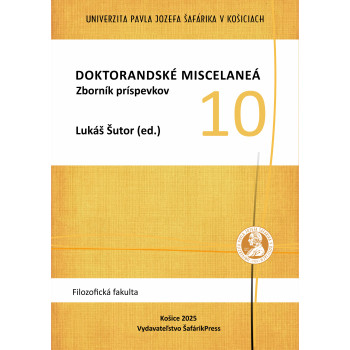
Lukáš Šutor (ed.)
Okrúhle číslo Doktorandských miscelaneí nás vyzýva na krátke bilancovanie. V desiatich zväzkoch zborníka sme uverejnili spolu 116 príspevkov zo siedmich doktorandských študijných odborov. V každom čísle boli zastúpené štúdie z literárnej vedy (v prvých šiestich zväzkoch bol pre interdisciplinárne filologické štúdie používaný názov literárna veda/slovakistika). Z ostatných odborov boli najčastejšie uverejňované texty z filozofie a sociálnej práce, pričom štúdie z filozofie chýbali iba v posledných dvoch zväzkoch a štúdie zo sociálnej práce v prvých dvoch a v siedmom zväzku.
V zborníku sa snažíme udržiavať prvotnú myšlienku, ktorou bolo kultivovať domáci výskumný priestor najmladšej generácie bádateľov v interdisciplinárnom dialógu, čo si vyžaduje dosahovanie medzinárodných štandardov kvality, no na druhej strane aj zachovanie identity zborníka ako jedinečnej domácej publikačnej platformy.
Download the e-book for free (pdf.)

Data sheet
E-book
Ingrid Madárová - Oksana Humenna - Beáta Jurečková - Veronika Pálová - Lucia Tóthová - Lívia Vašková
Slovak for Medical Students – Medical History Taking I is a Slovak language textbook designed for international medical students. It focuses on developing the language and communication skills required for medical history taking and professional communication with patients in the Slovak healthcare environment. The textbook contains thematically organized lessons related to clinical medicine, authentic dialogues, medical terminology, grammar and vocabulary exercises, communication tasks, and activities that promote the practical use of Slovak in medical practice. The electronic version of the textbook also includes audio recordings of the dialogues, supporting the development of listening comprehension, correct pronunciation, and spoken language understanding. The publication integrates Slovak language learning with medical content and prepares students for effective communication with patients during clinical training and future medical practice.
E-kniha
Preklad: Július Zimmermann a Eva Kiktová
Kniha je slovenským prekladom anglickej monografie Stevena J. Lucka An Introduction to Event-Related Potential Technique (2014). Technika potenciálov, ktoré súvisia s udalosťami (ERP), je neinvazívny spôsob skúmania procesov percepcie a kognície ľudského mozgu. Subjekty – skúmané osoby, vnímajú špeciálne navrhnuté formy vizuálnych alebo rečových stimulov. Zo snímanej sústavy EEG signálov sa matematickými metódami extrahujú osobitné ERP signály, pričom sú u nich zaujímavé tri typy rozlišovacích schopností: časové rozlíšenie (latencia), amplitúdové rozlíšenie (magnitúda) a priestorové rozlíšenie (oblasť mozgu), v ktorej sa generujú ERP signály. Latencia a magnitúda signálov sú v tejto metóde unikátne parametre prezentujúce uvedené procesy, priestorové rozlíšenie je v tomto prípade menej dokonalé.
V knihe je výklad celého experimentálneho ERP výskumu: návrh a prevádzka laboratória, dizajn experimentov, akvizícia EEG signálov a korekcia šumov a artefaktov. Nasleduje detekcia ERP signálov: filtrovanie a Fourierova analýza, kvantifikácia amplitúd a latencií, osobitné metódy v časovej aj frekvenčnej doméne a podobne. Nakoniec štatistickou analýzou a interpretačnými metódami sa formulujú dosiahnuté výsledky výskumu. Pre čitateľa sú cenné aj poznatky v kapitole o tom, ako sa píšu štúdie s dobrým kreditným ohodnotením a ako sa takéto štúdie oponujú.
Kniha je cenným zdrojom pre výskumných pracovníkov, pre doktorandov a postdoktorandov, ale aj pre študentov, ktorých zaujala nesmierne zložitá a málo preskúmaná činnosť ľudského mozgu.
E-book
The goal of the monograph is to highlight the significant problem of interpreting the Socratic question, as its approach represents a method of interpreting the history of philosophy, specifically in our case, the interpretation of Socrates and Plato. The Socratic question can be grasped in diametrically different ways, as shown by Patočka and Nietzsche, among others. The former aligns with Socrates and innovatively updates his question for the present. The latter is ambivalent towards Socrates but ultimately labels him a decadent.
In the first part of the monograph, Patočka's characterization of human existence is presented, which he formulates as unified and morally firm. Patočka interprets the Socratic question as care for the soul, for its well-being, without deriving the concept of good from something positively defined but from the whole world, which can only be defined negatively due to its constant openness. This sphere of negativity is for Patočka something immensely positive because transcendence lifts humans from relative goods to the overall meaning, making them morally capable in the true sense. The good, i.e., the requirement for a surge, for a turn of humans from the world of things to the whole world, is for him a program that Socrates first formulated through his knowing ignorance.
The second part of the work is dedicated to Nietzsche's concept based on the non-unified nature of human existence, which is not derived from the whole world or overall meaning but from situational meaning. Nietzsche strives to prove that in every situation, human existence is exposed to two opposing perspectives, between which it is impossible to decide which is correct. He concludes that both perspectives are equally valid and mutually conditioned, meaning that the opposite of good, what threatens meaning, is a beneficial condition for situational meaning. He labels this level as immoral, as a sphere where human existence creates meaning outside the thinking of good and evil in opposition.
The conclusion of the work is open because, as it turns out, we do not have a common denominator that could decide on the correctness of one or the other concept. Precisely in this lies the fact that the Socratic question remains a serious philosophical problem even today.
E-bool
When studying the Renaissance, researchers utilize various critical and core terms and concepts which it is necessary to characterize.
However, many such points, notably the following, are problematic: The relationship between the Renaissance and the antiquity; The connection with the Middle Ages; The transformation to Mannerism and Baroque; Realism and Secularism in Renaissance art; The individualism of the Renaissance artist; The reasons for the creation of Renaissance art in Italy, its determinants and stimulators; Distinguishing between the analysis of the genesis of the Renaissance and the analysis of the creation of the period’s art generally; Regional differences in Italy and their impact on the art; Chronological limits of the Renaissance and its milestones; The terms “Medieval Ages” and “Early Modern Period”; The impact, and its extent, of the artistic influences of the Byzantine, Gothic and Romanesque arts on the Renaissance. The term “Renaissance” itself, its content and existence, are also the subject of the discussion with students, alongside learning how such terms and definitions came about and continue to evolve, how they attain their content, how this content morphs in the historical discourse, what academical pluralism and freedom of thinking look like in the discourse led by historians, what the differences are between scientists and schools of thought on the same subject and how it is possible that they are so numerous.
The students will come to recognize the leading scholars in the field, and follow their arguments and methodological approaches. They shall be invited to closely trace and scrutinize the logic which those historians use in building their argumentation. It shall be seen that the freedom to create terms, concepts and new definitions cannot stand on an ignorance of the (historical) facts, as becomes clear with expanding knowledge of those historical facts, the variability of their interpretation growing in tandem. This approach, actually used across the whole range of seminars and lectures, shall drive discussion on the topics covered, students being invited to formulate their own theses and antitheses.