Filter By

Categories

Categories

Year of publication:

Year of publication:

Publication language:

Publication language:

Faculty:

Faculty:

Method of publication:

Method of publication:

Active filters

  • Categories: Law
  • Categories: Social sciences
  • Year of publication:: 2015
  • Publication language:: Slovak
Pracovnoprávne elementy výkonu (závislej) práce. Kritika a deformácia práva.

Pracovnoprávne elementy výkonu (závislej)...

E-book

E-book

Jana Žuľová (ed.)

Collection of Scientific Works

Article 35 of the Constitution of the Slovak Republic guarantees everyone the right to freely choose their profession and receive training for it, as well as the right to engage in entrepreneurial or other gainful activity. Everyone has the right to freely decide whether to secure their livelihood through self-employment—with all the associated consequences and risks—or through employment within labor-law relationships by performing dependent work.

The framework and rules for exercising these rights are primarily regulated by labor, commercial, and tax legislation, each with its own set of rights and obligations applicable specifically to entrepreneurs and employees. Constant competitive pressure, along with the effects of economic crises, pushes employers to seek ways to extract the most from workers while optimizing for the lowest possible insurance, administrative, and tax costs. As a result, employment contracts are being terminated, and under the pressure of losing their income, individuals are "voluntarily" shifting to commercial-law relationships.

This situation, along with other distortions in the labor market, confronts those entitled to work with unfair practices by employers, thereby undermining their ability to freely exercise this fundamental right.
Download the e-book for free (pdf)

Orgány obchodných spoločností

Orgány obchodných spoločností

E-book

E-book

Kristián Csach - Dušan Rostáš (eds.)

Proceedings of the 2nd Student Symposium on Company Law In November 2014

The second annual Student Symposium on Commercial Law—more specifically, on Company Law—was held at the university’s facility in Danišovce. As in the previous year, the aim of the symposium was to provide students with a greater opportunity to articulate their own perspectives on current legal issues and to present the results of their individual work.

The theme of the second symposium focused on the governing bodies of commercial companies, aligning it thematically with the APVV research project being carried out by members of the Department of Commercial and Economic Law at our Faculty of Law. This overarching topic made it possible to assign a range of current legal issues, allowing students to explore problems they are likely to encounter in their future professional practice. The selected topics are not among those unanimously settled by legal doctrine or established case law.

On the contrary, they were deliberately chosen for their complexity and the lack of sufficient domestic literature. As a result, students had to go beyond standard textbook or commentary-based knowledge to thoroughly address their assigned topics.

Download the e-book for free (pdf)

Regionalizmus a jeho prínos pre všeobecné medzinárodné právo

Regionalizmus a jeho prínos pre všeobecné...

E-book

E-book

Ján Klučka a kol.

The presented monograph, “Regionalism and Its Contribution to General International Law,” was prepared at the Institute of European Law and the Department of International Law of the Faculty of Law at Pavol Jozef Šafárik University in Košice as part of a project of the same name (APVV-0823-11) carried out in the years 2011–2015, and represents one of its final publication outputs.

The main reason for choosing this topic was the effort to evaluate regionalism in its various forms in relation to international law, and, conversely, to assess the place, significance, and role of international law in the creation and functioning of different forms of regional groupings. In fact, although regionalism is receiving increasing attention in doctrine, a more comprehensive assessment of its impact on international law and vice versa has so far been lacking.

This monograph attempts to partially fill this gap. Against the background of a brief historical development of regionalism, as well as its substantive and terminological components, the monograph examines in greater detail the individual types of regionalism—such as old and new regionalism, as well as contractual and institutional regionalism—their specific features, and their contribution to general international law.

Attention is also devoted to a specific phenomenon of contemporary regionalism, namely the influence of the European Union on its stabilization and development, both through practical measures and through a set of measures regulated by international treaties.

Download the e-book for free (pdf)

Ochrana kultúrnych hodnôt prostriedkami medzinárodného a regionálneho práva

Ochrana kultúrnych hodnôt prostriedkami...

E-book

E-book

Adam GiertlĽudmila Elbert

Collection of Papers from the 8th Student Symposium held on April 20–21, 2015 in Danišovce

The capture of the historic Syrian city of Palmyra by fighters of the radical Islamic State caused shock among the global public. The main reason is the barbarism with which this organization proceeds, not only in relation to the treasures of the world’s cultural heritage. The situation in the Middle East, where cultural treasures of inestimable value are under direct threat, demonstrates how fragile the world’s cultural heritage is. The reaction of the international public and world leaders shows how sensitively the destruction of cultural heritage is perceived.

The quoted statement chosen by the editors relates to the threat posed by the Islamic State—however, the spirit of this statement can be applied to any cultural wealth that forms part of the world’s cultural heritage. The destruction or damage of these values primarily represents a loss for humanity as such. Each destroyed artifact of world cultural heritage signifies the disappearance of a unique legacy left by previous generations for the future. At the same time, cultural heritage must be understood as a broad spectrum of assets—both tangible and intangible. Their legal protection was the topic of this year’s symposium. As with any social interest, the protection of cultural heritage can be ensured through various mechanisms and under different forms of social organization.

These diverse approaches are unified by law as a normative system. The question for the 8th year of the symposium on international law was what role international law plays in the protection of cultural heritage. In the context of the European region, the role of the European Union as a regional organization was examined.

Download the e-book for free (pdf)

Rule of Law a medzinárodné právo

Rule of Law a medzinárodné právo

E-book

E-book

Ľudmila Elbert

The presented scientific monograph addresses the issue of the Rule of Law and its place, roles, and particularities at the level of international law. The Rule of Law is understood as a value that should govern communities, both domestic and international. It is thus compared to Kelsen’s basic norm, which should stand at the top of the legal order as the norm justifying the validity and existence of the norms of the legal order, both domestic and international.

Although the Rule of Law is studied at the international law level, it cannot be considered without understanding the Rule of Law in domestic law. Just as its development differs depending on whether it evolved within Anglo-American or continental law, its application and development also differ between domestic law and international law.

These differences are mainly caused by the roles and objectives that international Rule of Law is meant to secure, as well as by the distinct characteristics of domestic and international law.

Download the e-book for free (pdf)

Slovenské a české obchodné právo v roku 2015: Vybrané problémy

Slovenské a české obchodné právo v roku 2015:...

E-book

E-book

Jozef Čorba(ed.)

Collection of Contributions from the Conference

On June 11–12, 2015, the Department of Commercial Law and Economic Law at the Faculty of Law, P. J. Šafárik University in Košice, organized the 13th meeting of the departments of commercial law from the law faculties of Czech and Slovak universities. This event further demonstrates that the idea of an annual gathering of representatives from these departments, initiated by Professor Bejček of the Faculty of Law at Masaryk University in Brno, has taken root and is likely to continue. Not only to preserve the tradition but primarily for the benefit of such meetings and the interest of participants to meet regularly.

A traditional part of these meetings, besides the exchange of knowledge and information about the teaching process and experience sharing, is a scientific conference focused on current issues in commercial law. This year’s conference was held under the title Slovak and Czech Commercial Law in 2015 – Selected Problems. A total of 17 contributions from various departments were included in the conference proceedings, divided into three thematic areas. The first group of contributions addresses selected issues related to the legal regulation of commercial companies and its practical implementation. The second group focuses on arbitration and insolvency law.

The third group includes contributions on the interpretation of the amended regulation of interest on late payments in commercial obligations, problems related to the application of this regulation, and issues concerning the interpretation of legal acts contained in the new Czech Civil Code. An additional part features an informational contribution on the development of Slovenian commercial law and its current form.

Ján Husár, Kristián Csach

Download the e-book for free(pdf)

Metodika tvorby učebných úloh a didaktických testov pre chémiu

Metodika tvorby učebných úloh a didaktických...

E-book

E-book

Mária Ganajová

The current teaching of chemistry has its specific problems. On one hand, due to the shift of the focus of chemistry curriculum towards theoretical content, the difficulty of chemistry material has increased, and in connection with this, students' interest in chemistry has decreased.

The lack of student interest in chemistry is mostly supported by the opinion that it is precisely chemistry that significantly contributes to the deterioration of environmental quality. On the other hand, we live in an era where we encounter chemical products practically everywhere. It is necessary to learn the basics of chemistry as well as possible, which makes the question of increasing interest in chemistry education and improving its effectiveness very relevant. State educational programs have been introduced into Slovak schools as a foundation for the creation of school educational programs. These emphasize not only acquiring a certain amount of knowledge but also the development and enhancement of key and specific competencies of students, preparing them for lifelong learning and their application in life.

Therefore, increasing attention is being paid to one of the fundamental didactic tools for raising student activity in teaching, and thus improving the effectiveness of chemistry education – learning tasks. From both theory and practice of chemistry teaching, we know that learning tasks, questions, examples, exercises, etc., are among the important components of every teaching lesson. Learning tasks are applied in all phases of teaching – in the motivational phase, the phase of acquiring knowledge, the phase of consolidating knowledge, and the phase of checking the acquired knowledge. It is therefore clear that every teacher will sooner or later find themselves in a situation where they will have to select learning tasks from textbooks, workbooks, collections of problems and examples, or create them themselves.

This scientific monograph is intended for educational specialists and chemistry teachers, aiming to familiarize them with examples of various types and forms of learning tasks and the basics of their creation in chemistry. It can also be helpful for them in preparing certification works focused on test creation and their statistical evaluation.

Download the e-book for free (pdf)

Aktuálne výzvy a problémy verejnej správy II.

Aktuálne výzvy a problémy verejnej správy II.

E-book

E-book

Drahomíra Ondrová - Veronika Džatková(eds.)

Perspektívy komunálnej politiky na Slovensku po voľbách v roku 2014

Peer-reviewed collection of works from the scientific conference with international participation held on May 28, 2015, in Košice

On May 28, 2015, the Department of Public Policy and Public Administration, in cooperation with the organizing and scientific committee, organized a scientific conference with international participation titled "Current Challenges and Problems of Public Administration II. – Perspectives of Municipal Policy in Slovakia after the 2014 Elections."

The conference content followed up on the conference "Current Problems and Challenges of Public Administration I.," which was held on November 21, 2012, and laid the foundation for a series of conferences dedicated to the important issue of public administration. The conference focused on a broad range of problems related to public administration from the perspective of its understanding as an academic discipline in connection with political science, law, ethical aspects, economics, digitalization, and public administration management, with a focus on the perspectives of municipal policy.

The authors in their contributions did not remain only at the theoretical and generally descriptive level but sought to address existing problems by formulating proposals and possible ways to solve them in the application to public administration practice. The authors and editors believe that this collection of papers will have a positive contribution not only for theorists and students of the Faculty of Public Administration but also for representatives and professionals from practice who are daily confronted with issues of public administration.

Download the e-book for free (pdf)

Územná samospráva a tvorba práva

Územná samospráva a tvorba práva

E-book

E-book

Michal Jesenko - Martina Kantorová(eds.)

Peer-reviewed proceedings of the scientific conference, which took place on 27.11.2015 at the Faculty of Public Administration, UPJŠ v Košice, Popradská 66, 041 32 Košice

Territorial self-government forms an integral part of a modern democratic and legal state. It is an expression of efforts to implement tasks to ensure the needs of the territorial community of citizens at the level that is closest to them.

One of the most important tools at the disposal of local self-government units in the performance of the tasks entrusted to them is the power to issue general binding regulations in matters of local self-government and to ensure the tasks arising for local self-government from the law. Law-making at the level of towns and municipalities or higher territorial units is thus an integral part of the exercise of territorial self-government and ultimately expresses its specific character as an essential part of public administration.

The aim of the scientific conference organized by the Department of Public Law Disciplines, Faculty of Public Administration, UPJŠ in Košice on 27 November 2015 was an effort to present the achieved results of scientific research activities in the field of law-making at the level of cities and municipalities, or higher territorial units. The conference provided a wide space for discussion on current issues of municipal standard-setting with the participation of representatives of the professional public, as well as representatives of local government and local self-government.

The scientific conference and the peer-reviewed proceedings of the conference were realized as a part of the solution of the VEGA grant project No. 1/0683/13 under the title "Normative Formation of Municipalities in the Matters of Local Self-Government. The present collection of papers from the scientific conference is an expression of the long-term efforts of the Department of Public Administration, Faculty of Public Administration, UPJŠ in Košice to address current issues of public administration with a special focus on the issue of local government.

Download the e-book for free (pdf)

Reflexia pedagogických možností vých. systémov vybraných detských a mládež. organizácií  v edukačnom priestore SR

Reflexia pedagogických možností vých. systémov...

E-book

E-book

Ján Juščák - Milan Darák

The aim of the monograph was to analyze the pedagogical possibilities of educational systems within children's and youth organizations, with an emphasis on those targeting the age group of children up to 15 years.

The starting point was an analysis of the current state of theory and practice in children's and youth organizations, with the intention of describing prevailing trends in their development and activities. This publication closely follows the previous monograph (Juščák, J. – Darák, M.: 2015), in which we processed, according to a unified methodology and using generally accepted pedagogical terminology, the collected available materials on the educational systems of selected (most representative) children's and youth organizations in Slovakia. Through a subsequent comparison of the obtained empirical data on educational systems, we aimed to identify their similar (identical) as well as specific (distinct) elements as a basis for establishing categorization criteria for their classification.

The culmination of our efforts was an attempt to characterize a children's organization as an educational institution, describing its characteristic features, functions, aims, content, principles, and educational methodology.

Download the e-book for free (pdf)

Reflexia pedagogických možností vých. systémov vybraných detských a mládež. organizácií  v edukačnom priestore SR

Reflexia pedagogických možností vých. systémov...

E-book

E-book

Ján Juščák - Milan Darák

 The aim of the monograph was to analyze and address the issue of educational systems within children's and youth organizations, with an emphasis on those focused on the age category of children up to 15 years.

The starting point was an analysis of the current state of the educational environment in terms of the systemic nature of education and the basic categories of the educational system. The collected available materials on the educational systems of selected (most representative) children's and youth organizations in the Slovak Republic were subsequently processed according to a unified methodology and using generally accepted pedagogical terminology.

Download the e-book for free (pdf)

Školský systém na Slovensku v medzivojnovej Československej republike (1918 - 1938)

Školský systém na Slovensku v medzivojnovej...

E-book

E-book

Soňa Gabzdilová

The educational system (schooling) is one of the most effective tools for shaping the young generation in any advanced society. Schools not only create the knowledge base necessary for fulfilling the demands of the economy and the social sphere, but they also shape the national and ideological identity of each member of society. The school plays a decisive role in forming positive values, but it can also become a breeding ground for xenophobia and racist attitudes. The school has an irreplaceable role in creating national consciousness, identification with one's own nation, its history, the heroic deeds of ancestors, and the meaning of its existence.

After the dissolution of Austria-Hungary, there were fundamental geopolitical changes in Central Europe. One of these was the creation of Czechoslovakia, a state founded on radically different principles than pre-war Hungary. The founders of the Czechoslovak Republic (CSR), the personalities who decisively determined the character of the political system in the newly established republic, did not belong to the privileged classes of the previous regime. Unlike Hungary, where political power was controlled almost without exception by the nobility, the elite in Czechoslovakia consisted of men who were radical critics of Austria-Hungary.

A fitting example was the most influential figure of interwar Czechoslovakia, President Tomáš Garrigue Masaryk. Despite his origins, Masaryk was perceived by both Czechs and Slovaks as the founder of the state, a legendary figure whose political and social influence far exceeded the powers of the presidential office.

Download the e-book for free (pdf)

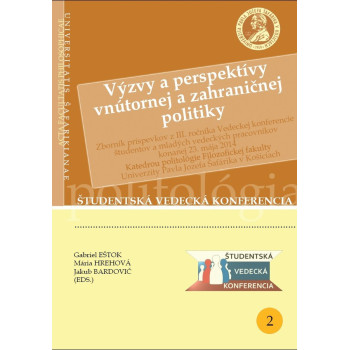
Výzvy a perspektívy vnútornej a zahraničnej politiky

Výzvy a perspektívy vnútornej a zahraničnej...

E-book

E-book

Gabriel Eštok- Mária Hrehová- Jakub Bardovič (eds.)

Proceedings of the 3rd Annual Scientific Conference of Students and Young Researchers held on May 23, 2014, by the Department of Political Science, Faculty of Arts, Pavol Jozef Šafárik University in Košice

On May 23, 2014, the Department of Political Science at the Faculty of Arts, Pavol Jozef Šafárik University in Košice hosted a conference entitled “Challenges and Perspectives of Domestic and Foreign Policy.” This was the third conference for students and young researchers organized by the Department of Political Science in cooperation with the civic association Res Publica. The event featured numerous young people interested in contemporary political issues, each presenting on a topic related to domestic or foreign policy. It can be stated that these presentations were of a high professional standard and stimulated discussion on the topics and problems raised.

The publication you are holding is a collection of scholarly works by students and young experts who focused on a variety of subjects. Some authors addressed issues of foreign policy, particularly the analysis of selected countries’ policies (Slovak Republic, USA), examined the Iranian nuclear program, or explored the possibilities of federalizing Ukraine as a solution to the emerging situation. Another contribution offered a perspective on foreign policy from the viewpoint of Slovak emigrants in Australia. Despite the wide range of topics addressed in the individual contributions, a common denominator can be found: the effort to highlight a particular problem or propose its solution, thereby contributing to the fulfillment of the ideal of democracy, the improvement of policy-making and functioning, and, above all, making the world a better place for all of us.

Editors

Download the e-book for free(pdf)

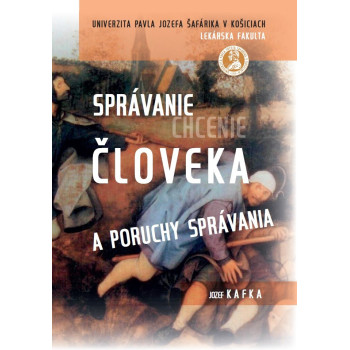
Správanie (chcenie) človeka a poruchy správania

Správanie (chcenie) človeka a poruchy správania

€10.02
Availability: 29 In Stock

Jozef Kafka

Behavior, in the slovak language expressed as an intention, belongs to basic mental processes of every individual. In this work I consider it as the basic component of an individual having two sides, outer- and inner side. I present it in the scheme No. 2.

The problem of behavior can not be fully covered, although there is a lot of writing, discussing and experimenting by ancient time.

The work may offer only few comments, approaching maily disorders of behavior. I present the original explanation of these disorders, dividing them on primary and derived ones. Primary disorders create the core of the disorder, derived disorders create a component of other disorders.

My classification of primary disorders is as follows:

  1. age dependent disorders of behavior
  2. disorders in the dynamical structure and in phases of behavior
  3. integrative disorders of behavior, disorders of the will, which is the sign of the developed behavior of the individual.

The work is addresses to everone who is interested in his/her owm behavior, but especially for the Medical faculty and psychiatrists, for students of all our faculties.

Author 

Teória štátu a práva pre študijný program „Európska verejná správa“

Teória štátu a práva pre študijný program...

€11.98
Availability: 52 In Stock

 Igor Palúš  Mária Hencovská 

Predložené učebné texty obsahujú vybrané témy z teórie štátu, štátovedy, ústavného práva a teórie práva, v takom rozsahu a skladbe, aby poskytovali dostatok informácii študentom pre absolvovanie povinného študijného predmetu Teória štátu a práva, a súčasne vytvorili solídny základ propedeutického charakteru pre nadväzujúce právne študijné predmety.
Autori pri tvorbe učebných textov rešpektovali zaradenie študijného programu „európska verejná správa“ do študijného odboru verejná politika a verejná správa, čo znamená, že ide o neprávnický študijný program a študijný predmet, pre ktorý je učebný text určený, je zaradený do prvého semestra. Študijný program európska verejná správa je naviac špecifický tým, že nadväzujúce právne študijné predmety sa zameriavajú najmä na poznávanie inštitucionálneho fungovania Európskej únie, jej jednotlivých orgánov a práva Európskej únie. Predkladané učebné texty by mali možnú absenciu poznatkov zo slovenského právneho poriadku v nevyhnutnej miere doplniť.

Autori

This website uses cookies to ensure you get the best experience on our website