Zavolajte nám:
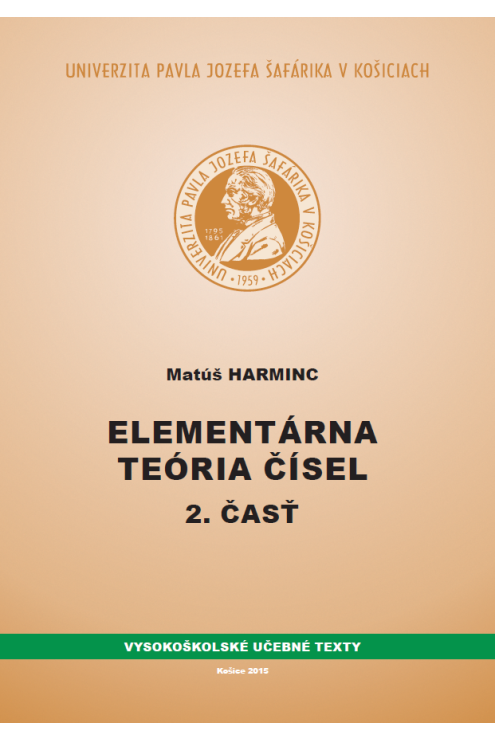
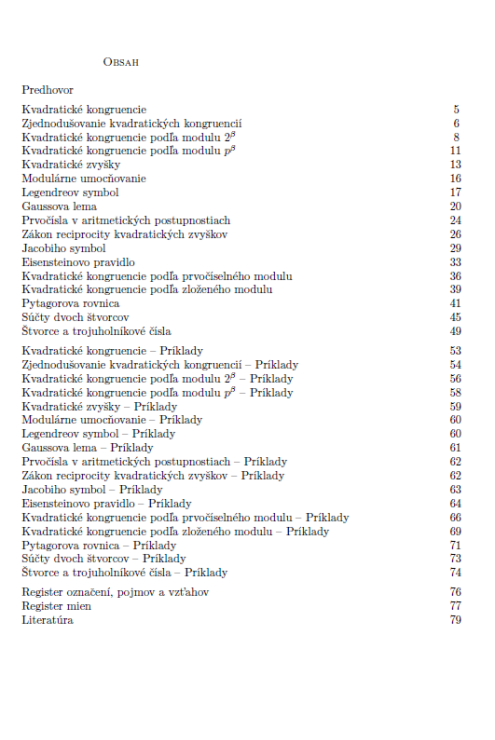
+421 55 234 1635Tento učebný text je určený poslucháčom medziodborového štúdia v kombináciách s matematikou, jednoodborového štúdia matematiky ako aj rozširujúceho štúdia matematiky. Je za-meraný na kvadratické kongruencie a niektoré diofantovské rovnice.
Autor
Data sheet
Specific References
E-book
Ľubomír Antoni a kol.
In university textbooks, we present the history of data science, basic concepts in artificial intelligence, machine learning, or deep learning. We describe the relationships between data science and other disciplines and summarize the tasks of the data scientist. We present an overview of university subjects in the field of data science, which were created and innovated at Slovak universities within the national project IT Academy - Education for the 21st Century. We present extended subject annotations, application examples and case studies using various methods in the field of data science. University textbooks are intended for students of bachelor's, master's, engineering and doctoral study programs in computer science, but also in non-informatics fields.
Download e-book for free (pdf)
E-book
Photonics is an application-oriented discipline at the interface of optics, opto-electronics and quantum optics. It includes classical optics extended by the description of physical phenomena and optical devices that rely on quantum (photon) nature of light.
The main objective of the Photonics course is to provide a comprehensive overview of essential optical and photonic phenomena routinely applied in experimental scientific research while working with various light sources (e.g. in the field of biophotonics). The first chapters are devoted to the description of light at different levels. The logical order of subsections in this part corresponds to the structure of the textbook: B. E. A. Saleh, M. C. Teich, Fundamentals of Photonics. The following chapters contain a description of laser operation and an overview of selected optical instruments and their applications.
The body text is complemented by practical notes on the use of theoretical knowledge during daily work in the laboratory. The course of Photonics requires a basic knowledge of mathematics, electromagnetism and optics, and thus it is recommended to students who previously passed through the courses of the Bachelor's program in Physics.
Ondrej Hutník a kol.
Zbierka úloh z matematickej analýzy III. je pokračovaním predchádzajúcich dvoch vydaných zbierok autorov Kulcsár a Kulcsárová. Táto časť obsahuje príklady na zopakovanie a precvičenie učiva stredných škôl, ako aj časti prvého semestra kurzu matematická analýza určeného pre študentov matematiky, fyziky, informatiky a učiteľského štúdia v kombinácii s matematikou. Zbierka môže tiež pomôcť všetkým učiteľom, ktorí chcú použiť rôzne úlohy vo svojom vyučovaní. Zbierka zahŕňa oblasť postupností reálnych čísel: aritmetické a geometrické postupnosti, všeobecne a rekurentne zadané postupnosti, nachádzajú sa tu úlohy na vyšetrovanie vlastností postupností (monotónnosť, ohraničenosť, konvergencia) a výpočet rôznych typov limít. Všetky zadané úlohy sú vyriešené na konci každej kapitoly s podrobným komentárom.
Autori
E-book
Adriana Zeleňáková - Zuzana Ješková - Adela Kravčáková et al. (eds.)
The proceedings contain abstracts of contributions from participants of the 10th Czech-Slovak Student Scientific Conference in Physics, which took place on May 2–3, 2019, at the Faculty of Science, Pavol Jozef Šafárik University in Košice.
E-book
The scientific book of abstracts from the conference „Novel Trends in Chemistry, Research and Education 2023“ is a summary of the contributions of conference participants, which contain the original results of their scientific and research activities.
The contributions published in this volume can be divided according to content into the fields of analytical, inorganic, organic, physical chemistry, biochemistry, didactics of chemistry, and NMR spectroscopy.
Download e-book for free (pdf)
E-book
Vladimír Zeleňák(ed.)
The proceedings contain abstracts of contributions from participants of the Student Scientific Conference of the Faculty of Science, Pavol Jozef Šafárik University in Košice, which took place on April 22, 2015.
The Student Scientific Conference (SSC) enjoys long-term popularity among the faculty's students and teachers, and we are pleased that this was no different this year, with 128 contributions submitted to the SSC.
The contributions were organized into 19 sections, additionally complemented by an open programming competition and the final of the IHRA contest. For many students, presenting at the SSC is one of the first opportunities to gain experience in presenting their results before a professional audience. Considering the number of submitted contributions, along with the members of the expert juries from the faculty's teaching staff and the audience who came to support their classmates' presentations, the SSC is an event where a large part of the student and academic community of the faculty meets at one place and time. Many abstracts presented in this proceedings were developed as part of students' work on partial tasks that are components of research projects at the departments of the Faculty of Science, Pavol Jozef Šafárik University.
The abstracts represent, in a way, an overview of research topics at the individual workplaces of the faculty. The SSC proceedings thus serve as a useful tool that students and faculty teachers can use to present the faculty externally to partners, employers, and potential collaborators. Partners from practice have shown interest in cooperating in organizing the SSC for a long time. Since 2005, the association of IT companies has awarded a Prize for the Most Original Work and a Prize for the Work with the Best Prospects for Practical Application.
E-book
Jozef Bednarčík (ed.)
Pavol Jozef Šafárik University in Košice under the auspices of Ministry of Education, Research, Development and Youth of the Slovak Republic, Ministry of Economy of the Slovak Republic and European X-Ray Free-Electron Laser Facility GmbH in Hamburg organizes School of XFEL and Synchrotron Radiation Users 2024 (SFEL 2024). The school is continuation of the Winter Schools of Synchrotron radiation held in 2011, 2013, 2014 and SFEL 2017, 2018, 2019 and 2022. The aim of the SFEL2024 school is to facilitate the growth of new Slovak research community of high expertise in high-efficiency RTG laser and synchrotron and neutron sources. The SFEL school is designed for efficient transfer of the rapidly developing know-how in these areas to young generation – researchers and university students. The next aim of the SFEL2024 is strengthening of personal connections between the local Slovak research community and forming scientific teams of XFEL users. Slovak research community thus can take advantage of the fact that Slovakia is a shareholder of European XFEL GmbH Company in Hamburg, but also makes more efficient use of other closely related scientific facilities, including ILL and ESRF in Grenoble and DESY in Hamburg.
E-book
We have prepared a publication that focuses on the personalities of professors. These personalities represent entire scientific teams, participated in the creation of new study programs, and had a significant impact on the formation of the faculty. Factually, we tried to capture the basic data in a uniform structure. We are building on a similar publication from ten years ago, which greatly helped us, especially with professors who worked at the faculty many years ago and whose memories are gradually fading. The ambition of the publication is to contribute to the preservation of basic information that is closely related to the history of the faculty.
doc. RNDr. Roman Soták, PhD. Dean of the Faculty of Science, UPJŠ in Košice
Download e-book for free (pdf)
E-book
This is a supporting text for the undergraduate students interested in quan- tum theory of magnetism. The text represents an introduction to various theoretical approaches used in this eld. It is an open material, in the sense that it will be supported by appropriate problems to be solved by student at seminars and also as a homework.
The text consists of four chapters that form closed themes of the in- troductory quantum theory of magnetism. In the rst part we explain the quantum origin of the magnetism illustrating the appearance of the ex- change interaction for the case of hydrogen molecule. The second chapter is devoted to the application of the Bogolyubov inequality to the Heisenberg model and it represents the part which is usually missing in the textbooks of magnetism. The third chapter deals with the standard spin wave-theory including the Bloch and Holstein-Primakoff a approach. Finally, we discuss the application of the Jordan-Wigner transformation to one-dimensional spin-1/2 XY model.
The primary ambition of this supportive text is to explain diverse math- ematical methods and their applications in the quantum theory of mag- netism. The text is written in the form which should be sufficient to de- velop the skills of the students up to the very high level. In fact, it is expected that students following this course will able to make their own original applications of the methods presented in this book.
E-book
Mária Vilková - Zuzana Kudličková - Ján Elečko
Organic chemistry is the chemistry of carbon. Organic compounds in the form of large molecules (macromolecules), such as nucleic acids, proteins, carbohydrates, and lipids are the basic elements of living organisms. This study material is created for non-chemistry students, especially students of biology. Most of these students have little or no knowledge of organic chemistry. Therefore, we proceed from the basic principles of organic chemistry to biochemistry.
The basic principles of organic chemistry and biochemistry are briefly summarized in individual chapters, but the main content consists of tasks for practising basic knowledge. To check the correctness of solving the tasks, the correct solutions are also given. The importance of this study material lies in the fact that students will get additional study material that they will use in studying the subject Basics of Chemistry.
E-book
This textbook covers the fundamentals of phenomenological thermodynamics to the extent typically taught in standard theoretical physics courses at the undergraduate level in the Physics degree program. A slightly reduced scope is also taught in all interdisciplinary study programs combined with physics. In recent years, the time allocation for individual courses has been slightly reduced, which is reflected in our selection and coverage of topics.
Our primary aim was to provide a sufficiently solid explanation of the key concepts and laws of thermodynamics necessary for mastering further theoretical physics courses at the master's level (e.g., Statistical Physics, Condensed Matter Physics, Quantum Theory of Solids, Quantum Theory of Magnetism, etc.). The book also presents the essential minimum knowledge required for the study of further applications of thermodynamics in biophysics, biology, chemistry, and engineering disciplines.
Understanding individual sections, as well as the text as a whole, requires a grasp of the basic concepts of thermodynamics at the level of a General Physics course and knowledge equivalent to a standard university mathematics course. Each topic is treated with the utmost emphasis on conceptual clarity and mathematical rigor.
E-book
Adriana Zeleňáková - Zuzana Ješková - Adela Kravčáková - Gabriela Fabriciová - Erik Čižmár - Róbert Tarasenko - Jaroslava Szűcsová - Ľuboš Nagy (eds.)
Zborník obsahuje abstrakty príspevkov účastníkov 14. česko - slovenskej študentskej vedeckej konferencie vo fyzike, ktorá sa konala 2.-3.mája 2024 na PF UPJŠ v Košiciach.
E-book
Vladimír Zeleňák (ed.)
The publication contains abstracts of contributions presented at the Student Scientific Conference of the Faculty of Natural Sciences at UPJŠ in Košice, held on April 25, 2013. The event was marked by the celebration of the 50th anniversary of the Faculty of Natural Sciences at UPJŠ and was part of a series of events called ScienceFest.
E-book
Neuroscience is an interdisciplinary field of science at the interface of biological, psychological and computer sciences, which aims to describe the functioning of the brain and mind. Computational and cognitive neuroscience are subfields of neuroscience focused on the study of information processing in the human and animal nervous systems, and on the theoretical description of the brain and mind. This university textbook contains several assignments that provide an overview of the methods used in computational and cognitive neuroscience, with an emphasis on mathematical modeling and on the behavioral study of cognitive processes. The textbook builds on the author's previous works.
Download e-book for free (pdf)
E-book
In the presented university textbooks, so-called satellite-based augmentation systems (SBAS, from the English Satellite Based Augmentation Systems, in Slovak Systémy rozširujúce základné satelitné systémy) are also discussed. These systems enhance, expand, or refine the basic satellite navigation systems. They are supportive satellite systems for GNSS (Global Navigation Satellite Systems). Currently, the long-operational American GPS and Russian GLONASS systems, as well as the partially operational European Galileo system (since December 2016), have and will continue to have broad applications in various fields of human activity, both professional and personal.
The university textbook Globálne navigačné satelitné systémy (Global Navigation Satellite Systems) reflects the current progressive development in the technological and instrumental principles and components of such satellite navigation systems. It presents the state of these satellite technologies from their historical origins and development to the present. The rapid advancements, particularly in the instrumental base of satellite navigation systems, will require updates on their current state in future editions of these university textbooks.
E-book
Miroslav Repčák - Martin Bačkor - Peter Paľove-Balang - Silvia Gajdošová
The establishment of the Plant Physiology Laboratory at the Department of Botany, Faculty of Arts, Pavol Jozef Šafárik University in Košice in 1969 was associated with the name of Ing. Štefan Kocúrik, CSc. (1923–2006), who also prepared the first "Instructions for Exercises in Plant Physiology" (Košice 1972, 1976).
Since 1980, the manual by Associate Professor RNDr. Karol Erdelský, CSc., and Ing. Fridrich Frič, DrSc., titled "Practicum and Analytical Methods in Plant Physiology" (Bratislava 1980) has been used. With the increase in the number of students, it became relevant in 1991 to publish the "Instructions for Exercises in Plant Physiology" again to improve preparation and the efficient organization of practical work. Associate Professor RNDr. A. Košturiak, CSc., contributed significantly to the expansion of the introductory part of the instructions with his valuable advice, for which the authors are grateful. For the fourth edition, some tasks were updated and modernized, taking into account the possibilities of the renovated laboratory. The selection of tasks was adapted to the current scope of exercises for individual plant physiology subjects within the bachelor's and master's study programs in biology and ecology. These subjects include: Plant Physiology, Plant Metabolism, Mineral Nutrition of Plants, Plant Growth and Development, and Plant Ecology. Some tasks are also suitable for high school experiments.
The choice of topics was influenced by the research focus of our workplace on secondary metabolism, ecophysiology, and medicinal plants. The instructions generally adhere to the SI unit system, occasionally including other commonly used units.
This website uses cookies to ensure you get the best experience on our website