Úvod do experimentálnej techniky v biológii
Peter Fedoročko a kol.
Vysokoškolský učebný text Prírodovedeckej fakulty UPJŠ.
E-book
Jana Shepa (ed.)
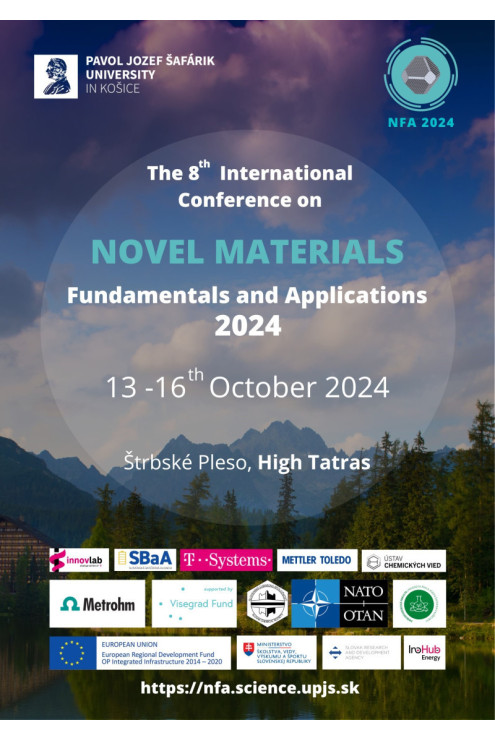
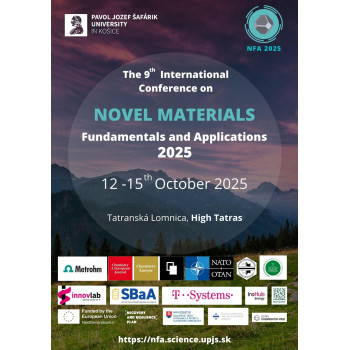
The book of abstracts from 8th International Conference on Novel Materials: Fundamentals and Applications, NFA 2023 is composed of contributions from the participants of this international conference. The conference consisted of 6 invited lecture and 38 abstracts of participants. The conference is focused on novel materials and its application in various research areas. All contributions are professionally processed and inspiring.
Data sheet
Peter Fedoročko a kol.
Vysokoškolský učebný text Prírodovedeckej fakulty UPJŠ.
E-book
The movement of domain walls in ferromagnetic materials is utilized in various magnetic devices for storing, processing, or transmitting signals and information. This mainly includes transformer cores, various sensors, memory devices (e.g., HDDs in PCs), as well as modern spintronic devices such as Racetrack memories, domain wall motion-based electronics, and so on.
This book is intended to serve as a textbook for advanced courses in the field of magnetic materials. It is primarily aimed at students interested in studying magnetic materials, as well as professionals from various fields who wish to understand the basics of domain structure and its changes. It is divided into nine chapters. The first chapter deals with a brief history of the study of domain structure in magnetic materials. The second chapter provides an introduction to the causes and manifestations of magnetic anisotropies. The third and fourth chapters are devoted to the causes of domain structure formation and domain walls. The fifth chapter discusses the structure of domain walls, their potential, and the critical field required for domain wall movement. The sixth chapter is dedicated to magnetization processes, one of which - domain wall movement - is discussed in detail in chapter 7. The eighth chapter contains a theoretical solution for domain wall movement. The final ninth chapter presents a modern method of domain wall movement induced by electric current.
The presented work assumes that the reader has at least basic knowledge in the field of magnetism. Otherwise, the author refers the reader to basic literature (e.g., [2.1 - 2.6]).
E-book
The textbook is designed to prepare students who will engage in the experimental study of the properties of condensed matter. It demonstrates that a contemporary experimental physicist must not only possess sufficiently detailed knowledge of the physical processes occurring within the object under study but also understand the methods for creating the experimental conditions in which the experiment is conducted. Active knowledge of the functioning of the entire experimental setup can be of fundamental importance in the implementation or potential modification of the measurement methodology used.
E-book
Kveta Markušová - Daniela Kladeková
Electrochemistry is the science that studies ionic systems and the processes or phenomena that occur at the interface between ionic systems and metals or semiconductors. At the current stage of development, electrochemistry can be divided into two main areas based on its focus. The first one - ionics - deals with the properties of ionic systems (solutions, melts, solid electrolytes). The second area - electrodeics - focuses on phenomena at the electrode/ionic system interface.
Both ionics and electrodeics investigate equilibrium and non-equilibrium phenomena and processes. Research into the properties of ionic systems under equilibrium conditions provides information and insights into the structure and composition of electrolyte solutions, melts, and solid electrolytes, while measurements under non-equilibrium conditions provide data on the electrical conductivity of ionic systems. In the field of electrodeics, the study of equilibria at the electrode/solution (or melt) interface is the domain of electrochemical thermodynamics. Measuring the rates of processes occurring at this phase interface and explaining the principles governing these processes fall under the scope of electrode process kinetics or electrochemical kinetics.
E-book
This textbook covers the fundamentals of phenomenological thermodynamics to the extent typically taught in standard theoretical physics courses at the undergraduate level in the Physics degree program. A slightly reduced scope is also taught in all interdisciplinary study programs combined with physics. In recent years, the time allocation for individual courses has been slightly reduced, which is reflected in our selection and coverage of topics.
Our primary aim was to provide a sufficiently solid explanation of the key concepts and laws of thermodynamics necessary for mastering further theoretical physics courses at the master's level (e.g., Statistical Physics, Condensed Matter Physics, Quantum Theory of Solids, Quantum Theory of Magnetism, etc.). The book also presents the essential minimum knowledge required for the study of further applications of thermodynamics in biophysics, biology, chemistry, and engineering disciplines.
Understanding individual sections, as well as the text as a whole, requires a grasp of the basic concepts of thermodynamics at the level of a General Physics course and knowledge equivalent to a standard university mathematics course. Each topic is treated with the utmost emphasis on conceptual clarity and mathematical rigor.
E-book
Vladimír Zeleňák (ed.)
Proceedings of Abstracts of the Student Scientific Conference of the Faculty of Science, Pavol Jozef Šafárik University in Košice
A characteristic feature of education at high-quality universities — among which the Faculty of Science at Pavol Jozef Šafárik University (UPJŠ) in Košice proudly belongs — is the close connection between education and scientific research. Students gain knowledge in their field of study not only through theoretical coursework in individual disciplines, but also through active involvement in solving specific scientific tasks as part of research teams. This can occur during the development of final theses or through participation in the Student Research Assistant Program (ŠPVS), which was revitalized at the faculty in 2015.
The Student Scientific Conference (ŠVK) is one of the faculty’s traditional events, organized during the Faculty’s Science Days as part of Sciencefest. By its very nature, it fits seamlessly into the aforementioned framework of combining education with research, and it has long enjoyed great popularity and student interest. In 2016, the conference featured presentations by 125 students of the Faculty of Science at UPJŠ in Košice, across 16 thematic sections. This collection of abstracts provides an overview of the focus and goals of the student projects. We believe it will serve as inspiration for other potential participants of future conferences and will also be of interest to the broader public, offering additional insight into the faculty's activities.
E-book
Stanislav Lukáč - Ľubomír Šnajder - Ján Guniš - Zuzana Ješková
The publication is intended for researchers in didactics and teachers of mathematics and computer science. Our aim is to provide readers with a basic orientation in the issue of inquiry-based teaching, to explain and demonstrate several levels of student inquiry through examples, and to offer a classification of inquiry skills.
The core part of the publication consists of methodologies for inquiry-based teaching of specific topics from school mathematics and computer science. We present ideas for implementing inquiry activities, active work with information in solving various types of problems, and the application of modern digital technologies in exploring and discovering patterns.
The publication includes seven methodologies for teaching mathematics and eight methodologies for teaching computer science in the 1st and 2nd years of secondary school.
E-book
Gabriel Semanišin - Emil Hutňan - Jana Oleničová
The proceedings contain contributions from participants of the UNIFOS 2014 conference, University Information Systems in Košice, which took place from October 27 to 29, 2014.
ICT centers are important element that provide functioning and development hardware and software infrastructure at Slovak Universities. There are more differences between them in real position, management, personal sources and financing. ICT centers provide a wide range of services to large number of university users and they implement the policy of information security recently.
E-book
Vasyl Cherlinka - Michal Gallay - Yuryi Dmytruk
The textbook is a practical guide to predictive mapping of soil types and properties in R. It bridges digital soil mapping theory with hands-on practice, covering the full workflow from data acquisition and preprocessing to validation and uncertainty quantification. Early chapters introduce the tidyverse ecosystem and the sf and terra packages for spatial data handling. Subsequent parts address modelling of categorical variables (soil types/WRB) and continuous variables (soil organic carbon) using Random Forest, Cubist, and Quantile Regression Forests. Step-by-step code examples show training/testing, feature selection, accuracy metrics, and model interpretation. Reproducibility and cartographic best practice are emphasised. A Slovakia case study demonstrates real-world application while outlining limits and generalisability. The book targets bachelor’s, master’s, and PhD students in geography, geoinformatics, environmental and agricultural sciences, as well as practitioners. Written in English, it fits international courses and mobility programmes.
E-book
Stela Csachová - Ján Kaňuk - Alena Gessert - Ladislav Novotný - Štefan Gábor - Jozef Šupinský
This book addressed the inquiry-based learning and teaching with the support of geospatial technologies. Today, geospatial technologies are influencing geography teaching learning, particularly in secondary education. Theoretical framework gives the reader the insight to inquiry-based learning, with special focus on inquiry in geography. The one-by-one step of inquiry is analysed in detail. The major part of the book presents the eleven models of geography lessons, representing the subject content of physical, human and regional geographies, various levels of inquiry and use of different geospatial technologies. The readers are acquainted with the use of geographic information system (particularly Google Earth and ArcGIS online), web portals, webGIS, open data, mobile applications and new forms of 3D cartographic visualisation (virtual reality, 3D print, dynamic 3D map) in teaching geography. The lesson models were tested with the students to be geography teachers in school year 2021/2022. This books serves as resource mainly for undergraduate teacher students and in-service geography teachers.
Download e-book for free (pdf)
E-book
Crystallography deals with discerning the arrangement and bonding of atoms in crystalline solids. Almost immediately after their discovery, X-rays began to be used to study the internal structure of substances.
The first chapter of this textbook deals with the basic concepts of crystallography. At the beginning, crystalline solids are characterized. In the next section, the basic types of bonds and their characteristics are briefly presented. The main subject of this chapter is the interpretation of basic concepts such as symmetry operations, translational periodicity, grid, elementary cell. Spatial lattices and crystal systems are presented. At the end of this chapter, attention is paid to the description of individual types of defects in crystal structures. In the second chapter, the Bohr model of the hydrogen atom is presented. Individual quantum numbers and their meaning are given.
Next, energy levels and allowed transitions within an atom with multiple electrons are described. The second chapter concludes with the characterization of the basic absorption and emission processes. The third chapter is devoted to the production of X-ray radiation and its properties. Sources of X-ray radiation and a description of their operation are presented.
Interaction of X-ray radiation with matter, absorption and detection of X-ray radiation are the subject of the last part of this chapter.
E-book
Adriana Zeleňáková - Jozef Bednarčík
Peer-reviewed Proceedings of the Scientific Conference NANOVIR
The main objective of the scientific conference NANOVIR was the presentation of scientific results obtained during the implementation of the NANOVIR project – Nanoparticles for solving diagnostic and therapeutic problems with COVID-19, co-financed by the European Regional Development Fund within the Operational Programme Integrated Infrastructure 2014 – 2020, ITMS: 313011AUW7.
The project was carried out from January 1, 2021, to June 30, 2023, and was supported with a sum of EUR 1,916,004.79. Three co-investigating organizations participated in the project: Pavol Jozef Šafárik University in Košice as the main investigator, the University of Veterinary Medicine and Pharmacy in Košice as partner no. 1, and the Institute of Experimental Physics of the Slovak Academy of Sciences as partner no. 2.
E-book
Jozef Strečka- Katarína Karl’ová (eds.)
Zborník obsahuje program a abstrakty workshopu s názvom: 1st Workshop on Perspective Electron Spin Systems for Future Quantum Technologies, ktorý sa bude konať 28.-29. júna 2022 v Košiciach. Workshop je organizovaný Prírodovedeckou fakultou Pavla Jozefa Šafárika v Košiciach a Ústavom experimentálnej fyziky Slovenskej akadémie vied v Košiciach s finančnou podporou Agentúry na podporu výskumu a vývoja. Ústrednými témami konferencie budú súčasné problémy kvantovej fyziky - kvantovej teórie magnetizmu spinových a elektrónových štruktúr, exotických kvantových spinových stavov, kvantového previazania, kvantových fázových prechodov, topologického kvantového počítania a kvantového spracovania informácie. Účastníci workshopu budú prezentovať originálne pôvodné výsledky svojho výskumu, ktoré môžu zásadným spôsobom ovplyvniť vývoj budúcich kvantových technológií.
E-book
Zuzana Vargová - Miroslav Almáši - Juraj Kuchár - Jana Dinajová
The script „Základné laboratórne praktikum z anorganickej chémie“ builds on previous editions of the script, with some thematic units updated and supplemented with new knowledge, principles, and detailed work procedures.
This script is intended as a teaching aid for first-year students of the chemistry and interdisciplinary study programs at the Faculty of Science, Pavol Jozef Šafárik University in Košice. The introductory part of the volume acquaints students with safety regulations that they should follow during work in a chemical laboratory. Subsequently, in five chapters, basic laboratory techniques are described in detail, which students will use in the further part of the practices for preparing inorganic compounds. These chapters are enriched with illustrative images created using the freely distributable ACDFreeLabs 10 program or taken from literature listed at the end of the script. Some images were created by the authors, and others were taken from the catalog of Fisher Slovakia, s.r.o., which provided written permission for their use. The chapters describing the preparation of inorganic compounds are organized according to their composition, from simple elements or molecules, through binary compounds, acids, and salts, to complex compounds.
Within this subject, students should apply their theoretical knowledge gained during lectures on General Chemistry and Inorganic Chemistry and thereby acquire basic practical experience and skills that they will use in further studies.
The last two chapters were developed based on cooperation with Duslo a.s., Production Plant Strážske, which participates in the innovation of practical teaching through direct involvement of experts from practice as part of the KEGA project No. 008UPJŠ-4/2018.
Authors
E-publication
Mária Ganajová-Ivana Sotáková-Petra Letošníková
The conference proceedings FORMATIVE 2025 – Implementing Formative Assessment in Schools Together constitute the output of an online conference organised by the Institute of Chemical Sciences, Faculty of Science, Pavol Jozef Šafárik University in Košice, in cooperation with the National Institute of Education and Youth in Bratislava, within the framework of the KEGA project No. 001UPJŠ-4/2023. These proceedings present current knowledge, experience, and examples of good practice in implementing formative assessment in primary, secondary, and university teaching, with an emphasis on the use of digital tools. The papers address the foundations of formative assessment in the context of curricular changes and the ongoing educational reform, as well as specific didactic procedures for its implementation in the teaching of science and social science subjects, including mathematics, Slovak language, and foreign languages. Particular attention is paid to the development of professional teaching competences, formative assessment strategies, providing targeted feedback, and promoting students’ active participation in the assessment process. These proceedings also present the Digilib digital library, a tool developed to support the creation and management of formative assessment processes within the school environment. This publication is intended for experts in pedagogy and didactics, teachers at all levels of education, student teachers, digital coordinators, and all those interested in educational innovation and in improving the quality of teaching through formative assessment.
This website uses cookies to ensure you get the best experience on our website