Slovenčina


E-book
Miroslav Almáši(ed.)
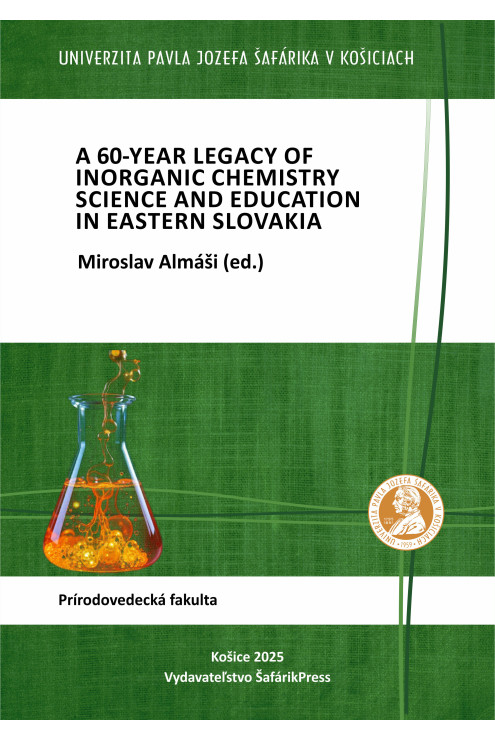
The proceedings of the conference 60 YEARS OF SCIENCE AND EDUCATION IN THE FIELD OF INORGANIC CHEMISTRY IN EASTERN SLOVAKIA comprise a collection of scholarly and scientific contributions presented on the occasion of the 60th anniversary of the establishment of the Department of Inorganic Chemistry at the Institute of Chemistry, Faculty of Science, Pavol Jozef Šafárik University in Košice. The conference focused on reviewing the scientific, research, and educational activities in the field of inorganic chemistry in eastern Slovakia and highlighting significant achievements accomplished over the sixty-year history of the department. The abstracts included in the proceedings cover a broad range of topics that reflect current trends and directions in inorganic chemistry. The proceedings are thematically divided into four main areas, encompassing contributions dedicated to inorganic, coordination, bioinorganic, and materials chemistry. This collection offers a valuable overview of the current state of research in inorganic chemistry, as well as its teaching and historical development in eastern Slovakia..

Data sheet
E-book
Zuzana Kudličková(ed.)
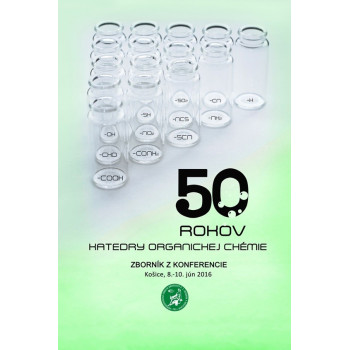
Proceedings of Abstracts from the Scientific Conference with International Participation Organized on the Occasion of the 50th Anniversary of the Establishment of the Department of Organic Chemistry, Faculty of Science, Pavol Jozef Šafárik University in Košice, held on June 8–10, 2016 in Košice.
The Department of Organic Chemistry was established on February 1, 1966. From its inception, the department’s development prospects have been linked to high-quality scientific research focused on the synthesis of isothiocyanates and the products of their nucleophilic additions. In addition, studies were conducted on the use of cycloaddition, cyclocondensation, and photocyclization reactions of heterocumulenes in the synthesis of heterocycles.
Currently, research at the Department of Organic Chemistry is concentrated on stereoselective syntheses of iminosugars and γ-lactam-β-lactone antibiotics, total synthesis of natural compounds and their analogues possessing a sphingoid structure, research into the synthesis of indole alkaloids from the phytoalexin group, and the synthesis of acetylcholinesterase inhibitors based on acridine and coumarin derivatives.
Download the e-book for free (pdf)
E-book
Katarína Cechlárová (ed.)
This year, the Student Scientific Conference was held on April 24, 2019, across 17 sections in disciplines such as biology and ecology, chemistry, physics, geography, mathematics, informatics, and their didactics. Bachelor’s and master’s students presented a total of 124 contributions. The most successful participants advanced to national or traditional Czech-Slovak student scientific showcases in fields like physics, chemistry, mathematics, informatics, and mathematics didactics.
In addition to faculty students, 10 high school students participated outside the competition. They were invited based on their achievements in subject-specific Olympiads or because they were already engaged with the faculty under the guidance of dedicated teachers in laboratory work as part of their preparation for future studies. The day also featured a programming competition with 23 participants, an IHRA contest involving 16 teams of high school students and 15 teams from elementary schools, and a new Puzzle section where 72 high school students from the region competed.
The abstracts from the Student Scientific Conference demonstrate that our faculty's students not only absorb theoretical knowledge delivered in lectures but also actively engage in solving partial scientific problems that align with research objectives at the institutes of PF UPJŠ. This collection serves as both a record of scientific activity at the faculty and a dignified presentation for the broader public.
Prof. RNDr. Katarína Cechlárová, DrSc.
Vice-Dean for Education
Doc. RNDr. Gabriel Semanišin, PhD.
Dean of the Faculty
E-book
The textbook "Special Practicum II" is dedicated to describing experimental methods used for studying the magnetic properties of solid materials, especially low-dimensional and molecular magnets. It subsequently contains instructions for the practical exercise "Special Practicum II," during which master's and doctoral students use state-of-the-art commercial equipment-an electron paramagnetic resonance (EPR) spectrometer and a SQUID magnetometer.
The introductory chapter briefly describes the origin of magnetism in solids, the role of the crystal field, and magnetic interactions in explaining their magnetic properties. This is followed by an explanation of the principles of EPR, the operation of the EPR spectrometer, and the optimization of its parameters for the specific practical exercise.
The next part of the textbook is devoted to an overview of the behavior of magnetic quantities with changes in magnetic field or temperature in various types of magnets. The textbook concludes with a description of the operating principle of the SQUID magnetometer and an example of its use in a practical exercise measuring the magnetic moment.
E-book
Valéria Skřivánková - Martina Hančová
The publication is focused on discrete random processes, primarily on Markov chains, which have wide application in the field of economics and finance.
The textbook is divided into five chapters, the first of which serves as an introduction to random processes and provides definition, properties and classification of random processes in general. The second chapter discusses Markov chains with discrete time, including valuation of transitions between states and their optimal management. The third chapter focuses on special Markov chains with continuous time and emphasizes construction and solution to the system of Kolmogorov differential equations, which describe the dynamics of the process development. The last two chapters illustrate applications of Markov chains using examples of queuing system modeling and renewal theory.
Besides the explanation of basic terms, definitions and theorems with proofs, this textbook also provides number of solved examples to illustrate the discussed theory. Problem assignments are placed at the end of each chapter, so that readers can test their understanding of the content as they progress through the book. Solutions to all the problems and the list of references are provided at the end of the publication.
This textbook is primarily intented for students majoring in Economics and Financial Mathematics at the Faculty of Science of Pavol Jozef Šafárik University in Košice, and it covers content of the course “Random Proceses 1“ thought there. It might however serve also students from other schools in similar progams or professionals interested in this topic.