- New

Zavolajte nám:
+421 55 234 1635Kolektív autorov
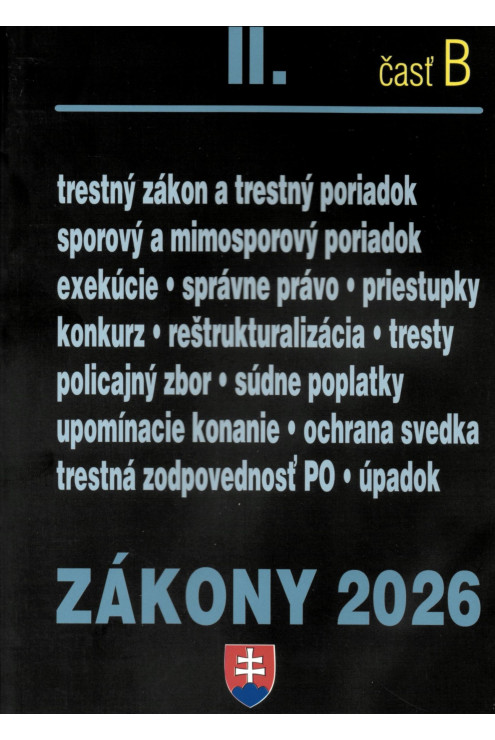
Publikácia obsahujúca najdôležitejšie právne predpisy z oblasti trestného práva, exekúcii, správneho práva a riešenia súdnych sporov v úplnom znení. Všetky právne predpisy obsahujú zmeny k 1. 1. 2026. Zmeny v zákonoch sú v texte prehľadne vyznačené. Hlavné témy: Trestný zákony, Trestný poriadok, Policajný zbor, Konkurz a reštrukturalizácia, Exekučný poriadok, Priestupky, Správny poriadok.
Titul obsahuje úplné znenie zákonov a súvisiacich predpisov:
Civilný proces (1. kapitola)
Zákon č. 160/2015 Z. z. Civilný sporový poriadok
Zákon č. 161/2015 Z. z. Civilný mimosporový poriadok
Zákon č. 307/2016 Z. z. o upomínacom konaní a o doplnení niektorých zákonov
Zákon č. 71/1992 Zb. o súdnych poplatkoch a poplatku za výber z registra trestov
Vyhláška č. 543/2005 Z. z. o Spravovacom a kancelárskom poriadku pre okresné súdy, krajské súdy, Špecializovaný trestný súd a vojenské súdy
Zákon č. 244/2002 Z. z. o rozhodcovskom konaní
Zákon č. 7/2005 Z. z. o konkurze a reštrukturalizácii
Zákon č. 111/2022 Z. z. o riešení hroziaceho úpadku
Zákon č. 391/2015 Z. z. o alternatívnom riešení spotrebiteľských sporov
Exekučný poriadok (2. kapitola)
Zákon Národnej rady Slovenskej republiky č. 233/1995 Z. z. o súdnych exekútoroch a exekučnej činnosti (Exekučný poriadok)
Zákon č. 233/2019 Z. z. o ukončení niektorých exekučných konaní
Trestné právo (3. kapitola)
Zákon č. 300/2005 Z. z. Trestný zákon
Zákon č. 301/2005 Z. z. Trestný poriadok
Zákon č. 192/2023 Z. z. o registri trestov a o zmene a doplnení niektorých zákonov
Zákon č. 91/2016 Z. z. o trestnej zodpovednosti právnických osôb
Zákon č. 274/2017 Z. z. o obetiach trestných činov
Zákon č. 86/2025 Z. z. o ochrane svedka
Zákon č. 236/2017 Z. z. o európskom vyšetrovacom príkaze v trestných veciach
Zákon č. 312/2020 Z. z. o výkone rozhodnutia o zaistení majetku a správe zaisteného majetku
Zákon č. 650/2005 Z. z. o vykonaní príkazu na zaistenie majetku alebo dôkazov v Európskej únii
Vyhláška MS SR č. 618/2005 Z. z. o tvorbe spisu orgánmi činnými v trestnom konaní a súdmi
Vyhláška MS SR č. 619/2005 Z. z. o podmienkach a postupe prokurátora pri konaní o dohode o uznaní viny a prijatí trestu
Vyhláška MV SR č. 275/2022 Z. z. o rozsahu vykonávania rozhodnutí, opatrení a úkonov trestného konania vo vyšetrovaní alebo skrátenom vyšetrovaní
Správne právo (4. kapitola)
Zákon č. 71/1967 Zb. o správnom konaní (správny poriadok)
Zákon č. 162/2015 Z. z. Správny súdny poriadok
Zákon Slovenskej národnej rady č. 372/1990 Zb. o priestupkoch
Zákon NR SR č. 171/1993 Z. z. o Policajnom zbore
Trestné právo procesné upravuje postup orgánov činných v trestnom konaní pri zisťovaní a prejednávaní trestných činov a pri výkone rozhodnutí, ako aj práva a povinnosti osôb zúčastňujúcich sa v trestnom konaní. Základnými prameňmi trestného práva a Trestnný zákon a Trestný poriadok. Trestné právo upravuje základy trestnej zodpovednosti, druhy trestov, druhy ochranných opatrení (protidrogové, protialkoholické), skutkové podstaty trestných činov a porovnanie trestného zákona s trestným poriadkom. Civilný sporový poriadok je základný civilný kódex občianskeho práva procesného Slovenskej republiky. Samotný civilný sporový poriadok pôsobí ako všeobecný predpis upravujúci tzv. sporové konania, mimosporové civilné konania sú upravené v Civilnom mimosporovom poriadku a problematika správneho súdnictva je vyčlenená do Správneho súdneho poriadku. Takéto rozčlenenie prispieva k sprehľadneniu právnej úpravy, nakoľko nie je nutné upravovať množstvo podobných inštitútov zvlášť pre každé osobitné mimosporové či správne konanie.
Data sheet
Specific References
Jaroslav Klátik a kolektív
Vysokoškolská učebnica Trestné právo hmotné – osobitná časť, 3. aktualizované vydanie bezprostredne nadväzuje na učebnicu Trestné právo hmotné – všeobecnú časť. Autorský kolektív rozoberá skutkové podstaty trestných činov zahrnuté do dvanástich hláv. Autori si za cieľ stanovili poskytnúť čitateľom podrobný prehľad o jednotlivých trestných činoch a zároveň poskytnúť i čo najpodrobnejší výklad jednotlivých skutkových podstát těchto trestných činov, ako aj výklad pojmov v nich sa nachádzajúcich. Obsah jednotlivých kapitol vychádza zo systematiky osobitnej časti Trestného zákona, čím sa študenti ako aj ostatná právnická veřejnost môžu lepšie orientovať v základných trestno-hmotných inštitútoch. V jednotlivých kapitolách sú zrozumiteľne a jasne vymedzené jednotlivé obligatórne znaky skutkových podstát trestných činov a ich súvislosti. Tam, kde je to potrebné, autori uvádzajú na vysvetlenie svoje teoretické a praktické skúsenosti a tiež v prípade bližšieho vysvetlenia aj aktuálnu súdnu prax. V rámci každej hlavy je uvedená všeobecná charakteristika príslušnej hlavy a dielu, do ktorého sa subsumuje konkrétny trestný čin. Učebnica je určená predovšetkým poslucháčom právnických fakúlt a Akadémie Policajného zboru. Učebnicu však môžu využívať aj sudcovia, prokurátori, policajti, advokáti, vyšší súdni úradníci, čakatelia prokuratúry, advokátski koncipienti pri rozbore a zdôvodnení mnohých ustanovení osobitnej časti Trestného zákona. Táto učebnica je určená aj pre široký okruh záujemcov o trestné právo.
E-book
Collection of Papers from the 8th Student Symposium held on April 20–21, 2015 in Danišovce
The capture of the historic Syrian city of Palmyra by fighters of the radical Islamic State caused shock among the global public. The main reason is the barbarism with which this organization proceeds, not only in relation to the treasures of the world’s cultural heritage. The situation in the Middle East, where cultural treasures of inestimable value are under direct threat, demonstrates how fragile the world’s cultural heritage is. The reaction of the international public and world leaders shows how sensitively the destruction of cultural heritage is perceived.
The quoted statement chosen by the editors relates to the threat posed by the Islamic State—however, the spirit of this statement can be applied to any cultural wealth that forms part of the world’s cultural heritage. The destruction or damage of these values primarily represents a loss for humanity as such. Each destroyed artifact of world cultural heritage signifies the disappearance of a unique legacy left by previous generations for the future. At the same time, cultural heritage must be understood as a broad spectrum of assets—both tangible and intangible. Their legal protection was the topic of this year’s symposium. As with any social interest, the protection of cultural heritage can be ensured through various mechanisms and under different forms of social organization.
These diverse approaches are unified by law as a normative system. The question for the 8th year of the symposium on international law was what role international law plays in the protection of cultural heritage. In the context of the European region, the role of the European Union as a regional organization was examined.
E-book
Katarína Skolodová - Monika Minčičová (eds.)
Proceedings of the 5th Year of the Student Symposium of Labour Law
New trends in the digital age around the world do not avoid the labour market and the labour law relations. Do labour law standards and employers' practices correspond to the actual factors that influence an individual's physical or mental condition? Does digitization, including artificial intelligence, bring improvements or threats? Is the protection of employees' mental health paid equal attention that to the protection of physical health? The Department of Labour Law and Social Security Law of the Pavol Jozef Šafárik University in Košice examines and analyzes legal aspects of new risks that threaten and affect individual health in the work environment within the researching of the project APVV-16-0002 - Mental Health in the Workplace and Employee Health Assessment.
The members of the department, with the theme of the 5th year of the student symposium "New Challenges of Employees´ Health Protection" created an opportunity for students to search deeper current legal issues and reflect the results of their creative work in the submitted papers. The proceedings of papers of the student symposium is rich in content and offers the reader the space to get acquainted with interesting questions and application problems accompanying them.
E-book
Jozef Suchoža - Ján Husár - Regina Hučková
In 2020 and 2021, the tradition of holding the Law – Business – Economics conference was exceptionally interrupted due to the unprecedented situation associated with the spread of Covid-19. This year, the situation allows us to restore the tradition of our Tatra conference and, after two years, to once again meet in person with our traditional domestic and international participants. At the same time, we look forward to welcoming participants who are attending our conference for the first time (and we hope it will not be the last).
You are holding in your hands the proceedings of scientific papers, published in connection with the implementation of scientific projects at the scientific workplace – the Department of Commercial and Economic Law, as the main organizer of the scientific conference, as well as at other departments of the Faculty of Law at UPJŠ and at many academic institutions both at home and abroad. The proceedings are published with the support of the Slovak Research and Development Agency. The editors would like to thank everyone who contributed their scientific articles, as well as the reviewers for their valuable comments and recommendations.
E-book
Jana Žuľová (ed.)
Collection of Scientific Works
Article 35 of the Constitution of the Slovak Republic guarantees everyone the right to freely choose their profession and receive training for it, as well as the right to engage in entrepreneurial or other gainful activity. Everyone has the right to freely decide whether to secure their livelihood through self-employment—with all the associated consequences and risks—or through employment within labor-law relationships by performing dependent work.
The framework and rules for exercising these rights are primarily regulated by labor, commercial, and tax legislation, each with its own set of rights and obligations applicable specifically to entrepreneurs and employees. Constant competitive pressure, along with the effects of economic crises, pushes employers to seek ways to extract the most from workers while optimizing for the lowest possible insurance, administrative, and tax costs. As a result, employment contracts are being terminated, and under the pressure of losing their income, individuals are "voluntarily" shifting to commercial-law relationships.
This situation, along with other distortions in the labor market, confronts those entitled to work with unfair practices by employers, thereby undermining their ability to freely exercise this fundamental right.
E-book
Adam Giertl (ed.)
Collection of Papers from the 9th Annual Student Symposium on International and European Law held on April 22, 2016 at the Faculty of Law, Pavol Jozef Šafárik University in Košice
As indicated by the very title of the 9th Annual Student Symposium on International and European Law, “Current Issues of Migration from the Perspective of International Law with Special Regard to the Charter of Fundamental Rights of the European Union,” the participants focused on the highly topical subject of European migration, which they examined from various aspects of both international and Union law (a total of 9 contributions).
In assessing the role of individual actors primarily involved in addressing the problems arising from migration to Europe, particular emphasis was placed on the role of international specialized organizations, which often provide direct assistance to migrants “in the field” through humanitarian or medical aid. However, this is not the only response of the international community, as it is complemented by the activities of the concerned states as well as various non-governmental organizations and volunteers. Regarding the evaluation of the European Union’s activities, the symposium participants agreed that the mass migration wave caught the EU relatively unprepared—institutionally, legislatively, and technically—accompanied by a lack of clarity in adopting a fundamental approach to this reality.
It was also emphasized that these shortcomings occurred despite the fact that developments in the preceding period clearly signaled the possibility of gradual migration to the European Union escalating into a mass phenomenon. According to the participants, additional ex post and sometimes delayed measures adopted in response to the ongoing migration process contributed to an overall increase in political tension within the EU and divided its member states into opposing camps.
E-book
Ján Klučka a kol.
The presented monograph, “Regionalism and Its Contribution to General International Law,” was prepared at the Institute of European Law and the Department of International Law of the Faculty of Law at Pavol Jozef Šafárik University in Košice as part of a project of the same name (APVV-0823-11) carried out in the years 2011–2015, and represents one of its final publication outputs.
The main reason for choosing this topic was the effort to evaluate regionalism in its various forms in relation to international law, and, conversely, to assess the place, significance, and role of international law in the creation and functioning of different forms of regional groupings. In fact, although regionalism is receiving increasing attention in doctrine, a more comprehensive assessment of its impact on international law and vice versa has so far been lacking.
This monograph attempts to partially fill this gap. Against the background of a brief historical development of regionalism, as well as its substantive and terminological components, the monograph examines in greater detail the individual types of regionalism—such as old and new regionalism, as well as contractual and institutional regionalism—their specific features, and their contribution to general international law.
Attention is also devoted to a specific phenomenon of contemporary regionalism, namely the influence of the European Union on its stabilization and development, both through practical measures and through a set of measures regulated by international treaties.
E-book
Elena Lazoríková - Adrián Popovič - Anna Románová
Reviewed proceedings of scientific papers
The Proceedings presents papers from international scientific conference “The Condition of Public Finances in the EU and their Future Perspectives” held on June 2 – 3, 2022 in Košice, Slovakia and is published as a partial outcome of the implementation of the VEGA project No. 1/0485/21: "Simultaneity and possibilities of reforming the system of own resources of the EU budget (legal and economic aspects also in the context of the consequences of the COVID-19 pandemic)" and VEGA project No. 1/0214/21: "Real Property Tax - Legal Status and Potential".
The proceedings consist of contributions from conference participants divided into two thematic sections: “The EU Budget” and “Real Estate in Taxation.” While the first section addresses both the revenue side of the EU budget (particularly in the context of the own resources system), as well as its expenditure side and its relationship to other budgets, the second section focuses on real estate as the subject of specific regulations under various taxes, including those that directly tax real estate through a tax of the same name.
Download e-book for free (pdf)
E-publication
Veronika Lenhardtová-Radoslav Pavlinský-Dominik Urban
The collection Judicial Power in the Era of Globalization, Artificial Intelligence and Other Trends in Society provides a comprehensive and up-to-date perspective on the transformation of the judiciary amid rapid technological and social change. It contains 25 contributions primarily focused on the introduction and use of artificial intelligence tools in law. The authors examine not only the technical and institutional aspects of this transformation but also issues of judicial legitimacy and public trust in an independent justice system. The publication also offers a critical reflection on potential risks, limitations, and ethical dilemmas associated with the automation and digitalization of judicial processes. Several contributions compare national and supranational legal frameworks, offering valuable insights into differences in regulatory approaches around the world. All texts are united by a common question concerning the future of judicial power in a changing world. The contributions are written in an accessible manner, making the collection suitable for both legal experts and the broader public.
Download the e-book for free
E-book
Ladislav Orosz, Martina Makaturová
This scientific volume has been published as an output of the VEGA grant project No. 1/0474/24 Audit of Slovak Electoral and Referendum Legislation. Thematically, it focuses on the issue of the legal regulation of election campaigns and a critical analysis of the experience of its application in electoral practice. On this basis, the authors also formulate proposals for improving the current legal framework of election campaigns.
The proceedings include contributions presented at the scientific conference of the same name held in May 2025. The volume contains papers not only from domestic but also from foreign authors, who present the legal regulation of election campaigns in their respective home countries. Contributions from academics are complemented and enriched by those of representatives of non-governmental organizations engaged in election and campaign monitoring, as well as by contributions from authors working in public authorities responsible for the administration of elections and for overseeing the constitutionality and legality of elections.
Predkladané vysokoškolské učebné texty tvoria základný učebný text, ktorý nemá ambíciu podať komplexný obraz pracovného práva. Z uvedeného dôvodu, pri tvorbe týchto učebných textov sa môže zdať, že niektoré kapitoly sú príliš stručné a iné neobvykle rozsiahle, vzhľadom na zameranie výučby predmetu Pracovnoprávne vzťahy vo verejnej správe v študijnom odbore Verejná politika a verejná správa. Zámerom autorky textu je uľahčiť pochopenie základných atribútov pracovného práva prostredníctvom identifikácie ťažiskových právnych inštitútov a právne významných väzieb medzi nimi s ohľadom na verejnoprávne zameranie.
Autorka
E-book
The presented scientific monograph addresses the issue of the Rule of Law and its place, roles, and particularities at the level of international law. The Rule of Law is understood as a value that should govern communities, both domestic and international. It is thus compared to Kelsen’s basic norm, which should stand at the top of the legal order as the norm justifying the validity and existence of the norms of the legal order, both domestic and international.
Although the Rule of Law is studied at the international law level, it cannot be considered without understanding the Rule of Law in domestic law. Just as its development differs depending on whether it evolved within Anglo-American or continental law, its application and development also differ between domestic law and international law.
These differences are mainly caused by the roles and objectives that international Rule of Law is meant to secure, as well as by the distinct characteristics of domestic and international law.
E-book
Marcel Dolobáč - Ľuboš Dobrovič (eds.)
Reviewed Proceedings of Contributions from a Scientific Conference
This reviewed collection of contributions from the scientific e-conference Legal Language in Application Practice, held from December 3 to 21, 2018, presents various academic contributions.
Legal language, as expressed in legal norms, is specific and should ideally be unambiguous, concise, and resistant to multiple interpretations. Is this an ideal world that does not exist but is worth striving for? Interpretative challenges and ambiguities in legal language and terminology (especially in the Labour Code) led the Department of Labour Law and Social Security Law at UPJŠ in Košice to undertake the VEGA grant project No. 1/0526/17 titled Linguistic and Sanction Mechanisms in the Creation and Operation of Labour Law Norms.
As part of this grant project, the department organized an e-conference open not only to labor law specialists but also to experts from other legal fields. Unsurprisingly, interpretative issues extend beyond labor law. The contributions in this collection are thus somewhat interdisciplinary, though with a focus on labor law. We hope this collection serves as an introduction to broader research and deeper study of legal language by experts beyond legal theory. Additionally, we trust these contributions will inspire you, the readers.
Authors
E-book
Alexander Bröstl - Marta Breichová Lapčáková (eds.)
The presented Collection Volume is dedicated to three framework areas, namely justice, community and freedom. These are the thematic areas of the 30th IVR World Congress, on the occasion of which a meeting of its Slovak section was held. The published contributions focus on the main topic of the congress, which is also the central topic of legal and social sciences. Thus, in the Collection we will find reflections on the freedom of the individual in society, its various shades of meaning and forms. The question of the organization of social relations in the form of the degree of participation of citizens in state power in the context of the democratic form of government and its current challenges should not be neglected either. Thus, the institutions of direct and indirect democracy, the dangers of the lures of the so-called totalitarian democracy, or the question of identities in a postmodern pluralistic society. The question of justice in procedural law is not avoided either.
The collection thus provides the reader with a wide area of research from legal-philosophical questions, through questions of the theory of the constitutional state, to their application in legal practice. Geographically, it maps the events in the Central European and wider European area with an impact on their global dimension. The publication can thus become a useful source of knowledge and current developments in jurisprudence and its main topics with the aim of a better understanding of social reality.
Jaroslav Klátik a kolektív
Vysokoškolská učebnica Trestné právo hmotné. Osobitná časť, 2. aktualizované vydanie bezprostredne nadväzuje na učebnicu Trestné právo hmotné. Všeobecná časť, 2. aktualizované vydanie. Autorský kolektív rozoberá skutkové podstaty trestných činov zahrnuté do dvanástich hláv. Autori si za cieľ stanovili poskytnúť čitateľom podrobný prehľad o jednotlivých trestných činoch a zároveň poskytnúť čo najpodrobnejší výklad jednotlivých skutkových podstát týchto trestných činov, ako aj výklad pojmov v nich sa nachádzajúcich. Obsah jednotlivých kapitol vychádza zo systematiky osobitnej časti Trestného zákona, čím sa študenti, ako aj ostatná právnická verejnosť môžu lepšie orientovať v základných trestno-hmotných inštitútoch. V jednotlivých kapitolách sú zrozumiteľne a jasne vymedzené jednotlivé obligatórne znaky skutkových podstát trestných činov a ich súvislosti. Tam, kde je to potrebné, autori uvádzajú na vysvetlenie svoje teoretické a praktické skúsenosti, v prípade bližšieho vysvetlenia aj aktuálnu súdnu prax. V rámci každej hlavy je uvedená všeobecná charakteristika príslušnej hlavy a dielu, do ktorého sa subsumuje konkrétny trestný čin. Učebnica je určená predovšetkým poslucháčom právnických fakúlt a Akadémie Policajného zboru. Učebnicu však môžu využívať aj sudcovia, prokurátori, policajti, advokáti, vyšší súdni úradníci, čakatelia prokuratúry, advokátski koncipienti pri rozbore a zdôvodnení mnohých ustanovení osobitnej časti Trestného zákona. Kniha je určená aj pre široký okruh záujemcov o trestné právo.
E-book
Milena Barinková (ed.)
The researchers of the grant task ‘Creation and implementation of labour law with regard to regional aspects of the labour market’ deal in their work with the analysis of employers' attempts for legislative changes in the level of social rights of employees justified by regional differences, the analysis of possible impacts in their implementation, as well as the assessment of their compliance with the protective function of Slovak labour law and the value character of fundamental human rights inherent in the European and legal culture.
This website uses cookies to ensure you get the best experience on our website