Slovenčina



Silvia Ručinská - Miroslav Fečko - Ondrej Mitaľ
Vysokoškolská učebnica poskytuje ucelený prehľad teoretických východísk, základných myšlienok, koncepcií a súvislostí v problematike cieľov a nástrojov hospodárskej politiky. Učebnica sa zameriava na kombináciu teórie a praxe hospodárskej politiky a sumarizuje reálie v rámci cieľov hospodárskej politiky a jednotlivých druhov politík ako súčasti cyklu verejnej politiky v súčasných demokratických a právnych štátoch. Hospodársku politiku autori vnímajú ako verejnú politiku, ktorá je praktickou činnosťou vlád štátov, a zároveň aj etablovanou teoretickou vednou disciplínou, ktorá má svoje teoretické východiská a koncepcie. Autori hospodársku politiku sledujú aj v jej praktických implikáciách, ktoré sa prejavujú v jednotlivých parciálnych politikách. Vzhľadom na celospoločenskú významnosť a schopnosti ovplyvniť správanie ekonomických subjektov, štátu a verejnej správy, autori upriamujú pozornosť na menovú politiku, fiškálnu politiku, zahranično-obchodnú politiku, stabilizačnú politiku, politiku hospodárskej súťaže a štruktúrnu politiku a na celkové hodnotenie účinnosti hospodárskej politiky. Jednotlivé hospodárske politiky autori rozpracovávajú samostatne, a následne aj v ich vzájomných súvislostiach. Vysokoškolská učebnica je súhrnnou publikáciou približujúcou čitateľovi teóriu a prax hospodárskej politiky v Slovenskej republike a v širšom európskom priestore.

Data sheet
Specific References
E-journal
Michal Jesenko (editor) - Eva Mihalíková - Darina Koreňová
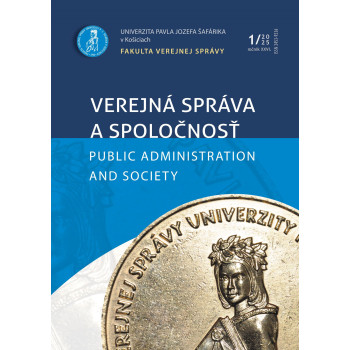
Public Administration and Society is a scientific journal publishing scientific academic articles, contributions to discussion and reviews having the content orientation on the theory and practice of Public Administration. The mission of the Journal is to publish significant results of the scientific scholarly researches regarding the area of public administration and related disciplines which are connected with the study profile and scientific bias of our Faculty. The Scientific Journal is issued in electronic version.
E-book
Jana Volochová - Lucia Rožová (eds.)
A peer-reviewed collection of contributions from the 4th year of the doctoral students' scientific conference, which took place on February 13, 2019, at the Faculty of Public Administration of Pavol Jozef Šafárik University in Košice, Popradská 66, 040 11 Košice.
The content of the proceedings of the conference consist of contributions presented on scientific conference Theory and Practice of the Public Administration: The Scientific Conference for PhD. Students held by the Faculty of Public Administration University of Pavol Jozef Šafárik in Kosice on 13th of February 2019. The conference proceedings consist of 28 contributions, which are according to its content divided in to the politological, legal and social-economic section.
Participants aimed their contribution on the current professional topics, which are important for the current theory and practice of public administration. Authors in their conference papers also included a number of important observations, opinions, experiences and knowledge. All published contributions provides space for the deeper qualified discussion.
Compilers
E-book
Milan Douša - Tatiana Gmitrová - Oskar Tóth - Matúš Vyrostko (eds.)
Peer-reviewed proceedings of contributions from the 5th year of the doctoral students' scientific conference, February 6, 2020
The dynamically evolving contemporary society creates expectations and demands among citizens for public administration to be efficient, reliable, open, professional, and fast. New theories of knowledge, in connection with constant changes, must also include practical application and reflection of these characteristics in the public administration system in practice. For this reason, it is important to pay attention to new approaches from both theoretical and practical perspectives to the application of modern public administration in the conditions of the V4 countries.
Given that public administration is an interdisciplinary scientific discipline that utilizes knowledge from a wide range of scientific fields and thus enables a comprehensive approach to solving problems of modern public administration, the peer-reviewed proceedings of contributions from the doctoral students' scientific conference are divided into three sections: socio-economic, political science, and legal. The sections eruditely respond to current public administration problems from both theoretical and practical perspectives.
PhDr. Milan Douša
Chairman of the Organizing Committee
E-book
Michal Jesenko Martina Kantorová Richard Vejo Tomáš Štuller
The proceedings of the international scientific conference of doctoral students “Theory and Practice of Public Administration 2026” present scholarly contributions addressing current issues in public administration and its legal, economic, and social aspects. The published contributions reflect contemporary challenges associated with the exercise of public authority, the functioning of public administration, public policies, the management of public resources, regional development, as well as social and technological changes. The proceedings also provide a platform for the presentation of the research work of doctoral students and early-career researchers and foster scholarly discussion on current issues and challenges in public administration.