Slovenčina


E-book
Ondrej Mitaľ - Denisa Rovenská - Eliška Župová a kol.
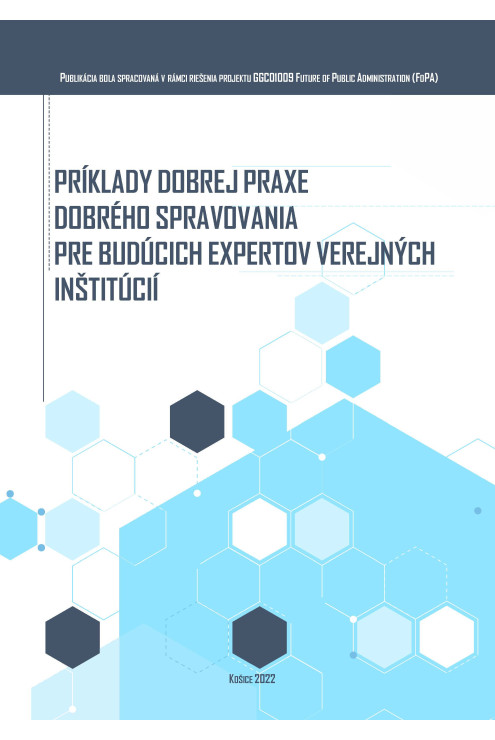
The textbook follows the publication "Good governance manual for future experts of public institutions". The publication complements the previous university textbook with case studies of the various principles of Good Governance. The case studies thematically copy the chapters of the university textbook and, with their unique, original and each author's own way of processing the case study, enrich the teaching of the study subject focused on the principles of Good Governance.

Data sheet
E-book
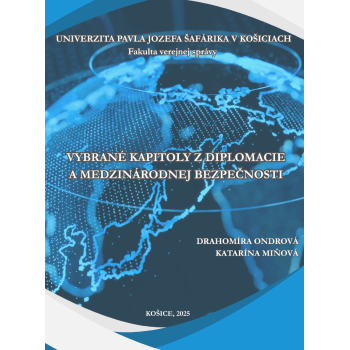
Drahomíra Ondrová Katarína Miňová
Súčasne potreba vytvoriť učebnicu pre vysoké školy uvedeného typu bola motivovaná požiadavkami a značným záujmom pomerne veľkého počtu samotných študentov a absolventov o danú problematiku v súvislosti s nedostatkom podobnej učebnice zameranej na potreby Fakulty verejnej správy, ktorá by zodpovedala stanovenému obsahu a rozsahu spracovania so zameraním sa na najpodstatnejšie problémové okruhy diplomacie v prepojení na oblasť verejnej správy.
Okrem zabezpečenia potrebnej učebnice pre vysoké školy, hlavný cieľ spočíva v snahe podať študentom a mladým vedeckým pracovníkom základnú orientáciu v danej problematike, a to tak v pojmovej oblasti, ako aj v teoretickej. V neposlednom rade učebnica napĺňa ambíciu motivovať záujem k ďalšej tvorivej akademickej práce a v rozširovaní vedomostí z oblasti zahraničnej, bezpečnostnej a medzinárodnej politiky v prepojení na diplomaciou.
E-book
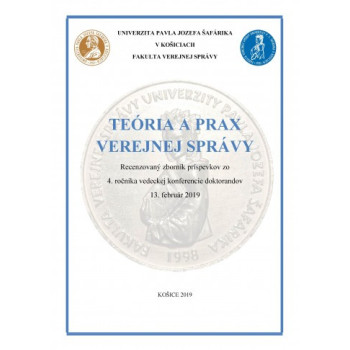
Jana Volochová - Lucia Rožová (eds.)
A peer-reviewed collection of contributions from the 4th year of the doctoral students' scientific conference, which took place on February 13, 2019, at the Faculty of Public Administration of Pavol Jozef Šafárik University in Košice, Popradská 66, 040 11 Košice.
The content of the proceedings of the conference consist of contributions presented on scientific conference Theory and Practice of the Public Administration: The Scientific Conference for PhD. Students held by the Faculty of Public Administration University of Pavol Jozef Šafárik in Kosice on 13th of February 2019. The conference proceedings consist of 28 contributions, which are according to its content divided in to the politological, legal and social-economic section.
Participants aimed their contribution on the current professional topics, which are important for the current theory and practice of public administration. Authors in their conference papers also included a number of important observations, opinions, experiences and knowledge. All published contributions provides space for the deeper qualified discussion.
Compilers
E-book
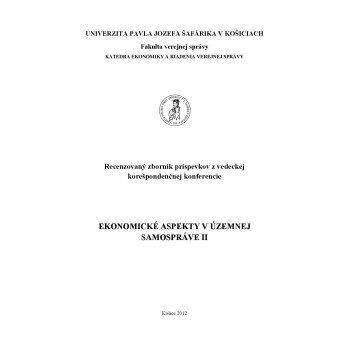
Eva Mihaliková - Zuzana Hrabovská (eds.)
Refereed Proceedings of the Scientific Correspondence Conference
The scientific conference is a space for exchange of experience and knowledge, presentation of results of scientific works and open electronic discussion in the field of economics and management of public administration in theory and practice.
The works are organized under the following thematic headings:
-Economics and Management in Local Government
- Financing of local government
- Current trends in the field of informatization in public administration
- Selected problems of local government marketing
- Translated with
E-book
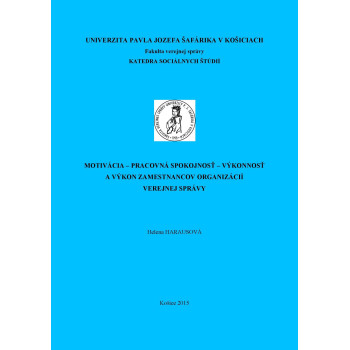
The main objective of the publication was to investigate the impact of motivation and job satisfaction on the performance and performance of employees in public administration organizations. The sub-objectives of the publication were to develop a theoretical background on motivation, job satisfaction, performance and performance and their inter-relationship; to suggest interventions arising from the research findings.
The content of the work can contribute partial findings to the understanding of work motivation and performance. The publication is intended for a circle of professionals who are dealing with the subject - human resource managers and theorists of human resource management. The work consists of two main parts. The first, theoretical part deals with the current state of the problem at home and abroad, with an emphasis on the solution of this problem in public administration. In this part there is also the author's theoretical contribution in the form of a general motivational-performance model and an applied contribution in the form of a proposal of intervention measures: a three-level incentive and motivational model.
The information is drawn from publications and scientific studies by renowned national and international authors. The second part describes the implementation of the research, the statistical evaluation of the obtained data using the methods of descriptive and inductive statistics, the discussion, in which the found results are compared with the results of other domestic and foreign scientific studies.