Filter By

Year of publication:

Year of publication:

Publication language:

Publication language:

Faculty:

Faculty:

Active filters

  • Year of publication:: 2017
  • Year of publication:: 2018
  • Year of publication:: 2018
  • Year of publication:: 2018
  • Year of publication:: 2018
  • Year of publication:: 2019
  • Year of publication:: 2019
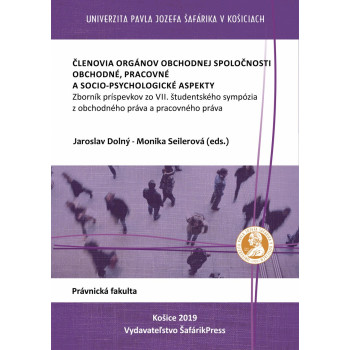
Členovia orgánov obchodnej spoločnosti. Obchodné, pracovné a socio-psychologické aspekty

Členovia orgánov obchodnej spoločnosti....

E-book

E-book

Jaroslav DolnýMonika Seilerová (eds.)

The collection of contributions from the VII. Student Symposium on Commercial Law and Labor Law held on December 5, 2019, at the Faculty of Law of Pavol Jozef Šafárik University in Košice

The theme of this year's symposium provided students with the opportunity to choose between addressing issues related to commercial law or focusing on labor law aspects concerning the position of members of the governing bodies of commercial companies, based on an analysis of legal regulations and case law.

The creative exploration of commercial law questions particularly related to areas such as the manner of acting on behalf of a commercial company, the liability of the de facto statutory body of a commercial company, information obligations of the statutory body towards its shareholders, and the remuneration for serving as a member of the board of directors of a joint-stock company. It also addressed the liability of the statutory body for the insolvency of the company and the enforcement of non-competition clauses concerning managing directors of limited liability companies.

The connection between commercial law and labor law was directed towards a legal analysis of personal data protection related to health and its misuse by members of the governing bodies of commercial companies, as well as the legitimacy of concurrently holding a position (as a member) in a statutory body with an employment relationship, and the legal status of senior employees, particularly concerning their duties and responsibilities for ensuring employee health through creating healthy working conditions.
Download the e-book for free (pdf)

Sankcie v pracovnom práve

Sankcie v pracovnom práve

E-book

E-book

Marcel DolobáčĽuboš DobrovičIvan Kundrát

Hypothesis, disposition, sanction. The standard tripartite structure of a legal norm, which is taught to first-year law students. Three concepts that students undoubtedly master from their perspective, yet they simultaneously challenge legal science, which repeatedly revisits them. The publication does not aim to theoretically address all aspects of the legal norm; it focuses solely on one of them, and as the title suggests, that is the sanction.

The monograph has been developed by three authors, whose contributions are equal; they engaged in debates and often could not reach a consensus. We hope that the reader will also join this debate and that the presented monograph will inspire further reflection and scientific activity.

Download the e-book for free (pdf)

Niekoľko poznámok k porozumeniu Zákonníka práce

Niekoľko poznámok k porozumeniu Zákonníka práce

E-book

E-book

Jana ŽuľováMilena Barinková 

Legal norms regulate everyday life. We learn about the rights and obligations that arise for us from these norms through language. It is therefore very important that they are created in such a way that all levels of society understand them, not only recipients with legal education.

The Labour Code is a norm of everyday use, and so far there is no publication that approximates or clarifies the understanding of the provisions of this law through the prism of its language. The main goal of the publication is to apply the acquired linguistic knowledge about the pitfalls of the comprehensibility of legal language for the general public to the Labour Code and thus enable its more adequate understanding. Our ambition is not a comprehensive interpretation of the provisions of the Labour Code, which give the impression of incomprehensibility for the average addressee.

We focused on selected problematic phenomena observed and identified during the solution of the VEGA grant project no. 1/0526/17 Linguistic and Sanctioning Mechanisms in the Creation and Operation of Labor Law Norms and strived for a conceptual approach to their examination enriched by empirical research.

Download the e-book for free  (pdf)

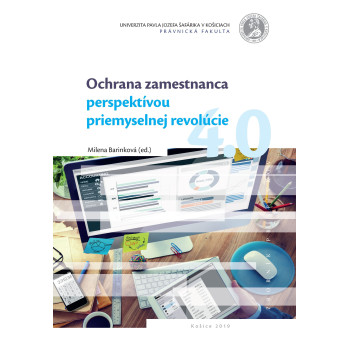
Ochrana zamestnanca perspektívou priemyselnej revolúcie 4.0

Ochrana zamestnanca perspektívou priemyselnej...

E-book

E-book

Milena Barinková (ed.)

Proceedings from the IV Annual Student Symposium on Labor Law held on April 5–6, 2019, in Danišovce

The term "Industrial Revolution 4.0" is currently widely used, yet remains mysterious and its content unfamiliar to many. While we do not claim omniscience, through the educational process at the Faculty of Law of Pavol Jozef Šafárik University in Košice and the scientific research of the Department of Labor Law and Social Security Law, we have delved into examining the accompanying features and anticipated phenomena of this modern industrial revolution.

It can be stated with great certainty that this revolution already affects—and will continue to affect—production processes, including radical changes in their structure, the emergence of groundbreaking technological and communication tools, and, undoubtedly, labor relations. The rise of new forms and methods of work based on automation and digitalization, applied within new models of labor relations, is beginning to threaten jobs in certain sectors of the economy. There is an increasing demand for specialized qualifications and skills, particularly in information technology, with an emphasis on process digitalization, data processing, and the creation of communication networks connecting objects and people. This intelligent industry inevitably disqualifies many existing jobs from their current structures, leading to job losses for numerous employees. Analysts openly predict that by 2030, robots will replace up to 20 million industrial jobs worldwide.

The vision of which occupations or working conditions will be impacted is becoming increasingly concrete. Radical changes will require radical solutions as well as previously unknown movements and new elements or measures in the labor market.

Download the e-book for free  (pdf)

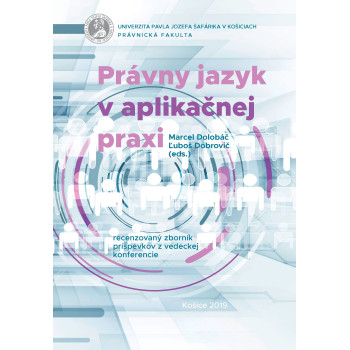
Právny jazyk v aplikačnej praxi

Právny jazyk v aplikačnej praxi

E-book

E-book

Marcel Dolobáč - Ľuboš Dobrovič (eds.)

Reviewed Proceedings of Contributions from a Scientific Conference

This reviewed collection of contributions from the scientific e-conference Legal Language in Application Practice, held from December 3 to 21, 2018, presents various academic contributions.

Legal language, as expressed in legal norms, is specific and should ideally be unambiguous, concise, and resistant to multiple interpretations. Is this an ideal world that does not exist but is worth striving for? Interpretative challenges and ambiguities in legal language and terminology (especially in the Labour Code) led the Department of Labour Law and Social Security Law at UPJŠ in Košice to undertake the VEGA grant project No. 1/0526/17 titled Linguistic and Sanction Mechanisms in the Creation and Operation of Labour Law Norms.

As part of this grant project, the department organized an e-conference open not only to labor law specialists but also to experts from other legal fields. Unsurprisingly, interpretative issues extend beyond labor law. The contributions in this collection are thus somewhat interdisciplinary, though with a focus on labor law. We hope this collection serves as an introduction to broader research and deeper study of legal language by experts beyond legal theory. Additionally, we trust these contributions will inspire you, the readers.

Authors

Download the e-book for free  (pdf)

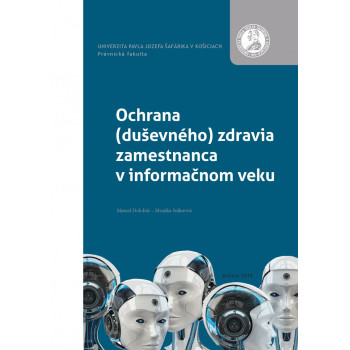
Ochrana (duševného) zdravia zamestnanca v informačnom veku

Ochrana (duševného) zdravia zamestnanca v...

E-book

E-book

Marcel DolobáčMonika Seilerová

The Industrial Revolution cannot be avoided or hidden from, but it is equally wrong to see it only in gray tones. Let us be optimistic. The Information Age can also mean a reduction in working hours, perhaps more time for family and interpersonal relationships, or an overall increase in individual economic luxury. The Information Age will take away many job opportunities but will put many others on the table, though mostly for the educated. Science and research will become even more important for overall economic development than they are today. Let us be prepared.

The ambition of this monograph is not, and cannot be, to provide an exhaustive answer to the above-outlined debates. Its goal is to stimulate broader scientific discussion, particularly on the issue of mental health protection in correlation with the advent of the Information Age. The subject of study is the protection of the individual—the employee—who must adapt to a new technological environment and its associated demands.

The monograph represents a comprehensive output by authors who, over the past two years, have published on similar topics within the APVV-16-0002 grant "Mental Health in the Workplace and Assessment of Employee Health Capability." The authors believe that thanks to this APVV grant, they will continue to build on this topic in the coming years. Most importantly, they hope that its content will engage you, the readers.


Marcel Dolobáč

Download the e-book for free (pdf)

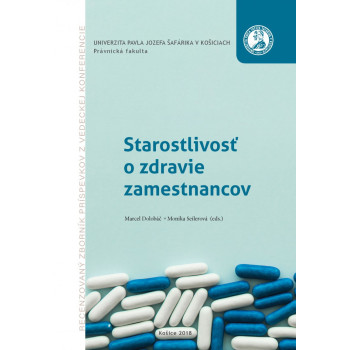
Starostlivosť o zdravie zamestnancov

Starostlivosť o zdravie zamestnancov

E-book

E-book

Marcel DolobáčMonika Seilerová (eds.)

The Proceedings presents papers from international scientific conference The Employees health care held on 6th and 8th June 2018 in High Tatras and is published as a partial outcome of the implementation of the project APVV-16- 0002 - Mental Health in the Workplace and Employee Health Assessment.

Pri hodnotení informačného veku sa ťažko uhýba streľbe fráz. Moderné technológie, internet, smartfóny, komunikačná technológia, či sociálne siete zmenili rytmus života na nepoznanie a svojim dosahom prekvapili aj samotných tvorcov. Možno takéto strohé hodnotenie znie až priveľmi povedome, snáď ako mnohokrát vyslovená fráza, ale je vskutku pravdivé. Rýchlo, obratom, hneď. ASAP. Heslá dnešnej doby. Pracovný život nevynímajúc. Namiesto uľahčenia práce a možnosti zosúladenia pracovného a rodinného života, čo je stále nenaplneným snom modelu flexikurity, moderné technológie prepletajú voľný čas s tým pracovným a nedokážu ich od seba oddeliť. Zamestnávateľ prostredníctvom emailu kladie požiadavky na neustálu online zapojenosť, z jeho pohľadu odpoveď možno zaberie iba pár minút, ale pripravený máme byť takmer vždy. Výsledkom je nezdravý, nadmerný, ba neustály stres. Stres sa stal takým fenoménom nového pracovného sveta, že mladí uchádzači o prácu sa vzájomne predbiehajú v tom, že práve oni vedia pracovať pod stresom, bez obáv zvládajú stresové situácie, dokonca majú stres radi, vyhľadávajú ho a túžia v stresovom prostredí pracovať. Nuž, nevedia, nezvládajú a netúžia ... ak, iba dočasne.

Nové stresové faktory sú predmetom skúmania nielen prírodných vied, najmä medicíny, ale aj humanitných vedných odborov, vrátane psychológie a práva. Autor tohto predhovoru s potešením konštatuje, že viacerí odborníci z týchto tieto zdanlivo vzdialených odborov sa stretli na spoločnej konferencii pod gesciou grantovej úlohy APVV-16-0002 Duševné zdravie na pracovisku a posudzovanie zdravotnej spôsobilosti zamestnanca a vzájomne si vymieňali poznatky a myšlienky. Vzájomná interdisciplinárna interakcia sa stáva základom pre nové poňatie problematiky a inšpiratívne metódy skúmania.

Zborník predstavuje výsledky prednesov prezentovaných na spoločnej konferencii s názvom Starostlivosť o zdravie zamestnancov, ktorá sa konala v dňoch 6. až 8. júna 2018 v Hornom Smokovci, vo Vysokých Tatrách. Veríme, že jeho obsah zaujme a podnieti i vás, čitateľov.

JUDr. Marcel Dolobáč, PhD.

Download the e-book for free (pdf)

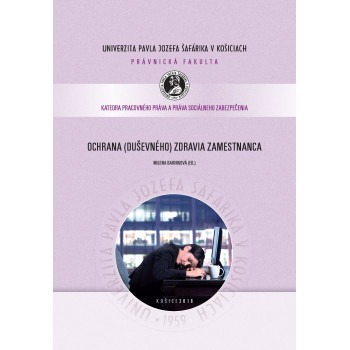
Ochrana (duševného) zdravia zamestnanca

Ochrana (duševného) zdravia zamestnanca

E-book

E-book

Milena Barinková (ed.)

The complex of legal norms protecting work, ensuring safety and health protection at work, is very broad in scope, extending beyond the Labour Code to include other specific legal regulations, collective agreements, executive legal regulations, and internal corporate normative acts.

Health protection of employees from hazardous workplace influences is a central requirement stemming from fundamental human rights guaranteed by the Constitution of the Slovak Republic. To ensure its universal enforcement across all employers in both private and public sectors, strict regulation through cogent norms is fully justified. The European Commission’s Communication to the European Parliament, Council, European Economic and Social Committee, and Committee of the Regions on the EU Strategic Framework on Health and Safety at Work 2014–2020 (COM(2014) 332 final) addresses the need to account for labor market changes arising from demographic shifts, aging populations, and technological advancements.

Work pace demands are intensifying, and all age categories of employees must adapt to new technologies, organizational changes, and evolving job structures. This increases requirements for maintaining health fitness throughout entire professional careers. Mental health fitness, which receives insufficient specific attention, is an inherent part of health fitness requirements. Prevention plays a critical role in mental health protection.

Download the e-book for free (pdf)

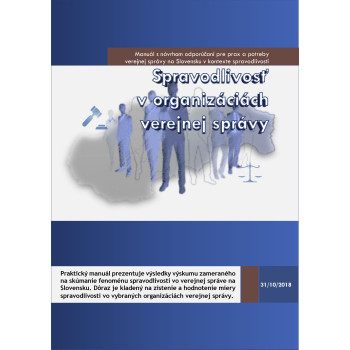
Spravodlivosť v organizáciách verejnej správy

Spravodlivosť v organizáciách verejnej správy

E-book

E-book

Eliška Župová et al.

Research into justice in public administration organizations has not yet been conducted in Slovakia, not even in the scope of respondents addressed. Therefore, we consider the project cross-sectional, current, and beneficial for deeper exploration of this area.

The project is designed as interdisciplinary, combining insights from legal perspectives in defining justice from labor law aspects, psychological and ethical evaluations of fairness levels, and knowledge from public administration management fields.

The inspiration for selecting this topic stems from its academic relevance, confirmed by both domestic and international studies, as well as its public relevance, where laypeople most intensely perceive justice/injustice in relation to remuneration and appropriate labor-law conditions – exemplified by teachers’ strikes (2003, 2006, 2016), nurses’ strikes (2003, 2006, 2012, 2016), ŽSR employees’ strikes (2003), and doctors’ strikes (2011).

Download the e-book for free  (pdf)

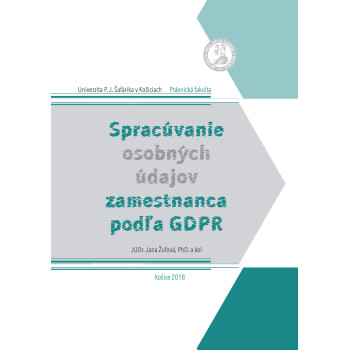
Spracúvanie osobných údajov zamestnanca podľa GDPR

Spracúvanie osobných údajov zamestnanca podľa GDPR

E-book

E-book

Jana Žuľová a kol.

The presented publication is intended for employers, managers, and HR professionals who process employees' personal data for various employment-related purposes and need to conduct an audit of their processing in compliance with the GDPR and the new Personal Data Protection Act. The publication will also be useful for new employers who are encountering data protection for the first time and need to establish internal data protection rules, essentially starting from scratch.

The reader has the opportunity to gain a comprehensive understanding of the data protection rules applicable in the employment sector, the obligations of the employer, and the rights of the data subject, i.e., job applicants, employees, and former employees.

Download the e-book for free (pdf)

Hranice zmluvnej slobody v pracovnom práve

Hranice zmluvnej slobody v pracovnom práve

E-book

E-book

Marcel Dolobáč

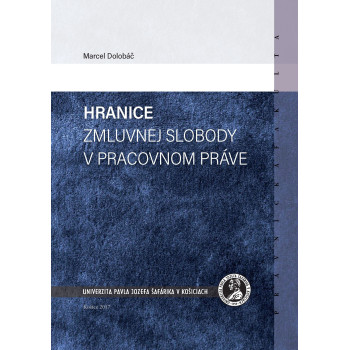
The author's ambition is to build on the current and at the same time to stimulate further discussion of the anchoring of labour law in the system of private law sectors and to contribute to the variation of views in relation to freedom of contract and its limits in labour law. The broad contractual freedom of civil law does not apply to the field of labour law, and thus the penetration of standard civil law institutes into labour law relations is not always self-evident.

The above constitutes the main theses of the present monograph. The issue of freedom of contract in labour law can be grasped in several ways. The author has chosen a content structure that is built on three basic pillars. In the first part, the author assesses the position of labour law in the system of law, which is determined primarily by the actual subject of legal regulation - dependent labour and the specific method of legal regulation through cogent and relatively cogent norms. In this context, the author would like to note at the outset that the much-discussed dispositive nature of labour law norms appears to be merely presumptive. Labour law is built on minima and maxima, with relative mandatory norms being the building blocks of fixed boundaries, a fact that distinguishes labour law from other branches of private law. These considerations are followed by the author's view of autonomy of will in labour law. The limits of contractual freedom (not only) in the theoretical sense form the second pillar of the author's ideas.

Finally, the third part of the thesis is to be the one that translates the theoretical-legal considerations of the interconnection of civil law and labour law into the interpretation of selected civil law institutes and the possibility of their application and implementation in labour law relations.

Download he e-book for free (pdf)

Zákonník práce do každej ruky alebo lingvistika a sankcie v pracovnom práve

Zákonník práce do každej ruky alebo lingvistika...

E-book

E-book

Jana Žuľová

Proceedings of the Second Annual Student Symposium on Labor Law held on May 12–13, 2017 in Danišovce

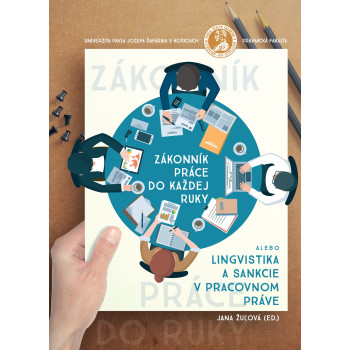
The presented proceedings are the result of scientific works by students of the Faculty of Law at Pavol Jozef Šafárik University in Košice and are systematically divided into two parts.

The first part presents interdisciplinary intersections of linguistics and labor law in its creation, interpretation, and application. The second part addresses the issue of targeting the addressees of labor law norms through various sanction mechanisms. The proceedings include a questionnaire compiled by the researchers of a grant project, aimed at determining whether and in which aspects the Labor Code diverges from its addressees in terms of linguistic and stylistic processing. Indeed, there is no other legal norm that is closer to the participants of labor relations, and whose understanding at the highest possible level is justified by its everyday use.

The presented proceedings thus serve as a means of expanding the horizons of our students beyond their regular studies and as a tool for popularizing scientific research. In case of interest, the completed questionnaire can be sent to: jana.zulova (@) upjs.sk.

Download the e-book for free (pdf)

This website uses cookies to ensure you get the best experience on our website