 English
 Slovenčina


Mathematics (e-books)
There are 7 products.
Active filters
Linear programming via problem solving
E-book
E-book
Linear programming belongs to parts of mathematics with the greatest number of real applications. This Slovak-English problem collection provides an overview of basic knowledge in the area, application problems as well as problems to acquire routine in calculations. It is complemented by questions motivating the student to look for further theoretical principles, construct conterexamples and formulate arguments to explain the studied phenomena.
Uncertainty Modeling 2024
E-book
E-book
Ondrej Hutník (ed.)
Book of abstract
Uncertainty Modeling 2024 (UM 2024) is organized by Pavol Jozef ˇSaf´arik University in Koˇsice. It is a continuation of the series of colloquia held in Rzesz´ow under the name International Symposium on Fuzzy Sets (ISFS) and in Bratislava under the name Uncertainty Modeling.
Teória vypočítateľnosti
E-book
E-book
Ľubomír Antoni-Stanislav Krajči
An important part of theoretical computer science is the problem of Turing machines. This computational model has two basic properties: like any other computational program, the software of a Turing machine is composed of instructions, but in its case they are all of a single type. Every other (so far known) computer program can be transformed into a Turing machine program without loss of information. While the second feature reduces the question of what a calculator cannot do to the question of what a Turing machine cannot do, the first feature allows a much simpler investigation of such a question. Using this computational model, we can thus find concrete problems that no automaton can ever deal with (perhaps the most famous is the problem of the Turing machine stopping). Their existence demonstrates the fundamental limitations of (not only ideal) computational means, and thus encourages both criticality and humility in our thinking.
Download e-book for free (pdf)
Určitý integrál
E-book
E-book
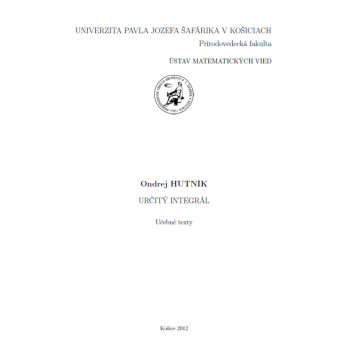
The concept of the integral is one of the most significant concepts in mathematics as a whole. In its most primitive form, it was already used by the ancient Greeks in the creation of Euclidean geometry. However, it was only after Descartes' work on analytical geometry in 1637 that mathematicians could begin to consider the integral as a subject of analysis. Descartes' work laid the groundwork for the discovery of infinitesimal calculus by Leibniz and Newton around 1665. At that time, a great dispute arose over the priority of this discovery, dividing scholars of Germany and England into two opposing camps, each favoring their own champion. Today, we know that Newton's work on fluxions and fluents was somewhat earlier, but Leibniz's notation and approach have gained more acceptance in the mathematical world, and the symbols ∫ ∫ and d d are still used today. A brief overview of the history of the integral will be presented in Chapter 1.
Today, there is a plethora of scripts, textbooks, and books dedicated to explaining the concept of the integral. Therefore, every potential author faces the initial question of whether to write another text on this topic. Our affirmative answer to this question was driven by the students' request to find the subject matter of a part of the winter semester of the second year presented in a coherent form. The second motivation is a slightly different approach to the topic. If we consider the methods typically used in solving problems and gaining routine with a certain integral, it mainly involves the Newton-Leibniz formula, and often there is little time left to compute the definite (Riemann) integral using its definition. Therefore, we included a discussion of the Newton integral in Chapter 2, which reflects this fact and is directly related to the indefinite integral, whose various calculation methods receive relatively much attention in the previous semester. Only after that, in Chapter 3, do we build the theory of the Riemann integral, present criteria for its existence, classes of integrable functions, basic properties, and finally its relationship with the Newton integral. Questions primarily concerning geometric applications are addressed in Chapter 4, and in the final chapter, we focus on extending the Riemann integral to unbounded functions and unbounded intervals.
Študentská vedecká konferencia PF UPJŠ 2016
E-book
E-book
Vladimír Zeleňák (ed.)
Proceedings of Abstracts of the Student Scientific Conference of the Faculty of Science, Pavol Jozef Šafárik University in Košice
A characteristic feature of education at high-quality universities — among which the Faculty of Science at Pavol Jozef Šafárik University (UPJŠ) in Košice proudly belongs — is the close connection between education and scientific research. Students gain knowledge in their field of study not only through theoretical coursework in individual disciplines, but also through active involvement in solving specific scientific tasks as part of research teams. This can occur during the development of final theses or through participation in the Student Research Assistant Program (ŠPVS), which was revitalized at the faculty in 2015.
The Student Scientific Conference (ŠVK) is one of the faculty’s traditional events, organized during the Faculty’s Science Days as part of Sciencefest. By its very nature, it fits seamlessly into the aforementioned framework of combining education with research, and it has long enjoyed great popularity and student interest. In 2016, the conference featured presentations by 125 students of the Faculty of Science at UPJŠ in Košice, across 16 thematic sections. This collection of abstracts provides an overview of the focus and goals of the student projects. We believe it will serve as inspiration for other potential participants of future conferences and will also be of interest to the broader public, offering additional insight into the faculty's activities.
Bádateľsky orientované vyučovanie matematiky a...
E-book
E-book
Stanislav Lukáč - Ľubomír Šnajder - Ján Guniš - Zuzana Ješková
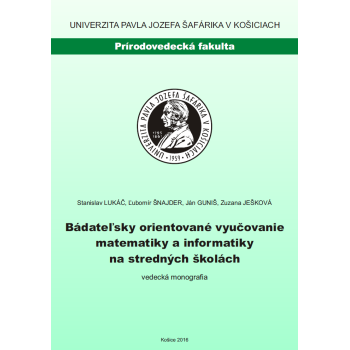
The publication is intended for researchers in didactics and teachers of mathematics and computer science. Our aim is to provide readers with a basic orientation in the issue of inquiry-based teaching, to explain and demonstrate several levels of student inquiry through examples, and to offer a classification of inquiry skills.
The core part of the publication consists of methodologies for inquiry-based teaching of specific topics from school mathematics and computer science. We present ideas for implementing inquiry activities, active work with information in solving various types of problems, and the application of modern digital technologies in exploring and discovering patterns.
The publication includes seven methodologies for teaching mathematics and eight methodologies for teaching computer science in the 1st and 2nd years of secondary school.